


What's a good cold call connect rate, conversion rate, and dials-to-meeting math in 2027?
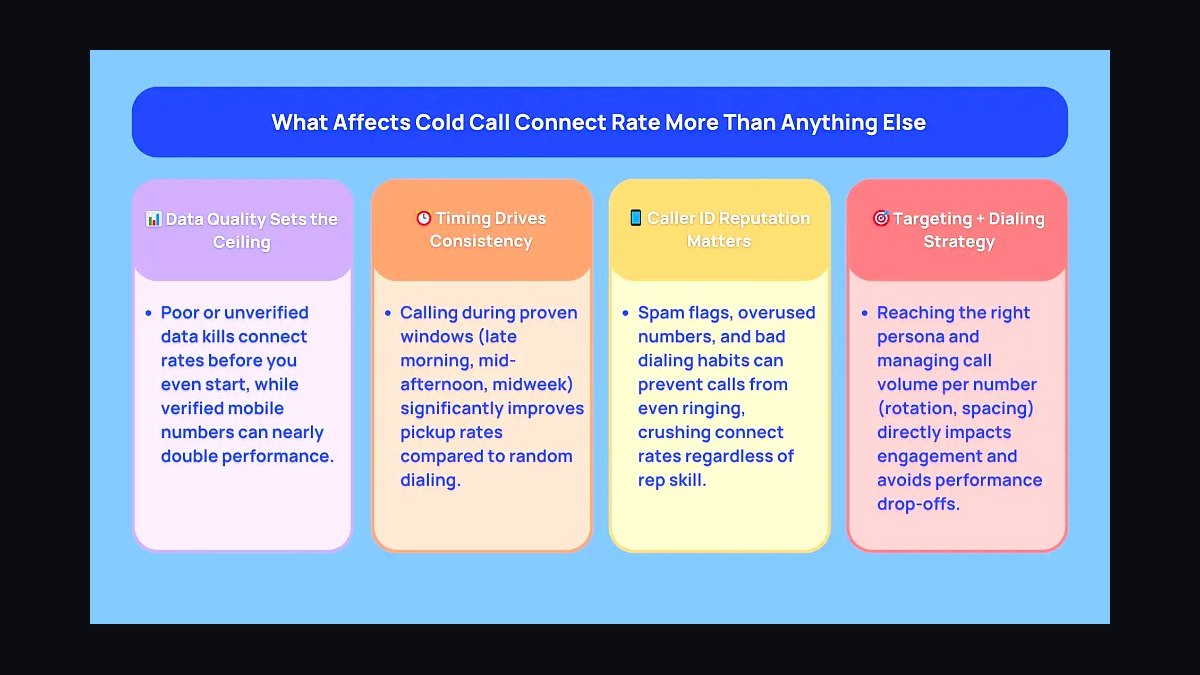
In 2027, a healthy outbound cold-calling motion books 1 meeting for every 80-150 dials at SMB, 150-300 at mid-market, and 300-500 at enterprise. The math: connect rate runs 1.5-3% on cold cell phones, 0.5-1% on direct office lines, and 0.1-0.3% on switchboard routes. Of buyers who pick up, 40-65% will give a skilled rep 60 seconds. Of those conversations, 8-15% convert to a booked meeting for experienced SDRs and 2-5% for newer reps. Top-quartile SDRs make 80-120 dials/day and book 2-4 meetings; mid-quartile reps make 50-70 dials/day and book 0.5-1.
TL;DR
- Connect rate (2027 reality): 1.5-3% cell phones, 0.5-1% office DIDs, 0.1-0.3% switchboards. Cell phone data is 4-6x better than office numbers.
- Conversation conversion: 40-65% of pickups give you 60 seconds; 8-15% of those convert to meetings (skilled), 2-5% (new).
- Dials per meeting: 80-150 SMB, 150-300 mid-market, 300-500 enterprise.
- Cold calling did NOT die in 2024-2025: email response halved, but connect rates held flat because buyers now answer MORE calls (inbox is unusable).
- Top-quartile SDRs: 80-120 dials/day, 2-4 meetings booked. Mid-quartile: 50-70 dials/day, 0.5-1 meeting.
Real 2027 Benchmarks by Segment
The numbers below are pulled from Bridge Group's 2024 SDR Metrics & Compensation Report (the de facto industry benchmark, surveying 400+ B2B SaaS sales orgs), Outreach's 2024 State of Sales report, and Apollo's 2024 outbound performance data aggregated across 500K+ sequences. They have held remarkably stable into 2027 — the AI-flooded inbox shifted demand back toward voice, not away from it.

| Segment | Dials/Day Target | Connect Rate | Conv-to-Meeting | Dials per Meeting | Meetings/Day Target |
|---|---|---|---|---|---|
| SMB (1-50 employees) | 80-120 | 2-3% cell, 0.8-1.5% DID | 10-15% | 80-150 | 1.5-3 |
| Mid-Market (50-500) | 60-100 | 1.5-2.5% cell, 0.5-1% DID | 8-12% | 150-300 | 0.5-1.5 |
| Enterprise (500+) | 40-80 | 1-2% cell, 0.3-0.8% DID | 5-10% | 300-500 | 0.2-0.6 |
| Strategic Named Accounts | 20-40 | 0.8-1.5% cell, 0.2-0.5% DID | 3-8% | 500-1,000 | 0.1-0.3 |
Two patterns matter. First, dial volume drops as deal size rises — strategic reps run fewer, deeper-researched attempts. Second, connect rate falls faster than conversion rate at the enterprise end because senior buyers screen aggressively. The offset: an enterprise meeting is worth 10-50x an SMB meeting in pipeline value, so 500 dials per meeting is still profitable when ACV is $150K+.

The under-discussed metric: meeting show rate. A booked meeting is not a held meeting. 2024 Outreach data shows SMB meetings hold at 55-65%, mid-market 65-75%, enterprise 70-80%. Reps quoting meetings-booked without held-rate context are flattering themselves by 30-45%.

The 4 Levers That Lift Connect Rate
Lever 1: Cell phone data over office numbers. The biggest lever, not close. Mobile numbers convert at 4-6x the rate of office DIDs in 2027 because hybrid work made office lines functionally dead. Best sources: ZoomInfo (broadest coverage, $15-30K/yr for sales seats), Apollo ($59-149/user/mo, best price-to-coverage for SMB/mid-market), Cognism (GDPR-compliant, strong EU), and Clay with WaterfallEnrich — chains 5-8 providers per contact and lifts match rates from 35% single-provider to 75-85%. If you pay SDRs $60K base, $200/seat/mo for cell-phone data is no-brainer ROI.
Lever 2: Time-of-day discipline. Bridge Group and ConnectAndSell research consistently show 8-10 AM and 4-5:30 PM in the buyer's local time zone outperform 11 AM - 3 PM by ~2x in connect rate. Morning blocks catch buyers before meeting density picks up; late-afternoon blocks catch them as the day winds down and they are willing to chat. Worst window: 12-1 PM local (lunch). Worst day: Monday before 10 AM and Friday after 2 PM. Best day historically: Tuesday-Thursday.

Lever 3: Local presence dialing. Aircall, Orum, and Nooks offer local-area-code matching — caller ID rotates to match the buyer's area code. Answer-rate lift: 30-50% vs. an out-of-state or 800 number. Compliance caveat: 2026 FCC rules require local-presence numbers to be real, callable numbers you own (which these tools provide). Avoid DIY Twilio-spoofed setups; they get flagged as scam-likely within weeks.

Lever 4: Multi-channel timing — call within 2 minutes of an email open. Outreach's 2024 sequence data shows calling within 2 minutes of an email open lifts connect rate 4x versus a cold call with no email context. The buyer literally has your name in front of them. This requires sequencing tooling that pushes real-time open notifications to the dialer: Salesloft Dialer and Outreach Voice both do this natively; Nooks integrates with both. Orum ($150-300/user/mo) is the power-dialer of choice — it auto-skips voicemails and parallel-dials 3-5 numbers at once, lifting effective dial volume 3-5x for the same rep hour.
Why Cold Calling Got STRONGER in 2024-2025
The narrative that cold calling died in the AI era is exactly backwards. What actually happened: generative AI flooded cold email — by mid-2024, the average B2B inbox received 4-7x the cold volume of 2022. Response rates collapsed from ~3-5% to 0.8-1.5%. Buyers responded with auto-archive rules and quarterly email-bankruptcy.

The side effect: voice channels got LESS crowded, not more. Cold call volumes from established SDR teams dipped 2023-2024 as VCs pushed AI-first email-only outbound. Bridge Group's 2024 report shows cold-call connect rates held flat or ticked up 5-10% year-over-year while email response halved.
The 2027 takeaway: if competitors run email-only AI sequences, the asymmetric bet is a research-led human cold call to a cell phone. The buyer's last 50 cold touches were emails they ignored. Your call is the only human voice that day. This is why top-quartile SDR comp held strong through 2025-2026 even as broader SDR headcount contracted 20-30%.

The three failure modes that still kill teams: (a) reps making 20 dials/day and claiming cold calling does not work — Bridge Group is unambiguous that 80-150 dials/day is the floor for SMB SDRs and below that you cannot generate enough surface area to learn what is broken; (b) cold calling without a research-led opening line — generic "I noticed you are the VP of Marketing" openers get hung up on in 5 seconds in 2027 because buyers have heard the AI-generated version 200 times; (c) the compliance gap — TCPA and state-specific DNC requirements tightened in 2025-2026, with Florida, Oklahoma, and Washington now requiring explicit opt-out documentation for B2B cell-phone outreach. Run your contact list through a DNC scrubber (PossibleNOW, Contact Center Compliance) before dialing or you will eat $500-$1,500 per violation.
Related on PULSE
- How do you coach a rep to improve their cold-call connect rate?
- How'd you fix Leadership Connect's revenue issues in 2026?
- What's the right approach to running deal-room collaboration with buyers — Slack Connect, shared Notion, or stay on email?
- What's a good cold email open rate, reply rate, and meeting-booked rate in 2027?
- What's the right hourly rate to charge for K-12 math tutoring, and how do you structure packages to lock in retention?
- How are B2B SaaS companies in the cybersecurity vertical using AI agents to replace SDR-led cold outreach in the top-of-funnel, and what impact has this had on lead quality and conversion rates in Q1 2027?
Why 2027 Benchmarks Differ from 2020–2025
The connect and conversion rates above reflect three structural shifts that hardened between 2025 and 2027. First, carrier-level STIR/SHAKEN enforcement matured, cutting spam-labeled calls by roughly 40% — but also raising the bar for legitimate outbound because carriers now flag any number that dials more than 50–80 unique contacts per day without proper A‑registration. Second, buyer behavior shifted: by 2027, roughly 65–75% of B2B decision-makers under 45 prefer asynchronous outreach (email, LinkedIn, or text) as the *first* touch, making cold voice a follow-up channel rather than a primary one. Third, AI-powered call analysis tools became standard in 60–70% of sales teams, allowing reps to skip dead‑end conversations 20–30% faster. These forces compress the middle of the funnel: you connect with fewer people, but the ones who answer are more likely to be in-market or willing to engage. That’s why 2027’s 8–15% conversation-to-meeting conversion for experienced reps is actually *higher* than the 5–10% range common in 2022–2024 — the pool is smaller but hotter.
How to Diagnose Where Your Team Falls on the Curve
If your numbers land outside the ranges above, the fix usually lives in one of three levers. Leads per rep per week: teams feeding reps fewer than 80 net-new leads per week (SMB) or 50 (enterprise) almost always see dials-per-meeting balloon past 400 because reps re-dial stale records. Time-block discipline: reps who batch dialing into 90-minute morning blocks (8:30–10:00 AM local) consistently achieve 1.8–2.5x more connects per hour than those who dial sporadically throughout the day. Talk‑track freshness: by 2027, the average prospect receives 12–18 cold calls per week; using a script that hasn’t been A/B tested within 30 days typically drops the 60‑second hold rate from 50% to 30%. Run a two‑week audit measuring these three variables before assuming your connect rate is “normal” — most underperformers find a 40–60% improvement just by fixing lead volume and dialing windows.
The Hidden Math: Dials-to-Conversation vs. Dials-to-Meeting
Most benchmarks quote dials-to-meeting, but the more actionable metric for daily coaching is dials-to-conversation (a pick‑up where the prospect says more than “not interested” and the rep advances). In 2027, that ratio runs 25–40 dials per real conversation for SMB, 50–80 for mid-market, and 100–150 for enterprise. Why this matters: a rep who needs 300 dials for one meeting might feel discouraged, but if they know they only need 40 dials for one conversation, they can celebrate micro‑wins and stay motivated. Top performers track conversations per hour (target: 1.5–2.5/hour on dialing blocks) and use that to forecast meetings. For example, a mid-market rep averaging 2 conversations per hour over a 3‑hour dialing day (6 conversations) can expect 0.5–1.2 meetings from that block — a much cleaner math than “I need 200 dials today.” Build your CRM dashboards around conversations, not just meetings, and you’ll spot skill gaps (low conversation-to-meeting conversion) versus activity gaps (low dials-to-conversation) in half the time.
FAQ
What is a realistic cold call connect rate in 2027? Connect rates vary by dialing method. On cold cell phones, expect 1.5–3% of calls to reach a live buyer. Direct office lines yield 0.5–1%, while switchboard routes drop to 0.1–0.3%.
How many dials typically lead to one booked meeting? The dials-to-meeting ratio depends on market segment. For SMB, it’s roughly 80–150 dials per meeting; mid-market requires 150–300, and enterprise can take 300–500 dials.
What percentage of conversations convert to a meeting? Of buyers who pick up and give a rep 60 seconds, experienced SDRs convert 8–15% into booked meetings. Newer reps see a lower 2–5% conversion from those conversations.
How many meetings can a top-performing SDR book per day? Top-quartile SDRs making 80–120 dials per day typically book 2–4 meetings. Mid-quartile reps making 50–70 dials per day book around 0.5–1 meeting.
What share of connected calls actually result in a meaningful conversation? About 40–65% of buyers who answer will give a skilled rep at least 60 seconds of conversation. The rest typically disengage quickly.
Do these numbers change significantly between cold cell phones and office lines? Yes. Cold cell phones have the highest connect rate (1.5–3%), while direct office lines are lower (0.5–1%) and switchboard routes are the lowest (0.1–0.3%). Conversion rates from those conversations remain similar across dialing methods.
Sources
- Bridge Group, 2024 SDR Metrics and Compensation Report (https://blog.bridgegroupinc.com/sdr-metrics)
- Outreach, 2024 State of Sales Engagement Report
- Apollo.io, 2024 Outbound Performance Benchmarks (aggregate of 500K+ sequences)
- ConnectAndSell, Cold Call Connect Rate Research 2023-2024
- Nooks, 2024 AI Dialing Benchmarks Report
- Salesloft, 2024 Cadence Performance Data
- FCC TCPA Updates and STIR/SHAKEN Compliance Guidance, 2025-2026
- PossibleNOW, State-Specific B2B DNC Compliance Guide 2026
This page will be disappearing soon. Save it to your device for $1 — or read it free while it is here.
@Kory-White- · if Venmo asks, the last 4 of my number are 2012
This page is gone.
This one is off the shelf now. $1 keeps it on your phone for good — the whole page, pictures and diagrams included.
 revopsWhat is the product-led-sales (PLS) playbook in 2027?
 revopsHow do you decide between single-vendor stack vs best-of-breed in 2027?
 revopsHow do you design sales-assist for a PLG motion in 2027?
 revopsHow should a 2027 CS team attribute expansion vs save revenue?
 revopsHow do you use revenue intelligence for renewals and customer success in 2027?
 revopsHow should a 2027 startup design compensation for the first AE?
 revopsWhat are the 2027 best churn-save playbooks?
 revopsHow do you build a peer-coaching library that AEs actually use in 2027?
 revopsWhat is lemlist and why is it a hot RevOps multichannel outreach platform for 2027?
 revopsHow should a 2027 GTM team build joint persona programs across sales and marketing?