


What is Clari Copilot and why is it replacing AE-self-reported forecast in 2027?
Quality
Certified
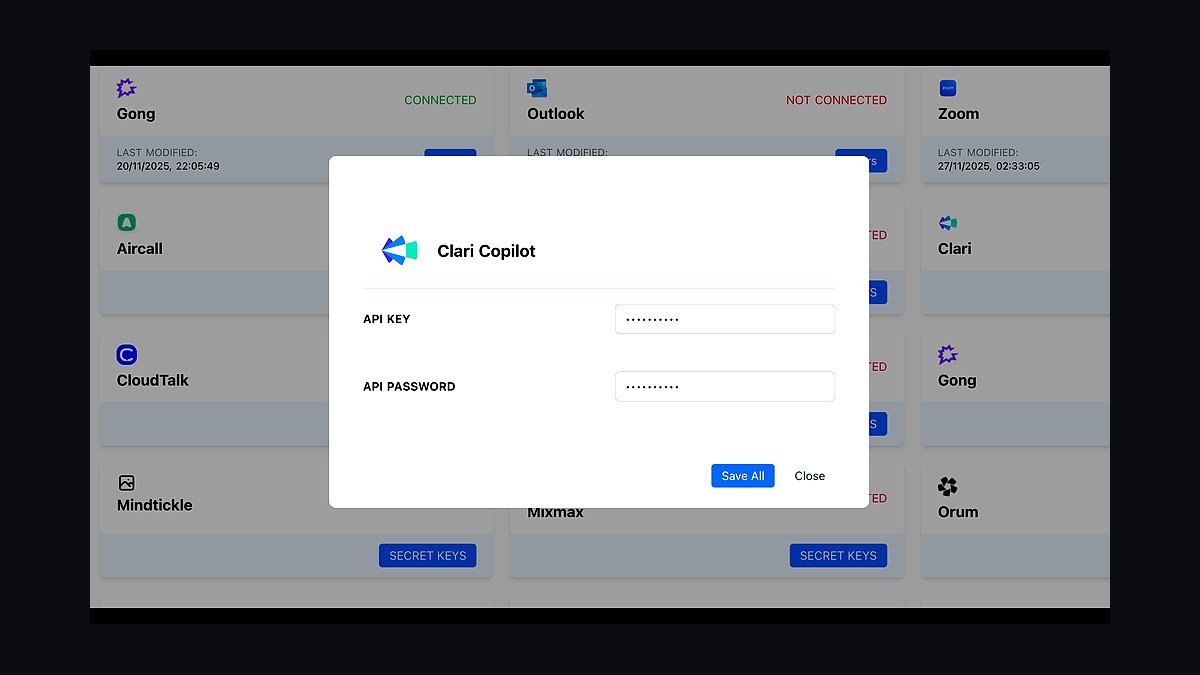
Clari Copilot is Clari's AI layer, launched in 2024 and matured through 2025–2026, that reads every customer interaction — calls, emails, Slack threads, document engagement — and scores each deal against patterns from historical closed-won and closed-lost deals. By 2027 it is replacing AE-self-reported forecast at well-instrumented enterprises because it turns forecast accuracy from roughly 70 percent, driven by systematic AE and manager optimism, into an 88 percent AI baseline grounded in what buyers actually said and did.
A Forecast Call That Goes Sideways
Picture a mid-quarter pipeline review at a 200-person B2B SaaS company in early 2026, before Copilot is fully trusted. An AE has a $180,000 deal marked "Commit" in Salesforce. The VP of Sales asks the standard question — "Where are we on this one?" — and the AE says the champion is bought in, procurement is a formality, and the deal closes by the 28th. Nobody in the room has independent evidence either way. The manager nods, rolls the number into the team forecast, and the CRO carries it into the board deck as a committed figure.
Three weeks later the deal slips to next quarter. The champion, it turns out, went quiet for twelve days after the last call — a signal that was sitting in the calendar and email metadata the entire time, visible to no one because nobody was looking at it systematically. The procurement contact who was supposedly a formality had never actually engaged with the contract redline. None of this was concealed; it just wasn't aggregated into anything a human reviewed before the number went to the board.

This is the exact failure mode Clari Copilot is built to close. Instead of a single AE narrative standing in for the state of a deal, Copilot continuously ingests the call recordings, the email thread, the Slack mentions, and the document-engagement logs, and produces a deal-health score that updates as those signals change — not once a week when someone remembers to update the CRM stage, but every few hours. The forecast stops being a story the AE tells in a meeting and becomes a rolling read of what the buyer has actually demonstrated. That shift — from narrative to signal — is the entire reason 2027-era RevOps teams describe Copilot as "replacing" the self-reported number rather than merely supplementing it: the AE's number still exists, but it is no longer the number that goes to the CFO unchallenged.
How the Mechanism Actually Works
Clari Copilot's scoring pipeline runs on six overlapping data streams, and understanding how they combine explains why the resulting forecast behaves so differently from a rep's gut check. Call recordings from Zoom, Microsoft Teams, Google Meet, or connected phone systems are transcribed and parsed for specific moments: a champion being named, a budget figure mentioned, a competitor referenced, a decision timeline stated out loud. Email metadata and body text from Outlook or Gmail track response latency and who is actually included on a thread — a deal where only one buyer-side contact ever replies looks structurally different from one where a champion, an economic buyer, and a technical evaluator are all engaging. Slack or Teams messages capture internal deal chatter, which often reveals AE uncertainty before it shows up anywhere else. Document engagement — time spent on a pricing page, how many times a contract section was reopened — adds a behavioral signal that's hard to fake. CRM activity history contributes stage changes, task completion, and meeting cadence. And a rolling 24–36 month window of historical win/loss outcomes gives the model the labeled examples it needs to know which combinations of signals actually preceded a close versus a slip.

Each of those six streams is weighted by how strongly it has correlated with past closed-won outcomes in that specific business — not a generic industry weighting, but one trained on the company's own deal history. A buyer who reopens a contract three times in a single week scores meaningfully higher than one who opens it once a month, because that pattern has repeatedly preceded a close in the training data. The score refreshes roughly every 4–6 hours, so by the time a Monday pipeline review happens, the number in front of the room reflects the weekend's email activity, not last Tuesday's stage update. Critically, none of this requires the AE to do anything — the score builds itself off tools the rep is already using, which is a large part of why it's harder to argue with than a dashboard the rep has to manually feed.
The Numbers Behind the Shift

The core statistic driving the 2027 adoption wave is the 18-point accuracy gap: AE-self-reported forecasts have sat around 70 percent accuracy at most B2B SaaS companies for roughly two decades, while the Pavilion 2026 RevOps Benchmarks survey found CROs running AI-baseline forecasts through Clari Copilot averaging 88 percent. That gap holds up across company sizes but is not uniform — teams with fewer than 90 days of Copilot-ingested call and email history typically see accuracy in the low 80s during the calibration window, climbing into the high 80s to low 90s once the model has a full historical training set from the specific business rather than an industry-generic baseline.
Pricing scales with team size and depth of integration. Enterprise deployments — typically 150-plus sales reps, full call-recording integration, and multi-CRM data ingestion — run $80,000 to $300,000-plus annually. Mid-market teams start closer to $25,000 to $50,000 for a lighter deployment with fewer integrated data sources. The 90-day calibration period is not optional in practice: companies that try to cut it short and switch the CFO-facing number to the AI baseline in week two see accuracy that is frequently worse than the AE self-report it's replacing, because the model hasn't yet seen enough of that company's own closed-won patterns to weight signals correctly.
The adoption curve on the human side follows a similar three-to-six-month arc. Organizations moving well through this transition report it takes roughly 3–6 months of weekly variance reviews — sessions where an AE's manual number and the Copilot baseline are compared line by line — before the sales floor stops treating the AI score as an obstacle and starts treating it as the starting point for the conversation. Companies that skip the variance-review cadence and simply flip the CFO-facing source of truth report much slower trust-building, often stretching past two quarters, because reps never get the structured venue to understand why the model scored a deal the way it did.
Trade-offs Against the Rest of the Field

Clari Copilot does not have the forecast-intelligence category to itself, and the choice between it and its closest competitors comes down less to raw accuracy and more to where each product's strength sits in the stack. Gong's Deal Health AI is the most direct rival and currently holds the largest conversational-intelligence training corpus in the category — more than 3 billion processed B2B sales conversations — which gives it an edge in nuanced call analysis and objection detection. Gong's signals surface natively inside Salesforce, HubSpot, or Slack workflows, which matters for teams that don't want a separate forecast-of-record system; Clari's advantage is that forecast roll-up and CFO-facing reporting are its native, original function, not a bolt-on.
Salesloft Rhythm pairs conversational intelligence with "Rhythm Signals," a next-best-action layer that tells reps what to do rather than only scoring what already happened — a meaningful difference for teams whose bottleneck is execution discipline rather than forecast math. Outreach Kaia leans toward outbound-and-forecast integration, useful where top-of-funnel sequencing and late-stage deal health need to live in one system. Salesforce's Agentforce Forecast Agent is the default choice for organizations standardizing entirely on Agentforce 360 and Sales Cloud's native forecast objects — it sacrifices some best-of-breed depth for zero-integration-friction inside Salesforce. Microsoft Sales Copilot wins cleanly for shops already committed to Dynamics 365 plus Teams plus Office, where cross-product signal-sharing outweighs any standalone accuracy edge.

The practical trade-off, then, is rarely "which tool scores deals best" — it's "which tool's strength matches the stack you already run and the workflow you're trying to change." A Salesforce-multi-tool enterprise gravitates to Clari or Gong; a HubSpot shop tends to pair HubSpot's native Breeze AI signals with a Gong overlay; a Microsoft-first org defaults to Sales Copilot regardless of category leadership elsewhere.
Where Adoption Breaks Down
The single most common failure is rushing calibration. Deal-health scores need training data specific to the business, and off-the-shelf accuracy in the first 30 days is frequently worse than what the AE self-report already delivered — running both forecasts in parallel for the full 90 days, with AEs documenting every variance reason, is what prevents a premature rollout from souring the sales floor on the tool before it's had time to learn the company's own patterns.
Adversarial behavior is the second recurring problem. Once reps understand that Copilot is parsing call language and engagement signals, some start gaming it — padding calls with artificially positive sentiment, avoiding phrases the model has learned to flag, or working around document-engagement tracking. RevOps teams that handle this well treat detected gaming as a coaching and performance issue rather than trying to patch the model reactively, since chasing every workaround individually turns into an arms race that degrades the signal for everyone.

Buyer-side privacy awareness is a smaller but real risk: enterprise buyers increasingly ask directly whether a call is being recorded and AI-analyzed, and companies need a clear, visible recording disclosure at the start of every call plus a documented privacy policy, or risk damaging trust with exactly the accounts the forecast is trying to protect.
The most underrated failure mode is forecast-committee dysfunction on either end of the spectrum. A CRO who accepts the AI baseline uncritically strips the forecast committee of any strategic judgment role — the model becomes a black box nobody questions, which reintroduces risk in a different form. A CRO who overrides the AI baseline too often, without written justification, erases the accuracy gain entirely, because the "AI baseline" the CFO sees is no longer the AI baseline. The sweet spot organizations converge on is structured variance: every override — AE or CRO level — gets a short written reason that's visible in the same report the CFO reads, so the forecast stays auditable in both directions rather than becoming a new, unaccountable version of the old narrative problem.
Vendor lock-in is worth planning for rather than dismissing. Copilot's scoring accumulates value specifically because it has learned a company's own deal patterns over time; switching vendors after 12–18 months means starting that training relationship over, since deal-pattern weighting doesn't transfer cleanly between platforms. Teams evaluating Clari against Gong, Salesloft, or the Salesforce and Microsoft native options should treat the choice as a multi-year commitment, not a one-year pilot to be revisited casually.
Related questions
Does Clari Copilot replace sales reps?

No. It replaces the self-reported forecast number, not the rep's job. Reps still own relationship-building and deal strategy; only their forecast adjustments now require a documented reason instead of standing unchallenged.
How long does Clari Copilot take to reach reliable accuracy?
Plan for a 90-day parallel-run calibration period where both the AI baseline and AE self-report are tracked side by side, with full trust typically building over 3–6 months of weekly variance reviews.
Can AEs still override the AI forecast?
Yes, but overrides require a written justification — for example, "buyer verbally committed off-record" — that RevOps and the CFO can review as a documented variance rather than an unexplained number swap.
Is Clari Copilot only useful for enterprise sales teams?
It's built for and priced for complex, multi-stakeholder enterprise motions; mid-market or high-velocity teams often get comparable value from lighter, cheaper platforms like Salesloft Rhythm or Outreach Kaia instead.
FAQ
How does Clari Copilot actually read customer interactions? It ingests data from calls, emails, Slack messages, and document engagement through integrations with common sales tools, then parses those interactions for buyer sentiment, objections, and stated next steps, comparing the pattern against thousands of the company's own past closed deals.
Is the 88 percent accuracy number real or just marketing?

It's a realistic benchmark reported for well-instrumented enterprises in 2027, drawn from the Pavilion 2026 RevOps Benchmarks survey and reinforced by independent RevOps audits, though actual accuracy ranges from the low 80s to low 90s depending on data quality and deal complexity.
Will Clari Copilot replace sales reps entirely? No — it replaces the self-reported forecast, not the rep. Reps still own relationships and strategy, but their forecast adjustments now require documented reasons, and the AI baseline becomes the system of record rather than the rep's gut feel.
What happens if a rep disagrees with the AI forecast? The rep submits an override with a written explanation, such as a verbal commitment made in a private meeting the model couldn't see, and the CRO and CFO then review that override as a structured variance rather than accepting it as the primary forecast number.
When did Clari Copilot start replacing AE forecasts? The AI layer launched in 2024 and matured through 2025–2026 as enterprises built enough calibration data to trust it over rep-reported numbers; by 2027 it had become standard practice among well-instrumented RevOps teams.
How does Clari Copilot compare to Gong Deal Health AI? Both analyze buyer interactions, but Clari is built around forecast roll-up and CFO-facing accuracy against closed-won and closed-lost patterns, while Gong leans on the deepest conversational-intelligence training corpus in the category; in 2027 the two compete directly for the forecast-source-of-truth role.
Sources
- https://www.clari.com/products/copilot/
- https://www.gong.io/
- https://www.salesloft.com/
- https://www.outreach.io/
- https://www.salesforce.com/agentforce/
- https://www.microsoft.com/en-us/microsoft-365/business/sales-copilot
- https://www.pavilion.com/
- https://www.forrester.com/
- https://www.gartner.com/en/documents/magic-quadrant
Related on PULSE
- What data sources are most effective for training AI models to predict next best action in complex enterprise deals?
- How does the expanding size of B2B buying committees increase the risk of vendor consolidation paralysis?
- Which vendor consolidation strategies are failing most often when integrating AI sales tools into existing stacks?
- Why are longer sales cycles now correlating with a shift from pipeline velocity to deal value predictability?
- What specific metrics are B2B RevOps teams using to measure AI's impact on lead quality in the top-of-funnel?
This page will be disappearing soon. Save it to your device for $1 — or read it free while it is here.
@Kory-White- · if Venmo asks, the last 4 of my number are 2012
This page is gone.
This one is off the shelf now. $1 keeps it on your phone for good — the whole page, pictures and diagrams included.
 revopsWhat is the 2027 outlook for Gong vs Clari vs Salesloft vs Outreach competition?
 revopsHow does AI change sales forecasting in 2027?
 revopsHow do conference TV networks like the Big Ten Network and SEC Network work in 2027?
 revopsHow do you build a RevOps automation roadmap in 2027?
 revopsHow do you build a sales enablement program in 2027?
 revopsHow do you score and route product-qualified leads in 2027?
 revopsDo you need a revenue data platform in 2027?
 revopsWhat RevOps metrics should you report to the board in 2027?
 revopsHow do you do effective deal coaching in 2027?
 revopsHow do you adapt RevOps to zero-click AI search eroding inbound in 2027?