


Is cold email outbound dead in 2027?
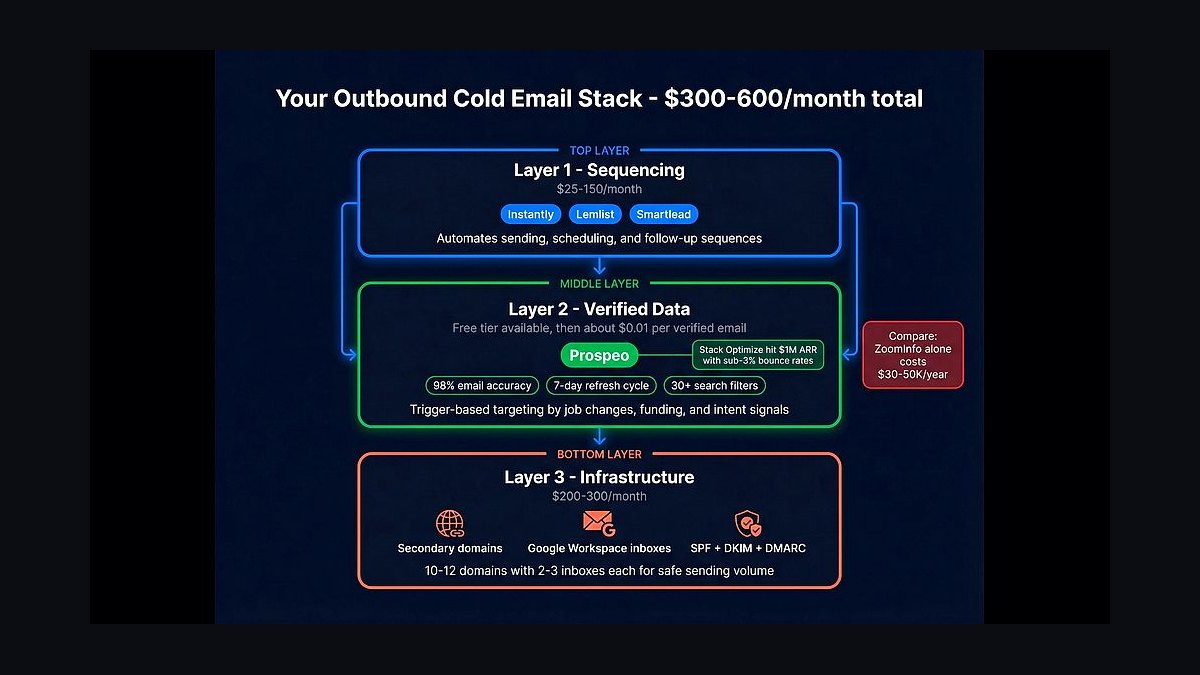
Cold email outbound is not dead in 2027, but the version that worked in 2018-2022 — 100 generic templated emails a day from a human SDR — is structurally obsolete. What replaced it is agentic AI outbound: Outreach Agentic Outreach, Salesloft Rhythm Agents, Apollo Agents, Clay, Regie.ai, Twain, and Lavender now write personalized sequences, send at deliverability-safe volumes, handle simple objections, and book meetings at 14 to 22 percent of human cost per booked meeting. The CROs declaring "cold email is dead" are usually CROs whose 2022-vintage stack stopped working because Microsoft Defender for Office 365, Google's Gmail security updates through 2024-2026, and the FTC's CAN-SPAM enforcement uptick raised the bar on what gets delivered. The CROs whose pipeline still flows from outbound are running tightly-instrumented agentic stacks with deliverability monitoring (GlockApps, MxToolbox, Litmus), domain warm-up discipline, and intent-signal-driven account prioritization. Cold email evolved; it didn't die.
1What Changed Between 2022 and 2027 That Killed the Old Playbook
The 2018-2022 SDR playbook was volume-led. A human SDR sent 80 to 140 emails per day from a personalized-template structure, hoped for 1 to 3 percent reply rates, and booked 8 to 14 meetings per month. The math worked because email delivery was loose, B2B inboxes were less crowded, and prospects were tolerant of moderately-personalized outreach. Three forces broke that math.
First, deliverability tightened dramatically. Microsoft Defender for Office 365 rolled out aggressive AI-driven spam filtering in 2023-2024 that flagged templated B2B outreach more aggressively. Google's Gmail bulk-sender requirements (announced October 2023, enforced through 2024) required SPF, DKIM, DMARC compliance, one-click unsubscribe, and sub-0.3 percent spam complaint rates for any sender doing 5,000+ messages per day to Gmail. The result: domains that worked fine in 2022 started landing in spam in 2024.

Second, B2B inbox volume exploded. The average enterprise buyer received 80 to 140 outbound emails per week by 2024, up from 30 to 50 in 2020. Reply rates collapsed across the industry — Pavilion's 2026 Sales Benchmark Report showed median outbound reply rates at 0.6 percent, down from 2.1 percent in 2021.
Third, AI-generated outreach saturation made templated personalization useless. When every SDR is using ChatGPT or Lavender to "personalize" emails, the personalization stops being a signal. Buyers can spot it instantly, and the marginal value of another "I noticed you posted about X" opener went to zero.

1.1 What Survived the Change
The outbound that still works in 2027 has three structural characteristics. It is signal-driven, meaning outreach fires based on real buyer intent (intent data from Bombora or 6sense, hiring signals from LinkedIn, technology-stack changes from BuiltWith, news triggers, web visits). It is genuinely personalized at depth, not template-and-AI-rewrite — the message references something specific to the buyer's company, role, or timing that a generic AI couldn't synthesize. And it is deliverability-disciplined, sent from warm domains at conservative volumes with continuous monitoring.
2What Agentic Outbound Looks Like in 2027
The dominant platforms — Outreach Agentic Outreach, Salesloft Rhythm Agents, Apollo Agents, Clay, Regie.ai, Twain, Lavender — converged on a common architecture. Step one, multi-signal account prioritization: which 200 accounts in the territory are showing buying intent this week? Step two, deep account research: agents pull recent news, hiring patterns, technology adoption, financial filings, and executive moves into a context bundle. Step three, message composition: the agent writes a sequence that references one or two specific things the agent identified, not a generic template. Step four, deliverability-aware sending: emails fire from warmed domains at 200 to 800 per week per inbox, with rotation and pause logic to keep spam complaint rates under 0.3 percent. Step five, response handling: simple replies ("not interested," "send more info") are handled by the agent; complex replies escalate to a human.

The output economics are genuinely better than the 2022 human-SDR model. Cost per booked meeting drops from 540-920 dollars on the human side to 65-180 dollars on the agentic side. Quality stays at parity or higher because the message is genuinely tailored. Volume scales by adding agents and warm domains, not by hiring SDRs.
3The Specific Risks Killing CROs Who Adopt Agentic Outbound Badly
Email deliverability damage is the single most common failure. A CRO who deploys an agentic platform without deliverability monitoring (GlockApps, MxToolbox, Litmus, Glock Apps inbox-placement tests) will burn domain reputation in three to six weeks and not know until pipeline collapses. The fix is mandatory: deliverability monitoring runs continuously, with weekly inbox-placement tests against Gmail, Outlook, and the major B2B inbox providers.

Domain reputation also takes time to build. CROs who buy 50 new sending domains and blast 2,000 emails each per week from cold start will land in spam universally. Mature operations warm domains over 30 to 60 days, starting at 25-50 emails per day per domain and ramping conservatively.
Brand-tone consistency is the underrated risk. AI-generated outbound at scale can produce off-brand messaging that customers notice and react negatively to. Mature operations have senior SDRs or marketing leadership QA agent prompts and message samples weekly.

Enterprise account development depth remains beyond agentic outbound's capability. Agents can identify enterprise accounts and send initial sequences but cannot do the champion-building and multi-stakeholder navigation that closes enterprise deals. Hybrid model: agents drive top-of-funnel, humans handle the champion phase.
4The Platforms Actually Working in 2027
Outreach Agentic Outreach is the largest agentic platform by installed base. Built on Outreach's existing sales-engagement DNA, the agents inherit years of cadence and deliverability learning. Pricing typically 1,200 to 2,400 dollars per orchestrator-equivalent seat per month at enterprise.

Salesloft Rhythm combines conversational intelligence with Rhythm Signals, a multi-signal prioritization engine that surfaces what each AE should engage next. Salesloft's strength is the signal-driven prioritization layer that decides what to send to whom.
Apollo Agents leverages Apollo's 275-million-contact database for cost-efficient mid-market and SMB outbound. Apollo's pricing advantage matters for sub-enterprise customers where Outreach and Salesloft are over-engineered.

Clay is the agentic outbound platform for ops-first teams. Its spreadsheet-style data orchestration lets users build custom multi-step workflows pulling from any data source. Clay wins where the customer wants control over the agent's behavior.
Regie.ai, Lavender, and Twain are specialty message-quality agents that layer on top of Outreach or Salesloft. They handle the "make the message actually good" component and improve reply rates measurably.

5The CRO Playbook for 2027 Outbound
The CROs running outbound that actually works in 2027 follow a specific playbook. Audit deliverability quarterly — every domain, every inbox, every sender. Tools: GlockApps, MxToolbox, Litmus, Mailgun Email Validation. Maintain a domain portfolio of 10-30 warm sending domains, not 1-3. Add new domains continuously, retire damaged ones, never blast from a single domain. Run intent-signal prioritization through 6sense, Demandbase, ZoomInfo Intent, or Bombora, so outreach fires when buyers are actively researching. Use agentic platforms (Outreach, Salesloft, Apollo, Clay) for the volume work and senior SDRs for the complex enterprise champion-building. Monitor reply rates by domain, sender, and segment weekly. When a domain's spam complaint rate creeps above 0.2 percent, pause that domain immediately and investigate.
6What Comes Next (2028-2029)
The next evolution beyond agentic outbound is buyer-AI mediation. Buyers are increasingly using their own AI assistants (Microsoft Copilot, Notion AI, ChatGPT, Claude) to filter, summarize, and triage inbound outreach. By 2028-2029 the buyer's AI will be the first reader of your cold email — and your outreach will need to be valuable enough that the buyer's AI flags it as worth showing the human. That changes the playbook again. The CROs preparing for this are building outreach that includes specific data points, ROI calculations, and decision-helpful information rather than relationship-building language. The message that an AI assistant flags as "worth surfacing to your boss" wins; the message it filters as "noise" loses.

Related on PULSE
- Is cold outbound dead in 2027 and what replaces it?
- How do you coach reps to remove dead deals from the pipeline?
- Is the MQL dead in 2026, and what replaces it for RevOps?
- How do I tell the difference between a stalled deal and a dead deal?
- How do longer sales cycles in 2027 impact the effectiveness of cold email sequences?
- What's a good cold email open rate, reply rate, and meeting-booked rate in 2027?
FAQ
Is cold email completely dead in 2027? No, cold email outbound is not dead in 2027. The old approach of sending 100 generic templated emails per day from a human SDR is obsolete, but agentic AI outbound has replaced it with personalized sequences, deliverability-safe volumes, and meeting booking at a fraction of the cost.
What changed to make cold email harder? Major email providers like Microsoft and Google have significantly tightened security filters through 2024-2026, and the FTC has increased CAN-SPAM enforcement. These changes raised the bar for deliverability, making it much harder for generic, high-volume campaigns to reach inboxes.
How do successful companies still use cold email in 2027? They run tightly-instrumented agentic stacks with deliverability monitoring tools like GlockApps, MxToolbox, or Litmus. They also use domain warm-up discipline and intent-signal-driven account prioritization to ensure emails land in the right inboxes at the right times.
What is agentic AI outbound? It's the new standard for cold email, using platforms like Outreach Agentic Outreach, Salesloft Rhythm Agents, Apollo Agents, Clay, Regie.ai, Twain, and Lavender. These tools write personalized sequences, handle simple objections, and book meetings at roughly 14 to 22 percent of the human cost per booked meeting.
Why do some CROs say cold email is dead? CROs whose 2022-vintage stack stopped working often declare it dead because their old methods no longer deliver results. In reality, cold email evolved—those who adapt with modern tools and strategies still see pipeline flow.
Can a small team still succeed with cold email in 2027? Yes, but they need to invest in the right tech stack and deliverability practices. A small team using agentic AI tools, proper domain warm-up, and deliverability monitoring can compete effectively, though the upfront setup is more complex than in earlier years.
Sources
- Pavilion 2026 Sales Benchmark Report — outbound reply rate trends
- Bridge Group Sales Development Metrics Report 2026
- Google Workspace bulk-sender requirements documentation (October 2023, enforced through 2024)
- Microsoft Defender for Office 365 anti-spam policy updates 2023-2025
- Outreach, Salesloft, Apollo, Clay, Regie.ai, Lavender, Twain product roadmaps 2025-2026
- GlockApps and MxToolbox industry inbox-placement benchmarks
- FTC CAN-SPAM Act enforcement actions 2024-2026
This page will be disappearing soon. Save it to your device for $1 — or read it free while it is here.
@Kory-White- · if Venmo asks, the last 4 of my number are 2012
This page is gone.
This one is off the shelf now. $1 keeps it on your phone for good — the whole page, pictures and diagrams included.
 revopsIs cold outbound dead in 2027 and what replaces it?
 revopsIs the SDR role being eliminated by agentic AI in 2027?
 revopsHow do you build a warm outbound motion in 2027?
 revopsWhat is Apollo.io's 2027 strategy and how is it competing with Salesforce and HubSpot?
 revopsWhat is Salesloft Rhythm Agents and what does it do for RevOps in 2027?
 revopsWhat is Outreach Agentic Outreach and how does it replace human SDR work in 2027?
 revopsOutreach vs Salesloft vs HubSpot Sales Hub: Which sales engagement platform should you pick in 2027?
 revopsHow do House settlement roster limits change college rosters and walk-ons in 2027?
 revopsHow do you reduce forecast slippage in 2027?
 revopsHow do conference TV networks like the Big Ten Network and SEC Network work in 2027?