


What is Syncari and why is it a hot RevOps data automation and MDM platform for 2027?
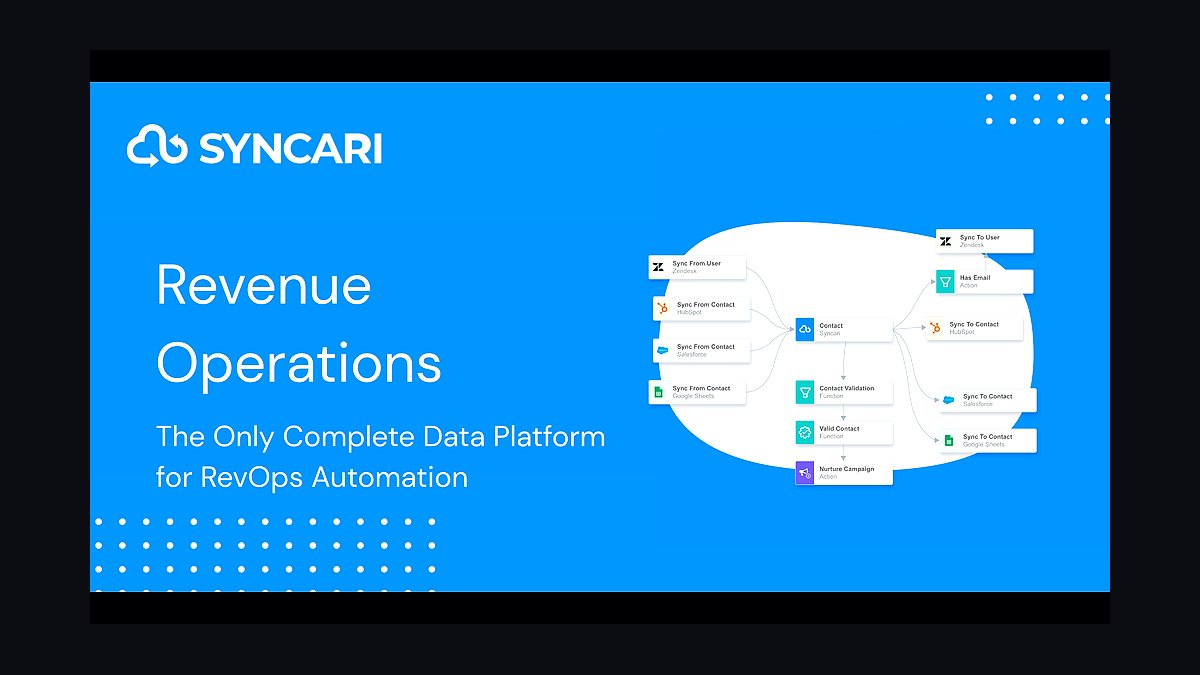
Syncari is a RevOps data-automation and master-data-management (MDM) platform that stitches disparate systems into one unified, governed data model and keeps every connected system in sync, and it is a hot RevOps tool for 2027 because clean, unified, trustworthy data across the revenue stack is the prerequisite for everything — accurate reporting, reliable automation, and AI agents — and Syncari is purpose-built to deliver it fast. Its Autonomous Data Management (ADM) platform syncs, unifies, governs, enhances, and accesses data across the enterprise, letting teams stitch disparate systems into one unified data model "in hours, not years." Its patented multi-directional synchronization maintains golden records across customer, product, employee, and vendor domains, with real-time updates propagating across all connected platforms and entity resolution deduplicating and reconciling records. Named a Visionary in the 2026 Gartner Magic Quadrant for MDM, Syncari's 2026 additions include Business Studio (a dedicated interface for business users and data stewards) and Syncari Agentic MDM, designed to orchestrate trusted data across AI agents and teams with agentic-ops capabilities. Pricing is enterprise-custom by data volume, records managed, and integrations. For RevOps teams where dirty, siloed, conflicting data corrupts reporting, breaks automation, and would make AI agents untrustworthy, Syncari is the data-unification-and-governance foundation that creates a single source of truth across systems.
1What Syncari actually is
Syncari is a RevOps data-automation platform built on master data management — the discipline of creating and maintaining a single, authoritative, trusted version of key data (customers, accounts, products) across all the systems that hold it. The problem it solves is the bane of RevOps: the same customer exists in the CRM, the marketing platform, the billing system, and the warehouse, each with different, conflicting, often-stale versions — so reporting is wrong, automation misfires, and no one trusts the data. Syncari unifies and governs that data into golden records.
The core is its Autonomous Data Management (ADM) platform — one system to sync, unify, govern, enhance, and access data across the enterprise. Its patented multi-directional synchronization is the key technical differentiator: rather than one-way pipes, it keeps every connected system in sync bidirectionally, propagating updates and maintaining golden records across customer, product, employee, and vendor domains. Entity resolution deduplicates and reconciles records, and the platform enables stitching disparate systems into one unified data model in hours, not years — a dramatic speedup over traditional MDM projects.

1.1 Agentic MDM and Business Studio
Syncari's 2026 developments push it toward the AI era. Syncari Agentic MDM is designed for orchestrating trusted data across AI agents and teams — with the multi-directional sync, real-time cross-platform updates, agentic-ops capabilities, and entity resolution that AI agents need to act on reliable data. Business Studio gives business users and data stewards a dedicated interface to work within the autonomous master-data environment, democratizing data governance beyond just IT. Named a Visionary in the 2026 Gartner MQ for MDM, Syncari positions itself as MDM built for the agentic future — because, as the recurring theme goes, AI agents are only as trustworthy as the data they act on, and unified golden records are that foundation.
2Where Syncari fits in the RevOps stack
Syncari sits at the data-foundation-and-governance layer, connecting all the systems in the stack and maintaining unified golden records synced across them. It doesn't replace the CRM, MAP, or warehouse; it's the connective MDM layer that keeps the data in all of them consistent, deduplicated, and trustworthy.

The diagram shows Syncari's value: it bidirectionally syncs all systems, resolves entities into golden records, governs and enhances them, and pushes trusted data back everywhere — with Business Studio for stewards and Agentic MDM for AI. For RevOps, this creates the single source of truth across systems that makes reporting accurate, automation reliable, and AI agents trustworthy — solving the dirty-data problem at its root rather than cleaning up downstream forever.
2.1 Why data unification is foundational for RevOps and AI
The strategic argument is that dirty, siloed data is RevOps's most pervasive problem and the binding constraint on AI. Conflicting customer records across systems corrupt reporting, break routing and automation, and — critically — make AI agents act on wrong information. Traditional MDM projects took years; Syncari's claim of "hours, not years" plus multi-directional sync makes unified, governed data achievable. And Agentic MDM directly targets the 2027 reality: AI agents need a trusted data foundation, and golden records synced across systems are exactly that. For RevOps, Syncari is the data-quality foundation that everything — analytics, automation, AI — depends on.

2.2 Enterprise-custom pricing
Syncari pricing is enterprise-custom and quote-based, tiered by data volume, number of records managed, and integration needs. As an MDM/data-automation platform, it's a foundational investment rather than a point tool, so RevOps must scope records and integrations for a quote and justify it against the value of trustworthy data across the stack — fewer reporting errors, reliable automation, and AI-ready golden records. The Gartner Visionary recognition supports its credibility for serious MDM needs.
3Who Syncari is for
Syncari fits mid-market and enterprise companies with multiple systems holding overlapping data — where siloed, conflicting records corrupt reporting and automation — that need a unified, governed source of truth, especially those building toward AI agents. It rewards organizations where data fragmentation is a real, costly problem.

3.1 Where it shines
The strongest fit is a company with several systems (CRM, MAP, billing, warehouse) holding conflicting customer/account data, where reporting is unreliable, automation misfires on bad data, and AI ambitions are blocked by data quality. For these teams, Syncari's multi-directional sync, entity resolution, and golden-record governance create one trusted source of truth fast, Business Studio empowers stewards, and Agentic MDM readies data for AI. It shines where data unification and governance are strategic priorities.
3.2 Where it is a weaker fit
Syncari is a weaker fit for small companies with few systems and little data overlap, where the data-quality problem is manageable manually and an MDM platform is overkill. It's also less compelling for organizations without the data-governance maturity or stewardship resources to operationalize MDM — the platform enables governance, but someone must own the data model and rules. And teams wanting a simple point fix rather than a foundational data-unification investment should look elsewhere; Syncari is infrastructure, not a quick patch.

4The 2027 edge
Syncari is a 2027 story because trustworthy unified data is the prerequisite for reliable automation and AI agents, and Syncari delivers it fast (hours, not years) with patented multi-directional sync — now extended with Agentic MDM for the AI era. The edge is fast, bidirectional, governed data unification recognized by Gartner, purpose-built for RevOps and the agentic future.
4.1 The RevOps shift
The 2027 implication for RevOps is that data unification and governance become a strategic, owned foundation rather than an endless downstream cleanup. RevOps owns the unified data model, the golden-record rules, the entity-resolution logic, and the governance (now democratized via Business Studio) — and increasingly the Agentic MDM configuration that feeds trusted data to AI agents. The discipline becomes maintaining a single source of truth across systems so reporting is accurate, automation reliable, and AI trustworthy. Teams that solve data unification will run on trusted data and deploy AI confidently; those without it keep firefighting dirty data and get unreliable analytics and confidently-wrong agents.

5Limits and watch-outs
The first watch-out is that MDM is a foundational commitment, not a point fix: Syncari is infrastructure requiring a real investment and ongoing stewardship, so teams wanting a quick patch will be frustrated — the value comes from operationalizing it. The second is the governance-capacity requirement: the platform enables unification and governance, but RevOps must own the data model, golden-record rules, and stewardship; without that ownership, even great MDM tech underdelivers. The third is fit: small companies with few systems and little data overlap won't justify an MDM platform — match it to genuine data-fragmentation pain. The fourth is enterprise-custom pricing and scope: RevOps must scope records and integrations and justify the foundational cost against trustworthy-data value. Finally, MDM unifies and governs data but depends on connecting the right sources well — the multi-directional sync is powerful, but the integrations and rules must be set up thoughtfully, and Agentic MDM's value depends on the underlying golden records being genuinely trustworthy.
6Bottom Line
Syncari is a strong 2027 bet for mid-market and enterprise companies plagued by siloed, conflicting data across systems, because its Autonomous Data Management platform unifies disparate systems into governed golden records fast — via patented multi-directional sync and entity resolution — creating the single source of truth that makes reporting accurate, automation reliable, and AI agents trustworthy, now extended with Agentic MDM. The strategic shift it embodies is data unification becoming a strategic, RevOps-owned foundation for the agentic era rather than endless downstream cleanup. Buy it if you have multiple systems with conflicting data, dirty data corrupts your reporting and automation, and you're building toward AI agents that need trusted data; be cautious if you have few systems and manageable data, lack the stewardship capacity to operationalize MDM, or want a quick point fix rather than a foundational investment. Its differentiator is fast, multi-directional, governed data unification — Gartner-recognized MDM built for RevOps and the AI agents that depend on trustworthy data.

Related on PULSE
- What is Openprise and why is it a hot RevOps data automation platform for 2027?
- What is Workato and why is it a hot RevOps integration and automation platform for 2027?
- What is Adobe Marketo Engage and why is it a hot RevOps marketing automation platform for 2027?
- What is Bardeen and why is it a hot RevOps AI automation tool for 2027?
- How are RevOps leaders balancing AI automation with human-led negotiation?
- Are longer sales cycles pushing RevOps teams to invest more in no-code workflow automation or AI copilots?
FAQ
What exactly does Syncari do that a traditional CRM or CDP can't? Syncari is built to solve the multi-system data fragmentation problem that CRMs and CDPs don't address. While those tools manage data inside their own walls, Syncari connects your entire revenue stack—CRM, marketing automation, billing, support, ERP—into a single governed data model and keeps every system in sync in near-real time.
Is Syncari really that different from other data integration or ETL tools? Yes, because it's not just moving data—it's unifying, deduplicating, and governing it with patented multi-directional sync and entity resolution. Traditional ETL tools batch-load data one way, while Syncari maintains golden records and propagates updates instantly across all connected platforms.
How long does it typically take to implement Syncari? Syncari claims implementation in "hours, not years," but realistic timelines range from a few weeks for simpler setups to a couple of months for complex, multi-domain deployments. The speed depends on the number of systems, data volume, and how clean your existing data is.
What kind of companies is Syncari best suited for? It's most valuable for mid-market to enterprise companies with 5+ revenue systems, especially those struggling with data silos, inconsistent reporting, or trying to enable AI agents. Smaller teams with just a CRM and email tool may not need its full capabilities.
Does Syncari replace my existing CRM or data warehouse? No—it complements them. Syncari sits on top of your existing systems, unifying and syncing data without replacing your CRM, data warehouse, or other tools. It acts as a governance and automation layer, not a storage replacement.
What's the pricing range for Syncari? Pricing is custom and enterprise-focused, typically based on data volume, number of records managed, and integrations needed. Honest ranges are hard to pin publicly, but expect annual costs from roughly $50,000 for smaller deployments to well over $200,000 for large, multi-domain implementations.
Sources
- Syncari.com product pages on RevOps data automation, Autonomous Data Management, Agentic MDM, and Business Studio
- Gartner Peer Insights and the 2026 Gartner Magic Quadrant for MDM (Syncari named Visionary)
- G2 2026 Syncari pricing data and reviews
- Syncari blog on data unification and multi-directional synchronization
- Industry analysis on MDM, RevOps data automation, and trusted data foundations for AI
This page will be disappearing soon. Save it to your device for $1 — or read it free while it is here.
@Kory-White- · if Venmo asks, the last 4 of my number are 2012
This page is gone.
This one is off the shelf now. $1 keeps it on your phone for good — the whole page, pictures and diagrams included.
 revopsWhat are Michigan Wolverines football's 2027 NIL needs and strategy?
 revopsHow should a 2027 sales enablement team run content audits at scale?
 revopsHow do you design the PLG-to-sales handoff in 2027?
 revopsWhat are North Carolina Tar Heels men's basketball's 2027 NIL needs and strategy?
 revopsWhat are Penn State Nittany Lions football's 2027 NIL needs and strategy?
 revopsWhen should a 2027 acquirer unify GTM motions vs keep them separate?
 revopsHow should a 2027 CRO and CEO align before a board meeting?
 revopsHow do you operate sales during a system outage during end-of-quarter in 2027?
 revopsWhat are Tennessee Volunteers men's basketball's 2027 NIL needs and strategy?
 revopsHow should a 2027 sales and marketing team run joint forecasting?