


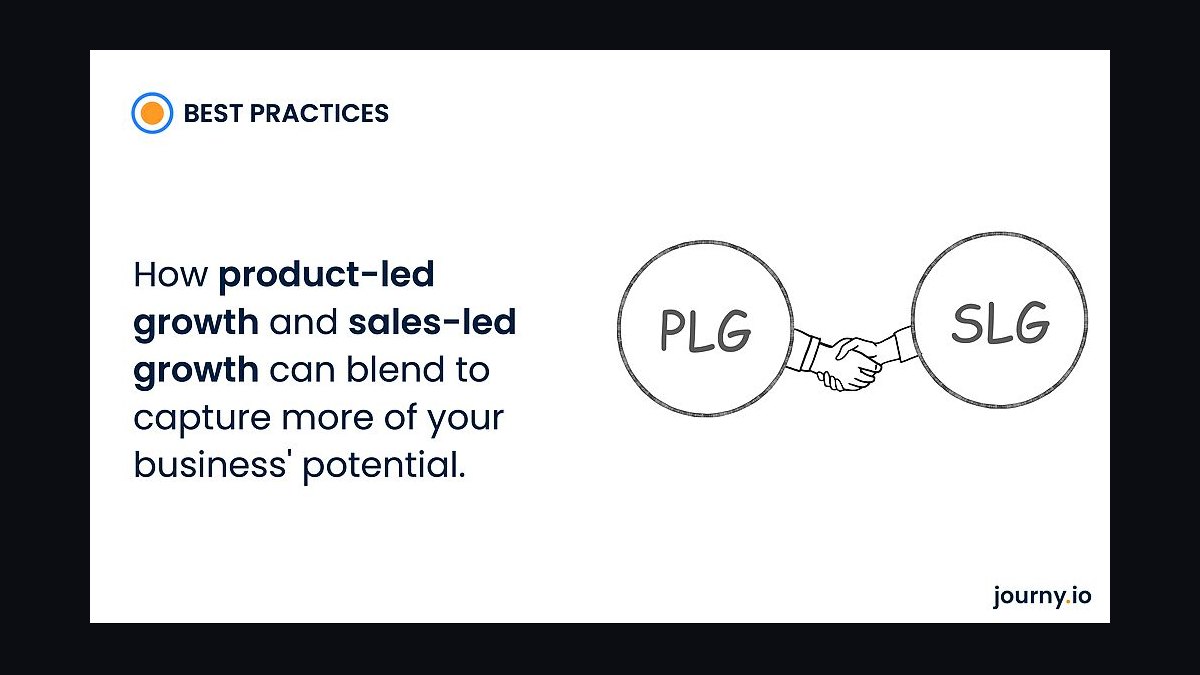
How do you blend product-led and sales-led growth in 2027?
Published June 13, 2026 · Updated June 13, 2026
You blend product-led and sales-led growth in 2027 by letting the product drive low-cost acquisition and qualification at the bottom of the market while deploying sales precisely where deal value and complexity justify a human — and connecting the two with shared data, clear handoff triggers, and aligned incentives so they reinforce rather than fight each other. The blend, often called product-led sales (PLS), is the dominant 2027 GTM model because pure PLG leaves enterprise revenue on the table and pure sales-led is too expensive for the long tail. The art is segmentation and timing: self-serve owns simple, low-ACV conversion; sales overlays where product-usage signals reveal a high-potential account worth human investment. Success depends on RevOps wiring product data into the sales motion, defining when a self-serve account graduates to sales, and ensuring the two motions share goals rather than cannibalizing each other's credit.
1Understand Why the Blend Wins
Pure PLG acquires efficiently but struggles to land and expand enterprise deals that need a human to navigate procurement, security, and multi-stakeholder buying. Pure sales-led covers enterprise well but is too expensive to chase the long tail of small accounts. The blend captures both: product-led efficiency for the bottom and middle, sales-led depth for the top — with the product also serving as a qualification and land mechanism that feeds sales warmer, usage-proven opportunities. This is why most successful 2027 SaaS companies run a hybrid rather than committing purely to one motion.
2Segment Where Each Motion Applies
The blend starts with segmentation: which customers should be served self-serve, and which justify sales. Generally:

- Self-serve — low-ACV, simple needs, individual or small-team buyers who can adopt and pay without help.
- Sales-assist — mid-market accounts showing strong usage and expansion potential.
- Full sales — enterprise accounts with complex, high-ACV, multi-stakeholder deals.
Draw these lines by ACV, account potential, and product-usage signals, not arbitrarily. The segmentation determines where you spend expensive human selling capacity, so getting it right is the core economic decision of the blend. RevOps owns the data and logic behind it.

3Define Clear Handoff Triggers
The hinge of the blend is when a self-serve account graduates to sales. Define explicit triggers based on product-qualified-lead signals plus account potential: a free account hits a usage threshold, adds many users, approaches a plan limit, and is a high-fit company → route to sales. Without clear triggers, high-potential accounts either get ignored by self-serve or swarmed prematurely by reps. RevOps builds the PQL-plus-firmographic logic that fires the handoff at the right moment, and equips the rep with the usage context so the sales conversation starts from the account's actual product behavior.
4Equip Sales With Product Context
In a blend, sales should never start cold. When a PQL graduates, the rep receives full product-usage context — what the account uses, how deeply, who is engaged, where they hit limits. This lets the rep have a value conversation grounded in real usage ("I see your team has 40 active users hitting the export limit") rather than a generic pitch. This product-context handoff is what makes product-led sales more efficient than traditional outbound: the product has already demonstrated value and qualified the account, so the rep's job is to expand and close, not to create demand from nothing. RevOps ensures this context flows to the rep.

5Align Incentives and Avoid Channel Conflict
The most common blend failure is conflict between the motions — sales claiming self-serve revenue, or self-serve and sales competing for the same accounts. Avoid it with clear rules of engagement (which accounts belong to which motion), fair crediting (how self-serve-originated, sales-expanded revenue is attributed), and aligned incentives (reps compensated in a way that does not punish self-serve conversion or encourage poaching). RevOps designs the segmentation, crediting, and comp logic so the two motions reinforce each other. Done right, self-serve feeds sales qualified expansion opportunities and sales lands accounts that then expand via product — a virtuous loop rather than a turf war.
6Use AI to Optimize the Blend in 2027
AI sharpens the blend on both sides. Predictive models identify which self-serve accounts are most likely to become high-value, improving the graduation triggers beyond simple thresholds. AI personalizes the self-serve experience to drive activation and conversion without human cost. AI surfaces expansion signals and drafts sales-assist outreach for graduated accounts. The result is a self-serve flywheel that converts more efficiently and sales capacity aimed precisely at the accounts where humans add the most value. RevOps governs these models and integrates them into the unified product-and-CRM data layer that the whole blend depends on.

6.1 Get the Economics and Capacity Model Right
The blend is fundamentally an economics decision, and getting the capacity model right is what makes it pay off. The principle: deploy human selling capacity only where the expected value of a sales touch exceeds its cost. A rep costs real money in salary, commission, and management, so putting a rep on a $5,000-ACV self-serve account destroys the unit economics, while leaving a $200,000-potential account to self-serve leaves money on the table. RevOps should model the cost-to-serve versus account potential across segments to calibrate exactly where the sales line sits, and revisit it as the product, pricing, and market evolve. This also informs sales capacity planning: because the product handles qualification and the long tail, a blended company needs fewer reps per dollar of revenue than a pure sales-led one, and those reps should be concentrated on the highest-potential graduated accounts. The capacity model should account for the fact that product-led sales reps are more productive per head — they work warmer, usage-qualified accounts — so the ratio of revenue per rep is typically higher than in traditional outbound-led sales. Getting this economic calibration right is the difference between a blend that is more efficient than either pure motion and one that combines the costs of both without the benefits. RevOps owns this analysis because it sits on both the product-usage data and the cost-and-revenue data needed to draw the lines correctly, and it should present the capacity-and-economics model to leadership as the basis for how many reps to hire and where to point them.
7Bottom Line
Blend product-led and sales-led growth by segmenting where each motion applies (self-serve for low-ACV, sales for high-ACV/complex), defining clear product-signal-plus-potential handoff triggers, equipping sales with full product-usage context, and aligning incentives and crediting so the motions reinforce rather than fight. Use AI to sharpen graduation triggers and personalize self-serve, and get the cost-to-serve versus account-potential economics right to calibrate where the sales line sits. The blended PLS model wins in 2027 because it pairs product-led efficiency across the market with human selling deployed precisely where it pays — a virtuous loop, not a turf war.

Related on PULSE
- When does product-led growth break down and require sales-led addition?
- How do you transition from sales-led to PLG (product-led growth) in 2027?
- Is product-led growth (PLG) dying in 2027, or evolving into hybrid GTM?
- What is PLG (Product-Led Growth) and how does it change your GTM?
- What is product-led sales and how do you run a PLS motion in 2027?
- What is Correlated and why is it a hot RevOps product-led sales platform for 2027?
The Data-Share Architecture That Makes PLS Work in 2027
The critical infrastructure for blending product-led and sales-led growth in 2027 is a unified data layer that surfaces product usage signals directly inside the CRM and sales tools. Without it, sales teams operate blind, and product-led conversions get no follow-up. Leading teams deploy reverse-ETL pipelines (e.g., from Segment or Census) to push real-time product events — feature adoption rates, account-level expansion triggers, support ticket patterns — into Salesforce or HubSpot as custom objects and scoring fields. A common threshold: when a self-serve account hits 10+ active users or a 90th-percentile usage score, an automated Slack alert fires to the assigned AE with a pre-built account summary. This architecture typically costs $2,000–$8,000/month in tooling but reduces sales ramp time on warm leads by 40–60% compared to cold outreach.
Handoff Triggers That Prevent Friction
Defining explicit, measurable handoff criteria prevents the classic PLS failure: sales calling a happy self-serve user and breaking trust. In 2027, mature blends use a three-tier trigger system. Tier 1: accounts that attempt a premium feature (e.g., SSO, API rate limits) are auto-enrolled in a sales-assisted trial with a 48-hour first touch. Tier 2: accounts crossing a dollar-based threshold (e.g., $5,000–$15,000 in implied annual value from usage) get a human outreach with a product-qualified lead (PQL) score above 80. Tier 3: enterprise-form submissions from accounts with 50+ users trigger immediate SE assignment. The key metric is handoff conversion rate — the percentage of PQLs that accept a meeting. Top-quartile teams see 25–35% conversion; below 15% indicates the trigger is too early or the sales pitch doesn't match the product experience.
Compensation Alignment That Ends Cannibalization
The most common blend killer is compensation misalignment: sales reps avoid self-serve accounts because they don't get full quota credit, while product teams optimize for sign-ups that never monetize. The 2027 fix is a split-credit model where product-led acquisition earns the sales team 20–40% commission on the first-year contract value, even if the rep only closes the expansion. For example, a $50,000 deal started via self-serve might give the AE $10,000 in quota credit and the product team the remaining attribution. RevOps typically runs monthly reconciliation using the unified data layer to assign credit based on first-touch and last-touch product events. Teams that implement this see 30–50% higher sales engagement with inbound PQLs and a 15–25% lift in net revenue retention, as sales focuses on expansion rather than fighting for initial credit.
FAQ
What’s the biggest mistake companies make when blending PLG and sales-led? The biggest mistake is treating them as separate funnels with separate metrics. When product and sales teams have conflicting goals—like self-serve chasing activation while sales chases pipeline—they end up competing for the same accounts. The fix is aligning both motions around a shared revenue target and using product usage data to decide which accounts need a human touch.
How do you decide when a self-serve account should be handed to sales? You set clear triggers based on product behavior, not just company size or industry. Common signals include a user hitting a usage threshold, inviting multiple teammates, or exploring a premium feature. The handoff should happen automatically through your CRM, with sales getting a full usage timeline so they don’t start from scratch.
Does blending PLG and sales-led mean you need a bigger sales team? Not necessarily—it often means a more specialized one. Instead of a large outbound team, you might have a smaller group of “product-qualified account executives” who only engage accounts already showing strong product adoption. This can lower cost per deal because sales time is spent only on high-intent, high-value opportunities.
How do you prevent sales from cannibalizing self-serve revenue? By defining clear “self-serve only” segments—usually smaller accounts or simple use cases—that sales never touches. For accounts that could go either way, you use a rule like “if the account hasn’t upgraded after X weeks of active usage, sales can reach out.” Compensation also matters: credit both motions for revenue that starts in self-serve but closes with sales help.
What metrics should you track to measure the blend’s success? Focus on conversion rate from product-qualified account to sales-engaged deal, average time from product sign-up to sales handoff, and revenue per account by motion (self-serve vs. sales-assisted). Also watch for “leakage”—accounts that should have been handed to sales but weren’t, or ones that got sales attention too early and churned.
How long does it take to see results from a blended model? It varies widely—some companies see improved conversion within a quarter, while others need six to twelve months to refine triggers and align teams. The biggest time sink is usually cleaning up data and getting product usage reliably into the CRM. Honest range: three to nine months before you can confidently say the blend is working.
Sources
- OpenView product-led-sales and PLG benchmarks, 2026–2027
- Pavilion 2026 RevOps hybrid-GTM and product-led-sales survey
- Gartner research on product-led sales and hybrid go-to-market, 2026
- Bessemer Venture Partners PLG and GTM-efficiency research, 2026–2027
- Reforge and ProductLed hybrid-motion frameworks, 2026
- SaaStr product-led-sales operating benchmarks, 2026–2027
Product-led sales review / reviews / rating / review 2027 / review of blending PLG and sales-led growth
This page will be disappearing soon. Save it to your device for $1 — or read it free while it is here.
@Kory-White- · if Venmo asks, the last 4 of my number are 2012
This page is gone.
This one is off the shelf now. $1 keeps it on your phone for good — the whole page, pictures and diagrams included.
 revopsHow do you set up RevOps for a PLG company in 2027?
 revopsHow do you score and route product-qualified leads in 2027?
 revopsIs product-led growth (PLG) dying in 2027, or evolving into hybrid GTM?
 revopsWhat is product-led sales and how do you run a PLS motion in 2027?
 revopsHow do you transition from sales-led to PLG (product-led growth) in 2027?
 revopsHow do you build a bottoms-up revenue model in 2027?
 revopsHow do you structure incentives for upsell and cross-sell in 2027?
 revopsDo you need a revenue data platform in 2027?
 revopsHow do you measure ROI on AI in sales in 2027?
 revopsWhat RevOps metrics should you report to the board in 2027?