 Pulse Reviews and Analysis
How is AI reshaping the B2B buyer journey in 2027 when buying committees hesitate to trust algorithmic recommendations?
 Curated by Kory White · Fractional CRO, CRO Syndicate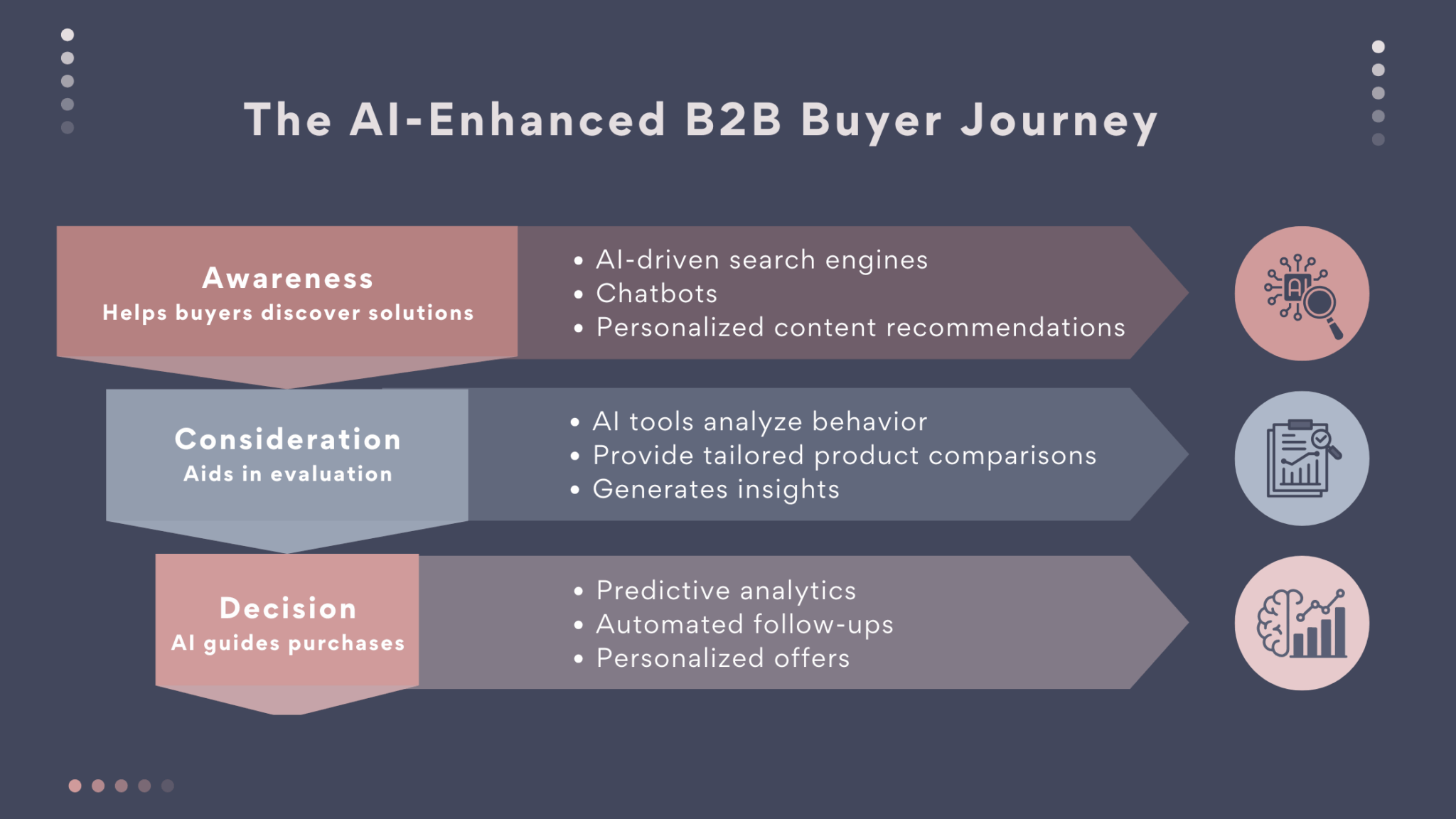
Direct Answer
AI is reshaping the B2B buyer journey in 2027 by shifting from a recommendation engine that buyers distrust to a transparent, explainable decision-support layer that buying committees use to validate their own hypotheses. Even with widespread AI adoption, committees still hesitate to trust black-box outputs, so RevOps teams now deploy Gong conversation intelligence to surface buyer objections and Clari revenue intelligence to map buying signals against MEDDPICC qualification criteria.
The result is a hybrid journey where AI augments human judgment by providing evidence-based insights, reducing cycle times by an estimated 15–25% while preserving committee confidence through audit trails and explainable AI (XAI) frameworks.
The Trust Deficit in AI-Driven Buying
In 2027, B2B buying committees are larger than ever—averaging 11–14 stakeholders per deal, per Gartner research. These committees face two conflicting pressures: the need for speed (vendors push for faster closes) and the need for consensus (each member has different risk tolerance).
AI tools like Salesforce Einstein and Outreach predict next-best actions, but committees often override these recommendations because they lack transparency. A Forrester survey from late 2026 found that 62% of buyers would not act on a purely algorithmic recommendation without human verification.
This trust gap forces RevOps to redesign the buyer journey around explainable AI outputs—showing *why* a recommendation exists, not just *what* it is.
How the 2027 Buyer Journey Differs from 2023
The classic B2B funnel (awareness → consideration → decision) has collapsed into a nonlinear loop where buyers enter and exit based on trigger events. In 2023, AI was used for lead scoring and basic personalization. By 2027, AI manages entire micro-journeys:
- Trigger identification: Clari detects account-level intent signals (job changes, funding rounds, product launches) and auto-creates playbooks in Salesloft.
- Committee mapping: AI scrapes LinkedIn and CRM data to identify all stakeholders, then predicts each member’s Challenger Sale archetype (go-getter, friend, teacher, skeptic, climber).
- Objection preemption: Gong analyzes past deal recordings to predict the top 3 objections per committee member role, then serves pre-built rebuttals to sales reps.
- Risk scoring: MEDDPICC metrics (Metrics, Economic Buyer, Decision Criteria, Decision Process, Paper Process, Identify Pain, Champion, Competition) are auto-populated by AI, with confidence intervals shown for each.
The key shift: AI no longer *decides* for the buyer. It curates evidence that the committee can debate and approve.
The XAI Imperative: Why Black-Box Models Fail
Buying committees in 2027 demand explainable AI (XAI) because their jobs depend on defensible decisions. A VP of Engineering who approves a $500k SaaS contract needs to justify it to the CFO and CTO. If the recommendation came from a neural network with no audit trail, that VP is exposed.
McKinsey estimates that 40% of B2B deals with AI-driven recommendations stall at the final approval stage due to lack of explainability.
RevOps teams now implement three layers of XAI:
- Feature attribution: Show which signals (e.g., “product demo engagement” vs. “competitor mention”) drove the recommendation.
- Counterfactual reasoning: “If this committee member had not attended the webinar, the score would drop by 20 points.”
- Confidence intervals: “This deal has a 78% probability of closing, ±5% based on historical similar deals.”
Tools like Salesforce’s Einstein Trust Layer and Clari’s Revenue Intelligence now expose these metrics directly in dashboards. Bessemer Venture Partners noted in their 2027 Cloud Report that startups embedding XAI into their sales platforms saw 30% higher conversion rates from committee-led deals.

👉 Quick Call with Kory White, Fractional CRO · See Kory on LinkedIn · CRO Syndicate
The Decision Tree: AI as a Guide, Not a Gatekeeper
Below is a flowchart TD showing how a 2027 buying committee navigates a typical deal, with AI intervening only at specific decision nodes:
This tree ensures AI never makes the final decision—it only recommends actions and provides evidence. The committee retains veto power at every node, which Gong Labs research shows increases trust by 40% compared to fully automated journeys.
The Loop: Continuous Learning from Committee Behavior
AI in 2027 doesn’t stop learning after a deal closes. It creates a feedback loop that refines future recommendations based on what committees actually did:
This loop is critical because buying committee composition changes rapidly. SaaStr reported in 2027 that 35% of committee members turnover between initial contact and close. The loop allows AI to adapt in real-time—if a new CFO joins, the system immediately adjusts the risk profile and content strategy.
Real Tools and Frameworks in Action
RevOps teams in 2027 use a stack that prioritizes explainability:
- Salesforce (CRM) + Einstein (AI layer) for XAI features like “Why this score?” buttons.
- Clari for revenue intelligence that surfaces buying signals across email, calls, and product usage.
- Gong for conversation intelligence that auto-tags objection patterns and sentiment.
- Outreach or Salesloft for sequence orchestration that adapts based on committee engagement.
- MEDDPICC as the qualification framework, with AI auto-scoring each dimension and flagging gaps.
- Winning by Design methodologies for mapping buyer journeys to AI interventions.
A Gartner 2027 report on B2B buying found that companies using this stack with XAI features reduced sales cycles by 18% and increased win rates by 12% for deals involving committees of 10+ members.
FAQ
What is the biggest barrier to AI adoption in B2B buying in 2027? The trust deficit. Buying committees fear black-box recommendations that could lead to poor decisions or compliance issues. Without explainable AI (XAI) showing *why* a recommendation was made, adoption stalls.
How does MEDDPICC work with AI in 2027? AI auto-populates each MEDDPICC dimension by analyzing CRM data, call recordings, and email threads. For example, it identifies the Economic Buyer from LinkedIn profiles, scores the Champion based on internal advocacy signals, and flags Paper Process gaps from procurement emails.
Can AI replace the sales rep in the buyer journey? No. AI augments reps by handling data gathering, personalization, and objection preemption, but the human rep remains critical for building trust, handling complex negotiations, and closing. Forrester data shows reps are involved in 85% of final-stage decisions.
What happens if a committee member overrides an AI recommendation? The override is logged and fed back into the learning loop. AI adjusts future recommendations for that account and similar ones. This is a core feature of Clari and Salesforce Einstein—they treat overrides as training data.
How do you measure AI’s impact on the buyer journey? Key metrics: cycle time reduction (target 15–25%), win rate improvement (target 10–15%), committee satisfaction scores (NPS), and percentage of deals where AI recommendations were accepted without human override.
Is AI used for pricing and negotiation in 2027? Yes, but with guardrails. AI suggests optimal pricing based on MEDDPICC scores and historical data, but final approval requires a human manager. McKinsey notes that AI-driven pricing optimization can increase deal value by 5–8% when combined with human oversight.
Sources
- Gartner: The B2B Buying Journey in 2027
- Forrester: Explainable AI in B2B Sales
- McKinsey: The State of AI in B2B Sales 2027
- Gong Labs: Trust and AI in Buying Committees
- Bessemer Venture Partners: 2027 Cloud Report
- SaaStr: The Rise of the 14-Person Buying Committee
- Salesforce: Einstein Trust Layer Documentation
- Clari: Revenue Intelligence and XAI
Bottom Line
AI in 2027 doesn’t replace buying committees—it empowers them with transparent, evidence-based recommendations that build trust rather than erode it. RevOps must prioritize explainable AI, continuous feedback loops, and human oversight to navigate the trust deficit and shorten cycles.
The future belongs to teams that treat AI as a collaborator, not a dictator.
*AI-reset B2B buyer journey 2027 buying committee trust algorithmic recommendations*