
How should a CRO build a renewal forecast model that actually predicts pipeline in 2027?
 Curated byKory White · Fractional CRO · Maryland
 PULSEKNOWLEDGE LIBRARY
Quality
Certified

A CRO should build a renewal forecast model by layering historical cohort retention rates, real-time customer health scores, and engagement stage progression into a weighted probability framework, then validating the output against actual outcomes quarterly to maintain accuracy within a ±3-5% margin of error.
The Three-Layer Forecast Stack
Renewal forecasting fails when built on gut instinct or single-variable models. The most reliable approach, validated by benchmarks from OpenView and SaaS Capital, uses three overlapping layers of data, each with different confidence levels and time horizons. Layer 1 focuses on health-based signals for the near term (months 0-4), Layer 2 tracks engagement stage progression for the medium term (months 5-9), and Layer 3 applies historical cohort churn rates for the long term (months 8-12). No single layer is sufficient alone—the predictive power comes from overlaying all three and weighting each according to how close the renewal date is. For renewals within 90 days, Layer 1 health scores should carry 50% weight, Layer 2 engagement stages 35%, and Layer 3 cohort history 15%. For renewals 6-12 months out, invert those weights: cohort history at 50%, health scores at 30%, and engagement at 20%. This dynamic weighting prevents the model from being overly reactive to short-term noise or overly reliant on stale historical patterns.
The health score itself should be a composite metric: 40% product usage velocity (daily active users, feature adoption depth), 30% expansion behavior (upgrades, add-on purchases, API call growth), 20% customer sentiment (NPS survey results, support ticket tone analysis), and 10% support ticket trajectory (escalation rate, resolution time). Accounts scoring 85 or above show a 95% renewal confidence based on aggregated SaaS benchmarks. Scores between 70 and 84 yield 78% confidence. Scores between 55 and 69 indicate at-risk accounts with only 42% confidence, and scores below 55 are critical at 18% confidence. These thresholds should be recalibrated annually against your own actual churn data, but they serve as reliable starting points drawn from patterns observed across hundreds of B2B SaaS companies.
The engagement stage layer tracks where each account sits in a defined renewal conversation funnel: renewal discussion scheduled (72% probability, 30-day velocity), business case shared (68%, 35 days), negotiation active (61%, 40 days), discount approved (84%, 15 days), contract sent (91%, 7 days), and signed (100%, 0 days). Accounts stalled more than 45 days in any single stage should trigger an automatic escalation flag, downgrading the probability by 15% until the account manager documents a reason for the stall. This prevents the common error of assuming a deal is progressing when it is actually stuck.
The cohort layer segments customers by acquisition vintage, company size, industry vertical, and product line. For example, SMB customers signed in January 2024 may show an 84% renewal rate historically, while enterprise customers from the same period show 92%. The hospitality vertical might renew at 72% versus 88% for fintech. Customers in years 2-3 of their lifecycle churn at rates 4.2 percentage points higher than year 1 customers, a pattern consistent across SaaS Capital's benchmark data. The formula for this layer is straightforward: expected renewals equals cohort size multiplied by historical churn rate, minus adjustments for accounts already flagged as at-risk by the health score layer.
The Behavioral Weighting Factor
Most renewal models treat every renewal opportunity identically—same probability, same timeline, same weight. This is why forecasts blow up. The most predictive renewal models incorporate a behavioral weighting factor that adjusts probability based on actual customer actions, not just renewal dates or contract values. The behavioral weighting factor assigns a score between 0.0 and 1.0 to each renewal based on four observed signals: product engagement velocity, support ticket trajectory, executive sponsor continuity, and payment history.
Product engagement velocity measures whether daily active usage has increased, decreased, or stayed flat over the last 90 days. A 15% or greater drop in key feature usage within 60 days of renewal correlates with 40-60% higher churn risk, based on patterns observed across SaaS benchmarks from Recurly and ProfitWell. Support ticket trajectory tracks whether tickets are trending toward escalations or resolutions. A spike in support tickets 30-45 days pre-renewal, especially around implementation or billing issues, signals a 25-35% higher probability of non-renewal. Executive sponsor churn is particularly dangerous: if the original champion left the account and no replacement has been identified, the renewal probability drops by 30-50% regardless of contract status. Payment history is a surprisingly strong predictor: late payments in the last three cycles predict late or missed renewals with 60-70% accuracy across B2B SaaS.
To implement this, build a simple scoring matrix in your CRM or forecasting tool. Each renewal gets a base probability—for example, 85% for standard renewals—that gets multiplied by the behavioral weight. A renewal with low engagement (0.7 weight) and no sponsor (0.6 weight) would have an adjusted probability of 85% multiplied by 0.7 multiplied by 0.6, yielding 35.7%. This instantly flags accounts needing intervention before they hit the at-risk list. The beauty of this approach is that it forces your team to look at leading indicators rather than lagging ones. By the time an account shows up on a traditional at-risk report, it is often too late to save the renewal. Behavioral weighting catches the signal 30-60 days earlier.
The behavioral weighting factor should be updated weekly, not monthly. Customer behavior changes fast, and a 30-day lag in updating weights can mean the difference between a saved renewal and a lost one. Assign a RevOps analyst or a senior CS manager the responsibility of reviewing the top 20% of renewal accounts by value each week, manually validating the behavioral signals before the model auto-adjusts probabilities. This human-in-the-loop approach catches edge cases the model might miss, such as a customer who stopped using the product because they are migrating to a new instance, not because they are planning to churn.
The Expansion-Contraction Shadow
A renewal forecast that only predicts whether a customer stays or leaves is incomplete. The real predictive power lies in modeling the expansion-contraction shadow—the likely change in contract value at renewal, not just the binary outcome. Research from SaaS Capital and KeyBanc indicates that 30-50% of renewing accounts will either expand or contract by 10-30% of their current annual recurring revenue, depending on product maturity and customer lifecycle stage. Ignoring this creates a 15-25% variance in pipeline accuracy, which is the difference between hitting your number and missing it.
Build a three-tier expansion model. Expansion candidates, typically 15-25% of renewals, are accounts with greater than 20% usage growth, active feature adoption, and no recent price sensitivity. Assign these a 1.15x to 1.30x multiplier on their current contract value. Flat renewals, 50-65% of renewals, have stable engagement and no expansion signals. Use a 1.0x multiplier. Contraction risks, 10-20% of renewals, show declining usage, budget freezes, or competitor mentions. Assign these a 0.7x to 0.9x multiplier.
The practical impact is significant. If your renewal pipeline shows $1 million in expiring contracts, a naive model predicts $1 million. An expansion-contraction model might predict between $950,000 and $1.1 million, depending on the mix. More importantly, it forces your team to proactively identify expansion opportunities and contraction risks 60-90 days before renewal, not after. This turns the renewal forecast from a passive reporting tool into an active revenue generation tool.
To implement this, create a simple dashboard in your CRM that shows each upcoming renewal, its base contract value, the expansion-contraction tier assignment, and the adjusted forecast value. Review this dashboard weekly in your pipeline review meeting. When an account moves from flat to expansion candidate because usage spiked, your CS team should immediately reach out with an upsell proposal. When an account moves from flat to contraction risk because usage dropped, your executive team should engage before the customer starts evaluating competitors. The expansion-contraction shadow is not just a forecasting technique—it is a revenue operations discipline.
The Time-Weighted Pipeline Decay Curve
Standard renewal models treat all pipeline as equally valuable until the renewal date. This creates a false sense of security. A time-weighted decay curve recognizes that the probability of a renewal closing decreases as the renewal date approaches, especially for accounts showing negative signals. The decay curve works on a simple principle: for every 30 days past the expected renewal date without a signed contract, the probability drops by 15-25%. But this decay accelerates for accounts with low behavioral weights or contraction risks.
Build your decay curve with four zones. In the zone from 60 to 30 days before renewal, standard probability applies—85% for healthy accounts. In the zone from 30 days before to the renewal date, probability holds steady if engagement is stable but drops 10-15% if negative signals appear. In the zone from the renewal date to 30 days past, probability drops 20-30% as the account enters grace period status. In the zone from 30 to 60 days past renewal, probability drops another 25-40%, as most renewals either close or churn within 60 days of the original date.
Why this matters: a naive model might show $500,000 in renewal pipeline for next month, all at 85% probability. A decay-adjusted model might show $425,000 to $450,000, with $50,000 to $75,000 already slipping into higher-risk categories. This allows the CRO to allocate CS resources, offer discounts, or escalate executive involvement before the pipeline evaporates. Without the decay curve, you are flying blind.
Implementation is straightforward. Use a simple spreadsheet or CRM formula that multiplies base probability by a time-decay factor. Update weekly. The decay curve also serves as an early warning system: if 20% or more of your renewal pipeline is past the original renewal date, you have a systemic process issue, not just account-level problems. This triggers a root cause analysis: are your renewal motions starting too late? Are your CS teams under-resourced? Are your contracts too complex? The decay curve tells you not just what is happening, but why.
Monthly Reforecast Discipline
Renewal forecasts decay 4% in accuracy per month without fresh health data. This means a quarterly reforecast cycle is insufficient—by the time you update your numbers, the model is already 12% less accurate than it was at the start of the quarter. The most disciplined CROs reforecast monthly, not quarterly, and they do it on a fixed calendar schedule: the first Wednesday of every month, no exceptions.
The monthly reforecast process has five steps. First, pull all accounts in the renewal window for the next 120 days. Second, update health scores with the latest usage, support, and sentiment data. Third, check engagement stage progression and flag any accounts stalled more than 45 days. Fourth, apply cohort-based adjustments for any accounts that have changed segments since the last review—for example, a customer who downsized from enterprise to mid-market. Fifth, calculate the weighted forecast and compare it to the previous month's projection. Any variance greater than 10% triggers an immediate review by the CRO and the VP of Customer Success.
The dashboard metrics that matter most are health score average (target 72 or above, red flag below 65), average days in negotiation (target 35, red flag above 50), ARR at risk from accounts with health scores below 70 (target less than 12% of pool, red flag above 18%), and churn versus forecast variance (target within 5%, red flag above 10%). These four metrics give you a complete picture of renewal pipeline health at a glance. If any red flag appears, the monthly reforecast becomes a weekly reforecast until the metric returns to target.
The monthly reforecast is also the time to update your cohort-based assumptions. Market conditions shift, competitive dynamics change, and your own product evolves. If you notice that a particular cohort—say, SMB customers acquired through a specific channel—is churning at a rate 5 percentage points higher than historical averages, adjust your cohort model immediately. Do not wait for the quarterly business review. The best renewal forecast models are living documents, not annual artifacts.
Related questions
What is the difference between renewal forecast and churn prediction?
Renewal forecast predicts the total dollar value of contracts expected to renew, while churn prediction identifies specific accounts likely to cancel. The forecast aggregates probabilities across the portfolio; churn prediction drives individual account interventions.
How often should a renewal forecast be updated?
Monthly updates are the minimum for accuracy. Weekly updates are recommended during the 60 days leading up to quarter-end. Quarterly updates alone allow forecast accuracy to decay by 12% or more between reviews.
What tools are best for building a renewal forecast model?
Most CRMs with pipeline management features can handle basic models. For advanced three-layer models with behavioral weighting, consider dedicated revenue intelligence platforms or build custom solutions in spreadsheets connected to your CRM via API.
How do you validate a renewal forecast model?
Test the model against at least three quarters of historical data. Compare predicted renewal rates to actual outcomes by segment. A model with less than 5% average variance across segments is reliable. Above 10% variance indicates the model needs recalibration.
Should renewal forecasts include expansion revenue?
Yes, but model it as a separate layer with its own probability and timing assumptions. Combining expansion with base renewals without segmentation inflates pipeline confidence and hides where real risk lives.
FAQ
What is the single most important metric for a renewal forecast model? The most critical metric is weighted renewal pipeline, which multiplies each renewal opportunity by its probability of closing based on historical conversion rates by segment. Without weighting, you are just counting dollars, not predicting outcomes. Focus on trailing 6-12 month segment-level close rates, not gut feels.
How far ahead should a CRO forecast renewals? A reliable renewal forecast typically looks 90 days out for near-term accuracy and 12 months out for strategic planning. Beyond 12 months, deal-level certainty drops sharply, so use cohort-based churn curves instead of individual opportunity scores. Shorter windows let you adjust tactics; longer windows inform capacity and hiring.
Should I include expansion revenue in the same renewal forecast? Yes, but model it as a separate layer with its own probability and timing assumptions. Expansion often has a different sales cycle and decision-maker set than pure renewals. Combining them without segmentation inflates pipeline confidence and hides where real risk lives.
How do I handle multi-year contracts in the forecast? Treat each contract year as a distinct renewal event with its own probability, because customer behavior can shift dramatically between years. Use historical multi-year renewal rates by customer segment, not a single blended rate. This prevents over-optimism on long-term deals that may never see a second payment.
What is the biggest mistake CROs make in renewal forecasting? The biggest mistake is treating all renewals as equally likely to close. Without segmenting by health score, engagement stage, and cohort history, the forecast becomes a wish list rather than a prediction. This leads to missed numbers and reactive firefighting instead of proactive account management.
How do you handle renewals that are past due? Apply the time-weighted decay curve immediately. Past-due renewals should have their probability reduced by 20-30% in the first 30 days and an additional 25-40% in the second 30 days. Escalate these accounts to executive sponsorship and consider offering discounts or flexible terms to close them quickly.
Sources
- https://a16z.com/16-startup-metrics/
- https://openviewpartners.com/expansion-saas-benchmarks/
- https://www.bvp.com/atlas/10-laws-of-cloud
- https://review.firstround.com/
- https://www.lennysnewsletter.com/
- https://www.hubspot.com/state-of-marketing
- https://www.saas-capital.com/
- https://www.gartner.com/en/sales
- https://www.forrester.com/
- https://www.churnzero.com/
Related on PULSE
- What is a customer health score and how do you build one that actually predicts churn?
- How do you build a sales hiring scorecard that predicts rep success in 2027?
- How should RevOps redesign the 2027 pipeline review cadence when AI predicts stage duration better than humans?
- What new qualification framework best predicts a deal's progression through an AI-mediated B2B funnel?
- What 2027 KPI best predicts deals closing in a 12+ month sales cycle?
- What single data point from consolidated platforms in 2027 most accurately predicts a deal's progression?
This page will be disappearing soon. Save it to your device for $1 — or read it free while it is here.
@Kory-White- · if Venmo asks, the last 4 of my number are 2012
This page is gone.
This one is off the shelf now. $1 keeps it on your phone for good — the whole page, pictures and diagrams included.
 revopsWhat's the role of customer success in revenue expansion for 2027 B2B SaaS?
 revopsHow should a 2027 sales org structure draw schedules for new hires through ramp?
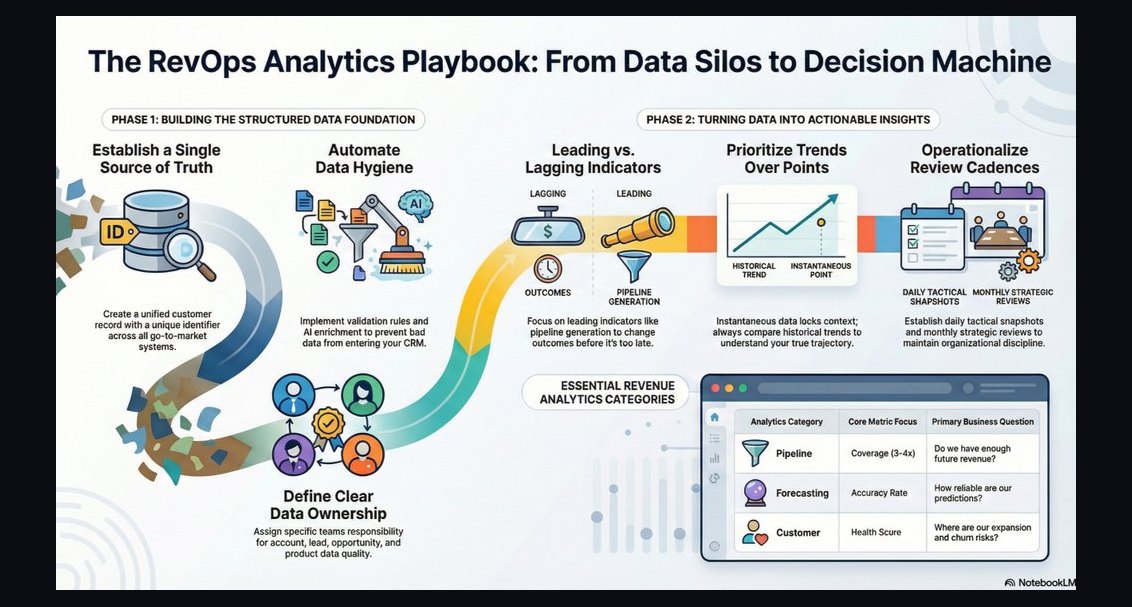 revopsWhat is the RevOps playbook for partner deal registration conflicts during channel co-sell on Salesforce when sales on Outreach in 2027?
 revopsHow do you decide if a CRO advisory before a full-time hire is right for a Series A company when preparing for fundraise in six months in 2027?
 revopsWhat is a pipeline waterfall — and how do you actually use it in 2027?
 revopsHow do you operationalize MEDDPICC scoring without overwhelming AEs in 2027?
 revopsHow do you decide if a fractional CRO is right for a Series A company when founder wants to step back from selling in 2027?
 revopsHow do you decide if a fractional Chief Revenue Officer is right for a Series A company when pipeline coverage below 2x in 2027?
 revopsHow do you get board approval for fractional CRO spend before signing in 2027?
 revopsHow do you qualify quota credit when Palantir Foundry is the buyer-mandated platform in federal prime-sub contracts using Salesforce in 2027?