
How do you start a commercial office cleaning business in 2027?
 Curated byKory White · Fractional CRO · Maryland
 PULSEKNOWLEDGE LIBRARY
Quality
Certified

Start a commercial office cleaning business in 2027 by registering an LLC, buying general liability insurance and a janitorial bond, and mastering production-rate bidding before you sign anything. Budget $15K–$60K — mostly insurance, equipment, and working capital to float payroll during net-30 invoice lags. Then win 3–7 recurring building contracts and supervise them relentlessly.
Owner-operator route versus regional company versus franchise
Three distinct structures exist, and the choice shapes your capital needs, your ceiling, and your daily life. Pick deliberately — the failure mode is drifting between them.
The owner-operator route is the lean default. You personally sell, walk buildings, build bids, hire cleaners, run night inspections, and cover call-outs. Overhead is minimal: no office, no salaried managers, one supervisor vehicle at most. You can be cash-flow positive inside 90 days on $15K–$35K of launch capital. The ceiling is your own span of control — one person can personally inspect roughly 8–15 buildings before quality starts sliding somewhere you aren't looking. Margins are the best of the three models because there's no management layer to carry: 20–28% net is achievable when bids are disciplined.
The regional company builds a real management layer — area supervisors covering 10–20 buildings each, an operations manager, a dedicated salesperson, back-office billing and HR. This scales to dozens or hundreds of buildings across a metro. Net margin compresses to 12–20% because supervision and admin become permanent overhead lines, but total owner profit climbs because you're running 5–10x the revenue. The real prize is that a systematized book of multi-year contracts with low owner-dependence is a saleable asset — private-equity platforms consolidating the fragmented janitorial market pay meaningful EBITDA multiples for exactly that shape.
The franchise buys you a brand, a bidding system, training, back-office support, and in some structures accounts handed to you at signing. You pay a franchise fee up front, ongoing royalties, and sometimes a percentage of every account the franchisor sourced. The spread between franchise systems is enormous: some are genuinely supportive operating partners, others function as a labor pool where the franchisor sells the accounts, keeps the client relationship, and takes a heavy cut of revenue you generate. Read the Franchise Disclosure Document — specifically Item 19 financial performance representations and Item 20 turnover tables — before you sign anything.

Most independent founders start as owner-operators, prove they can bid and supervise, then decide in Year 2 or 3 whether to build the management layer. The franchise fits someone who wants structure and will trade margin for a playbook.
How to decide between them
The decision turns on four honest self-assessments: how much capital you actually have, whether you can sell B2B, how much of your own time you can put into buildings at 7pm, and whether you're building for cash flow or for an exit.
If you have under $20K and no B2B sales experience, the franchise removes the hardest problem — finding at-bats — at real cost. If you have $20K–$40K and can walk into a property management office and hold a conversation, the owner-operator route dominates on economics. If you're already running a route profitably and turning away work because you can't supervise it, that's the signal to build the regional layer.

The decision is also sequential rather than permanent. An owner-operator route that hits 12 contracts and $600K in revenue *becomes* a regional company by hiring the first area supervisor. The franchise is the only genuinely one-way door, because the non-compete and account-ownership terms usually prevent you from taking the book independent later.
One more filter: route density. If your target geography has a dense commercial corridor — an office park, a medical campus, a downtown block — the owner-operator model gets unusually strong, because clustered buildings collapse your supervision cost. If the commercial buildings in your market are scattered across forty-five minutes of driving, the labor math gets punishing and the franchise's account-sourcing starts looking worth its royalty.
The numbers behind each option
Every path lives or dies on one calculation beginners almost never run: fully-loaded labor as a percentage of contract revenue. Commercial cleaning is a managed-labor business wearing a cleaning-supplies costume. You aren't selling cleaning; you're selling the reliable presence of vetted, trained, supervised people in a building every night.
The contract-level math. Take a $4,000/month office contract. Direct labor — the wages of the cleaners servicing it — must land at roughly $1,800–$2,200, or 45–55% of revenue. On top of wages sits labor burden: employer-side Social Security and Medicare, federal and state unemployment, and workers' compensation, which is expensive in janitorial because the classification carries a real injury rate. Burden adds roughly 25–35% on top of wages, or 12–18 points of revenue. Fully burdened labor is therefore $2,300–$2,900, or 57–72% of revenue. Supplies and consumables run 4–8%. Insurance, bonding, supervision time, vehicle, and software run 8–12%. What's left is your owner margin: 15–30%.

Push labor to 65% of revenue and the contract is a treadmill. Get it to 40% through route density and good supervision and the contract is an annuity.
Production rates are how you get there. A production rate is the square footage one cleaner services to a given spec in one hour. General office at a standard nightly spec runs roughly 2,500–4,000 sq ft per labor-hour, depending on furniture density, restroom count, and carpet-versus-hard-floor mix. Medical space cleans far slower — often 1,500–2,500 sq ft per labor-hour — because of disinfection steps and exam-room turnover. Restrooms are the labor sink: one restroom eats 15–25 minutes regardless of building size, so a small building with six restrooms cleans like a much larger one.
The estimating sequence: walk the building, count restrooms and fixtures, get cleanable square footage, classify space types, apply realistic production rates for total nightly labor-hours, multiply by service nights per month, multiply by your fully-burdened hourly cost, add supplies, add overhead and insurance, add target margin. That's your bid. Build it in a spreadsheet, never in your head.
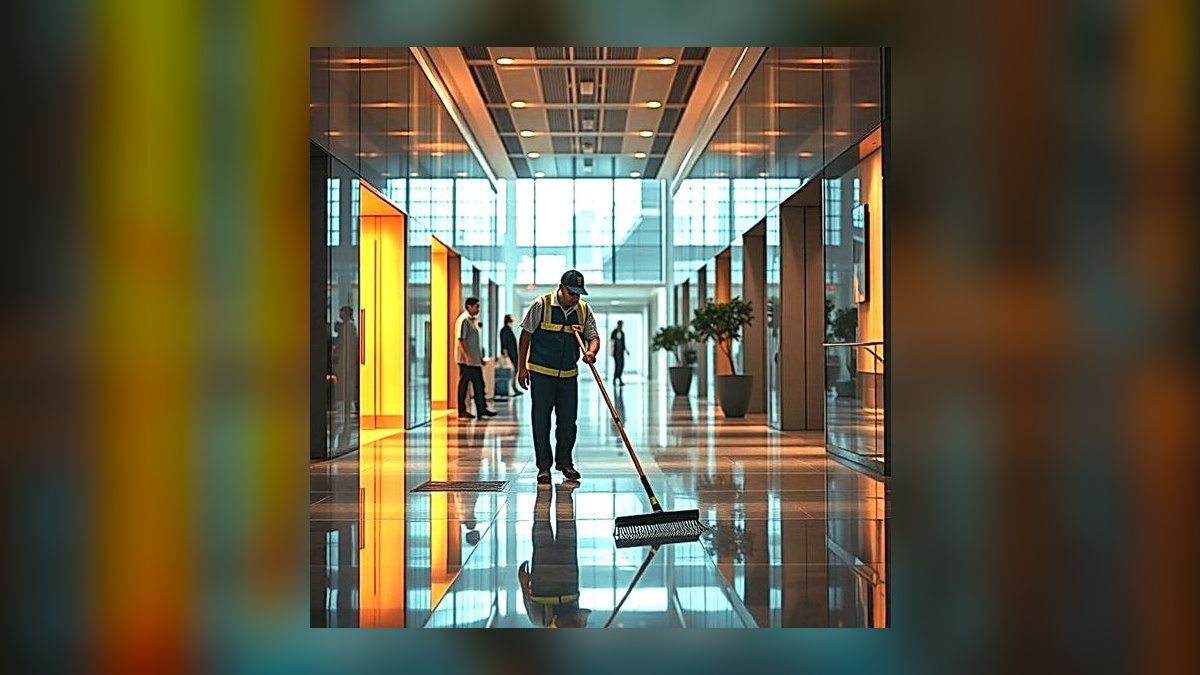
Two estimating errors destroy startups. First, optimistic production rates — assuming a cleaner covers 5,000 sq ft/hour when the real spec yields 3,000 understates labor by 40% and turns a 20% margin into a loss. Second, forgetting periodics — floor stripping and waxing, carpet extraction, high dusting, window work — which are real labor and material costs that need an amortized annual line if the contract bundles them.
The route-level P&L. At $1,000,000 of annual contract revenue: direct labor $450K–$550K; labor burden $120K–$180K; supervision $60K–$100K; supplies and consumables $40K–$80K; equipment and depreciation $15K–$40K; vehicles $15K–$35K; insurance $15K–$35K; software $5K–$15K; office, admin, marketing, and professional fees $30K–$70K. Net margin lands at 15–25% — $150K–$250K of owner profit — with the spread driven almost entirely by bidding discipline and labor control.
Startup capital, honestly. Insurance (general liability, first workers' comp payment, commercial auto) $2,000–$8,000. Janitorial or surety bond $200–$1,000. Equipment — commercial uprights and backpack vacuums, mop and microfiber systems, carts, caddies, hand tools — $3,000–$15,000; rent or buy used floor-care machines initially. Initial supplies $500–$2,500. Entity formation, licensing, contract and proposal templates $500–$2,500. Software $200–$1,500. Website and marketing $500–$4,000. Vehicle $0–$15,000. And the line that matters most: working capital, $8,000–$30,000+. A lean launch totals $15K–$35K; a built-out one with a vehicle and owned floor equipment runs $35K–$75K.
Notice how little of that is equipment. Commercial cleaning is not capital-intensive in the equipment sense — it is working-capital-intensive in the payroll-timing sense.
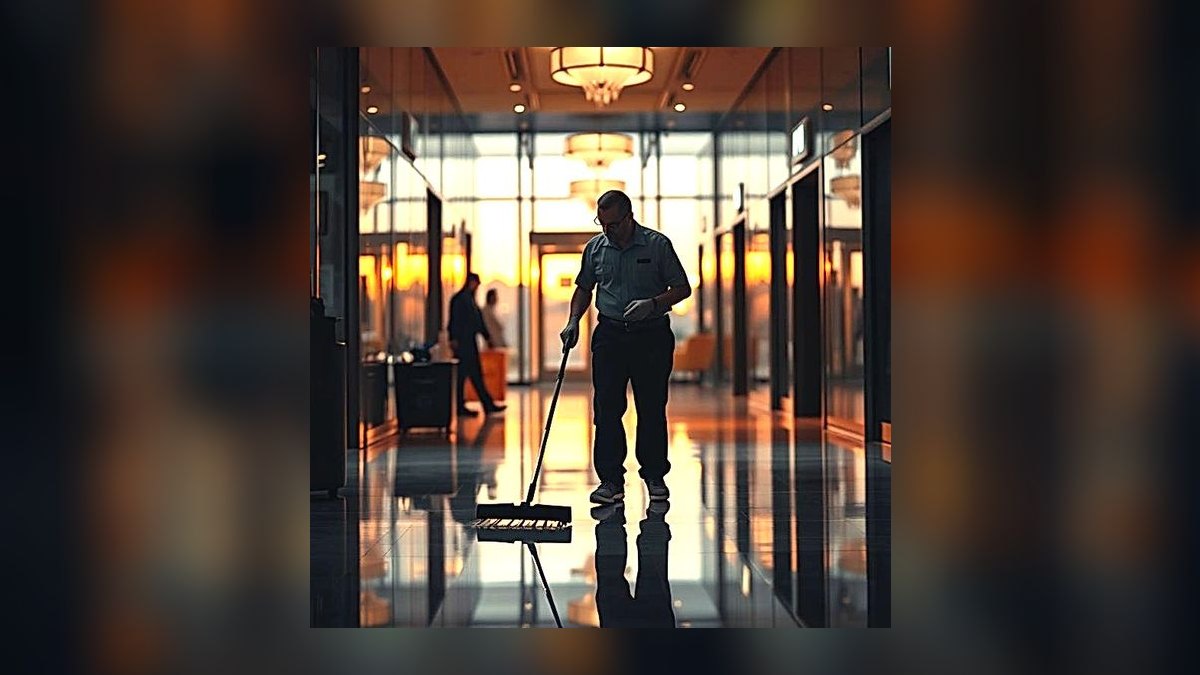
The trajectory. Year 1: 3–7 contracts, $150K–$500K revenue, $30K–$110K owner profit, founder doing everything including 9pm walkthroughs. Year 2: 8–15 contracts, $400K–$900K revenue, $70K–$200K owner profit, first real supervisor hired. Year 3: 15–25 contracts, $700K–$1.5M revenue, $120K–$330K owner profit, founder managing rather than cleaning. Year 5: a mature regional operation at $1.5M–$4M+ revenue and $250K–$700K+ owner profit, with a genuine choice between holding it as a cash-flowing asset and selling into the roll-up market.
These assume disciplined production-rate bidding, controlled burden, real supervision, wage-escalation clauses on every multi-year contract, and growth paced against available cash.
What you actually clean, and why the segment changes the math
"Office" undersells the market, and segment choice moves your margin more than almost any other early decision.

General office buildings — multi-tenant towers, single-tenant corporate offices, professional suites — are the volume core: predictable nightly specs, straightforward labor, moderate margins, and a buyer (property management or facilities) who price-shops hard.
Medical and dental is the margin upgrade. Clinics, dental practices, urgent care, imaging centers, and outpatient facilities pay a 20–40% premium because the spec is genuinely more demanding — disinfection protocols, regulated-waste awareness, exam-room turnover — and because the buyer fears a bad cleaner far more than a high price. The trade-off is a slower production rate and a spec you must actually master.
Schools and education — private and charter schools, daycare centers, training facilities, college buildings — bring large square footage and a calendar rhythm, including summer deep-clean windows that can be a meaningful revenue block.
Industrial and warehouse pays for tonnage of space rather than detail. Retail and restaurant carry their own timing (overnight or pre-open) and, in kitchens, real grease and health-code stakes. Banks and financial offices want bonded, background-checked, key-controlled crews and pay for that trust. Gyms are high-traffic, high-moisture, locker-room-heavy. Government and municipal buildings are large and stable, contract through formal bid processes, and pay slowly but reliably.

The strategic point: do not serve every segment in Year 1. Pick a beachhead — general office for volume and learnability, or medical for margin — get genuinely good at that spec, build density inside it, then expand into adjacent segments. Bidding a daycare, a warehouse, a restaurant kitchen, and a bank in the same month, with no spec mastery and no route logic, produces a scattered route that cannot be supervised profitably.
The 2027 market context matters here too. Hybrid work reduced some general-office demand and pushed owners to scrutinize frequencies — a five-night spec became a three-night spec in some buildings. But demand did not vanish; occupied space still needs cleaning, and medical, education, industrial, life-sciences, government, retail, and fitness were barely affected. The winning 2027 entrant bids intelligently to the buyer's *actual* reduced-or-changed spec rather than assuming the old five-night standard everywhere.
Competition is bifurcated: national and large regional building-service contractors at the top with full management infrastructure, and a long tail of solo operators and franchisees at the bottom. The opportunity sits in the underserved middle — single buildings and small portfolios the giants find too small to chase attentively and the long tail serves unreliably.

Implementation and sequencing: your first 180 days
Order matters. Doing these steps out of sequence is how founders end up with contracts they cannot legally staff or cash they cannot float.
Days 1–30: legal and financial foundation. Form the LLC or S-corp. Get an EIN. Open a business bank account and keep it strictly separate. Buy general liability insurance at the coverage level your target buyers require — property managers commonly specify minimums in their vendor requirements, so ask before you buy. Get the janitorial/surety bond that protects clients against employee theft; it's a near-universal requirement and it's cheap. Set up workers' comp before your first hire, not after. Register for state and local business licenses. Set up payroll software and accounting software with proper receivables tracking.
Days 20–60: build the bidding system before you bid. This is the step founders skip and pay for over three-year contract terms. Build the production-rate spreadsheet: space-type classifications, your production rates by type, restroom fixture counts, your fully-burdened hourly labor cost (wage × 1.25–1.35), supplies load, overhead load, target margin. Write your scope-of-work template so the spec is unambiguous — what gets done nightly, weekly, monthly, quarterly. Write your service agreement with a defined term, a wage-escalation clause, and a sane cancellation provision. Practice-bid three buildings you can access before you bid one for money.
Days 30–90: first contracts. Find opportunities — buildings up for rebid, new construction, property managers unhappy with an incumbent. Get the walkthrough: physically tour with the decision-maker, count everything, understand the pain the last cleaner caused. Build the bid from the spreadsheet. Present the system, not just the price — vetted crews, scheduled documented inspections, a responsive point of contact, proof of insurance and bonding. Never bid a building you haven't walked. Never win on a number you can't service profitably for the full term.

Days 45–120: hire and train. Recruit through job boards, community networks, and — the best source — referrals from existing crew. Run real background checks; these people hold keys and work unsupervised at night. Classify them as W-2 employees, not contractors; you control schedules, methods, and supervision, and misclassification is a serious liability. Train on cleaning methods, chemical safety, equipment operation, the building-specific spec, and the standard the client expects. Treat retention as a core metric — 150% annual turnover bleeds money and quality, while lower turnover is a structural cost advantage no clever bid can replace.
Days 60–180: supervision and cash discipline. Every building gets inspected on a rotation against a checklist tied to the contract spec, scored, timestamped, and photographed in a digital inspection app — that record both holds crews accountable and demonstrates performance to the client. Respond to complaints fast; a professional response often saves a contract that silence would lose. Check in proactively rather than waiting to be told something's wrong.
And plan for the killer nobody warns about: payroll is due weekly, but commercial clients pay net-30 to net-60. You service a building all month, invoice at month-end, and may not see cash for another 30–60 days — but you paid the cleaners every week along the way. The faster you grow, the worse the squeeze. Mitigations: a launch cushion covering 6–12 weeks of payroll, invoicing immediately at period-end, active collections follow-up, a line of credit established *before* you need it, invoice factoring as a legitimate and common janitorial tool, and pacing new contracts against your cash cushion.

Filling the route is a permanent function, not a launch task. Your buyers are property managers and commercial real estate management firms (highest leverage — they control many buildings), facilities managers, building owners, and office managers. Reach them through BOMA chapters and property management associations, commercial brokers, referrals from satisfied clients in your cluster, disciplined direct outreach timed to rebid windows, and formal RFPs once you have the infrastructure to service portfolios. A professional website won't generate the bulk of your leads, but an absent or amateur one kills credibility with a buyer who was referred to you.
Route density is the hidden margin lever. Three buildings within a ten-minute radius let one supervisor inspect all three in an evening and one floater cover a call-out across them. The same three scattered across forty-five minutes of driving means every call-out is a crisis and per-contract overhead balloons. Evaluate each new contract not only on its own economics but on what it does to density — a building that anchors or deepens a cluster is worth more than a slightly richer building stranded alone. Sometimes decline the distant building, or price the isolation into it.
Run it on software. Bidding tools or a rigorous spreadsheet; a field-service or janitorial management platform for the contract and route database, scheduling, and work orders; time-tracking with location verification so you know the crew was at the building; digital inspection apps as the supervision backbone; payroll software given the weekly multi-employee run and burden calculations; accounting with disciplined invoicing; and a CRM tracking buildings, rebid dates, and property-manager relationships. A cleaning company is a coordination problem — many crews, many buildings, nightly — and software is what lets a small team run it without dropping a building or invoicing late.
The three things that kill startups, in order: underbidding (winning on a price that can't cover real labor plus burden, then being trapped in a multi-year term), losing control of labor (turnover, no-shows, theft, unsupervised crews letting quality slide until the client cancels), and running out of working capital (profitable on paper, unable to make Friday payroll). Every one of them is visible in advance and preventable with the discipline above. It's the same operating truth any RevOps practitioner would recognize: the recurring-revenue engine only compounds when unit economics are modeled honestly at the point of sale, and retention is treated as the product.
Related questions
How much does it cost to start a commercial cleaning business?
A lean owner-operator launch runs $15,000–$35,000; a built-out launch with a vehicle and owned floor equipment runs $35,000–$75,000. Equipment is only $3,000–$15,000 of that. The largest and most under-planned line is working capital — $8,000–$30,000+ to float payroll during net-30 to net-60 invoice lags.
What profit margin should a commercial cleaning business target?
Target 15–30% net owner margin at the contract level and 15–25% across a mature route. That requires direct labor at 45–55% of contract revenue and fully burdened labor under about 72%. Above 65% direct labor, the contract stops compounding and becomes a treadmill you're locked into.
Do you need a license to start a commercial cleaning business?
Requirements are jurisdiction-specific and generally straightforward: business registration, a local business license, and an EIN. What clients actually gate on is insurance — general liability at a specified coverage level, a janitorial or surety bond covering employee theft, and workers' compensation. Without certificates on hand, you don't get to bid serious contracts.
How do you price a commercial cleaning contract?
Build from production rates, not from the competitor's number. Estimate nightly labor-hours from square footage, space type, and restroom count; multiply by fully-burdened hourly cost and service nights per month; add supplies, supervision, insurance, and overhead; then add 15–30% margin. Use per-square-foot pricing only as a sanity check.
Is commercial cleaning still a good business after remote work?
Yes, though reshaped. Hybrid work cut some general-office frequency — five-night specs became three-night in some buildings — but medical, education, industrial, government, retail, and fitness segments were barely affected. The winning approach bids to the buyer's actual current spec rather than assuming pre-2020 frequencies.
FAQ
Should I get a franchise or start independent?
Start independent if you have $20K+ and can hold a B2B sales conversation — the economics are meaningfully better without royalties, and you own the client relationships. Choose a franchise if your binding constraint is finding at-bats rather than capital. Read the Franchise Disclosure Document carefully, particularly Item 19 (financial performance representations) and Item 20 (outlet turnover), and get an attorney to review account-ownership and non-compete terms before signing. Franchise is the one genuinely one-way door in this business.
How many contracts do I need to quit my day job?
It depends on contract size and your burn rate, but a useful benchmark: at a 20% net margin, $200,000 of annual contract revenue produces roughly $40,000 in owner profit. That's typically 4–6 mid-size office contracts. Most founders keep the day job through the first two contracts, work the cleaning route at night, and go full-time once monthly recurring revenue covers their personal expenses with a margin of safety — because the working-capital lag means booked revenue is not cash in hand.
Should cleaners be employees or contractors?
W-2 employees, in nearly every case. You control their schedules, their methods, the specification they clean to, and their supervision — which is the textbook profile of an employment relationship, not an independent contractor one. Misclassification exposes you to back payroll taxes, penalties, and wage-and-hour liability. It also undermines the thing you're actually selling: a supervised, trained, accountable crew. Budget the 25–35% burden on top of wages from the first bid, not as a discovery in month four.
What's the single most common reason these businesses fail?
Underbidding. A founder wins a building by undercutting the incumbent, without having run production-rate math or loaded labor burden into the number. The contract looks profitable on wages alone and is actually near-zero margin or a loss once burden, supervision, supplies, and overhead are included — and it's locked for three years with no repricing mechanism. The fix is unglamorous: build the spreadsheet, walk every building, and walk away from bids that don't clear the full cost stack.
Do I need a wage-escalation clause?
Yes, in every multi-year contract. Labor costs rise over a three-to-five-year term, and a fixed fee with no adjustment mechanism sees its margin erode toward zero by Year 3. Include either a defined annual escalator or a renegotiation trigger tied to a stated condition. Buyers accept this routinely when it's presented up front as a standard term; trying to renegotiate mid-term after your margin has already collapsed is a much harder conversation and a common reason operators surrender contracts.
How do I handle the cash-flow gap between payroll and invoices?
Plan for it before it bites. Launch with 6–12 weeks of payroll in cash. Invoice the instant the service period ends — late invoicing compounds a lag that's already structural. Track receivables actively and follow up on slow payers rather than letting anyone drift to net-90. Establish a line of credit while you're healthy, not when you're desperate. Invoice factoring — selling receivables for immediate cash at a discount — is more expensive but is widely used in janitorial precisely because it solves this exact timing problem. And pace growth: don't sign more contracts in a quarter than your cushion can float.
Sources
- https://www.bls.gov/ooh/building-and-grounds-cleaning/janitors-and-building-cleaners.htm
- https://www.sba.gov/business-guide/launch-your-business/choose-business-structure
- https://www.irs.gov/businesses/small-businesses-self-employed/independent-contractor-self-employed-or-employee
- https://www.osha.gov/chemical-hazards
- https://www.dol.gov/agencies/whd/flsa
- https://www.ftc.gov/business-guidance/resources/franchise-rule-compliance-guide
- https://www.cdc.gov/infection-control/hcp/environmental-control/index.html
- https://www.boma.org/
- https://www.issa.com/
- https://www.epa.gov/greenerproducts
Related on PULSE
- How do you price a recurring B2B service contract without losing money?
- How do you calculate fully-burdened labor cost for a service business?
- How do you reduce churn in a recurring-revenue service business?
- How do you build a working-capital cushion for a payroll-heavy business?
- How do you sell into commercial property managers?
This page will be disappearing soon. Save it to your device for $1 — or read it free while it is here.
@Kory-White- · if Venmo asks, the last 4 of my number are 2012
This page is gone.
This one is off the shelf now. $1 keeps it on your phone for good — the whole page, pictures and diagrams included.
 commercial-cleaningHow do you start a commercial cleaning business in 2027?
 post-construction-cleanupHow do you start a post-construction cleanup business in 2027?
 mobile-barberHow do you start a mobile barber business in 2027?
 robotic-floor-scrubbingHow do you start a robotic floor scrubbing service business in 2027?
 custom-embroideryHow do you start a custom embroidery shop business in 2027?
 eyelash-extension-studioHow do you start a eyelash extension studio business in 2027?
 mobile-detailingHow do you start a mobile detailing business in 2027?
 laundromatHow do you start a laundromat business in 2027?
 bookkeepingHow do you start a bookkeeping business in 2027?
 holiday-lightingHow do you start a holiday lighting installation business in 2027?