
Handling the 'Not Interested' Objection: A Ready-to-Run Roleplay Session
 Curated byKory White · Fractional CRO · Maryland
 PULSEKNOWLEDGE LIBRARY
Quality
Certified
"Not interested" is a reflex, not a verdict. A ready-to-run roleplay session teaches reps to classify the brush-off as status quo, timing, or no perceived pain, then ask one low-pressure clarifying question before pitching anything. Run it in 60 minutes: warm-up, framework walkthrough, three scored rounds, and a debrief that produces written scripts.
What the session is and why objection roleplay changes rep behavior
A ready-to-run roleplay session is a fully scripted 60-minute block that a manager can open and facilitate without prep. Everything is pre-written: the scenario cards, the prospect personas, the observer scorecard, the timer breakdown, and the debrief questions. The distinction matters because most "objection handling training" fails on logistics rather than content. A manager who has to invent three personas, write a scorecard, and moderate discussion will schedule the session, cancel it twice, and eventually drop it. A session where the facilitator reads from a page and starts a timer survives the calendar.
The specific objection — "not interested" — deserves its own session because it arrives earlier and more often than any other. It shows up in the first 10 to 30 seconds of a cold call, in the first reply to a cold email, and at the start of an inbound-lead callback. It is almost never an evaluated decision. The prospect has not read your materials, has not compared you to an incumbent, and has not consulted a budget. They are pattern-matching: unknown number, unfamiliar name, sales cadence in the voice. The phrase is a door-closing utility, not an assessment of fit.
That has a direct training implication. Reps who treat "not interested" as a real objection respond with real arguments — features, differentiators, proof points — which confirms the prospect's pattern match and ends the call faster. Reps who treat it as a reflex respond with a short, low-stakes question that gives the prospect an easy, non-committal way to keep talking. The gap between those two behaviors is one sentence long and almost entirely a matter of practice. Reps know intellectually that they should not pitch into a brush-off. Under the mild social pressure of a live call, they pitch anyway, because pitching is what their mouth has rehearsed.
Roleplay closes that gap by moving the skill from declarative memory into motor memory. This is why the format matters more than the framework. Reading a framework document produces recognition; saying the words out loud, badly, in front of a peer, three times in a row, produces recall under pressure. The session should therefore be weighted heavily toward reps talking — roughly 60 to 70 percent of the clock on rounds and debriefs, with 30 to 40 percent on setup and teaching. A session where the manager talks for 40 minutes and reps roleplay for 15 is a lecture wearing a roleplay costume.

There is a second, less obvious benefit. Objection roleplay surfaces what your reps actually believe about the product. When a rep flounders on "we already have something for that," it is frequently not a scripting failure — they genuinely cannot articulate why a company would switch. That is a positioning gap, and it will show up in the room before it shows up in a pipeline review. Facilitators should log those moments separately from the scoring, because they route to marketing or product, not to coaching.
Finally, this session is cheap to repeat. Once the materials exist, running it costs one hour of team time per cycle. Teams that run some version of it monthly get compounding returns: new hires inherit a working script instead of inventing one, and veterans get a low-risk place to test new phrasing before burning live prospects on it.
Running the session: a minute-by-minute facilitator script
Book 60 minutes with a hard stop. Cap the room at 8 to 10 reps; beyond that, pairs go unobserved and the debrief turns into a queue. If you have 20 reps, run the session twice rather than doubling the room. Bring three printed artifacts: the persona cards, the observer scorecard, and a one-page framework reference. Printed matters — reps looking at laptops start answering email.
Minutes 0–8, warm-up. Ask every rep to write down, verbatim, the last "not interested" they heard this week, then write underneath it what they think the real reason was. Two minutes of silent writing, then three minutes of pairs comparing, then three minutes of open share. The purpose is not the content; it is getting every voice into the room before anyone has to perform. A rep who has already spoken once is measurably more willing to roleplay badly in front of peers.
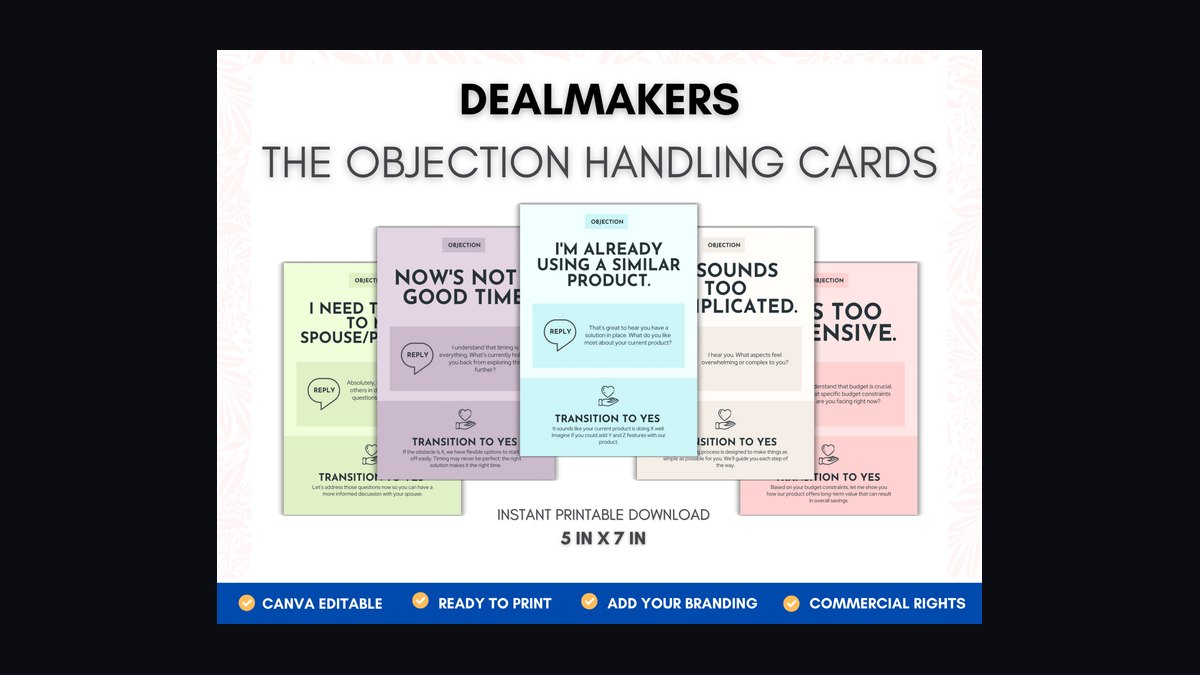
While they share, sort the quotes on a whiteboard into three buckets:
- Status quo — "we already use someone," "we're all set," "we're happy with our current setup." The prospect has a solution, real or nominal, and switching costs feel higher than the unknown upside.
- Timing — "not right now," "call me next quarter," "we're in the middle of something." The prospect concedes possible relevance but is protecting attention, not budget.
- No perceived pain — "we don't need that," "that's not a problem for us," "we don't do much of that." The prospect does not recognize the category as applying to them.
Three buckets is deliberate. Five or six categories look more rigorous and are useless on a live call, where a rep has about two seconds to classify and respond. Three is the most a person can sort under pressure.
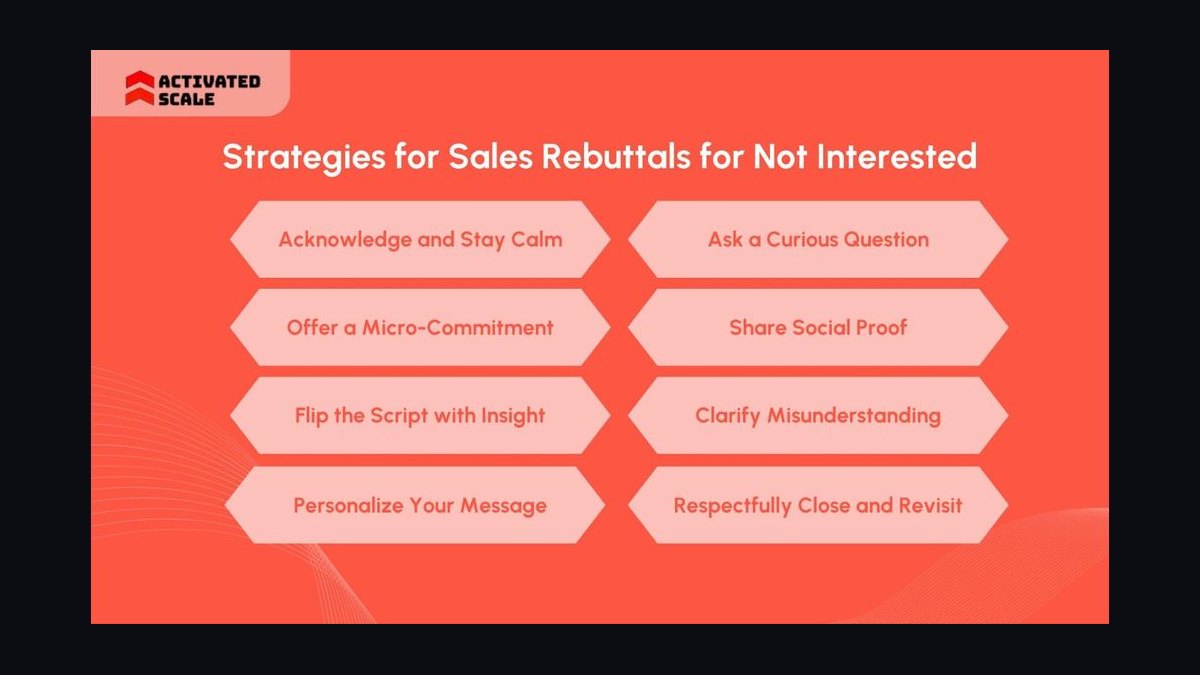
Minutes 8–20, teach the pattern. Walk the four-move sequence below, then have the room practice only the second move — the clarifying question — in 90-second pairs. Isolating one move before running full scenarios is the single highest-leverage structural choice in the session, and it is the one most facilitators skip.
Minutes 20–50, three rounds of ten. One round per objection bucket. Each round is 4 minutes of live roleplay, then 6 minutes of debrief. Rotate roles every round so nobody sits in the prospect chair twice in a row; playing the prospect is genuinely useful, because reps discover how transparent their own tactics sound from the other side.
Minutes 50–60, output. Every rep leaves with their own written version of the clarifying question and the follow-up ask, in their own words, in their own handwriting. Collect a photo of each. Scripts a rep wrote themselves get used; scripts handed to them get skimmed once.
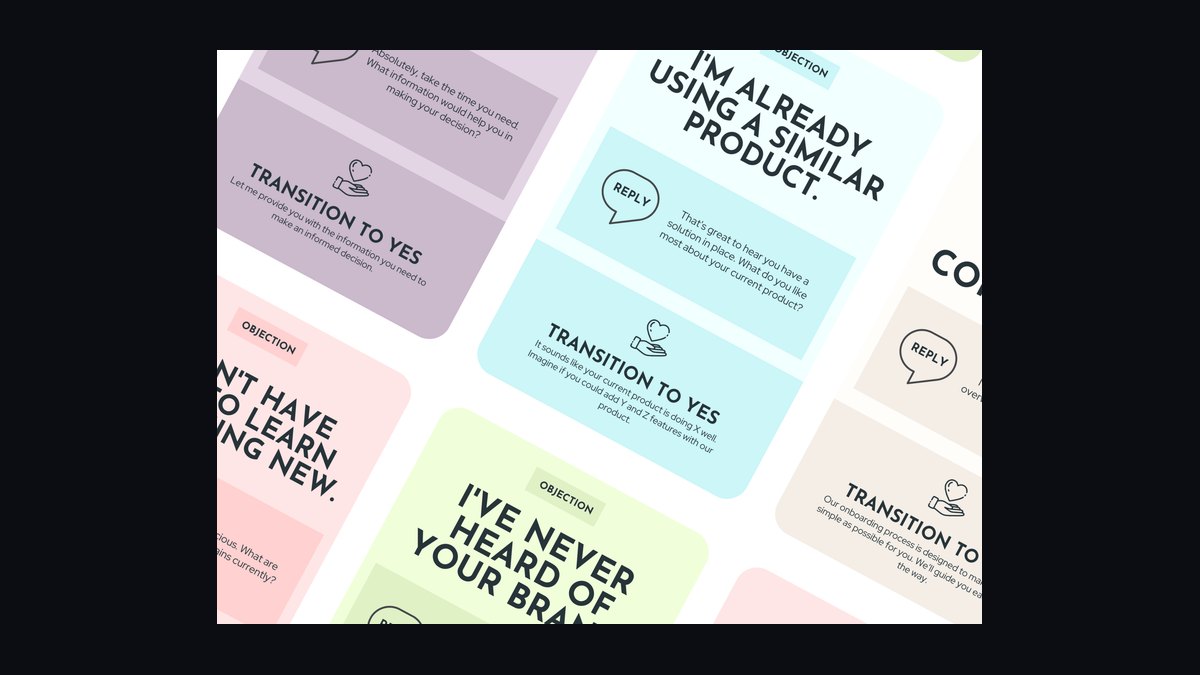
The four moves the diagram encodes are worth stating plainly, because the diagram compresses them.
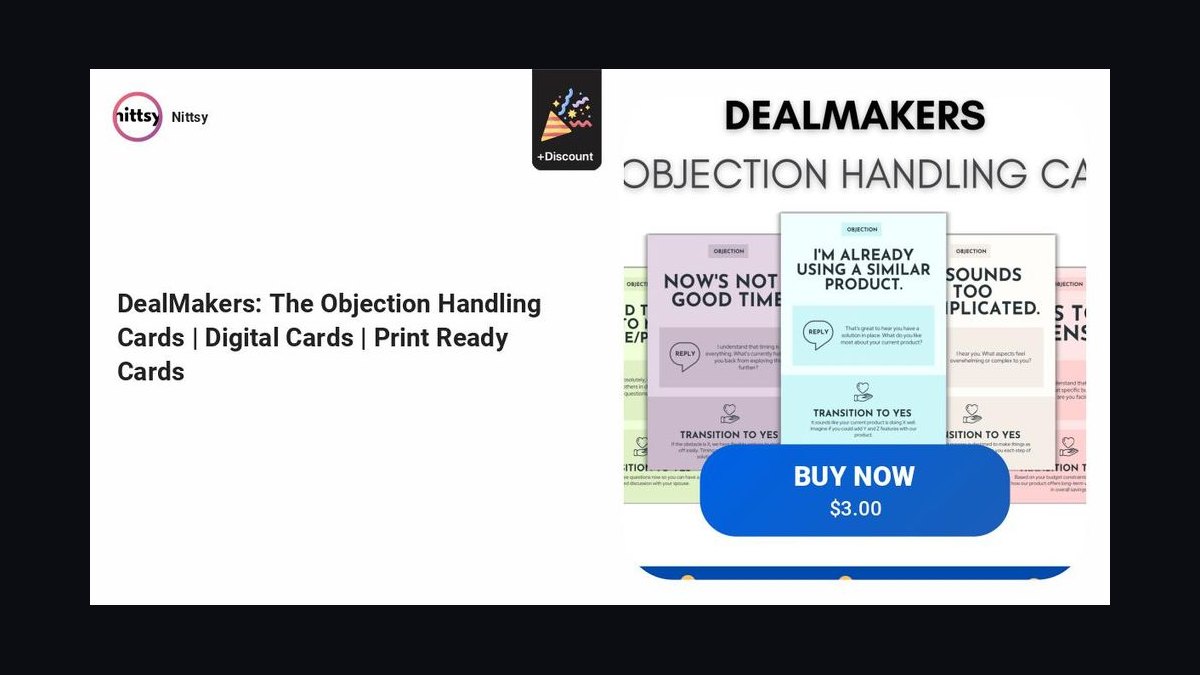
Move one: absorb. Acknowledge without arguing. "Totally fair" or "understood, I figured that might be the case." Three words to seven words, no "but." The moment a rep says "but," the prospect's guard goes back up. This move exists purely to lower the temperature and buy the two seconds needed for move two.
Move two: one clarifying question. Open-ended, low stakes, easy to answer honestly. Tailored to the bucket. This is the whole session in one sentence, and it is where reps fail most.
Move three: follow the answer, not the script. If the prospect gives you a detail — "the reporting is a pain," "we're mid-migration," "we only do a handful a month" — ask one question about that detail. One. Reps who ask three consecutive questions turn a brush-off into an interrogation.
Move four: ask for the smallest viable next step, or exit cleanly. A 12-minute call next Tuesday, a one-page summary, permission to check back in a specific month. If the answer is still no, exit warm and log the objection type. A clean exit preserves the number for the next cycle; a grinding exit burns it.
What the session costs, how long it takes, and what to expect from it
Facilitator prep. Building the materials from scratch the first time takes roughly 3 to 5 hours: writing three personas with enough specificity to play, drafting a scorecard, and assembling the framework page. Adapting an existing template to your product takes 45 to 90 minutes. After the first build, per-session prep should be 10 to 15 minutes — rereading the personas and booking the room. If prep is still costing you an hour on the fourth run, the materials aren't finished.
Team time. One hour per rep per session. For a team of eight, that is eight rep-hours plus one manager-hour, or nine hours of loaded selling time. Priced against a fully loaded mid-market AE cost, a monthly cadence is a small line item, but it is not free, and it competes directly with prospecting blocks. Schedule it against the lowest-value hour in the week — typically late Friday morning or the dead zone after a Monday pipeline review — not against prime calling hours.
Cadence. Monthly is the common steady state for an established team. Weekly for the first month of a new hire's ramp, then folded into the monthly rhythm. Quarterly is too infrequent for a reflex skill; the motor memory decays, and each session becomes a re-teach rather than a refinement. If you can only commit to quarterly, shorten the session to 30 minutes and run it more often rather than running the full hour rarely.
Room size and duration trade-offs. At 4 to 6 reps, 45 minutes is enough and every pair gets observed. At 8 to 10, you need the full 60 and you should assign a third person as observer in at least one round. Above 10, either split the session or accept that half the room is practicing unwatched — which is not worthless, but it removes the feedback that makes practice productive.
Tooling. The session works with a whiteboard, a timer, and printed cards. Conversation-intelligence platforms — Gong, Chorus, Salesloft, Outreach and similar — add real value if you already own one, because you can pull actual recorded moments where a rep hit "not interested" and play the ten seconds that followed. Playing a real call from someone in the room is dramatically more effective than a hypothetical, but it requires trust; do not do it in a team where a public teardown would be humiliating, and never play a clip without telling the rep beforehand. If you have no such tool, a phone voice memo of the roleplay serves the same function at zero cost.
What to measure. Resist the urge to attribute win rate to a training session — too many confounds, too long a lag. Measure things closer to the behavior:
- Percentage of cold calls that continue past 60 seconds, tracked weekly.
- Percentage of "not interested" dispositions that carry a recorded objection type rather than a blank field. This is a pure hygiene metric and should approach 90 percent within two cycles.
- Number of callbacks scheduled from a call that opened with a brush-off.
- Self-scored rep confidence on a 1–5 scale, taken before the first session and again after the third.
Expect the leading indicators to move within two to four weeks and the lagging ones to stay noisy for a quarter or more. Also expect a temporary dip: reps consciously applying a new pattern sound stilted for the first week or two before it smooths out. Warn them about this in the session, or they will abandon the pattern precisely when it starts working.
Where these sessions go wrong
The prospect plays too easy. This is the most common failure by a wide margin. The rep playing the buyer wants their colleague to succeed, so they cave after the first clarifying question. The roleplay produces a clean transcript and zero learning. Fix it in the persona card: write an explicit resistance instruction — "you say no twice before giving any detail, and you only open up if the rep asks about your current process specifically." Give the prospect a win condition, not just a role.
The prospect plays too hard. The opposite failure, usually from the team's most competitive rep, who treats the exercise as a chance to be unwinnable. Nobody learns from an impossible scenario either. The persona card should state what will open the prospect up. If the rep hits that trigger, the prospect must respond.
The manager demonstrates instead of coaching. A facilitator who takes over the roleplay to show how it's done consumes rep practice time and signals that the standard is "sound like me." Demonstrate once, at most, during the teaching block. After that, ask questions: "what were you going for there?" and "what did you hear in her tone?" beat "here's what I would have said."
Scripts get memorized word-for-word. A rep delivering a script verbatim sounds like a rep delivering a script, and prospects hear it instantly. The clarifying questions are patterns, not liturgy. This is exactly why the session ends with reps writing their own phrasing — the pattern travels, the words shouldn't.
Only one objection type gets practiced. Teams gravitate toward status quo because it feels most like a real sales conversation. No-perceived-pain gets skipped because it's the hardest and the least satisfying. Run all three, in the same order, every time.
No follow-through between sessions. The session ends, everyone feels good, and nothing changes on the floor. Attach one concrete between-session commitment: every rep logs the objection type on their next 20 brush-offs. That single hygiene habit does more for the next session than any amount of in-room enthusiasm, because it gives you real data to build round one around.
Overclaiming in the room. Reps under pressure invent numbers — savings percentages, customer counts, timelines — because a specific claim feels stronger than a vague one. If it happens in roleplay, it is happening on live calls. Stop the round when you hear it and say so directly. Anything a rep cannot source is off the table, and the session is the right place to enforce that, because it costs nothing here and costs a deal later.
The session becomes a performance review. If scoring feeds into compensation or promotion, reps will play safe and the practice value collapses. Keep the scorecard explicitly developmental and say so out loud at the start. Coaching notes and evaluation notes should live in different documents.
Deciding how to run it for your team
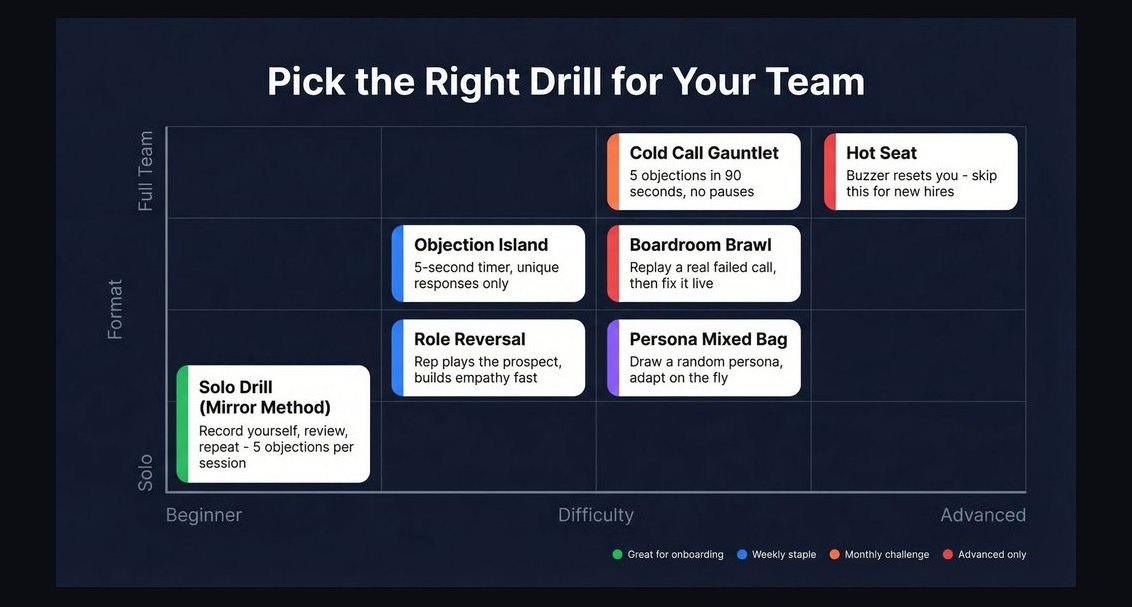
There is no single correct configuration. The right shape depends on team tenure, call volume, and whether you have call recordings to work from.
A few decision rules worth making explicit.
Choose real clips over hypotheticals whenever you safely can. A recorded ten-second moment from your own team is more persuasive than any invented scenario, because nobody can argue that it wouldn't happen that way. The constraint is psychological safety, not technology. If your team would experience a clip teardown as public failure, use anonymized written quotes from the warm-up instead — you lose the tone information but keep the realism.
Choose depth over breadth in short sessions. If you only have 30 minutes, run one objection type properly rather than three types badly. Three four-minute rounds with no debrief teaches nothing; one four-minute round with a real ten-minute debrief teaches a lot.
Choose peer observation over manager observation once the pattern is established. In the first two sessions, the manager should watch every pair they can. After that, a third-rep observer with a scorecard gives better coverage and turns observation itself into a learning activity — watching someone else fumble the clarifying question is often clearer than fumbling it yourself.
Choose to skip the session entirely when the problem isn't skill. If reps are hitting "not interested" on 95 percent of calls, the issue is list quality or messaging, not objection handling, and an hour of roleplay will not fix it. Check the raw connect-to-conversation ratio before you book the room. A targeting problem dressed up as a training problem is one of the more expensive mistakes a sales manager can make, because the training is visible, feels productive, and consumes exactly the time that fixing the list would take.
Choose to end sessions early when the room is done. A session that hits its objective at minute 45 should end at minute 45. Filling the remaining time with a fourth round teaches the team that the calendar block matters more than the learning, and attendance quietly degrades from there.
Related questions
How long should each roleplay round actually run?
Four minutes of live roleplay, six minutes of debrief. Longer rounds drift into general product conversation and lose the objection focus. The debrief is where learning happens, so protect it — if you're running behind, cut a round, never the debrief.
Should the manager or a peer play the prospect?
Peers, in most rounds. Reps discover how their own tactics sound from the buyer's chair, which is half the value. Have the manager play prospect once, in the hardest round, to model appropriate resistance without caving too early.
What if a rep refuses to roleplay?
Usually fear of public failure, not defiance. Start them as observer with a scorecard, which is participation without exposure, then move them to the prospect role, then to rep. Forcing the rep chair on session one reliably backfires.
How do you handle "not interested" over email versus phone?
Same classification, different mechanics. Email gives you time to compose a single clarifying question and no tone information. Keep the reply under three sentences, ask the same bucket-appropriate question, and do not attach anything on the first reply.
Does this work for inbound leads too?
Yes, but the ratios shift. Inbound "not interested" skews heavily toward timing and toward the prospect having forgotten they filled out a form. Lead with the context reminder before the clarifying question, or the call starts confused.
FAQ
Why practice this one objection instead of running general objection training?
Because "not interested" occupies a different position in the conversation than every other objection. Pricing, security, and competitor objections arrive after the prospect has engaged; they respond to information. "Not interested" arrives before engagement and responds only to lowered pressure. Bundling it into general objection training means it gets 10 minutes of a session designed around a different reflex, and reps carry the wrong instinct into the first ten seconds of every call.
How do I write personas that produce useful roleplay?
Give each persona four things: a role and company size, one concrete detail about their current situation, an explicit resistance rule ("say no twice before revealing anything"), and an explicit opening condition ("if the rep asks how you handle it today, admit the process is manual"). Without the last two, the roleplay swings between too easy and impossible. Keep each card under 120 words so the prospect can absorb it in 30 seconds.
What should the observer scorecard measure?
Behaviors, not outcomes. Did the rep acknowledge before responding? Did they ask exactly one clarifying question rather than launching a pitch? Did they follow the prospect's answer or return to their script? Did they ask for a specific, small next step? Four binary checks beat a ten-point rubric, because an observer scoring ten dimensions stops watching the conversation.
How soon should we expect this to show up in results?
Behavioral indicators — calls surviving past 60 seconds, objection types logged, callbacks booked off brush-offs — move in two to four weeks with consistent practice. Pipeline and win-rate effects are confounded by seasonality, list quality, and territory changes, and are not reliably attributable to a training session. Track the leading indicators and treat downstream movement as encouraging rather than as proof.
Can this session run remotely?
Yes, and breakout rooms work well because pairs get genuine privacy. Two adjustments: assign pairs in advance rather than letting the room self-organize, since remote self-organization wastes three or four minutes per round, and require cameras on during rounds. Objection handling is substantially about tone and pacing, and an audio-only roleplay removes the feedback that makes the debrief specific.
What do we do with reps who handle the objection well already?
Move them into the prospect and observer chairs for most rounds, and give them a harder variant when they do rep — a prospect who is polite, engaged, and still declines every next step. Strong reps also make good session co-facilitators, which spreads the material's ownership beyond the manager and makes the cadence survive a manager change.
Sources
- HubSpot: Sales Objection Handling
- Gong Labs: Sales Research and Call Analysis
- Harvard Business Review: Sales
- Salesforce Blog: Sales
- MIT Sloan Management Review: Sales and Marketing
- Sandler Training Resources
- RAIN Group Sales Blog
- Richardson Sales Performance Blog
Related on PULSE
- [60-Min Sales Training: Timing Objections — Bad Time, Not Yet, Q4](/knowledge/st0457)
- [Objection Handling Roleplay Session Blueprint](/knowledge/st0752)
- [Objection Handling Bootcamp: Template for a One-Hour Team Sales Session](/knowledge/st0777)
- [Top 10 sales role-play templates for objection handling practice](/knowledge/st0753)
- [Upsell and Cross-Sell Scenarios: Roleplay for Existing Customer Growth](/knowledge/st0740)
- [Deal Desk Simulation: Cross-Functional Approval Process Roleplay](/knowledge/st0710)
This page will be disappearing soon. Save it to your device for $1 — or read it free while it is here.
@Kory-White- · if Venmo asks, the last 4 of my number are 2012
 pulse-sales-trainingsTop 10 team-meeting templates for analyzing lost deals in 2027
 pulse-sales-trainingsSelling with Stories: Narrative Structure Template for a 45-Minute Sales Workshop
 pulse-sales-trainingsThe Close Loop: Template for Practicing Assumptive and Alternative Choice Closes
 pulse-sales-trainingsTop 10 ready-to-run sales training templates for consultative selling in 2027
 pulse-sales-trainingsClosing Techniques Deep Dive: Structured Agenda for a Sales Team Huddle
 pulse-sales-trainingsTop 10 Conceptual Selling training exercises for sales managers in 2027
 pulse-sales-trainingsQuarterly Goal Cascading: From Quota to Daily Activity Breakdown
 pulse-sales-trainingsPipeline Review to Revenue: Template for a Data-Driven Sales Sprint Session
 pulse-sales-trainingsTop 10 sales enablement training drills for 2027
 pulse-sales-trainingsTop 10 Sales Training Templates for Value Proposition Crafting in 2027