
Cold Calling Script Practice Session Guide
 Curated byKory White · Fractional CRO · Maryland
 PULSEKNOWLEDGE LIBRARY
Quality
Certified

Run a 90-minute cold calling script practice session in three blocks: a 15-minute script breakdown (using a framework like MEDDPICC), 45 minutes of triad role-play (caller, prospect, observer with a scorecard) across two or three rotations, and a 20-minute debrief where each rep commits to one specific change. Repetition with structured feedback, not memorization, builds real script fluency.
What it is and why it matters
A cold calling script practice session is a facilitated block of time — typically 60 to 90 minutes — where a sales team rehearses call openers, discovery questions, and objection responses out loud, in front of peers, instead of only reading a script silently or hearing it for the first time on a live prospect call. The distinction matters because reading a script and executing a script under real-time pressure are different skills. A rep can recite a perfect opener in a training doc and still freeze, ramble, or lose the thread the moment a prospect pushes back with "not interested" or "we already use someone." Practice sessions close that gap by forcing the script through a live human reaction before it ever reaches a real account.
The business case is straightforward: cold call performance is highly variable across a team, and most of that variance comes from delivery, not script quality. Two reps working from the identical script can produce meeting-set rates that differ by a factor of two or three, purely because one pauses after the opener and lets the prospect respond while the other steamrolls into the pitch. A practice session isolates delivery as the variable being trained. It also creates a shared vocabulary — terms like "trigger event," "diagnostic question," and "low-commitment ask" become common language the team uses when giving each other feedback on live call recordings later.
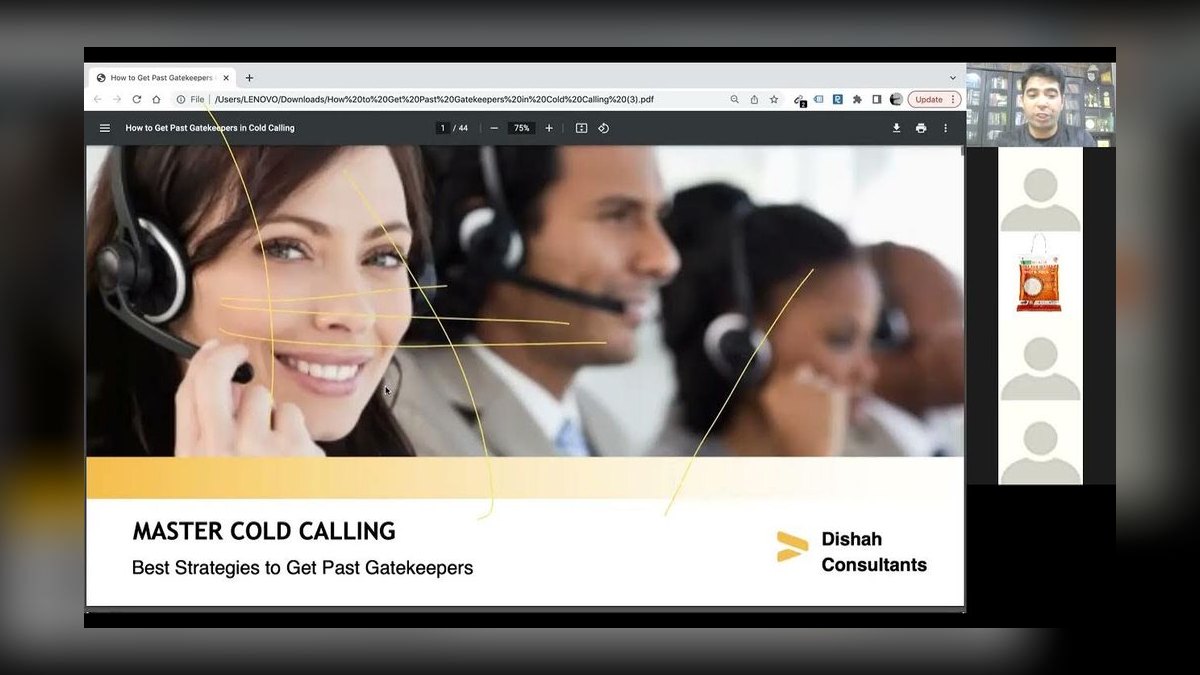
Frameworks give the session structure so it doesn't turn into unfocused role-play. MEDDPICC (Metrics, Economic Buyer, Decision Criteria, Decision Process, Paper Process, Implicate the Pain, Champion, Competition) is built for qualification calls further into a deal, but its components translate well to cold call scripts: state a metric early, identify the right title to reach, ask a question that surfaces pain, and differentiate from the incumbent. The Challenger Sale framing of "teach, tailor, take control" gives reps a second lens — does the opener teach the prospect something they didn't know, is it tailored to their specific role or trigger event, and does the close take control of the next step rather than leaving it open-ended. Sandler's contribution is mindset: the caller acts as a diagnostician gathering information, not a salesperson begging for a meeting, which changes tone and reduces the anxiety that makes reps rush their words.
Running this as a session — not a one-off memo — matters because script adoption decays fast without reinforcement. A script emailed to the team on Monday is mostly forgotten by Thursday's calls unless reps have said it out loud, been challenged on it, and adjusted it themselves.

The step-by-step process (mermaid)
A well-run 90-minute session follows a fixed sequence. Deviating from the order — especially skipping the warm-up or cutting role-play short to save time — is the most common reason sessions feel flat.
- Warm-up and mindset reset (10 minutes). Open by having each person write down one call that went poorly recently and one thing they learned from it, then share with a partner for two minutes. This reframes the session around learning rather than performance anxiety before anyone has to speak a script out loud.
- Script and framework review (15 minutes). Distribute the script and have participants mark it up individually, identifying where it states a metric, where it teaches something new, and where it asks a diagnostic question. Discuss as a group for the last five minutes.
- Script build and customization (15-20 minutes). Each rep adapts the base script to their own accounts using a four-sentence structure: trigger event plus introduction, metric plus social proof, diagnostic question, low-commitment ask. This step is what prevents the session from producing generic, unusable scripts — every rep leaves with a version tailored to territory or vertical.
- Live practice rounds (30 minutes). Groups of three rotate through caller, prospect, and observer roles. Each round runs five minutes of role-play followed by five minutes of feedback, for two to three full rotations so everyone plays each role at least once.
- Debrief and pattern recognition (10 minutes). Groups report their top "aha" moments to the full room; the facilitator captures recurring patterns — for example, several groups independently noticing that pausing after the opener kept prospects talking longer.
- Commitment and next steps (5 minutes). Each person writes down one specific change to try on real calls this week and schedules a follow-up practice call with a partner before leaving the room.
The role-play round itself has its own internal loop worth diagramming separately, because it's where most of the actual skill-building happens: caller opens with the trigger event, the observer watches for whether the prospect (played by a peer instructed to be realistically skeptical) engages, and the script branches into either the qualification path or an objection-handling path depending on the reaction.
Costs, timelines, and typical ranges
Running a cold calling practice session requires almost no budget — the cost is facilitator time and calendar coordination, not software licenses. A single session for a team of six to ten reps takes 90 minutes of team time plus 30 to 45 minutes of facilitator prep to print or share scorecards and select or write the base script. Teams running this weekly should expect the facilitator role to rotate, since preparing a fresh script variant or objection set every week for months falls disproportionately on one person otherwise.

For tooling, a shared Google Doc or Notion page with the script is sufficient for most teams; this costs nothing beyond an existing workspace subscription. If a team wants to record practice calls for later review, Zoom's local recording or the free tool OBS Studio covers that need without a paid add-on. Teams that already pay for Gong or a similar conversation-intelligence platform can extend its scorecards to practice sessions, but buying one specifically for practice sessions is not justified — the value in this exercise comes from structured repetition and peer feedback, not from software.
On dial volume and cadence expectations that inform how scripts should be paced: a solid B2B daily target is 30 to 50 dials per rep, and calls that run long past roughly two minutes without securing a next step are usually losing the prospect's attention rather than gaining ground. Scripts practiced in session should be timed against this reality — if a rehearsed script naturally runs three or four minutes before reaching the ask, that's a signal to tighten it, not a signal that the rep needs to talk faster.

Cadence for the sessions themselves varies by team maturity. A team onboarding new reps benefits from running this weekly for the first six to eight weeks, then dropping to biweekly or monthly once scripts and objection handling are solid. Established teams often run a lighter 30-minute version — skipping the full script-build step and jumping straight to two rounds of role-play — as a standing agenda item before a weekly sales meeting, which costs far less calendar time while still keeping delivery sharp.
Where teams get it wrong
The most common failure is treating the session as a read-through instead of a rehearsal. When facilitators let reps read the script silently or recite it while looking directly at the page, nobody practices the actual skill of delivering it while maintaining eye contact and reacting to interruption — which is the entire point. The fix is simple: require reps to glance at bullet points, not full sentences, and to close the document for at least one of the practice rounds.

A second frequent mistake is over-investing in the opener and neglecting the transition into discovery. Teams will polish the first ten seconds of a script for twenty minutes and then rush through how the call actually pivots from small talk into a real qualifying question, leaving reps unprepared for the part of the call that determines whether a meeting gets booked. Swapping scripts between partners mid-session — so each person practices a script they didn't write — breaks this attachment to the opener and forces attention onto the rest of the flow.
Vague feedback is the third major problem. "That sounded good" or "needs work" gives a rep nothing to change. Observers need a concrete scorecard: was the opener under ten seconds, was a metric stated clearly, did the prospect end up talking more than half the time, was there a specific low-commitment ask at the end. A simple two-point rule — one specific thing that worked, one specific thing to change — produces far more usable feedback than open-ended commentary.
Fourth, teams sometimes skip the commitment step at the end entirely, treating the debrief as the natural close of the session. Without a written, specific commitment ("I will add a diagnostic question in the first fifteen seconds") and a scheduled follow-up practice call, the insights from the session evaporate within days and the next session starts from zero instead of building on progress.
Finally, some sessions collapse under too large a group. Beyond six participants, breakout groups of three to four are mandatory — otherwise several reps sit through the entire session without ever speaking the script aloud, which defeats the purpose of a practice format built around repetition.

Decision framework: when to choose what (mermaid)
Not every team needs the full 90-minute version every time, and choosing the wrong format wastes calendar time without building the skill. The decision mostly comes down to two variables: how new the reps are to the script, and how much calendar time is actually available.
For a brand-new script or a team of mostly new hires, run the full six-block, 90-minute session with the complete build-and-customize step — reps need to internalize the framework, not just rehearse a fixed script. For an established team refreshing an existing script, a 45-minute compressed version works: skip the framework review and script-build steps, and go straight to two rounds of live practice plus a short debrief, since the underlying structure is already familiar. For a standing weekly cadence meant to keep skills sharp rather than teach something new, a 20 to 30 minute version focused on just one objection-handling scenario per week sustains the habit without demanding a large time investment.
Group size should also drive the choice between one shared session and parallel breakouts: under six people, run everyone through one shared room; six or more, split into breakout groups of three so each rep still gets multiple turns speaking.
Related questions
How long should a cold calling script practice session run?
Most teams get full value from 90 minutes for a new script or new hires, and can compress to 45 minutes for maintenance sessions on an already-familiar script. Anything under 20 minutes rarely leaves time for a real live-practice round.
How many people should be in each practice group?
Groups of three work best: one caller, one prospect, one observer with a scorecard, rotating roles each round so everyone practices delivery, not just observation.
What's the difference between a script review and a practice session?
A script review is reading and annotating the script on paper; a practice session adds live role-play where a peer reacts unpredictably, which is what actually builds delivery skill under pressure.
Do reps need special software to run this?
No — a shared document with the script and an optional free recording tool like OBS Studio covers most teams' needs. Paid conversation-intelligence tools are useful if already licensed but not required to run an effective session.
How often should a team repeat these sessions?
Weekly for the first six to eight weeks with a new script or new hires, then biweekly or monthly maintenance sessions once delivery is solid.
FAQ
How do I handle a prospect who says "I'm busy" during practice? Acknowledge it directly — "I understand, when would be a better time?" — then pause and let the practice partner respond. If no time is offered, ask for the best way to follow up rather than pushing further in the moment.
Should reps memorize the script word for word? No. The script should function as a guide for structure — trigger, metric, question, ask — that reps internalize and adapt in their own voice. Word-for-word recitation tends to sound robotic and breaks down the moment a prospect deviates from the expected response.
How long should the actual cold call be once reps take the script live? Aim for under two minutes. The goal of the call is to secure a next step, not to deliver a full pitch, so scripts practiced in session should be timed to reach the ask well before that mark.
What should a rep do about a script when they hit voicemail? Leave a short message, roughly 20 seconds, that states who's calling and one specific result achieved for a similar company, then say a follow-up email is coming. Reciting the entire live-call script into voicemail wastes the message and sounds scripted.
How should observers give feedback during live practice rounds? Use a concrete scorecard rather than general impressions — mark whether the opener was under ten seconds, whether a metric was stated, and whether the prospect ended up talking more than the caller. Pair every score with one specific behavior to keep and one to change.
What's a reasonable daily call volume once the practiced script goes live? Roughly 30 to 50 dials per day is a common B2B benchmark. The practice session should focus on making each of those calls better, not on making reps talk faster to hit a number.
Sources
- Gong: The Science of Cold Calling
- Winning by Design: MEDDPICC Framework
- Challenger Inc.: The Challenger Sale
- Sandler Training: Cold Calling Mindset
- Outreach: Cold Calling Best Practices
- Salesforce: Sales Engagement Resources
- HubSpot: Cold Calling Tips
Related on PULSE
- [Top 10 Sales Script Practice Templates for Cold Calling Success](/knowledge/st0707)
- [Discovery Call Script A/B Testing: Compare and Contrast Session](/knowledge/st0742)
- [Cold Call Script Workshop: A 45-Minute Rehearsal and Feedback Template](/knowledge/st0702)
- [Top 10 Ready-to-Run Sales Training Templates for Cold Calling Mastery](/knowledge/st0658)
- [How do you run a sales training on cold calling in 2027?](/knowledge/st484)
This page will be disappearing soon. Save it to your device for $1 — or read it free while it is here.
@Kory-White- · if Venmo asks, the last 4 of my number are 2012
 pulse-sales-trainingsObjection Handling Roleplay Session Blueprint
 pulse-sales-trainingsSales Forecasting Accuracy: Template for a Team Meeting Focused on Data Hygiene
 pulse-sales-trainingsTop 10 Target Account Selling training exercises for sales managers in 2027
 pulse-sales-trainingsCold Outreach Revamp: 20-Minute Micro-Training Template for Sales Reps
 pulse-sales-trainingsTop 10 CSM workshop agendas for 2027
 pulse-sales-trainingsWhat should you know before investing in Sales Trainings in 2027?
 pulse-sales-trainingsTop 10 Conceptual Selling sales training drills for AEs in 2027
 pulse-sales-trainingsTop 10 closing role-play scenarios for sales teams in 2027
 pulse-sales-trainingsTop 10 sales enablement drills for mid-market reps in 2027
 pulse-sales-trainingsTop 10 Sandler sales training drills for AEs in 2027