

How does a fractional CRO build pipeline for a B2B SaaS company in 2027?

A fractional CRO builds pipeline by auditing existing CRM and call data first, sharpening the ICP against real closed-won evidence, then rebuilding one channel at a time — outbound sequences, inbound conversion, and partner referrals — while coaching the existing team. Expect diagnostic work in month one and measurable qualified-meeting lift by day 60 to 90.
Signals you actually need this
The clearest signal is not "pipeline is down." It is that nobody in the company can explain *why* pipeline is down with data. A founder who says "we need more leads" is usually wrong about the diagnosis — in most B2B SaaS shops under roughly $10M ARR the volume at the top is adequate and the loss happens somewhere between first meeting and second call. If your team cannot tell you, off the top of their heads, what percentage of first meetings convert to a second, that gap itself is the signal. A fractional CRO's first deliverable is almost always that number, and founders are routinely surprised by it.
A second signal: you have a sales team, but no sales *system*. Two SDRs who each write their own emails, an AE who runs discovery differently every time, a CRM where "Stage 3" means whatever the rep felt that Tuesday. Nothing here is broken enough to fire anyone over, and that is exactly why it persists. Revenue arrives, but it arrives unpredictably, and you cannot forecast it, which means you cannot hire against it. Fractional leadership is well suited to this because the fix is codification, not headcount — someone senior spending five to ten days a month writing the playbook, installing stage definitions, and enforcing them, rather than a full-time executive who will spend their first quarter doing the same work at four times the cost.
Third: the founder is still the best closer in the building and cannot get out of deals. This is the most common and most expensive pattern in early B2B SaaS. Founder-led sales works beautifully to roughly $1M–$3M ARR and then becomes the ceiling, because the founder's conversion rate is unreproducible — it rests on credibility and product depth no AE can borrow. The fractional CRO's job here is extraction: watching recorded founder calls, isolating what is actually persuasive, and converting it into discovery questions and objection paths a normal rep can run. That transfer takes a quarter minimum and rarely reaches full parity, but going from a founder closing at 40% to reps closing at 22% is a win when it removes the founder as the bottleneck.

Fourth signal, more subtle: your win rate is fine but your cycle is lengthening. Deals that used to close in 45 days now take 90. That is usually not a sales-execution problem — it is a buying-committee problem. Procurement, security review, and budget scrutiny have all thickened in B2B software purchasing, and a deal process built for a single champion with a credit card does not survive contact with a five-person committee. A fractional CRO with recent enterprise reps knows to build multi-threading, security-questionnaire prep, and a mutual action plan into the motion. Founders rarely build these unprompted because they never needed them at the deal sizes where they were personally closing.
Fifth: adjacent to pipeline but often the real culprit — churn or flat expansion. If net revenue retention sits below 100%, the pipeline problem is arithmetic. You are refilling a leaking bucket, and every new logo funds a replacement rather than growth. A competent revenue leader will say this out loud in week two and may recommend spending the first month on onboarding and CS handoff instead of outbound. That is the correct call and a useful test of who you hired: someone who accepts a pipeline brief and only executes the pipeline brief, ignoring an obvious retention hole, is billing you rather than helping you.

Finally, there is the counter-signal — the situation where you should not hire. Fewer than ten customers, no repeatable buyer profile, product still moving weekly. There is nothing to systematize yet. What you need is founder-led discovery, not a revenue engine, and a fractional CRO in that seat will produce a well-argued document that goes stale before you implement it.
What good looks like versus what bad looks like
Bad starts with a slide deck in week one. A fractional CRO who arrives with a pre-built "revenue framework" and maps your company onto it is selling a template, and you will pay retainer for a repackaged version of what they gave the last three clients. Good starts with read-only access to your systems and a week of near-silence. They pull closed-won and closed-lost for the trailing twelve months, listen to fifteen or twenty call recordings, sit in on live pipeline reviews without speaking, and interview each rep for thirty minutes. Their first artifact is a diagnosis, not a plan.
Bad measures activity. Dials, emails sent, sequences launched, "touches." These are the metrics that look busiest on a dashboard and correlate weakest with revenue. Good measures the conversion ladder end to end: contacted-to-replied, replied-to-meeting-booked, booked-to-held (this stage-drop is chronically ignored — no-show rates of 25–40% on cold-booked meetings are ordinary and quietly destroy a quarter), held-to-qualified-opportunity, opportunity-to-close. Fix the worst ratio first, then re-measure. Volume increases come last, once each stage is efficient, because scaling a leaky funnel just makes the leak bigger and more expensive.

Bad rebuilds everything at once. New CRM, new sequencing tool, new ICP, new messaging, new comp plan — all in month two. When it works you learn nothing about why; when it fails you cannot isolate the cause, and the team is exhausted and cynical either way. Good changes one variable at a time with a stated hypothesis and a read window: "I believe our reply rate is low because we lead with product rather than a specific operational pain. We test a pain-led opener against the current one for three weeks at roughly 400 sends each, and we need a meaningful lift, not noise, before we roll it out." That discipline is boring and it is the entire value of hiring someone senior.
Bad treats RevOps as somebody else's job. Good treats it as the substrate. Every playbook change has a corresponding field, stage definition, or dashboard change, because a process that is not instrumented is a suggestion. If your stage definitions are subjective, forecasting is theater; a good operator rewrites them as evidence-based exit criteria — "Stage 3 requires an identified economic buyer on a recorded call and a documented business case" — and then audits pipeline against them, which typically deletes 20–40% of reported pipeline in the first pass. That deletion is a feature. It is the first honest number the company has had.
Bad avoids the uncomfortable conversation. Good has it in week three: the rep who is not going to make it, the pricing that does not survive procurement, the ICP segment that closes but churns, the founder's insistence on a message that no buyer echoes back. A fractional operator is structurally better positioned for this than a full-time hire — they have no internal political future to protect — and if they do not use that freedom you are paying senior rates for a diplomat.

Real cost, real ROI, and how the math actually works
Fractional CRO pricing is a function of four variables: days per month, scope depth, company stage, and cash-versus-equity mix. The typical structure is a monthly retainer covering five to ten days, sometimes paired with 0.5%–2% equity vesting over two to three years. Advisory-only engagements — diagnosis, playbook, monthly review — sit at the low end of days. Engagements where the person actually manages reps, runs the weekly pipeline review, and owns the number sit at the high end and start to resemble a part-time executive role. Some operators add a performance component tied to qualified pipeline created or closed revenue; treat that as a good sign, provided the metric is defined tightly enough that both sides agree on what counts.
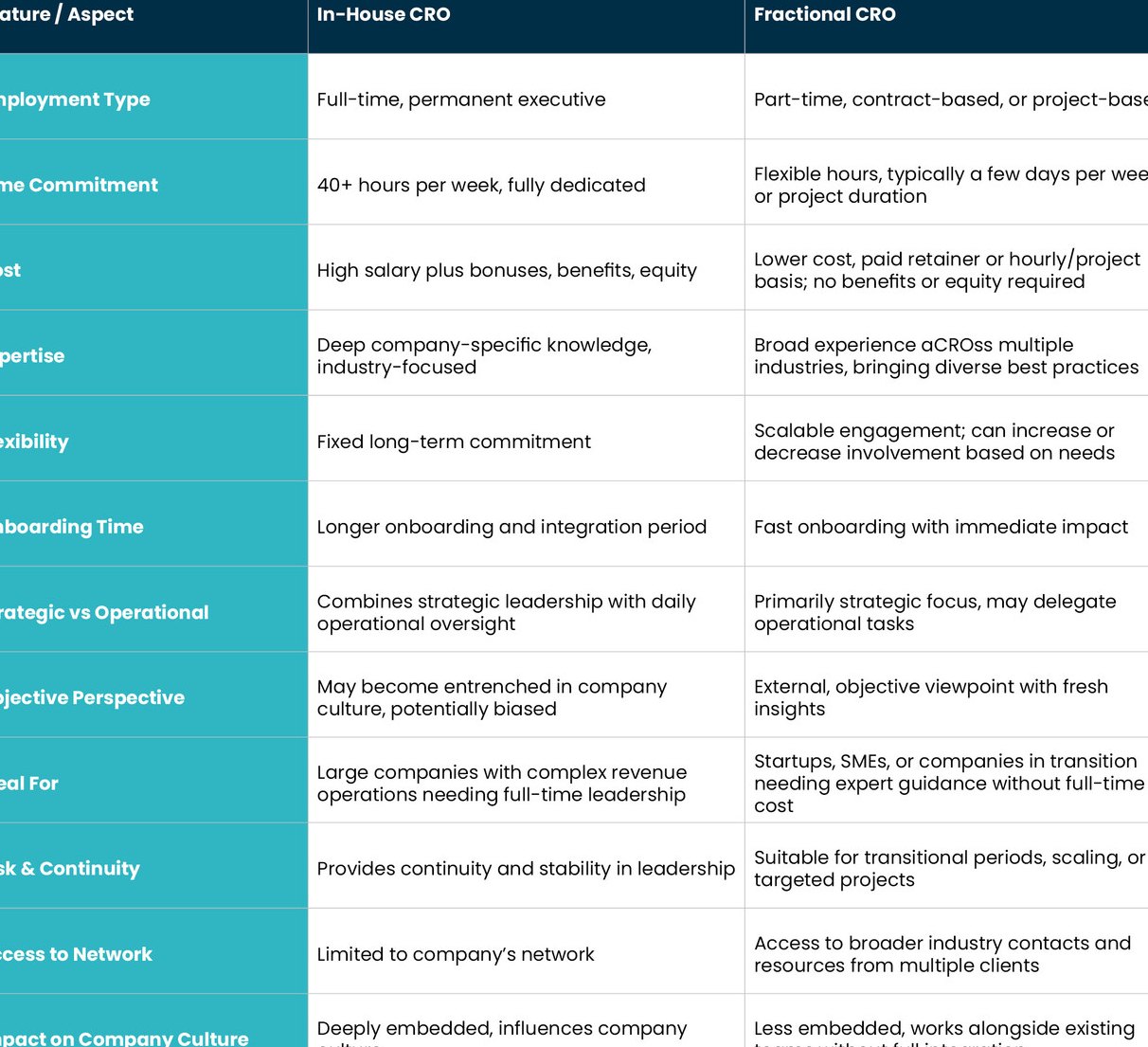
The comparison that matters is against a full-time VP of Sales. A full-time hire at that level runs meaningfully into six figures in base, plus variable, plus equity, plus recruiting fees, plus a ramp of three to four months before they are net-positive — and if the fit is wrong you discover it around month five and absorb both the sunk cost and the restart. Fractional inverts the risk shape: lower absolute spend, faster start because there is no notice period or relocation, and a scope you can adjust or end month to month. What you give up is presence. Someone in the building eight days a month cannot absorb culture, cannot catch the hallway signal that a rep is checked out, and cannot be in every deal. That is a real cost, not a rounding error, and it is the reason the model works better at Series A and B than at $20M ARR with thirty reps, where the coordination load genuinely requires a full-time executive.

ROI should be evaluated on pipeline created, not revenue closed, for the simple reason that revenue lags outside the engagement window. If your average sales cycle is 75 days and the engagement starts in January, revenue attributable to the new motion lands in April at the earliest — and if you judge in March you will kill something that was working. Set the primary metric as qualified pipeline value created per month, with conversion rates by stage as the supporting evidence, and set the revenue read at two full sales cycles out.
A concrete way to size the decision: take your current qualified-opportunity count per month and your average deal value. If you are creating eight qualified opportunities a month at $30K average and closing 25%, that is $60K of new ARR monthly. A fractional engagement that lifts opportunity creation from eight to twelve, holding conversion flat, adds $30K of monthly ARR run rate — which pays for most retainers inside the first quarter of realized revenue. Run that arithmetic before signing rather than after, because it also tells you when the model does not pencil: at a $6K average deal value with a two-week cycle, the lift required to cover a senior retainer is large, and your money is better spent on demand generation or a self-serve motion than on senior sales leadership.
Watch the failure modes in pricing. A flat quote given before any discovery call means the scope has not been sized and you will renegotiate in month two. An equity-heavy package with minimal cash aligns incentives on paper but often means the person is carrying several clients and yours gets the leftover hours; equity should be a supplement to a real retainer, not a substitute. And be specific in the statement of work about deliverables and cadence — playbook document, stage definitions, weekly pipeline review attendance, monthly written update, number of coaching sessions per rep. Vague scope is how a five-day engagement quietly becomes three days of Zoom calls.

One adjacent cost people forget: tooling and data. If the engagement calls for intent data, enrichment, or a sequencing platform you do not already own, that is a separate line item, and it can be substantial at the account volumes that make intent data worth having. A good operator will tell you upfront which tools are load-bearing for the plan and which are nice-to-have, and will usually push to run the first 60 days on what you already own — precisely because proving the motion on existing tooling is cheaper evidence than buying a stack to test a hypothesis.
How it plugs into your existing workflow
Nothing about this works if the fractional CRO operates as a parallel track that reports findings inward. The engagement has to sit inside your existing operating rhythm, which in practice means four recurring touchpoints: the weekly pipeline review, the deal desk or forecast call, per-rep coaching, and a monthly written update to the founder or board.
The weekly pipeline review is the load-bearing ritual. Most companies run this badly — a stage-by-stage recitation where reps narrate optimism and nobody's forecast changes. A good operator restructures it to interrogate a small number of deals deeply: what changed since last week, who else in the account has been reached, what is the documented next step with a date, what would have to be true for this to close. Deals with no change and no next step get pushed or killed on the call, not quietly rolled forward for six weeks. The first few of these meetings are uncomfortable and the pipeline number drops. That drop is the point.

Coaching runs off call recordings, not opinions. The mechanism is specific: pick one skill per rep per month — discovery depth, or handling the "send me pricing" deflection, or multi-threading past the champion — and review two calls a week against that single skill. Trying to fix everything at once produces reps who are self-conscious and worse. One skill, four weeks, then move on. This is also where the fractional model's day constraint bites; ten days a month across a team of six is roughly a day per person plus overhead, so the coaching must be tightly scoped or it becomes drive-by feedback.
Upstream, the work touches marketing whether or not marketing reports into the engagement. If outbound messaging shifts to a pain-led angle and the website still leads with feature language, prospects experience a discontinuity between the email that earned the meeting and the site they check beforehand. The cheapest fix is usually not a website rebuild — it is a handful of pages and a demo-booking flow aligned to the new message, plus honest lead routing so inbound requests get a response inside minutes rather than the following afternoon. Speed-to-lead is the least glamorous and most reliable conversion lever in B2B SaaS; it costs nothing but attention.
Downstream, it touches customer success and onboarding, because a pipeline motion that closes poor-fit accounts is worse than no motion at all. Tightening the ICP nearly always means disqualifying deals the team would previously have worked, and reps whose comp rewards any closed-won will resist that. This is where compensation design enters scope even when nobody planned for it — if you want fewer, better-fit deals, the plan has to pay for them, whether through accelerators on target-segment logos or clawbacks on early churn.
Sideways, it touches RevOps and data hygiene continuously. Every playbook decision lands as a configuration change: required fields at stage transitions, a lost-reason picklist that is actually used, a dashboard that shows the funnel ratios rather than a revenue bar. If you have no RevOps function, expect the fractional CRO to spend real hours in the CRM themselves or to require a contractor for it, and budget accordingly — this is the most commonly under-scoped part of these engagements.
The exit matters as much as the entry. A fractional engagement should be designed to end: a written playbook, instrumented dashboards, stage definitions, coached reps, and ideally a full-time hire the fractional CRO helped screen and onboard. If month fourteen looks like month four, with the same person running the same weekly review and no internal successor, the engagement has quietly become a part-time job rather than a build. Ask about the handoff plan in the first conversation. The good ones bring it up before you do.
Related questions
How is this different from hiring a sales consultant?
A consultant diagnoses and recommends; a fractional CRO owns the number and manages the people. The practical test is whether they attend your weekly pipeline review and coach individual reps, or deliver a document and leave. Ownership costs more and is usually what the problem requires.
Can a fractional CRO work with only two SDRs and one AE?
Yes, and small teams often see the fastest effect because one person can coach every rep directly. The constraint is that the playbook must be designed to survive scaling, so document decisions rather than fixing things conversationally.
Should the fractional CRO carry a personal quota?
Usually not. Player-coach arrangements exist, but a person selling deals will always deprioritize building the system, because deals have deadlines and systems do not. If you need a closer, hire a closer separately and negotiate that explicitly.
What if we do not have a CRM yet?
Then month one becomes CRM setup and baseline instrumentation rather than pipeline building, and your timeline to results shifts out by roughly thirty days. Factor that into the retainer discussion and set expectations with the board accordingly.
How do we know it is working before revenue arrives?
Watch qualified opportunities created per month and stage-conversion ratios. Both move well before closed revenue does. If opportunity creation and meeting-to-opportunity conversion are both flat at day 75, ask hard questions.
FAQ
How long before a fractional CRO produces measurable pipeline?
Typically 60 to 90 days for a measurable lift in qualified meetings and pipeline value, assuming usable CRM history and a team willing to change. The first 30 days are diagnostic and design, not execution. If someone promises pipeline in three weeks, they are either skipping the diagnosis or counting activity as pipeline.
Do they build the pipeline themselves or train our team to do it?
They design the engine and coach your team to run it. Some will personally run a small outbound test to prove a message before handing it over, which is reasonable. But a fractional operator working five to ten days a month cannot generate meaningful volume personally, and any engagement structured that way ends when they leave.
What does the first 30 days actually look like?
Week one is access and listening — CRM, call recordings, win/loss, rep interviews. Week two produces a pipeline audit with real conversion rates at each stage and a named primary constraint. Weeks three and four produce a 60-day plan with target segments, channel priorities, messaging, and the training required to execute it.
Is fractional leadership only for B2B SaaS?
No. The model works in any business with a repeatable, considered-purchase sales motion — professional services, industrial B2B, healthcare technology. SaaS is simply where it is most common, because recurring revenue makes the pipeline math legible and the tooling is mature. The diagnostic approach transfers largely intact.
When should we convert to a full-time hire?
When the coordination load exceeds what eight to ten days a month can cover — usually somewhere past a team of eight to ten reps, or when multiple segments and motions run simultaneously. Ideally the fractional CRO screens the candidate and overlaps for a month during the handoff.
What is the single most common reason these engagements fail?
The founder does not actually delegate. They agree to the playbook, then override messaging, reverse disqualification decisions, and step into deals. The fractional CRO's authority is borrowed, and when it is visibly undermined, reps revert to old behavior within weeks. Decide before signing whether you are prepared to follow a playbook you did not write.
Sources
- SaaStr — Practitioner content on SaaS sales hiring, pipeline benchmarks, and go-to-market stages.
- Pavilion — Community and curriculum for revenue leaders, including fractional and interim leadership tracks.
- Harvard Business Review — Research and analysis on sales strategy, buying committees, and organizational design.
- First Round Review — Long-form operator interviews on building early-stage revenue teams.
- OpenView Partners — SaaS benchmarks and product-led growth research.
- Gartner — Research on B2B buying behavior and the growth of buying committees.
- Bessemer Venture Partners — Bessemer's Atlas library on SaaS metrics, retention, and efficient growth.
- a16z — Essays on enterprise go-to-market motions and sales-led versus product-led growth.
- LinkedIn — Primary channel for vetting fractional operators and reviewing their engagement history.
Related on PULSE
- [What should an SMB company look for in a fractional CRO in 2027?](/knowledge/tl11523)
- [Is there a fractional CRO available near me in Boise in 2027?](/knowledge/tl11886)
- [Is there a fractional CRO available near me in Massachusetts in 2027?](/knowledge/tl12062)
- [Is there a fractional Chief Revenue Officer available near me in Detroit in 2027?](/knowledge/tl16754)
- [Who is the best fractional Chief Revenue Officer in Middletown in 2027?](/knowledge/tl20960)
- [Is there a fractional CRO available near me in Pasadena in 2027?](/knowledge/tl12271)
 pulse-toolsWhat does a fractional CRO cost in Smithsburg in 2027?
 pulse-toolsHow do I hire a fractional head of revenue in Stamford in 2027?
 pulse-toolsShould I Hire a Fractional CRO If I Am Preparing for a Series B in Six Months in 2027?
 pulse-toolsHow do I find a fractional CRO in Bakersfield in 2027?
 pulse-toolsShould I Hire a Fractional CRO If I Am Consolidating Regional Sales Teams in 2027?
 pulse-toolsHow do I find a fractional CRO in Hagerstown in 2027?
 pulse-toolsWhere do I find a fractional CRO in Charleston in 2027?
 pulse-toolsHow do I hire a fractional CRO in Centreville in 2027?
 pulse-toolsHow do I evaluate a fractional CRO in Richmond in 2027?
 pulse-toolsWhat does a fractional Chief Revenue Officer engagement cost in Utah in 2027?