
How do I find a fractional CRO in Austin in 2027?
 Curated byKory White · Fractional CRO · Maryland
 PULSEKNOWLEDGE LIBRARY
Quality
Certified
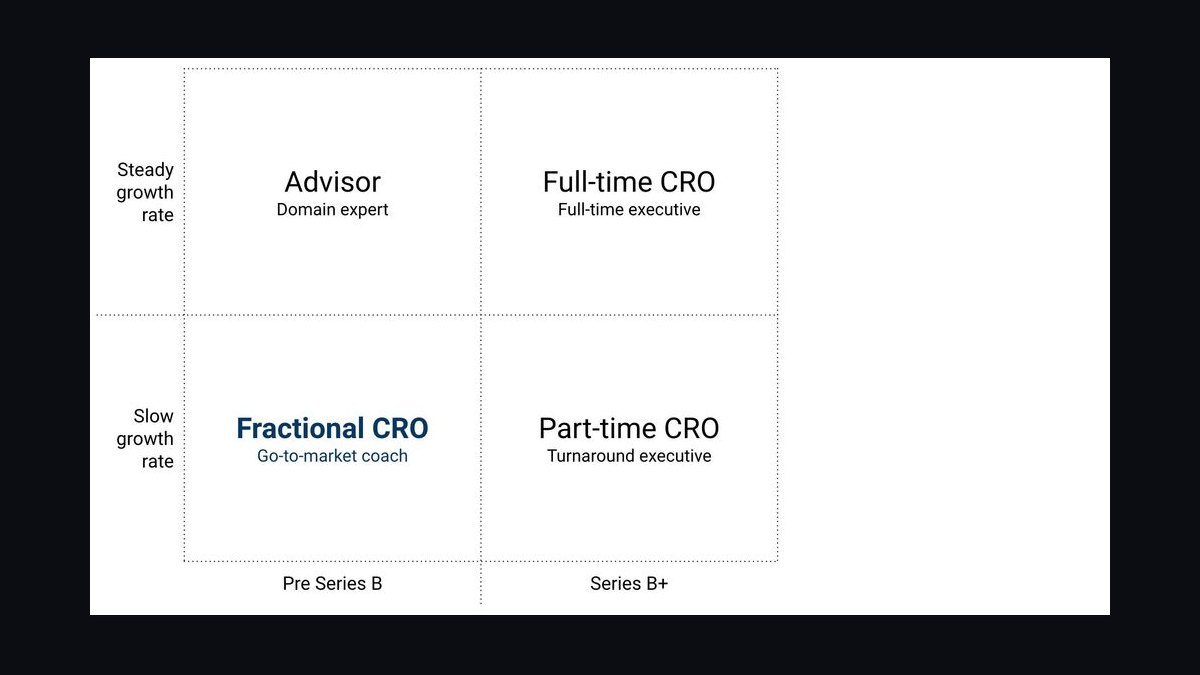
Search nationally, not just locally: Austin's fractional CRO supply is thinner than demand, so use operator networks (Pavilion, RevOps Co-op), targeted LinkedIn filters on ACV and sales-cycle match, and vetted matchmaking. Budget a retainer for 10–20 days per quarter, run a paid two-week trial, and expect four to eight weeks to close.
Signals you actually need this
The clearest signal is a revenue org that has outgrown founder-led selling but cannot yet justify a 250k–400k fully-loaded VP of Sales. In practice that means somewhere between 500k and 5M ARR, two to six reps, and a pipeline that moves in bursts tied to whoever the founder personally touched last quarter. If your forecast is a spreadsheet the founder rebuilds from memory every Monday, you have a systems problem, not a headcount problem — and a systems problem is exactly what part-time senior leadership is built to solve.
A second signal is diagnostic ambiguity. You know the number is missing but you cannot say *why*. Is it top-of-funnel volume? Qualification discipline? Pricing that quietly caps deal size? Rep competency? Churn masking as slow growth? When five plausible root causes compete and nobody in the building has seen this pattern before, you are paying for pattern recognition, not hours. Someone who has watched ten to twenty revenue organizations up close will narrow five hypotheses to one in about three weeks — a timeline an internal first-time hire rarely matches, because they are learning your business and diagnosing it simultaneously.
Third: a leadership gap with a defined end date. A VP of Sales quit, a co-founder is stepping out of the revenue seat, or you just raised and the board wants a plan before you commit to a twelve-to-twenty-four-month employment contract. Interim coverage of a live team is a real and separate use case from strategic redesign, and it is worth naming which one you have before you write a job description. Interim coverage means daily standups, deal desk, one-on-ones, and quota conversations. Redesign means playbook, territories, comp plan, and tooling. The same person can often do both, but not in the same ten days a month.

Fourth signal, and the one founders most often miss: your RevOps foundation is broken and nobody senior owns it. Opportunity stages mean different things to different reps. Close dates slip in bulk on the last day of the month. Half your accounts have no owner. You cannot answer "what is our win rate by lead source" without a two-day export project. That is not a sales problem — it is an operations problem wearing a sales costume, and hiring three more reps on top of it will make the noise worse, not the revenue better. Fractional leaders are unusually good here because instrumentation is a project with a finish line, which suits a time-boxed engagement.
Adjacent to all of this: the same signals apply to fractional CMO, fractional CFO, and fractional RevOps-lead engagements, which increasingly get bundled in the Austin market. If your diagnosis lands on "our marketing generates leads sales won't touch," you may need a demand-gen leader more than a revenue leader — and a good fractional CRO will tell you that in week two rather than bill you for six months of the wrong fix. Ask candidates directly what problems they refer out. The ones with a crisp answer have real boundaries.

There are also anti-signals. Pre-product-market-fit, still hunting for a repeatable buyer, fewer than roughly twenty paying customers: a part-time executive cannot substitute for a founder living in customer conversations. Boards that expect an executive in every weekly meeting and on major customer calls will chafe against a ten-day-a-month arrangement. And if you are not willing to act on hard recommendations — fire an underperformer, raise prices, sunset a product line — the engagement will produce a very good deck and no revenue change.
What good looks like versus what bad looks like
Good starts with a diagnostic that has actual teeth. In the first thirty days, a strong operator should pull your CRM to a flat file, interview every rep individually, listen to fifteen to twenty recorded calls, talk to five to ten customers including at least two who churned, and come back with a written assessment naming the two or three constraints that matter. The tell is specificity: "your enterprise deals stall at security review because nobody owns the questionnaire, and that adds nineteen days to a sixty-day cycle" is good. "You need better discovery" is not.
Bad looks like a prescription that arrives before the diagnosis. If someone tells you in the first meeting that you need to hire three SDRs and buy an outbound sequencer, they are selling a template. Watch also for the candidate who cannot repeat your unit economics back to you — customer acquisition cost, gross margin, net revenue retention, average sales cycle, average contract value — by the end of the second conversation. Those five numbers are the vocabulary of the job. Not knowing them by then means they are not curious enough about your business to fix it.

Good is also structurally honest about time. Ten days per quarter is roughly three days a month, and three days a month cannot run a daily pipeline cadence. A candidate who agrees to a light retainer *and* promises hands-on deal coaching for six reps is either going to under-deliver or is quietly planning to bill you more later. The stronger move is a candidate who pushes back on your scope: "at that cadence I can build the playbook and coach your two senior reps, but you need an internal manager for daily execution — here is how I would hire that person." Scope pushback is a buying signal, not an objection.
Another marker of quality: references that hold up under an uncomfortable question. Do not ask "were they good?" Ask "when did they tell you something you did not want to hear, and what happened next?" Every genuinely useful revenue leader has delivered bad news to a founder — about a beloved rep, a pet product, or the founder's own selling habits. A reference who cannot recall a single instance of friction is describing a consultant who optimized for renewal, not results.
Bad also shows up in how someone talks about attribution. A fractional leader who claims full credit for a revenue jump that coincided with a funding round, a competitor's outage, or a seasonal spike is either not measuring carefully or is comfortable overstating. Good sounds like: "pipeline coverage went from 1.8x to 3.1x over four months, win rate on the mid-market segment moved from 18 to 24 percent, and roughly half of that I would attribute to the qualification change we made — the rest was a stronger quarter across the board."
Finally, watch the exit design. A good engagement is built to end. From day one there should be a plan for what gets handed to whom: a documented playbook, a comp plan someone else can administer, dashboards an internal analyst can maintain, and ideally a named internal successor being coached. If nobody can describe what "done" looks like, you have hired a dependency rather than a fix.
Real cost, structure, and the ROI math
Fractional CRO engagements in Austin generally price as a monthly retainer tied to committed days. The common shapes: a light advisory tier around two to four days a month, a standard tier around six to eight days a month, and an interim-heavy tier at twelve-plus days a month that starts approaching a part-time salary. Rather than quoting figures that vary widely by operator and stage, evaluate on effective day rate — total monthly retainer divided by committed days — and compare that against what a fully-loaded senior revenue executive costs you per working day. A full-time VP of Sales at 200k base plus commission, benefits, taxes, and equipment lands somewhere in the 250k–400k all-in range, which across roughly 240 working days gives you a baseline day rate to benchmark against.

Structure matters as much as price. Cash-only keeps the relationship clean and easy to exit. Cash-plus-equity typically trades twenty to thirty percent of the monthly cash for a small advisory grant, usually on a one-to-two-year vest with a cliff — attractive when cash is tight post-seed, but it converts a vendor into a stakeholder, which cuts both ways. A stakeholder is more invested; a stakeholder is also harder to fire. Some operators will do a hybrid where a success component keys to a specific, measurable outcome — pipeline coverage ratio, a named enterprise logo closing, a comp plan shipped and adopted. Keep success metrics to one or two, make them measurable in your CRM without argument, and define them in writing before the first invoice.
Contract terms worth negotiating: a three-month initial term with thirty-day notice thereafter, rather than a twelve-month commitment; a written scope naming the two or three outcomes; explicit IP assignment so the playbook and dashboards are yours; and a clause on how additional days are billed if scope expands mid-quarter. Also negotiate travel separately if you want in-person time — a monthly two-day Austin visit from a Denver- or Atlanta-based operator adds real cost and should not be buried inside the retainer.
The ROI math is more tractable than founders expect. Start with the constraint you believe you have and ask what a fix is worth annually. If your enterprise cycle is sixty days and a security-questionnaire owner removes nineteen of them, you free roughly a third of your cycle time, which compounds into more at-bats per rep per year. If win rate moves three points on a segment doing 2M in annual pipeline, that is 60k in incremental closed revenue from one change. If a comp plan redesign shifts rep behavior toward multi-year contracts and lifts average contract value fifteen percent, the effect is permanent and compounds with every future hire. Against a two-quarter engagement, the bar for payback is usually one structural change that sticks.

The honest counterweight: fractional engagements fail to produce ROI most often for non-financial reasons. The company does not implement. The scope creeps from "rebuild enterprise motion" into "also fix marketing, also help with fundraising, also sit in on product." The founder overrides recommendations selectively, keeping the pleasant ones. Or nobody internal owns the handoff, so the playbook rots in a shared drive three months after the engagement ends. Before signing, name one internal person who will own implementation and give them the time to do it. That single decision moves outcomes more than any negotiation over rate.
Budget the search itself, too. Four to eight weeks of founder or COO time — scoping, thirty-plus profile reviews, eight to twelve first conversations, three to four deep interviews, six to eight reference calls, and a paid trial — is real. Compressing that timeline is where most bad hires originate. Paying for a two-week diagnostic from two finalists simultaneously is expensive on paper and frequently the cheapest decision in the whole process, because you get two written assessments of your business and learn more about how each person thinks than any interview reveals.

How to run the search, week by week
Week one is scope, not sourcing. Write a one-page brief: current ARR and growth rate, team shape, the go-to-market motion (self-serve, inside sales, enterprise field), average contract value, sales cycle length, the two or three symptoms you are worried about, days per month you will fund, and what "done" means in six months. Notice that this brief is useful even if you never hire anyone — several founders write it and realize they need a sales manager, a demand-gen contractor, or a RevOps analyst instead.
Week one also, a tactical note on outreach: do not lead with the word "fractional." Many experienced revenue leaders take both fractional and full-time roles and will filter your message out on the label. Describe the problem — "we need someone to rebuild our enterprise playbook and coach two senior reps" — and let them propose the engagement shape. The proposal itself is diagnostic data.
Weeks two and three are sourcing across four channels in parallel. Operator communities: Pavilion and RevOps Co-op both have member directories and job boards where a stage-specific post gets qualified responses. LinkedIn with real filters, not keyword soup — search current and past titles, then filter for companies with comparable contract value and cycle length, because someone who scaled a 200k-ACV enterprise motion has almost nothing transferable to a 6k-ACV SMB motion, and vice versa. Vetted matchmaking networks, which trade a fee for pre-screening. And warm referrals from your investors, other founders in Austin, and the local operator scene — the highest-signal channel by a wide margin, because the referrer has watched the work.

Weeks three and four are conversations. Ask for one specific story: a revenue stall they diagnosed, what they thought the cause was initially, what it turned out to be, and how they found the gap. Then ask how they would audit your CRM data quality in week one — concretely, which objects, which fields, which reports. Strong candidates get tactical fast. Weak ones stay at altitude.
Weeks four through six are the paid trial and references in parallel. The trial is a two-to-four-week scoped diagnostic with a written deliverable. Judge it on whether it told you something you did not already know, whether the recommendations are sequenced rather than listed, and whether the person was pleasant to disagree with. References run six to eight calls, weighted toward former clients at your stage rather than the impressive logo from a decade ago.
Weeks six through eight are contracting and onboarding. Give real authority in writing — CRM admin access, attendance at leadership meetings, explicit permission to change pipeline stages and run performance conversations. A part-time executive without authority produces recommendations nobody has standing to implement. Announce the engagement internally with a clear frame: this person is here for six months to fix the revenue system, they are not replacing anyone, and here is what changes for you specifically. Ambiguity here breeds rep anxiety, and anxious reps stop entering accurate data — which blinds the very diagnostic you are paying for.

Once the engagement is live, the workflow integration is mostly cadence. A typical six-days-a-month shape: one day for the weekly forecast and pipeline review, one day for one-on-ones and call coaching, one day for deal strategy on the top three opportunities, and three days spread across playbook work, tooling, and hiring. The tool stack this touches is predictable — a CRM (Salesforce or HubSpot), conversation intelligence for call review, a forecasting layer, and a sequencer — and a good operator will resist adding tools until the CRM is trustworthy, because dashboards built on bad data are worse than no dashboards. Insist that everything produced lands in your systems, not their laptop.
What it costs you when the fit is wrong
The direct cost of a bad fractional engagement is the retainer, and that is the smallest part. The larger costs are momentum and credibility. A revenue leader who arrives, restructures territories, changes the comp plan, and leaves after four months teaches your reps that leadership direction is temporary — and the next person to propose a change gets quiet resistance from people who have already lived through one reversal. Sales teams remember whiplash for a long time.

There is also opportunity cost in the diagnosis itself. If someone spends your first quarter fixing outbound when the real constraint was onboarding-driven churn, you have not just wasted a quarter — you have compounded the churn for three more months while telling your board the problem is being handled. That is why the paid trial matters disproportionately: it is the cheapest available test of whether this person can find the real constraint in your specific business rather than the constraint they most enjoy fixing.
Watch for the slow drift into general management. It usually starts helpfully — the operator sits in on a product conversation, offers a useful opinion, gets invited back. Six weeks later they are informally running three functions on ten days a month and doing none of them well. Quarterly scope reviews against the original written outcomes are the antidote. If the scope genuinely should change, change it explicitly and re-price it.
Finally, plan the ending before you need it. The healthiest outcomes look like one of three things: a full-time VP hired and coached through the first ninety days by the outgoing fractional leader; a step-down to two days a month of advisory as an internal manager takes the wheel; or a clean, documented exit because the defined problem is solved. The unhealthy outcome is indefinite renewal with a slowly shrinking mandate and a retainer nobody wants to renegotiate. If you cannot articulate what the next quarter buys you, that is the signal to end it — and ending well preserves a relationship you may want to reopen when the next inflection hits.
Related questions
Should I search only in Austin, or nationally?
Search nationally, then filter. Most fractional revenue leaders work hybrid, and the Austin supply of operators who have run revenue through two growth phases is thin relative to demand. A Denver- or Atlanta-based candidate flying in monthly often beats a local one who has never scaled your motion.
How is a fractional CRO different from a consultant?
A consultant delivers a recommendation and leaves. A fractional CRO holds the seat — runs forecast calls, coaches reps, sits in your leadership meeting, and carries accountability for the number during the engagement. If a candidate resists owning outcomes and wants deliverables only, you are buying consulting with a fancier title.
What if we cannot fund a full retainer?
Scope down rather than dilute. A one-month paid diagnostic with a written assessment, or a two-to-four-hour-per-week advisory arrangement, buys real value. Peer communities and operator groups also provide informal guidance at far lower cost while you build the budget for a proper engagement.
Can the same person cover RevOps and sales leadership?
Sometimes, at small scale. Below roughly five reps, one senior operator can own both instrumentation and coaching. Past that, the RevOps work — data hygiene, reporting, territory and comp administration — becomes a full job. Expect a good fractional leader to tell you when to split the role.
How do I know when to convert to a full-time hire?
Convert when the process is repeatable, the forecast holds within roughly fifteen percent for two consecutive quarters, and the remaining work is daily execution rather than design. Design work suits part-time senior talent; execution rhythm needs someone in the building every day.
FAQ
How long does the search realistically take?
Plan four to eight weeks from writing the brief to a signed agreement. Sourcing is rarely the bottleneck — vetting is. Reference calls, a paid trial, and scope alignment consume most of that window. Founders who compress the timeline to two weeks tend to hire on charisma and re-run the search six months later.
What should I pay attention to in the first meeting?
Whether they ask more questions than they answer, and which questions. Strong operators go straight at unit economics, segment-level win rates, churn, and how the sales cycle actually unfolds. If someone spends the first thirty minutes describing their methodology without asking about your business, that meeting has already told you what you need to know.
Should I include equity in the deal?
Only if cash conservation genuinely matters and the engagement is expected to run beyond two quarters. Equity aligns incentives but converts a flexible vendor relationship into a stakeholder relationship that is harder to unwind. If you do include it, use a standard advisory grant with a cliff and keep the vest short.
What does a fractional CRO actually do in a typical month?
At six days a month: one day on forecast and pipeline review, one on one-on-ones and call coaching, one on strategy for the largest open deals, and the balance on playbook development, tooling, hiring, and board prep. The mix shifts across the engagement — diagnostic-heavy early, coaching-heavy in the middle, handoff-heavy at the end.
Do we need in-person presence?
Usually less than founders assume. Kickoff, quarterly planning, and any offsite or all-hands benefit from being in the room. Weekly forecast calls, coaching, and deal strategy work fine remote. Decide what genuinely requires physical presence, price the travel separately, and stop treating a local address as a proxy for quality.
How do we measure whether it worked?
Pick two or three leading indicators before the engagement starts — pipeline coverage ratio, segment win rate, sales cycle length, forecast accuracy — and baseline them in your CRM on day one. Judge the engagement on movement in those numbers plus whether the artifacts produced are still in daily use ninety days after the work ends.
Sources
- Pavilion — operator community and member directory
- RevOps Co-op — revenue operations community
- SaaStr — SaaS go-to-market benchmarks and executive hiring content
- First Round Review — operator playbooks on executive hiring
- Harvard Business Review — leadership and organizational design research
- Bessemer Venture Partners — State of the Cloud and SaaS metrics
- OpenView Partners — SaaS benchmarks and go-to-market research
- Gong Labs — sales conversation and pipeline research
- U.S. Bureau of Labor Statistics — Occupational Outlook, sales managers
- LinkedIn — professional search and operator sourcing
Related on PULSE
- [How much does an interim CRO cost in Austin in 2027?](/knowledge/tl11994)
- [How much does an interim Chief Revenue Officer cost in Austin in 2027?](/knowledge/tl16877)
- [How much does a part-time Chief Revenue Officer cost in Austin in 2027?](/knowledge/tl16347)
- [How do I evaluate a fractional Chief Revenue Officer in Austin in 2027?](/knowledge/tl16248)
- [How do I find a fractional CRO in Millsboro in 2027?](/knowledge/tl20032)
- [How do I hire a fractional CRO in Tulsa in 2027?](/knowledge/tl9705)
This page will be disappearing soon. Save it to your device for $1 — or read it free while it is here.
@Kory-White- · if Venmo asks, the last 4 of my number are 2012
 pulse-toolsWhat does a fractional CRO cost in Odenton in 2027?
 pulse-toolsWhere do I find a fractional head of revenue in Reston in 2027?
 pulse-toolsHow do I find a fractional CRO in Christiana in 2027?
 pulse-toolsWhat KPIs should a fractional CRO own at a clean energy company in 2027?
 pulse-toolsWhat should I look for in a fractional CRO in San Diego in 2027?
 pulse-toolsIs there a fractional CRO available near me in the Gulf Coast in 2027?
 pulse-toolsHow much does a fractional CRO cost for a real estate company in 2027?
 pulse-toolsWhere do I find a fractional VP of Sales in Pennsylvania?
 pulse-toolsWhere do I find an interim CRO in Fort Lauderdale in 2027?
 pulse-toolsHow do I hire a fractional VP of Sales in Tampa?