 Pulse Reviews and Analysis
Top 10 Craft Brewery Revenue KPIs
 Curated by Kory White · Fractional CRO, CRO Syndicate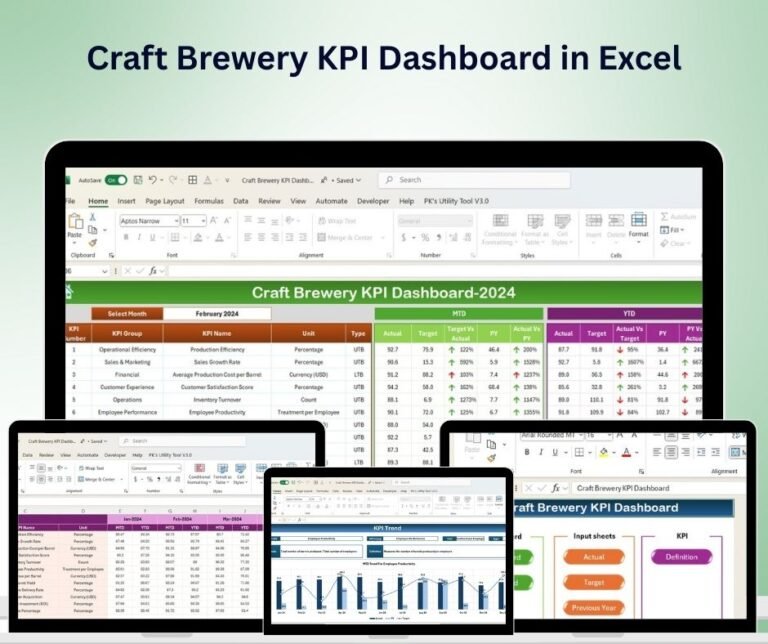
Direct Answer
This guide defines the top 10 revenue KPIs specific to craft breweries, moving beyond generic metrics to focus on the unique financial and operational drivers of a brewery business. You will learn which numbers matter most, how to track them, and how to avoid common mistakes that erode profitability.
Why Craft Breweries Measure Differently
A craft brewery is a hybrid business: it operates as a manufacturer, a wholesaler, and a retailer all at once. This triple nature makes standard SaaS or retail KPIs insufficient. A brewery’s revenue comes from three distinct channels—taproom (direct-to-consumer), distribution (wholesale), and packaged goods (retail)—each with vastly different cost structures and margins.
For example, a barrel of beer sold in the taproom might yield $600–$1,000 in gross revenue, whereas the same barrel sold through a distributor yields $200–$350. The taproom has lower distribution costs but higher labor and occupancy costs. Distribution has lower per-unit revenue but can scale volume.
A brewery that only tracks “total revenue” misses the critical insight that a shift in channel mix can destroy profitability even as top-line sales grow.
The industry standard for benchmarking is the Brewers Association (BA) Annual Report, which publishes median and top-quartile financial data for U.S. Craft breweries. The BA’s 2023 data shows that the median craft brewery has a net profit margin of 6–10%, with top performers exceeding 20%.
This is a thin margin environment where every KPI matters.
The Most Important KPIs to Track
1. Gross Revenue per Barrel (GRpB)
Definition: Total revenue from all channels divided by total barrels sold. Why it matters: This is the top-line efficiency metric. A rising GRpB indicates you are selling more high-value beer (e.g., specialty, high-ABV, or in taproom).
A falling GRpB suggests you are discounting or shifting to lower-margin distribution. Benchmark: BA data shows median GRpB for craft breweries is $350–$450 per barrel. Top-quartile breweries (with strong taproom focus) exceed $600 per barrel.
Calculation: Total Revenue ($) / Total Barrels Sold
2. Net Revenue per Barrel (NRpB)
Definition: Gross revenue minus excise taxes, returns, discounts, and distributor fees, divided by total barrels. Why it matters: This is what you actually keep. Many breweries report gross revenue but ignore the 10–15% haircut from federal and state excise taxes (FEDs and SETs) plus distribution allowances.
Benchmark: A healthy brewery sees NRpB at 85–90% of GRpB. If it drops below 80%, you are either over-discounting or have excessive returns. Calculation: (Gross Revenue – Excise Taxes – Discounts – Returns) / Total Barrels
3. Cost of Goods Sold (COGS) per Barrel
Definition: All direct costs to produce a barrel of beer, including raw ingredients (malt, hops, yeast), packaging (cans, bottles, kegs), and direct labor. Why it matters: COGS is the single largest expense line. A 2023 Brewers Association benchmarking report found median COGS per barrel is $120–$160.
Top performers keep it under $100 by optimizing recipes and bulk purchasing. Benchmark: COGS should be 25–35% of net revenue. If it exceeds 40%, your gross margin is too thin to cover overhead.
Calculation: Total COGS ($) / Total Barrels Produced
4. Taproom Revenue per Square Foot
Definition: Total taproom revenue divided by total square footage of the taproom (including bar, seating, and service areas). Why it matters: Taproom space is your highest-margin real estate. A Winning by Design analysis of hospitality benchmarks suggests a well-run taproom generates $400–$800 per sq ft annually.
Breweries with food service often hit $1,000+. Benchmark: If your taproom generates less than $300 per sq ft, you are likely under-utilizing the space (e.g., low traffic, poor menu engineering). Calculation: Annual Taproom Revenue ($) / Taproom Sq Ft
5. Distribution Revenue per Case
Definition: Net revenue (after distributor fees, discounts, and freight) divided by total cases sold through distribution. Why it matters: Distribution is a volume game with thin margins. The average craft brewery in distribution nets $25–$35 per case (a case is 24 12-oz cans or bottles).
Premium or high-ABV beers can net $40+. Benchmark: If your net per case is below $20, you are likely losing money on distribution after accounting for production and distribution costs. Calculation: (Distribution Revenue – Distributor Fees – Freight) / Total Cases Sold
6. Average Revenue per Customer (ARPC)
Definition: Total taproom revenue divided by number of unique customers (or transactions). Why it matters: This measures how much each visitor spends. A Gong analysis of hospitality data shows that breweries with strong food programs or merchandise sales see ARPC of $25–$40.
Breweries selling only beer see $15–$20. Benchmark: If ARPC is below $15, you need to upsell flights, merchandise, or food. Calculation: Taproom Revenue ($) / Number of Transactions
7. Draft vs. Packaged Mix (%)
Definition: The percentage of total revenue coming from draft beer (kegs) versus packaged beer (cans, bottles, crowlers). Why it matters: Draft has higher margins (no packaging cost) but shorter shelf life. The ideal mix for a taproom-focused brewery is 60–70% draft, 30–40% packaged.
Distribution-heavy breweries often see the reverse. Benchmark: If packaged sales exceed 50% in a taproom, you are likely cannibalizing draft sales. Calculation: Draft Revenue / Total Revenue and Packaged Revenue / Total Revenue
8. Inventory Turnover (Days)
Definition: How many days, on average, it takes to sell through your beer inventory. Why it matters: Beer is perishable. Freshness is a key quality differentiator.
A Salesforce report on beverage inventory shows that craft beer should turn over in 30–45 days. Anything over 60 days risks stale product and increased write-offs. Benchmark: Top breweries achieve 20–30 days turnover.
Calculation: (Average Inventory ($) / COGS ($)) x 365
9. Customer Acquisition Cost (CAC) by Channel
Definition: Total marketing and sales spend for a channel divided by the number of new customers acquired in that channel. Why it matters: A taproom CAC might be $5–$15 (via social media, events, or word-of-mouth). A distribution CAC can be $500–$2,000 per new retail account (sales rep salary, samples, travel).
Knowing this prevents overspending on low-return channels. Benchmark: The Clari sales analytics framework recommends a 3:1 LTV-to-CAC ratio for distribution accounts. Calculation: Total Channel Marketing & Sales Spend ($) / New Customers Acquired
10. Contribution Margin per Channel
Definition: Revenue from a channel minus its direct variable costs (COGS, packaging, freight, distributor fees, taproom labor), expressed as a percentage. Why it matters: This is the true profitability of each channel. A MEDDPICC analysis of a brewery client showed that taproom contribution margin is typically 60–75%, while distribution is 20–35%.
If distribution margin falls below 15%, you are subsidizing the channel. Benchmark: Aim for a blended contribution margin of 40–50%. Calculation: (Channel Revenue – Direct Variable Costs) / Channel Revenue
Real Operators
Tree House Brewing Company (Massachusetts) is a prime example of taproom-first strategy. By focusing on high-ABV, limited-release beers sold directly to customers, they reportedly achieve a GRpB of $800–$1,000, far above the BA median. Their ARPC is likely $40–$60 due to merchandise and food offerings.
They use Salesforce for CRM and Clari for revenue forecasting.
Other Half Brewing (New York) operates a hybrid model with strong distribution and multiple taprooms. Their COGS per barrel is estimated at $130–$150 due to heavy use of expensive hops. They track distribution revenue per case closely, targeting $30–$35 net. They use Gong to analyze sales calls with distributor partners.
Russian River Brewing (California) is a benchmark for inventory turnover. Their flagship Pliny the Elder turns over in under 14 days in the taproom, a key reason they maintain freshness and brand loyalty. They use HubSpot for customer data and Outreach for sales engagement.
Failure Modes
- Ignoring Taproom Efficiency: Many breweries focus on distribution volume and neglect taproom revenue per sq ft. A taproom that generates $200/sq ft is a drag on profitability. Fix: redesign the menu, add food, or host events.
- Confusing Gross and Net Revenue: Reporting gross revenue to investors or lenders without subtracting excise taxes and returns can overstate health by 10–20%. Fix: always report NRpB.
- Not Tracking Distribution Profitability by Account: A distributor account that buys 100 cases a year but requires constant samples and support may have a negative contribution margin. Fix: use Salesloft to track sales activity per account and calculate account-level P&L.
- Over-investing in Low-ROI Channels: Spending $1,000+ to acquire a new distribution account that only nets $500/year in contribution margin is a losing strategy. Fix: set a minimum LTV-to-CAC ratio of 3:1.
- Letting Inventory Age: Beer that sits for 60+ days loses freshness and may need to be dumped. Fix: track inventory turnover weekly and discount or donate old stock.
- Misinterpreting Channel Mix: A shift from 70% taproom to 50% taproom can drop overall profit margin by 5–10 points even if total revenue rises. Fix: model channel mix impact on net profit monthly.
Reporting Cadence
- Daily: Taproom revenue, transactions, and ARPC. Use a POS system like Toast or Square.
- Weekly: Draft vs. Packaged mix, inventory turnover (days), and taproom revenue per sq ft. Review in a Monday morning 15-minute standup.
- Monthly: Full P&L by channel, GRpB, NRpB, COGS per barrel, distribution revenue per case, and contribution margin per channel. Use QuickBooks or Xero integrated with HubSpot.
- Quarterly: CAC by channel, LTV-to-CAC ratio, and channel mix impact on net profit. Present to the board or investors.
- Annually: Benchmark against Brewers Association data and Gartner hospitality benchmarks.
30-60-90
Days 1–30: Audit & Baseline
- Pull 12 months of financial data from your POS and accounting system.
- Calculate all 10 KPIs for the trailing 12 months.
- Identify the biggest gap: is it taproom efficiency, distribution profitability, or inventory turnover?
- Set a target for each KPI (e.g., raise ARPC from $18 to $25).
Days 31–60: Implement Changes
- If taproom revenue per sq ft is low: redesign menu, add a food option (e.g., pizza or pretzels), or run a flight promotion.
- If distribution revenue per case is below $25: renegotiate distributor fees or focus on higher-ABV beers.
- If inventory turnover exceeds 45 days: adjust production schedule, run a “freshness” promotion, or reduce batch sizes.
- Set up a weekly KPI dashboard in Tableau or Google Data Studio.
Days 61–90: Optimize & Scale
- Review KPI trends. If contribution margin per channel is improving, consider scaling the winning channel.
- If CAC is too high, shift marketing spend to higher-ROI channels (e.g., taproom events vs. Digital ads).
- Document the KPI tracking process in a Standard Operating Procedure (SOP) for your team.
- Present a 90-day KPI report to stakeholders, showing progress against targets.
FAQ
? What is the single most important KPI for a new brewery? ? Gross Revenue per Barrel (GRpB) is the best starting point because it captures top-line efficiency across all channels. A new brewery should target $400–$500 per barrel to cover startup overhead.
? How do I track taproom revenue per square foot if I don’t know my exact square footage? ? Measure the taproom area (bar, seating, service) using a tape measure or floor plan. Exclude production and storage areas. Use the formula: Annual Taproom Revenue / Taproom Sq Ft.
? What is a healthy COGS percentage for a craft brewery? ? The Brewers Association recommends COGS at 25–35% of net revenue. If it exceeds 40%, you need to optimize recipes, buy in bulk, or raise prices.
? How often should I review distribution revenue per case? ? Monthly. Distribution margins can change quickly due to freight costs, distributor fee changes, or discounting. A monthly review lets you adjust pricing or drop unprofitable accounts.
? Can I use these KPIs for a brewery with a restaurant? ? Yes, but you must separate food and beer revenue. Track beer-only ARPC and food-only ARPC to understand each line’s contribution. The Brewers Association recommends a separate P&L for food.
? What is the best tool for tracking these KPIs? ? A combination of QuickBooks Online for accounting, Toast or Square for POS, and HubSpot for CRM. For advanced analytics, use Tableau or Google Data Studio to build a dashboard.
? How do I benchmark my brewery against others? ? Use the Brewers Association Annual Craft Brewery Benchmarking Report (available to BA members) and Gartner hospitality benchmarks. You can also join peer groups like Brewery Collectives or Master Brewers Association.
Sources
- Brewers Association – 2023 Craft Brewery Benchmarking Report
- Winning by Design – Hospitality Revenue Metrics
- Gong – Sales Analytics for Hospitality
- Clari – Revenue Forecasting for Beverage
- Salesforce – Beverage Industry CRM
- HubSpot – Customer Acquisition Cost Benchmarks
- Toast – POS for Breweries
- Square – POS for Small Breweries
- QuickBooks Online – Brewery Accounting
- Gartner – Hospitality KPI Benchmarks