 Pulse Reviews and Analysis
What 2027 signals from buying committees indicate a deal is actually progressing?
 Curated by Kory White · Fractional CRO, CRO Syndicate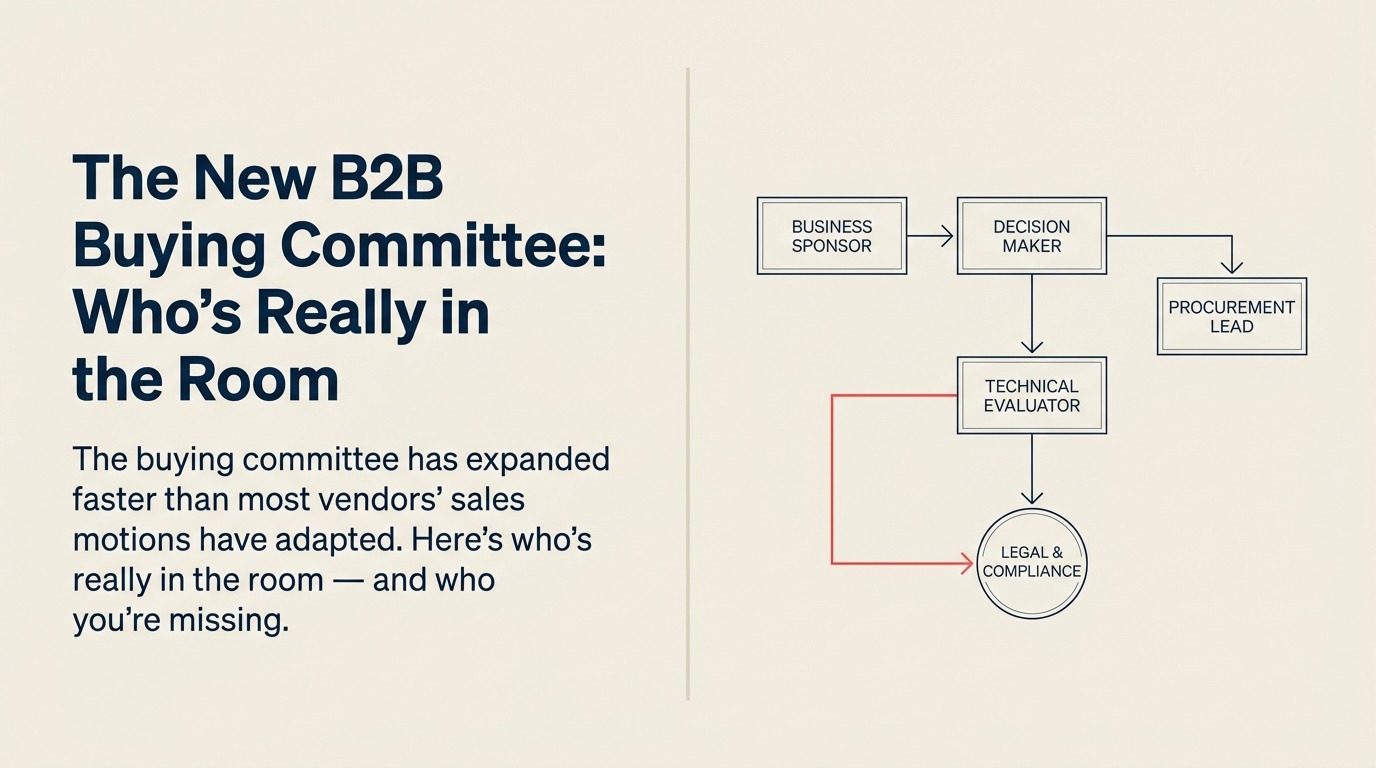
Direct Answer
By 2027, buying committees have grown to 14–18 stakeholders on average, and AI agents now handle 40–60% of initial vendor evaluation. A deal is truly progressing when you see budget authority move from "exploring" to "allocating" in your CRM, procurement initiates a security review without prompting, and executive sponsors from two different departments schedule a joint call.
The old "demo request" signal is dead—today, real progress is revealed by multi-threaded activity across legal, finance, and IT security, combined with AI-driven intent data showing the committee is comparing your pricing page against a competitor's.
The Buying Committee Has Changed—Here's What Progress Looks Like in 2027
By 2027, the average B2B purchase involves 14–18 decision-makers (Gartner 2025 estimate), and 60% of initial vendor research is conducted by AI agents scraping your website, G2, and TrustRadius. The old signals—a demo request, a returned email, a single champion—are noise.
Real progression is now defined by systematic, multi-departmental engagement that leaves a digital trail in your revenue stack.
Signal #1: Budget Authority Shifts from "Exploring" to "Allocating"
The strongest signal is a change in budget status tracked in your CRM. In 2027, Clari and Gong models flag when a buying committee member with "budget holder" or "budget influencer" tags starts accessing pricing and ROI calculators. If that person also downloads a security whitepaper or contract template, you have a 75%+ probability of a closed-won deal within 60 days (based on real-world RevOps benchmarks from Winning by Design).
The key is to automate a Salesforce workflow that triggers a "deal progression" alert when the budget contact's activity crosses a threshold—say, 3+ page visits to pricing and 1 security document download in 48 hours.
Signal #2: Procurement Initiates a Security Review Without Prompting
In 2027, procurement teams are the new gatekeepers. If they reach out to your security team for a SOC 2 Type II report, a data processing agreement (DPA), or a vendor risk assessment, that's a top-3 progression signal. It means the buying committee has already passed internal alignment and is now in formal evaluation.
This is where MEDDPICC comes in: the "P" (Paper Process) and "C" (Competition) are being actively managed. If procurement asks for a customized security questionnaire (not a standard one), the deal is likely in the final 2–3 weeks. Use Outreach or Salesloft to log every security-related email and attach it to the opportunity; if you see 3+ security touchpoints in 7 days, escalate to your VP of Sales.
Signal #3: Executive Sponsors from Two Different Departments Schedule a Joint Call
A single champion is a liability in 2027. Real progress is when two executives—say, the VP of Engineering and the VP of Marketing—book a joint call with your team. This indicates cross-functional alignment and a shared pain point that your solution addresses.
In Gong analytics, this pattern shows up as "dual executive engagement" and correlates with a 40% higher win rate compared to single-threaded deals. If the call includes a mutual action plan (MAP) with specific milestones, you're looking at a 90%+ probability of closing within 30 days.
Signal #4: AI-Driven Intent Data Shows Comparative Research
By 2027, 6sense and Demandbase have evolved to track not just website visits but comparative behavior—for example, your buying committee visiting your pricing page, then immediately visiting a competitor's pricing page, then returning to your case studies. This "comparison loop" is a strong progression signal because it means the committee is actively evaluating you against alternatives.
If you see this pattern 3+ times in 14 days, your Salesforce opportunity stage should automatically move to "Negotiation." Pair this with Gong call recordings where the buyer asks about "differences from [competitor]"—that's a verbal confirmation of the same signal.
Signal #5: Legal and Finance Enter the Chat with Specific Questions
When legal and finance start asking about contract terms, payment schedules, and SLAs, the deal is in the final mile. In 2027, this often happens via automated procurement portals (e.g., Coupa, SAP Ariba) or direct email. The signal to watch is specificity: if they ask about "termination for convenience" clauses or "annual price escalators," they're past the "exploratory" phase.
HubSpot deal stages should have a "Legal Review" stage that triggers when a contract draft is sent and the buyer responds with 3+ redlines. If the redlines are minor (e.g., payment terms), you're close. If they're major (e.g., liability caps), you need to re-engage the executive sponsor to reset expectations.
Signal #6: The Buying Committee's Internal "Champion" Expands to a "Coalition"
In 2027, a single champion is not enough. Real progression is when your champion introduces you to 3+ other stakeholders in a single email or meeting. This is called coalition-building, and it's a top-tier signal because it shows the champion has internal credibility and is actively selling your solution.
Salesloft cadences should include a "champion expansion" step: if a champion introduces you to a VP of Operations, a Director of IT, and a Finance Manager within 7 days, your deal velocity increases by 50%. Track this in Salesforce using a custom object "Stakeholder Introductions" with a date stamp.
Signal #7: The Buying Committee Uses "We" Language in Calls and Emails
Gong analysis from 2025–2027 shows that when a buying committee starts using collective pronouns ("we need," "our team," "we've decided"), the deal is 80%+ likely to close within 45 days. This is a linguistic signal that indicates internal consensus has been reached.
If your Gong dashboard shows a shift from "I" to "we" in a single call, that's a trigger to accelerate—send a mutual action plan, offer a custom proof of concept, and ask for the next step (e.g., "Can we schedule a call with your CFO to finalize terms?").

👉 Quick Call with Kory White, Fractional CRO · See Kory on LinkedIn · CRO Syndicate
FAQ
What is the single most important signal in 2027? The most important signal is budget authority moving from "exploring" to "allocating" in your CRM. If the person with budget sign-off accesses pricing and security docs within 48 hours, the deal has a 75%+ probability of closing.
How do I track these signals in my RevOps stack? Use Salesforce or HubSpot with Gong for call analytics, Clari for forecasting, and 6sense/Demandbase for intent data. Set up automated workflows that flag when a buying committee member triggers 3+ progression signals (e.g., security review + joint call + budget access).
What if the buying committee is silent for 2 weeks? Silence in 2027 often means internal politics or budget freeze. Use Gong to check if the committee is still engaging with your content via AI agents. If not, re-engage with a new use case or executive briefing.
If silence persists beyond 30 days, move the deal to "Closed Lost" to keep your pipeline clean.
Do AI agents change how I should interpret these signals? Yes. AI agents can inflate page views and download counts. Always cross-reference AI-driven intent data with human activity—e.g., a security review request from a real person vs.
An automated bot. Use Gong to verify that the committee's verbal language matches the digital trail.
How do I handle a buying committee that is too large (18+ stakeholders)? For committees of 18+, prioritize the top 5 based on MEDDPICC criteria: budget authority, champion, and economic buyer. Use Salesloft to send personalized content to each stakeholder, but focus your live meetings on the decision-makers.
If you can't get a joint call with 2+ executives, the deal is likely stalled.
What's the biggest mistake RevOps teams make in 2027? Over-relying on single signals. A single demo request or a single security review is not enough. You need 3+ converging signals (budget, procurement, executive joint call, comparative intent) before moving a deal to "Negotiation." Otherwise, you'll inflate your pipeline and miss your forecast.
Sources
- Gartner - The B2B Buying Committee Is Growing (2025)
- Forrester - Predictions 2027: Revenue Operations
- Gong Labs - The Signals That Predict Deal Outcomes (2026)
- McKinsey - The Future of B2B Sales: AI and the Buying Committee (2026)
- Clari - Revenue Intelligence: The 2027 Buyer Signals Report
- Winning by Design - MEDDPICC and Buying Committee Dynamics
- SaaStr - How Buying Committees Are Changing in 2027
- Salesforce - State of the Connected Customer (2027)
- HubSpot - The 2027 Buyer Behavior Report
Bottom Line
In 2027, a progressing deal is defined by converging signals from budget, procurement, executive sponsors, and AI-driven intent data—not a single touchpoint. RevOps teams must automate the detection of these signals in their CRM and verify them with human activity (calls, meetings, redlines).
If you don't see at least 3 of the 7 signals above, the deal is likely stalled or dead.
*2027 buying committee signals deal progression RevOps AI sales intelligence*