 Pulse Reviews and Analysis
What Makes Susan B. Anthony's "On Women's Right to Vote" a Great Speech
 Curated by Kory White · Fractional CRO, CRO Syndicate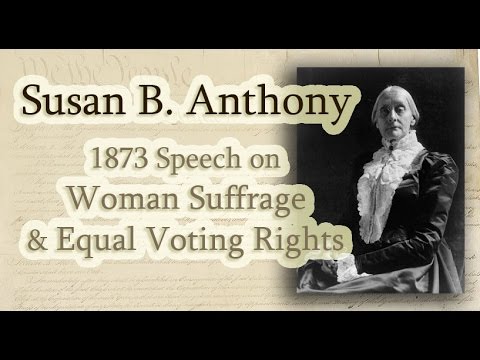
What Makes Susan B. Anthony's "On Women's Right to Vote" a Great Speech
The Occasion
In 1873, Susan B. Anthony had been arrested, tried, and fined $100 for the crime of voting while female. Rather than pay, she took her defense to the people, delivering this short address across the towns of Monroe and Ontario counties in New York.
It is the speech of a citizen who has already acted and now dares the country to explain why she was wrong. Read aloud, it runs roughly ~6 minutes (~900 words spoken), though Anthony's full circuit version ran longer. This page is for students, speech coaches, debaters, and anyone who wants to understand why a tight legal argument can still land like a thunderclap.
The Speech
Anthony does not open with apology or warmth. She opens by naming the charge and refusing it outright. The whole speech is built on a single, almost mathematical move: she takes the founding language of the country and turns it against the people enforcing the law.
"Friends and fellow citizens, I stand before you tonight under indictment for the alleged crime of having voted at the last presidential election, without having a lawful right to vote. It shall be my work this evening to prove to you that in thus voting, I not only committed no crime, but, instead, simply exercised my citizen's rights, guaranteed to me and all United States citizens by the National Constitution, beyond the power of any state to deny."
That second sentence is the engine of the entire address. She is not asking for a favor. She is claiming something she insists is already hers. When you study this speech, notice how she immediately quotes the Preamble — "We, the people" — and then squeezes it until it breaks open:
"It was we, the people; not we, the white male citizens; nor yet we, the male citizens; but we, the whole people, who formed the Union."
The genius is the list. She names each narrowing word the opposition might smuggle in — white, male — and strikes them one at a time. By the time she finishes, the burden has flipped.
It is no longer her job to prove she may vote; it is the state's job to prove the Constitution secretly meant to exclude half the country. She closes the trap with a line that still gets quoted in courtrooms:
"To them this government has no just powers derived from the consent of the governed."
What makes it great is restraint. There is no sentimental appeal, no plea for sympathy, no long story about suffering. It is roughly the length of a modern conference talk, and almost every sentence does one job.
She treats her listeners as jurors capable of following an argument, which is itself a quiet act of respect — and a strategic one. A great persuasive speech often wins by assuming the audience is smarter than the people trying to silence it.
Make It Yours
If you are teaching, performing, or borrowing the structure of this speech, here is what to lift and what to swap:
- Swap her grievance for [your cause], but keep her method: open by naming the accusation against you, then dismantle it with the other side's own founding words.
- Replace the Preamble with [a document your audience already reveres] — a mission statement, a constitution, a contract, a scripture.
- Prompts to spark your own version: What sacred text does my opponent claim to honor? Which single word in it have they quietly narrowed? What happens if I read it literally, out loud, in front of witnesses?
Delivery Notes
Anthony's text rewards a flat, confident pace — closer to a lawyer than a preacher. Do not rush the opening; let "the alleged crime of having voted" hang for a beat so the absurdity registers. Pause hard before "It was we, the people," then read the list of excluded words slowly, almost tenderly, as if examining each one before discarding it.
Make eye contact during the questions she poses to the jury; this is the moment the room becomes complicit. Resist the urge to raise your voice at the end. The line about consent of the governed is more devastating spoken quietly than shouted.
Memorize the three pivot sentences and you can deliver the rest from notes without losing the spine.
Variations
A 30-second version that captures the core move:
"I am charged with a crime for voting. But the Constitution says 'We, the people' — not the white people, not the men, the whole people. If I am one of the people, then the right was already mine. The only crime here is a government denying its own founding words."
For a longer or formal version, restore Anthony's full citations of the Fourteenth and Fifteenth Amendments and let the legal argument breathe across ten or twelve minutes; this suits a classroom or moot-court setting. For a lighter tone, lean into the dry irony of being fined for obeying the Constitution.
For a solemn tone, slow everything down and end on the consent-of-the-governed line with no flourish at all.
FAQ
How long was Susan B. Anthony's speech? The circuit version Anthony delivered was several minutes long and ran longer in full; the most-quoted text reads in about six minutes aloud. It is short by 19th-century standards, which is part of its power.
Why is this speech considered great if it is so short? Because it does one thing perfectly. It reframes a request for permission as a defense of a right already granted, using the opposition's most sacred document as the weapon.
What is the single most important line? "It was we, the people; not we, the white male citizens; nor yet we, the male citizens; but we, the whole people." The escalating list is the entire argument in miniature.
Can I use this structure for a modern speech? Yes. The template — name the accusation, quote a revered document, narrow it to expose the contradiction, claim the right as already yours — works for almost any persuasive cause.
Did the speech win her case? Not in the courtroom; she was still fined and refused to pay. But the argument outlived the verdict, and that is the deeper victory great speeches are built for.
Bottom Line
Anthony's address proves that a great speech does not need length, ornament, or tears — it needs a single irrefutable move executed without flinching. She borrowed the country's own founding promise and held it up as evidence. Study it when you want to learn how to win an argument by refusing to ask permission.