


Who by Geoff Smart and Randy Street — Cliff Notes Summary
Quality
Certified

*Who: The A Method for Hiring* by Geoff Smart and Randy Street (Ballantine, 2008) is a four-step hiring playbook — Scorecard, Source, Select, Sell — that replaces gut-feel interviewing with a structured process. This Cliff Notes Summary distills the book's core claim: disciplined hiring lifts A-Player hit rates from roughly 25% to near 90%, and a bad hire costs up to 15x salary.
The $3M seat that sat empty for nine months
Picture a Series B SaaS company, $18M ARR, 140 employees. The CEO has an open VP of Sales seat. He's been burned twice — the first VP lasted eleven months and left behind a pipeline that never converted; the second lasted seven months and cost the company roughly $400K in salary, recruiter fees, and lost bookings before the board pushed for a change. So he does what most founders do after two bad hires: he freezes the seat, spreads the work across three directors, and tells himself he'll "know it when he sees it" when the right candidate walks in.
Nine months later, the seat is still open. The three directors are exhausted. Net new ARR has flatlined. The board is asking pointed questions about the go-to-market strategy. And the CEO has interviewed 34 candidates, liked four, made offers to two, and lost both to competitors who moved faster. He has spent roughly $180K on retained search fees with nothing to show for it.
This is the exact scenario Geoff Smart and Randy Street open *Who: The A Method for Hiring* to address. Their argument is blunt: the CEO in this story doesn't have a talent-market problem. He has a process problem. He is running what the authors call "voodoo hiring" — a mix of first-impression aesthetics, charisma anchoring, and unstructured conversation that feels like diligence but predicts almost nothing about on-the-job performance.
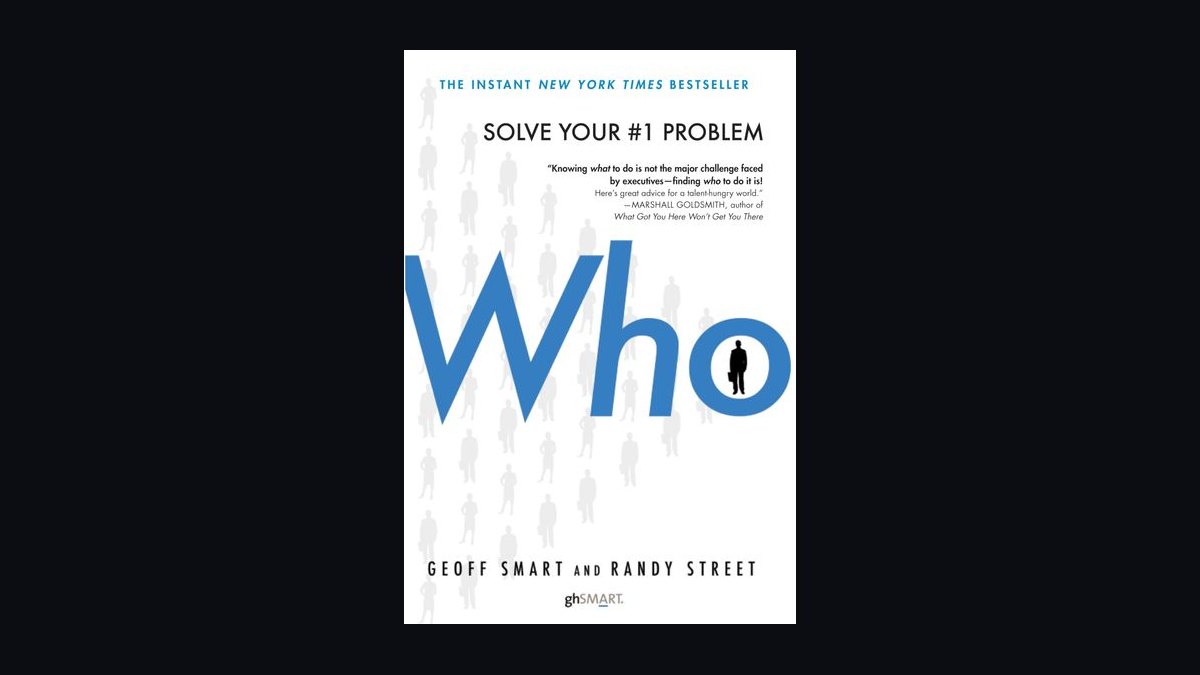
The book's central promise is that a disciplined, repeatable method — one that any manager can run, not just trained recruiters — gets you to roughly a 90% A-Player hit rate. That number is the hook. The rest of the book is the how.
What makes the framing durable is that it applies far beyond the VP-of-Sales seat. The same failure pattern shows up in a two-person startup hiring its first engineer, a hospital system hiring a department head, a private equity firm staffing a portfolio company CFO, and a professional services firm promoting a senior manager into a partner track. The scale changes; the mechanism does not. Smart and Street wrote the book for the CEO, but the audience that adopted it hardest was the operator — the COO, the CRO, the head of talent — who has to run the process dozens of times a year and needs something that survives contact with a busy calendar.
How the A Method actually works
The method has four sequential steps, and the discipline is that you don't skip ahead. Each step feeds the next. The Scorecard defines what you're looking for; Sourcing finds candidates who match it; Selecting tests them against it with structured interviews and reference calls; Selling closes the A-Player you decided you want.

The Scorecard is the artifact that carries the whole method. It has three parts: a mission (5-8 sentences describing why the role exists), 5-7 outcomes (specific, measurable results the person must produce in their first 12-36 months), and 8-12 competencies (behavioral traits that predict the person can deliver those outcomes). Smart segments competencies into role competencies — analytical, strategic, persuasive — and cultural competencies, the specific behaviors your team actually rewards. The Scorecard is written *before* recruiting starts, and every downstream step references it. Without it, the authors argue, the rest collapses back into voodoo.
Sourcing inverts what most managers do. Referrals come first. Ongoing sourcing — talking to one potential hire per week even when you have no open seat — comes second. Job postings come dead last. The authors report that job postings produce the lowest A-Player conversion rate of any source, typically under 5%, because A-Players are already employed and not browsing boards. The prescribed tactic is to ask for referrals systematically: ten names per ask, not "anyone come to mind?" You also build a "deputy network" — five to ten outside friends-of-the-firm who source talent in your domain year-round, paid or traded for favors.
Selecting is a four-interview sequence. First, a 30-minute screening call with five questions: career goals, what you're really good at, what you're not good at or interested in, your last five bosses and how they'd rate you 1-10, and why you're leaving or why you're interested. The 1-10 boss-rating question is the diagnostic — candidates who claim every former boss would rate them a 9 or 10 are either genuine A-Players or fabricators, and the gap shows up later. Second, a roughly two-hour Topgrading interview: a chronological walk through every job since college, with the discipline to never skip a job and to press on the "why did you leave" answer until the real reason surfaces. Third, a focused interview — one hour per major Scorecard outcome, conducted by a different team member, drilling exclusively on past evidence the candidate can deliver that specific outcome. Fourth, the reference interview.

The voicemail reference check is Smart's signature mechanic. You pull 7-10 references from the Topgrading interview — every former boss the candidate named. You call each and leave a specific voicemail: who you are, that you're strongly considering hiring the candidate, that the candidate spoke highly of them, and a callback number. The diagnostic is who calls back. A-Players have former bosses who call back within 24 hours, because those bosses genuinely want to help launch the next chapter for someone they respected. When they do call back, you ask five questions: in what context did you work with them, what were their strengths, what were areas for improvement, how would you rate their overall performance 1-10, and would you hire them again?
Selling is the final step, and it's the one most managers skip. Once you've decided to make the offer, you sell hard against the Five F's: Fit (how the role connects to the candidate's career goals), Family (how the move fits the candidate's spouse, kids, and personal context), Freedom (autonomy and decision rights), Fortune (base, bonus, equity, long-term wealth), and Fun (team, culture, day-to-day texture). Most managers default to selling on Fortune. The authors' argument is that A-Players who join for money also leave for money, while A-Players who join for Fit, Freedom, and Family build careers at the company.
Real numbers, ranges, and benchmarks
The book is unusually specific with numbers, and those numbers are what made it quotable in board decks and PE playbooks. Here are the ones that travel.
The A-Player definition. Someone with at least a 90% chance of achieving outcomes only the top 10% of possible candidates could achieve. The definition is role-relative, not absolute — a bookkeeping A-Player is not a CFO A-Player. This matters because it kills the "hire the smartest person in the room" instinct. You're hiring for the specific outcomes on the Scorecard, not for general brilliance.

Hit rates. The authors claim the average manager hires an A-Player only about 25% of the time using traditional methods. With the A Method, they report hit rates of roughly 90%. The gap between those two numbers is the entire commercial argument for the book.
Cost of a bad hire. Roughly 15x the employee's salary for a typical hire, and up to 50x for senior leaders. That includes wasted salary, lost productivity, team disruption, severance, and rehiring costs. For a $200K VP, a 15x multiplier is $3M of value destroyed. That's the number that gets a board's attention.
Scorecard composition. Mission: 5-8 sentences. Outcomes: 5-7 measurable results. Competencies: 8-12 behavioral traits. These ranges are deliberately tight. Fewer outcomes and you haven't thought hard enough; more and you've written a job description, not a Scorecard.
Interview cadence. Screening: 30 minutes. Topgrading: roughly 2 hours. Focused: 1 hour per major outcome. Reference calls: multiple 15-minute conversations, with 7-10 references pulled. Total time investment for a senior hire: 6-10 hours of structured interviewing across the team, plus reference calls.
Sourcing conversion. Job postings: under 5% A-Player conversion. Referrals: materially higher, though the book doesn't give a single number because it depends on the quality of the ask. The "ten names per ask" rule is the operational version of the referral-first principle.
The voicemail response window. A-Players' former bosses call back within 24 hours. Silence past that window is a signal, not a scheduling problem.

The "hire one, interview ten" habit. Ongoing sourcing means talking to one potential hire per week even when you have no open seat. Over a year, that's roughly 50 conversations — a bench that makes the next open seat a sourcing problem you've already half-solved.
The compression from Topgrading. Brad Smart's original Topgrading interview was a four-hour endurance test. Geoff Smart's version is roughly two hours. The compression matters because the four-hour version was rarely actually run by hiring managers; the two-hour version is the one PE-portfolio operators adopt.
Trade-offs and alternatives
The A Method is not the only structured hiring framework, and knowing where it sits relative to alternatives helps you decide when to use it whole, when to adapt it, and when to reach for something else.
The most common alternative is Lou Adler's Performance-Based Hiring, published around the same era. Adler's framework also starts with outcomes — he calls them "performance objectives" — and also insists on structured interviews and reference checks that go beyond the surface. The difference is emphasis: Adler is more focused on the candidate experience and on marketing the role throughout the process, while Smart and Street are more focused on the diagnostic mechanics of the interview and reference check. In practice, many talent leaders blend them.
Brad Smart's Topgrading is the direct ancestor. Geoff Smart is Brad's son, and *Who* is a simplification and streamlining of the Topgrading method. If you want the exhaustive version — the four-hour interview, the full chronological career history, the deep reference protocol — go to Topgrading. If you want the version a busy hiring manager will actually run, go to *Who*.
Academic structured-interview research — the Schmidt and Hunter meta-analyses being the canonical example — provides the empirical backbone. Structured interviews with consistent questions and scoring rubrics are among the highest-validity selection methods known. The A Method is essentially a practitioner's packaging of that research, with the Scorecard as the rubric and the four-interview sequence as the structure.
Modern AI-augmented hiring stacks — sourcing tools, screening platforms, video interview analytics — automate parts of the Sourcing and Screening steps. The A Method's referral gospel still wins for senior roles, but mid-funnel candidate generation is increasingly machine-mediated. The voicemail mechanic itself has aged: voicemail response rates have collapsed industry-wide since 2008, and modern practitioners adapt the same signal to LinkedIn voice notes, scheduled video calls, or text-message references for younger candidates.
The trade-off at the center of all of this is time versus signal. The full A Method takes 6-10 hours of structured interviewing per senior hire plus reference calls. For a VP or a C-level seat, that's obviously worth it. For a high-volume mid-level role — say, hiring 20 support reps a quarter — running the full sequence on every candidate is impractical. The adaptation most teams make is to run the full method on senior and pivotal roles, and a lighter structured version — competency rubric, panel interview, work sample — on volume roles. The Scorecard discipline, though, is cheap enough to apply everywhere.
Common pitfalls and how to avoid them
The book catalogs the failure modes that make hiring go wrong, and most of them are not exotic. They're the defaults that smart, busy people fall into when they don't have a process.
Voodoo interviewing. The authors catalog eight archetypes: the Art Critic (judges on first-impression aesthetics), the Sponge (absorbs the candidate's energy and confuses warmth for competence), the Prosecutor (drills on brain-teasers like "how many golf balls fit in a 747?"), the Suitor (so eager to sell the role that the interview becomes a recruiting pitch), the Trickster (asks gotcha questions), the Animal Lover (anchors on a single pet trait — "she went to Stanford"), the Chatterbox (talks past the candidate), and the Psychological (asks open-ended therapy questions and reads tea leaves). Most senior managers use two or three of these in combination without realizing it. The fix is the Scorecard: when you have defined outcomes and competencies, the interview has a job to do and the voodoo has nowhere to hide.
The Halo Trap. One impressive credential — Stanford, ex-McKinsey, ex-Google — overrides all other evidence. The fix is to score every candidate against the Scorecard on every dimension, not to let one strong signal dominate.
Halo Bias. A close cousin: a candidate's confident or charismatic delivery in one interview anchors every subsequent interviewer to the same favorable conclusion. The fix is independent interviewer notes and a debrief discipline where each interviewer scores against the Scorecard *before* hearing the others' opinions.
Funnel Bias. Interviewers ask broader and broader questions when a candidate is faltering, trying to "find something" to like, instead of letting the data speak. The fix is the same: structured questions tied to the Scorecard, scored independently.
Skipping the Scorecard. The most common failure. Managers write a job description, post it, and start interviewing. The job description describes the role; the Scorecard describes the outcomes. Without outcomes, you can't tell whether a candidate is an A-Player, because you never defined what A looks like.
Sourcing from job boards first. The instinct is to post and wait. The method says the opposite: referrals first, ongoing sourcing second, job boards last. Candidates who respond to job boards are disproportionately people who are looking, not people who are performing.
Skipping the reference check, or doing it lazily. The voicemail mechanic is the diagnostic. If you call references and they don't call back, that's data. If you email a reference form and get a polite paragraph back, you've learned almost nothing. The five questions — context, strengths, areas for improvement, 1-10 rating, would you hire again — are the ones that surface the real story.
Selling on Fortune alone. If the candidate joins for money, they'll leave for money. The Five F's exist because Fit, Family, Freedom, and Fun are what keep A-Players in the seat past the first year.
Settling. The book's final injunction is the line that has aged into PE-portfolio doctrine: "If you have to choose between hiring someone and waiting — wait." The cost of a B-Player in a critical seat is always larger than the cost of an empty seat. This is the hardest rule to follow, because the empty seat hurts every day, and the B-Player only hurts later. But the math is the math.
Related questions
What is the A Method for hiring?
The A Method is a four-step hiring process — Scorecard, Source, Select, Sell — described by Geoff Smart and Randy Street in *Who*. It replaces gut-feel recruiting with a structured approach: define the role's mission, outcomes, and competencies before sourcing, then use structured interviews and reference checks to select, then sell the best candidate.
How much does a bad hire cost?
The book estimates a hiring mistake costs roughly 15x the employee's salary, and up to 50x for senior leaders. That includes wasted salary, lost productivity, team disruption, severance, and rehiring costs. Actual figures vary by role and industry, but the multiplier is the book's most-quoted number.
What is a Scorecard?

A Scorecard is a one-page document created before recruiting starts. It lists the role's mission (5-8 sentences), 5-7 measurable outcomes, and 8-12 key competencies. It forces clarity on what success looks like and prevents hiring based on vague "culture fit" or a compelling resume.
How does the voicemail reference check work?
You call a candidate's former bosses and leave a voicemail asking them to rate the candidate 1-10 and share strengths and weaknesses. The key insight: the ones who call back within 24 hours are usually the most revealing references, while silence often signals a problem the candidate doesn't know is visible.
What is the typical A-Player hit rate without this method?
The authors claim the average manager hires an A-Player only about 25% of the time using traditional methods. With the A Method, they report hit rates of roughly 90%, though this depends on consistent application and the quality of the Scorecard.
FAQ
How is this book different from Topgrading by Brad Smart? Geoff Smart's father, Brad Smart, wrote *Topgrading* (1999), which introduced the concept of A-Players and structured reference checks. *Who* simplifies and streamlines the process into four clear steps, adds the Scorecard, and focuses on outcomes and competencies rather than exhaustive career histories. The Topgrading interview in *Who* is roughly two hours, versus the original four-hour version.
Who should read Who: The A Method for Hiring?

Anyone who makes hiring decisions — founders, CEOs, department heads, hiring managers, and the talent and HR partners who support them. It's most valuable for senior and pivotal hires where the cost of a mistake is high. For high-volume mid-level hiring, the Scorecard discipline still applies, but the full four-interview sequence is usually adapted down.
Does the A Method work for remote-first companies? Yes, with adaptation. The Scorecard, structured interviews, and reference discipline all work remotely. The voicemail reference mechanic needs adjustment because voicemail response rates have collapsed — modern practitioners use LinkedIn voice notes, scheduled video calls, or text-message references. The underlying signal — who engages and how fast — still holds.
What's the single most important takeaway? Write a Scorecard before you write the job posting. Define the mission, the 5-7 outcomes, and the 8-12 competencies before you source a single candidate. Everything else in the method depends on that artifact. Without it, you're back to voodoo hiring.
Is the 90% A-Player hit rate realistic? It's the authors' reported figure from firms that apply the method consistently. In practice, the number depends on the quality of the Scorecard, the discipline of the interviewers, and the honesty of the reference calls. Even a partial application — Scorecard plus structured interviews plus real reference checks — moves hit rates meaningfully above the 25% baseline.
How does this compare to Lou Adler's Performance-Based Hiring? Both frameworks start with outcomes and insist on structured interviews. Adler emphasizes candidate experience and marketing the role throughout; Smart and Street emphasize the diagnostic mechanics of the interview and reference check. Many talent leaders blend the two. The Schmidt and Hunter meta-analyses on structured interviews provide the academic backbone for both.
Sources
- Who: The A Method for Hiring — Penguin Random House
- ghSMART — Geoff Smart and Randy Street's firm
- Topgrading — Brad Smart's original methodology
- Lou Adler — Performance-Based Hiring
- Schmidt & Hunter, The Validity and Utility of Selection Methods in Personnel Psychology — Psychological Bulletin
- Harvard Business Review — Geoff Smart articles
- Society for Human Resource Management — Structured Interview Research
- LinkedIn Talent Solutions — Global Recruiting Trends
Related on PULSE
This page will be disappearing soon. Save it to your device for $1 — or read it free while it is here.
@Kory-White- · if Venmo asks, the last 4 of my number are 2012
This page is gone.
This one is off the shelf now. $1 keeps it on your phone for good — the whole page, pictures and diagrams included.
 pulse-recentWhat is the first concrete step in the Sandler Selling System for handling a prospect's initial brush-off in 2027?
 pulse-recentWhat are the first three concrete steps in Sandler Rule #1 for a new sales rep in 2027?
 pulse-booksTop 10 practical takeaways from Atomic Habits for building a new routine in 2027.
 book-summaryMajor Account Sales Strategy by Neil Rackham: Summary, Key Lessons, and RevOps Takeaways
 pulse-recent$100M Offers by Alex Hormozi — Top 10 Key Takeaways for Sales Leaders in 2027
 pulse-recentMonetizing Innovation by Madhavan Ramanujam — Top 10 Key Takeaways for Sales Leaders in 2027
 pulse-recentHow do you implement the Sandler Rules in your first 30 days as a new sales rep in 2027?
 pulse-recentHow I Raised Myself from Failure to Success in Selling by Frank Bettger — Top 10 Key Takeaways for Sales Leaders in 2027
 pulse-recentWhat is the first concrete step in The Sandler Rules by David Mattson for a sales leader to implement the system in 2027?
 pulse-recentThe Sales Acceleration Formula by Mark Roberge — Top 10 Key Takeaways for Sales Leaders in 2027