
How does *SNAP Selling* adapt to remote sales teams in 2027?
 Curated byKory White · Fractional CRO · Maryland
 PULSEKNOWLEDGE LIBRARY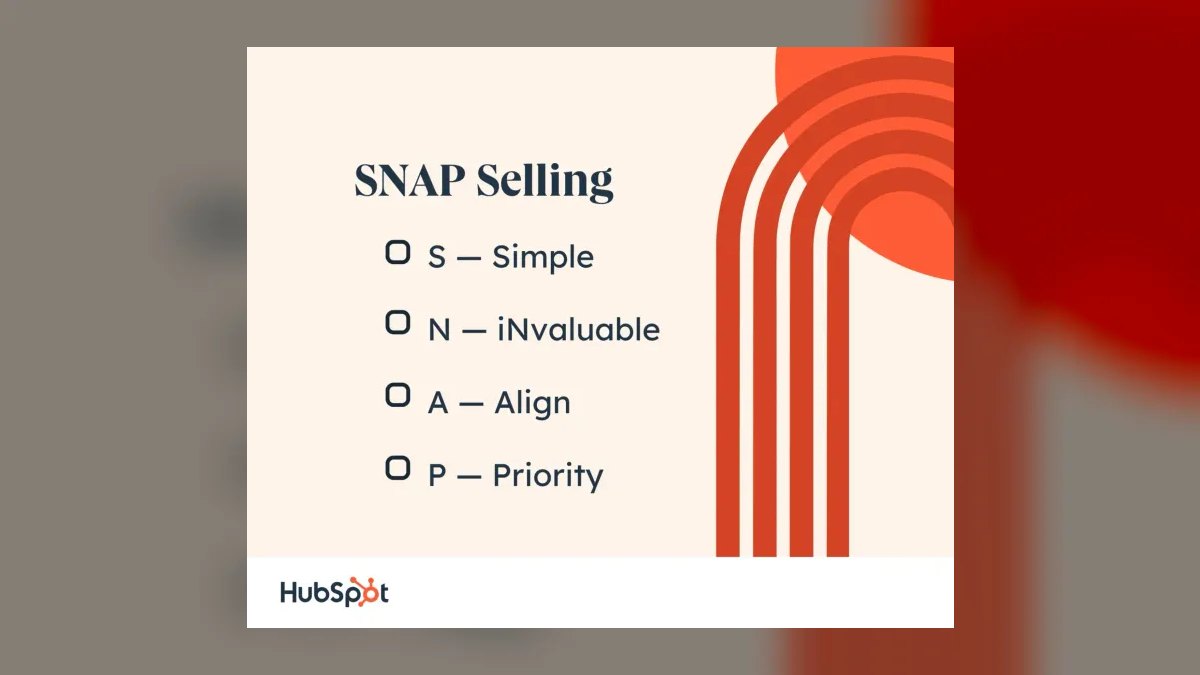
SNAP Selling adapts to remote sales teams in 2027 by moving its four filters — Simple, iNvaluable, Aligned, Priority — out of the live meeting and into asynchronous channels. Remote reps deliver insight before the call through short video, digital sales rooms, and trigger-based outreach, then use engagement data to prioritize ruthlessly across scattered buying committees.
The outcome you should expect
The honest outcome of running a SNAP-shaped remote motion is not a dramatic lift in win rate. It is a dramatic lift in *how much of your week is spent on deals that can actually close*. That distinction matters, because most remote sales teams that adopt a methodology expect the conversion number to move first, get impatient when it doesn't, and abandon the change at week six.
What moves first is calendar composition. A remote rep who applies the Priority filter honestly will disqualify accounts earlier — often within the first two weeks of outreach rather than the first two months. The visible symptom is a pipeline that gets *smaller* before it gets better. Managers who have not been briefed on this read it as a productivity collapse and intervene. Brief them beforehand. The pipeline contraction is the methodology working, not failing, and it typically lasts one full sales cycle before the effect on closed revenue becomes legible.
What moves second is response quality. When every outbound touch is filtered through "is this Simple enough to consume in ten seconds, and does it contain something invaluable the buyer didn't already know," reply rates tend to improve on lower volume. Teams often report fewer sends and more conversations. Whether the absolute numbers improve depends heavily on your list quality, your market's saturation, and whether your "invaluable" insight is genuinely non-obvious — a generic industry statistic pasted into a video is not insight, and buyers in 2027 have been trained by three years of AI-generated outreach to spot it instantly.
What moves third, and slowest, is cycle time. Remote deals stall on internal buyer alignment, not on seller persuasion. SNAP's Aligned pillar attacks exactly that stall — but only if the seller actually maps the committee rather than assuming the champion will do the work. Teams that do the mapping see the stall shorten. Teams that install a digital sales room and call it alignment see nothing change, because the tool is not the practice.

There is also an outcome you should expect that nobody markets: SNAP surfaces which of your reps were relying on charisma. In-person and even on-camera, a warm rep can carry a mediocre message. In asynchronous channels, the message stands alone. A 90-second recorded video with nothing to say is a 90-second video nobody finishes. Expect your performance distribution to widen before your coaching closes it back up.
Finally, expect the framework to be *lighter* than what you replaced. SNAP is not a qualification apparatus like MEDDIC and not a conversation architecture like the Challenger approach. It is a filter for the overloaded buyer. If your remote team has built a fourteen-field qualification form and is now bolting SNAP on top of it, you have misread the methodology. The point is subtraction.
What drives that outcome
Four mechanisms do the actual work, and they are worth separating because teams usually implement one and expect the results of all four.

Attention economics. Jill Konrath's original argument was that the buyer is "crazy busy." In a remote-first 2027, the buyer's attention is not merely scarce — it is *adversarially contested*. Every vendor now has access to the same generative tooling, which means the marginal cost of producing plausible-sounding personalized outreach has collapsed to near zero. Volume went up; signal went down. Simplicity stopped being a stylistic preference and became the only mechanism by which a message gets read at all. A subject line that requires parsing is a subject line that gets archived. The practical version: one idea per message, one action requested, no attachments on first touch.
Insight arbitrage. The iNvaluable pillar asks the seller to bring something the buyer cannot easily get elsewhere. Remotely, this has to survive being consumed alone, with no seller present to fill gaps. That constraint is clarifying. It forces the insight to be self-contained: a specific observation about the buyer's public posture, their hiring pattern, their product changelog, their regulatory exposure. Generic market commentary fails the test because the buyer can generate it themselves in seconds. The arbitrage is in what you know from *pattern exposure across many similar accounts* — the thing an individual buyer structurally cannot see from inside one company.
Committee parallelism. In-person selling is inherently sequential: you get one room, one hour, one set of people. Remote selling can be parallel, and this is its genuine structural advantage — the one thing remote does *better*, not merely adequately. Six stakeholders can each consume role-appropriate material on their own schedule, in their own timezone, without any of them waiting on a calendar. SNAP's Aligned pillar is what turns that theoretical parallelism into a real cycle-time reduction. Without it, parallelism just means six people ignoring the same generic deck independently.
Attention allocation under scarcity. The Priority pillar is a rationing rule for the seller's own hours. Remote reps lack the ambient signals that let in-office sellers course-correct — no overheard call, no manager glancing at a screen, no hallway sanity check. Priority substitutes an explicit rule for those absent signals: define the disqualification criteria in advance, apply them on a schedule, and let the low-scoring accounts go to nurture rather than to a rep's calendar.
The diagram is worth reading as a loop rather than a funnel. The re-scoring path matters: an account that fails the Priority filter today may pass it in three months when a new executive arrives or a contract renewal window opens. Deprioritized is not dead. Remote teams that treat disqualification as permanent throw away half the value of the filter, because they lose the accounts where the only missing ingredient was timing.
Benchmarks and realistic ranges
Be careful with benchmarks here. Published sales-engagement figures vary enormously by segment, list source, and how the vendor publishing them defines the metric, and 2027 outreach volumes have distorted year-over-year comparisons badly. What follows is a framework for setting *your own* baselines rather than a set of numbers to import.
Establish the baseline before you change anything. Run four weeks of your current motion and record: replies per hundred sends, meetings booked per hundred sends, percentage of pipeline that goes sixty days without stakeholder movement, and median days from first touch to first live conversation. Those four numbers are your control. Any SNAP benchmark you read elsewhere is measuring a different list, a different market, and probably a different definition of "reply."

Expect volume down, quality up. A reasonable target for the first quarter is holding meeting count flat on a meaningfully lower send volume. If your team was sending high volumes of lightly personalized sequences, the SNAP version takes longer per touch, so the sends must drop or the quality claim is fiction. Watch the ratio, not the absolute.
Async touches before a live conversation. Most remote teams settle somewhere in the low single digits — roughly three to five meaningful asynchronous interactions before a first real conversation. Beyond that range, you are usually looking at an account that is politely not interested. Set a ceiling and enforce it. The ceiling is a Priority mechanism disguised as a cadence rule.
Time-to-insight. Measure the hours between first buyer response and the moment you deliver something genuinely useful. Same-day is a strong target and is achievable if your research process is prepared in advance rather than improvised. Teams that take a week to send the "invaluable" asset have effectively converted a warm signal into a cold one.
Digital sales room engagement. Track per-stakeholder rather than per-account. Account-level DSR analytics flatter you: one enthusiastic champion opening a page eleven times looks identical to six stakeholders opening it twice. The number that predicts deal progression is *breadth* — how many distinct roles from the committee have engaged with material relevant to them. If only the champion is in the room, you do not have alignment; you have a fan.

Committee size. Complex B2B purchases routinely involve buying groups in the mid-to-high single digits, and remote work has not reduced that. Plan content for at least five distinct concerns: economic, technical, security, end-user, and procurement. If your DSR has one deck, you are serving one of those five.
Cycle time. Do not promise a specific percentage reduction to your leadership. Promise a mechanism: fewer sequential meetings because stakeholder review happens in parallel. Then measure it in your own data over one full cycle. Any external number quoted to you without your segment attached is marketing.
A caution on scoring thresholds. If you build an automated SNAP score, resist the urge to publish a precise cutoff before you have data. Start with the score as *advisory* — shown to the rep, not enforced — for at least one cycle. Then look at which scores actually correlated with closed-won and calibrate. Teams that hard-code a threshold on day one usually encode their existing biases and then congratulate the model for reproducing them.

Risks, edge cases, and failure modes
Tooling substitution. The most common failure is buying a digital sales room and declaring the Aligned pillar complete. The DSR is a container. Alignment is the work of identifying each stakeholder's actual concern and putting something specific in front of it. A beautifully organized room full of generic material is a well-lit empty house.
Insight inflation. As generative tools made competent-sounding content cheap, the bar for "invaluable" rose sharply. Sellers who send AI-summarized public information as insight are not merely neutral — they actively damage credibility, because sophisticated buyers recognize the pattern and downgrade the sender. The safe rule: if the buyer could produce this in under two minutes with a prompt, it is not insight. Use it as connective tissue, never as the payload.
Over-disqualification. Priority is a filter, and filters can be set too tight. A rep under quota pressure who is also told to disqualify aggressively will sometimes clear the pipeline to a level from which recovery is arithmetically impossible. Pair the Priority discipline with an explicit floor on active accounts, and review disqualifications in coaching rather than accepting them silently. The most dangerous version is a rep who disqualifies to *avoid* difficult conversations and reports it as methodology adherence.
Async as avoidance. Asynchronous delivery is a genuine advantage for buyer convenience. It is also a comfortable hiding place for reps who dislike live conversation. Watch for reps whose async-to-live ratio drifts upward indefinitely — the pattern is a rep who has stopped asking for the meeting. SNAP earns the right to a live conversation; it does not eliminate the need for one.

The single-threaded champion. Remote deals are more prone to single-threading than in-person ones, because there is no natural moment where you meet the room. A champion who volunteers to "handle it internally" is often signaling that they cannot get you access. Treat that offer as a risk flag, not a convenience. The specific mitigation: ask the champion which internal objection worries them most, then build the asset that answers it and ask them to forward it. If they will not forward anything, you are not multi-threaded regardless of what the CRM says.
Timezone asymmetry. Globally distributed teams accumulate a hidden tax: each round trip across a large timezone gap costs roughly a business day. Three sequential clarifying questions can burn a week of cycle time invisibly. The mitigation is front-loading — anticipate the next two questions and answer them unasked in the same message. This is Simple applied to sequencing rather than to prose.
Signal decay in engagement data. Engagement analytics degrade as buyers learn they are being tracked. Some stakeholders deliberately avoid tracked links; some forward material outside the room where you cannot see it. Absence of tracked engagement is weak evidence of absence of interest. Never disqualify on tracking data alone — confirm with a direct question.

Regulated and security-sensitive buyers. In sectors with strict procurement or data-handling rules, external sales rooms may be blocked outright, and unsolicited video may be treated as a phishing vector. For these accounts, the SNAP principles still apply but the delivery must change: plain-text, no tracking pixels, attachments only when requested, and patience with a procurement calendar that does not care about your quarter.
Methodology stacking. Organizations rarely retire a framework; they layer. A team running SNAP over MEDDIC over a legacy stage gate has three vocabularies for the same deal and reps who spend more time reconciling them than selling. If you adopt SNAP, name explicitly what it replaces. If it replaces nothing, you have added overhead.
Small-team dynamics. Two- and three-person remote teams often cannot support the tooling assumed by most SNAP content. That is fine. The pillars are behavioral, not technological. A shared document per deal with a stakeholder table, a phone camera video, and a weekly disqualification review reproduces most of the value. The failure mode is a small team concluding it cannot adopt the methodology because it cannot afford the software.
A practical rollout plan
Sequence matters more than speed. The rollouts that fail almost always start with tooling and end with behavior; the ones that hold do the reverse.

Weeks one and two — baseline and language. Capture the four baseline metrics described above. Then run a single ninety-minute session that teaches the four pillars and nothing else. Do not introduce tools. The deliverable is that every rep can state the four filters and apply them to one live account out loud. Konrath's framework survives compression well; that is its point.
Weeks three and four — rewrite the outreach. Take your existing sequences and cut them. Every message gets one idea, one ask, and a length a buyer can consume standing up. Have reps rewrite their own top-performing template rather than handing them a corporate version — ownership of the rewrite is what makes the discipline stick. Run these against live accounts and compare reply rates to baseline. This step alone frequently produces the first visible change.
Weeks five and six — build the insight library. This is the step teams skip, and skipping it is why their iNvaluable pillar stays theoretical. Assemble the genuinely non-obvious things your organization knows: patterns across your customer base, common implementation failure modes, the objection that kills deals in a given segment, what actually happened to accounts that chose a competitor. Write each as a self-contained asset a buyer can absorb alone. Ten strong assets outperform a hundred templated ones.

Weeks seven and eight — stakeholder mapping. Introduce a simple per-deal table: role, primary concern, the one asset that addresses it, current engagement state. Keep it to a single screen. Review it in every pipeline conversation. Only after reps are filling this table reliably should you introduce a digital sales room, because the room is a rendering of the table — build the table first and the room organizes itself.
Weeks nine through twelve — priority discipline. Now install the scoring, advisory only. Reps see the score; nobody is forced to act on it. Hold a weekly disqualification review where each rep names one account they are stopping work on and why. Making disqualification a *public, celebrated* act is the single highest-leverage cultural move in the whole rollout, because it removes the shame that keeps dead deals in the forecast.
Quarter two — calibrate and extend. Compare scores against actual outcomes and adjust. This is also the point to extend the same filters outward: customer success teams can apply Simple and iNvaluable to renewal and expansion conversations with almost no translation, and partner channels benefit from the same insight library. The upstream extension is to marketing — if the sales team has identified which insights actually earn a reply, that is a content roadmap.
A note on what to measure during rollout: track adherence separately from results. Adherence is whether reps are doing the four things. Results are whether the numbers moved. Conflating them means that when results lag — and in the first cycle they will — you cannot tell whether the methodology is wrong for your market or whether nobody is actually running it. In most cases where a remote team concludes "SNAP didn't work for us," adherence data would have shown the sequences were never rewritten.
Related questions
Does SNAP Selling replace MEDDIC or the Challenger approach?
No — they solve different problems. MEDDIC is a qualification apparatus for complex enterprise deals; the Challenger approach is a conversation architecture. SNAP is an attention filter for overloaded buyers. Many remote teams run SNAP for outreach and early qualification while keeping a heavier framework for late-stage enterprise deal inspection.
How small can a remote team be and still run SNAP?
Two people. The pillars are behavioral, not technological. A shared stakeholder table, a phone-camera video, and a weekly disqualification review reproduce most of the value. The tooling described in vendor content is an accelerant for scale, not a prerequisite for the method.
Is video prospecting still effective when everyone is doing it?
Effectiveness now depends almost entirely on content, not format. A short video containing a specific, non-obvious observation about that buyer still performs. A templated video with a swapped name does not. The format is commoditized; the insight inside it is not.
What if our buyers refuse to use a digital sales room?
Fall back to the underlying practice. The room exists to route role-appropriate material to each stakeholder and to reveal who engaged. Email attachments plus a direct question — "who else needs to see this, and what worries them?" — achieves the alignment even without the tool.
Where does SNAP fit after the deal closes?
Cleanly. Renewal and expansion conversations face the same overloaded stakeholder and the same distributed committee. Customer success teams can apply Simple and iNvaluable to quarterly business reviews with almost no translation, which is often the highest-return adjacent use of the framework.
FAQ
Who wrote SNAP Selling and when?
Jill Konrath, a sales strategist and author, published *SNAP Selling* in 2010, with wide paperback circulation following. Her central premise was that buyers are overwhelmed, distracted, and risk-averse, and that sellers must therefore make themselves easy to deal with rather than merely persuasive. That premise has aged unusually well.
What do the four letters actually stand for?
Keep it Simple, be iNvaluable, always Align, and raise Priorities. The order is not a sequence of stages — all four operate simultaneously on every interaction. A message can be simple and still fail if it aligns with nothing the buyer cares about right now.
Does SNAP work for inbound leads or only outbound?
Both, with a different emphasis. Inbound leads have already signaled interest, so the Priority filter matters less at entry and more at qualification. The iNvaluable pillar carries more weight inbound: the buyer arrived with a question, and the fastest genuinely useful answer usually wins the account.
How do you apply SNAP when the buyer will not respond at all?
You change the trigger, not the volume. Silence usually means the timing is wrong rather than the message. Move the account to periodic re-scoring, watch for genuine change signals — leadership moves, funding, regulatory shifts, product launches — and re-engage on the change rather than on your calendar.
Can AI tooling run the Priority pillar without a human?
It can produce the score; a human should still make the call. Automated scoring reflects the historical patterns in your data, which means it reproduces past bias, including systematic under-scoring of segments your team historically neglected. Run it advisory for a full cycle, compare against outcomes, then decide how much authority to grant it.
What is the single biggest mistake remote teams make adopting this?
Adding it on top of everything else. SNAP's power is subtraction — fewer touches, shorter messages, fewer accounts, less process. A team that adopts SNAP while keeping every existing template, stage gate, and required field has taken a simplification framework and used it to add complexity.
Sources
- Jill Konrath — official site and SNAP Selling resources
- SNAP Selling (Portfolio/Penguin Random House)
- Gartner — B2B buying and sales research
- Harvard Business Review — sales and buying-committee research
- HubSpot Sales Blog
- LinkedIn Sales Solutions — State of Sales research
- Forrester — B2B sales and buyer research
- Salesforce — State of Sales report
Related on PULSE
- [How does *SNAP Selling* help you shorten a six-month sales cycle into three months in 2027?](/knowledge/bs0389)
- [How does *SNAP Selling* simplify complex sales cycles in 2027?](/knowledge/bs0344)
- [How does *SNAP Selling* help you simplify a complex product story for a first-time buyer in 2027?](/knowledge/bs0405)
- [How does *Fanatical Prospecting* define the perfect prospecting day for a remote sales team in 2027?](/knowledge/bs0381)
- [How does *SNAP Selling* help you break through the noise in a crowded market?](/knowledge/bs0375)
- [What's the core message of *The Psychology of Selling* for handling rejection in sales?](/knowledge/bs0364)
@Kory-White- · if Venmo asks, the last 4 of my number are 2012
 bsWhat are the key lessons from *Never Split the Difference* for negotiating a raise in 2027?
 bsHow do you apply *Fanatical Prospecting* to LinkedIn outreach in 2027?
 bsHow does *Gap Selling* help you close more deals in a recession in 2027?
 bsWhat sales script does *New Sales. Simplified.* recommend for cold calls in 2027?
 bsDoes *The Psychology of Selling* still hold up for modern sales techniques in 2027?
 bsWhat’s the most actionable principle from *How to Win Friends and Influence People* for remote work in 2027?
 bsWhat’s the biggest mistake *SPIN Selling* warns against in complex B2B sales?
 bsHow does *Fanatical Prospecting* change your daily routine for outbound sales?
 bsWhat’s the most persuasive technique from *Pitch Anything* for investor pitches?
 bsWhat’s the key insight from *The Challenger Sale* for leading a sales team in 2027?