
How does *SNAP Selling* simplify complex sales cycles in 2027?
 Curated byKory White · Fractional CRO · Maryland
 PULSEKNOWLEDGE LIBRARY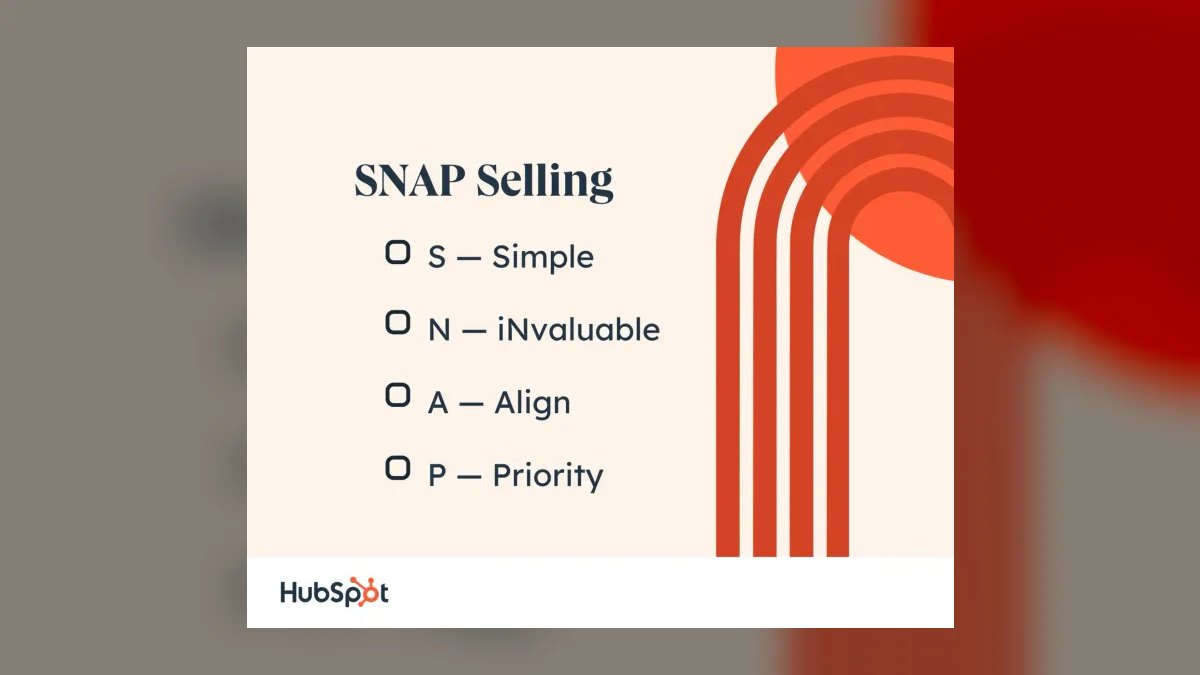
SNAP Selling simplifies complex 2027 sales cycles by forcing every touch through four filters — Simple, iNvaluable, Aligned, Priority — so buyers spend less cognitive effort deciding. Instead of adding stages, stakeholders, and documents, sellers strip decisions down to the fewest choices that still let a frazzled committee move forward confidently.
The eleven-week deal that should have taken four
Picture a mid-market ops platform quoting a 90-seat deployment to a logistics company. The champion is a VP of Operations who liked the demo in week one. By week eleven the deal is still open. Nobody said no. What happened instead is the ordinary way modern complex deals die: the seller sent a 34-page proposal, looped in a solutions architect for a second technical deep-dive, added a security questionnaire, added a procurement intake form, added a reference call, and added a "quick alignment session" with two people who had never heard of the project. Each of those steps was individually defensible. Collectively they turned a yes into a maybe, and a maybe into a queue item that competes with the ERP upgrade, the warehouse lease renewal, and the CFO's hiring freeze.
Jill Konrath's *SNAP Selling* (Portfolio, 2010) was written for exactly this pattern, and the pattern has only intensified. Her framing was that the customer is "frazzled" — overloaded, interrupted, risk-averse, and defended against anything that costs thinking time. The seller's instinct under those conditions is to work harder: more content, more meetings, more proof. Konrath's argument is that effort applied that way is counterproductive, because the buyer's real constraint is not information scarcity. It is attention scarcity and decision risk. Every artifact you add is another thing that must be read, circulated, and defended internally by someone whose day is already full.
The reframe that makes SNAP useful in 2027 is this: the seller is not competing against the other vendor. The seller is competing against the buyer's status quo, their calendar, and the twelve other initiatives that are easier to say yes to. In that contest, whoever makes the decision cheapest to make usually wins. That is a strategy, not a personality trait — it can be designed into a sales process, measured, and enforced.

Applied to the logistics deal, a SNAP-shaped rerun looks different in a few concrete ways. The proposal is one page with a second page of appendix that nobody is required to read. The security questionnaire is pre-answered from a standing library and sent unprompted in week one, before it becomes a blocker. The technical deep-dive is folded into the first demo by having the architect attend, silent, and answer three questions at the end. The reference call is replaced with a two-minute recorded clip from a comparable customer, watchable at 11pm. Each substitution removes a scheduling dependency, which is where calendar time actually leaks. Twelve weeks becomes five or six, not because anyone worked faster, but because there were fewer places for the deal to wait.
That distinction matters for anyone running a revenue operation. Cycle time is mostly *waiting* time, not *working* time. Pull up any CRM stage-duration report and the pattern is consistent: the hours of actual selling labor in a 90-day deal might total fifteen. The other 2,145 hours are the deal sitting in someone's inbox. Simplification attacks the waiting, which is where the leverage is.
How the four filters actually change seller behavior
SNAP is often taught as an acronym and then forgotten, which is a waste, because each letter maps to a specific behavior change that a manager can inspect in a deal review.
Simple means reducing the buyer's cognitive load per interaction. Practically: one recommendation instead of three packages, one page instead of thirty, one next step instead of a menu. The test is not whether *you* find it simple — it is whether the champion can accurately re-explain your offer to their CFO in ninety seconds without notes. If they can't, you have not simplified; you have merely shortened. Konrath's emphasis on the "so what" of every message applies here: an email that requires the buyer to infer why it matters is a tax, not a touch.

iNvaluable means the seller is worth talking to independent of whether a purchase happens. In 2027 this bar has moved. Generic market education is now free and infinite; a buyer can get a competent overview of any category in four minutes without speaking to a human. What remains scarce is pattern knowledge from having watched forty similar implementations succeed or fail — which integrations break, which internal politics kill rollouts, what the real staffing cost is in month three. That is not retrievable from a search box, and it is the only kind of "value-add" that still earns a meeting in a crowded calendar.
Aligned means your process maps to their buying reality rather than your pipeline stages. If their fiscal year closes in January and their budget is committed in November, a February push is arguing with physics. If their procurement requires three quotes, get them three quotes rather than fighting it. Alignment also means matching the buyer's preferred channel and pace — some champions want a weekly 15-minute call, others want async updates and will resent every invite.
Priority means helping the buyer see why this belongs above the line now. This is the least-practiced letter and the one that most often decides complex deals, because in a portfolio of competing initiatives, "good idea, not this quarter" is functionally a loss. Priority framing ties your solution to something already on the executive agenda: a stated board metric, a compliance deadline, a hiring plan, an announced expansion.
The four filters compound. A simple offer that isn't a priority stalls. A priority that isn't simple gets stuck in committee. The framework's value is diagnostic — when a deal freezes, you can ask which of the four failed rather than guessing.
Notice what the diagram implies operationally: three of the four failure modes look identical in the CRM. The deal is open, the champion is friendly, nothing is marked lost. That is why simplification has to be enforced at the input side — the artifacts and steps you allow into a deal — rather than diagnosed after the fact from pipeline data.
There is a useful adjacent application here. The same four filters work on internal deals: getting a systems change approved, getting headcount, getting a data migration prioritized. Revenue operations leaders who use SNAP on their own executive team tend to internalize it faster than those who only apply it to customers, because they feel the frazzled-buyer problem from the other side.
What the numbers look like when you actually simplify
Be careful with benchmarks in this area — published sales-cycle statistics vary enormously by deal size, industry, and how a vendor defines "cycle start." Treat the following as planning ranges to instrument against your own baseline, not as claims about your business.
Stage count. Many mid-market processes carry seven to nine CRM stages, several of which exist for forecast hygiene rather than buyer reality. Collapsing to four or five buyer-meaningful stages — problem confirmed, solution fit confirmed, economics confirmed, terms confirmed — usually reveals two or three internal steps that never touched the customer. Those are free to delete.
Document length. A one-page recommendation plus optional appendix versus a 30-page proposal is not a cosmetic change. Circulation is what costs time: a short document gets forwarded and read same-day, a long one gets scheduled for reading and then isn't. If you track time-from-send to first-response on proposals, this is one of the few changes where the effect shows up within a single quarter.
Stakeholder count. Complex B2B purchases routinely involve six to ten people, and that number has trended upward for a decade across published research from Gartner and CEB. SNAP does not pretend you can shrink the committee. It says you should shrink what each member must process. Give the security reviewer a security packet, not the full deck. Give the CFO a payback figure with its assumptions on one page. Give the end-user lead a workflow walkthrough. The committee stays at eight; the reading load per person drops by most of its volume.
Meeting count. Count the distinct calendar events required to get from first conversation to signature in your last ten closed-won deals. In many organizations it's nine to fourteen. Each one carries a scheduling delay averaging several business days for a multi-person invite. Removing three meetings by folding attendees together or replacing a live session with a recorded one can pull two to three weeks out of the cycle without touching the sales conversation's substance at all.
Response latency. Track hours from buyer question to substantive seller answer, not to acknowledgment. Sub-four-hour answers on weekdays keep momentum; multi-day gaps invite the deal to fall down the priority list. This is the metric most within a seller's unilateral control and the one most often unmeasured.
Where to instrument. Baseline four things before changing anything: median stage duration, meeting count per closed deal, proposal-to-response latency, and stalled-deal rate at 60 days. Then make one simplification at a time and watch which needle moves. Konrath's own standard is worth adopting as a gate: if cycle time isn't dropping, you haven't simplified enough — you've just made a shorter version of the same complicated process.
One caution on measurement. Cycle time can shrink for a bad reason: you started disqualifying faster and only easy deals remain. Always read cycle time alongside win rate and average deal size. A 30% cycle reduction with a 20% drop in deal size is a mix change, not a process improvement.
Trade-offs, and where other methodologies fit better
SNAP is not a universal replacement, and treating it as one produces predictable damage. Its bias toward compression works against a specific class of deal: genuinely novel, high-risk, first-of-kind purchases where the buyer's uncertainty is real rather than manufactured by seller clutter. If a hospital system is replacing a clinical workflow that affects patient safety, a nine-month evaluation is not friction — it is due diligence. Compressing it signals that you don't understand the stakes.
The honest framing is that SNAP optimizes for *decision cost*, while methodologies like MEDDIC or MEDDPICC optimize for *qualification rigor*, and Challenger optimizes for *reframing the buyer's thinking*. These are complementary lenses on the same deal, not competitors. MEDDIC tells you whether the deal is real; SNAP tells you whether it's easy to say yes to. A team running MEDDIC discipline with SNAP-shaped artifacts is in a stronger position than one running either alone.
The specific trade-offs worth naming:
Simplicity versus completeness. A one-page proposal omits things. If your buyer's procurement genuinely requires the detail, the one-pager becomes a second round-trip and you've *added* a cycle. The fix is the appendix pattern — short front, complete back, explicit signal about which is required reading.
Compression versus trust-building. Long cycles do produce something real: familiarity. Cutting three meetings can cut three relationship-building opportunities. In relationship-driven segments and long-tenured verticals, that cost can exceed the time saved. Compress process steps, not human contact.
Priority framing versus manufactured urgency. The line between "here's why this matters to your Q3 board metric" and "this discount expires Friday" is the line between credibility and its opposite. Sophisticated buyers in 2027 recognize artificial deadlines instantly, and the penalty is not just a lost deal but a poisoned relationship. Use real business events only.

Single-threading versus committee coverage. Focusing on one champion is faster and more fragile. Champions change jobs. A deal built entirely on one relationship is a deal with a single point of failure, and the reorganization rate in most companies makes that a meaningful risk over a two-quarter cycle.
An adjacent note for RevOps teams: the same trade-off analysis applies to your tooling stack. Every field you make required, every approval you route, every mandatory step in the CPQ flow is friction you are adding to your own sellers' cycles. Teams that apply SNAP thinking to customers while running a twelve-approval quote process are simplifying one half of a two-sided problem.
Where teams get this wrong
Confusing brevity with simplicity. The most common failure. A team cuts the proposal from 30 pages to 6, keeps all 30 pages' worth of concepts, and now the buyer has a dense document instead of a long one. Simplification means removing *decisions* and *concepts*, not just words. Test it by asking a colleague outside the deal to state the recommendation after one read.

Simplifying the seller's work instead of the buyer's. Automated sequences, templated outreach, and AI-drafted follow-ups make the seller's day simpler while often making the buyer's inbox worse. If your simplification initiative increased outbound volume, you moved the complexity onto the customer.
Killing discovery in the name of speed. A short cycle built on a misdiagnosed problem produces a fast close and a churned account eleven months later. Compress the *scheduling and paperwork*; do not compress your understanding of what the buyer actually needs. The measure is meetings-to-clarity, not questions asked.
Treating priority framing as a scripting exercise. Priority only works when tied to something the buyer already cares about, which means you have to know their operating calendar, their board metrics, and their competing projects. Reps who haven't done that homework fall back on discount deadlines, which is the failure mode buyers are most trained to resist.
Skipping the alignment audit. Most teams never map their stages against actual buyer stages. Spend an afternoon interviewing three recent buyers about the steps they went through internally. The mismatch is usually larger than expected, and the fix is usually deleting a stage rather than adding one.
Under-serving the silent evaluators. Security, legal, and IT rarely appear in the seller's narrative until they block the deal. Pre-emptively supplying a security packet, a standard MSA redline position, and an integration architecture summary in week one removes the three most common late-stage stalls. This single change often does more for cycle time than any conversational technique.
Letting the CRM enforce the old complexity. If your pipeline requires eleven fields to advance a stage, reps will spend selling time on data entry and will route around the process. Simplification has to include the internal system, or the buyer-facing changes get eaten by administrative drag.
Rolling it out as training instead of process. A two-day workshop produces a two-week behavior change. Durable adoption comes from changing artifacts and gates: replace the proposal template, cap the deck length, add a "which SNAP filter is failing?" question to every stalled-deal review. Behavior follows the tooling.
Related questions
Does SNAP Selling work for enterprise deals over $500K?
Yes, but selectively. Large deals carry legitimate diligence that shouldn't be compressed. Apply SNAP to artifacts and scheduling — pre-answered security packets, one-page executive summaries, folded meetings — while preserving full technical and legal rigor.
How is SNAP different from the Challenger Sale?
Challenger focuses on reframing how the buyer thinks about their problem, using teaching and constructive tension. SNAP focuses on reducing the effort required to decide. They target different bottlenecks and are frequently used together on the same deal.
Can SNAP shorten a cycle without hurting deal size?
Often, but verify it. Cycle time can drop because you're winning smaller deals faster. Always read cycle time alongside average deal size and win rate before declaring the simplification a success.
What's the fastest SNAP change to implement this quarter?
Replace your standard proposal with a one-page recommendation plus optional appendix, and send your security and compliance documentation unprompted in week one. Both are artifact changes requiring no retraining, and both attack scheduling delays directly.
Does AI-assisted buying make SNAP more or less relevant?
More. When buyers arrive pre-researched by AI tools, generic education has zero value and the seller's remaining edge is pattern knowledge and decision simplification — precisely what the iNvaluable and Simple filters describe.
FAQ
Who wrote SNAP Selling and when? Jill Konrath, published by Portfolio in 2010, with the subtitle "Speed Up Sales and Win More Business with Today's Frazzled Customers." Konrath also wrote *Selling to Big Companies* and *Agile Selling*, both of which extend the same concern with buyer attention scarcity.
Is SNAP a full sales methodology or a communication framework? Closer to a communication and prioritization framework than a stage-gated methodology. It doesn't prescribe pipeline stages or qualification criteria, which is why it layers cleanly on top of MEDDIC, Sandler, or whatever process you already run.
How do I know which SNAP filter is failing on a stalled deal? Ask four diagnostic questions in your deal review. Can the champion re-explain the offer unaided? Would they take your call if they weren't buying? Does your timeline match their fiscal and procurement calendar? Can they name the executive priority this ladders up to? The first "no" is your answer.
Does simplifying mean using fewer stakeholders? No. Committee size is largely outside your control and has been growing for years. SNAP reduces the processing burden per stakeholder — targeted materials for each role — rather than trying to shrink the group.
What's a realistic timeline to see results? Artifact changes such as proposal length and pre-sent compliance documentation show up in response latency within weeks. Full cycle-time improvement needs at least one complete sales cycle to read cleanly, so a 90-day cycle means roughly two quarters before the data is trustworthy.
How do I stop simplification from becoming under-selling? Keep a completeness backstop. Short front, complete appendix. The rule is that nothing is *removed* from the buyer's access — it's removed from their *required reading*. That distinction preserves rigor while cutting decision cost.
Sources
- https://www.jillkonrath.com/
- https://www.penguinrandomhouse.com/books/307129/snap-selling-by-jill-konrath/
- https://www.gartner.com/en/sales/topics/b2b-buying-journey
- https://hbr.org/2012/07/the-end-of-solution-sales
- https://hbr.org/2017/03/the-new-sales-imperative
- https://www.salesforce.com/resources/research-reports/state-of-sales/
- https://blog.hubspot.com/sales/sales-methodology
- https://www.mckinsey.com/capabilities/growth-marketing-and-sales/our-insights
Related on PULSE
- [How does *SNAP Selling* help you simplify a complex product story for a first-time buyer in 2027?](/knowledge/bs0405)
- [How does *SNAP Selling* help you shorten a six-month sales cycle into three months in 2027?](/knowledge/bs0389)
- [What's the biggest mistake *SPIN Selling* warns against in complex B2B sales?](/knowledge/bs0337)
- [How does *SNAP Selling* adapt to remote sales teams in 2027?](/knowledge/bs0331)
- [How does *SNAP Selling* help you break through the noise in a crowded market?](/knowledge/bs0375)
- [What's the core message of *The Psychology of Selling* for handling rejection in sales?](/knowledge/bs0364)
@Kory-White- · if Venmo asks, the last 4 of my number are 2012
 bsWhat are the key lessons from *Never Split the Difference* for negotiating a raise in 2027?
 bsHow do you apply *Fanatical Prospecting* to LinkedIn outreach in 2027?
 bsHow does *Gap Selling* help you close more deals in a recession in 2027?
 bsWhat sales script does *New Sales. Simplified.* recommend for cold calls in 2027?
 bsDoes *The Psychology of Selling* still hold up for modern sales techniques in 2027?
 bsWhat’s the most actionable principle from *How to Win Friends and Influence People* for remote work in 2027?
 bsWhat’s the biggest mistake *SPIN Selling* warns against in complex B2B sales?
 bsHow does *Fanatical Prospecting* change your daily routine for outbound sales?
 bsWhat’s the most persuasive technique from *Pitch Anything* for investor pitches?
 bsWhat’s the key insight from *The Challenger Sale* for leading a sales team in 2027?