
What’s the key insight from *The Challenger Sale* for leading a sales team in 2027?
 Curated byKory White · Fractional CRO · Maryland
 PULSEKNOWLEDGE LIBRARY
The key insight from *The Challenger Sale* for leading a sales team in 2027 is that the Challenger profile — built on teaching, tailoring, and taking control — outperforms the Relationship Builder because self-service AI research has already answered buyers' basic questions before a rep ever gets a meeting. Leaders must rebuild hiring, coaching, and compensation strategy around delivering commercial insight, not warmth.
Two Ways to Lead: Relationship Builder vs. Challenger
Every sales leader in 2027 is really choosing between two competing operating models for the team, and the choice shapes everything downstream — who you hire, how you coach, and what you pay for. The first model, the Relationship Builder approach, optimizes for responsiveness, likability, and service. Reps under this model measure success by how quickly they answer emails, how often they check in, and how well-liked they are by their champion. It was a defensible strategy when buyers lacked easy access to information and depended on a rep to walk them through options. That dependency is gone. By 2027, a buyer researching a six-figure software purchase can pull competitor comparisons, pricing benchmarks, and implementation risk summaries from generative AI tools in minutes, then arrive at a vendor call already holding a shortlist and a set of assumptions.
The second model, the Challenger approach, optimizes for disruption instead of comfort. A Challenger-led team trains reps to walk into every conversation with a point of view the buyer hasn't already assembled — a reframe of the problem, not a recap of the solution. Where the Relationship Builder rep asks "what do you need?", the Challenger rep opens with "here's a cost you're probably not counting." The original research behind the book grouped sales reps into five behavioral profiles — Hard Worker, Challenger, Relationship Builder, Lone Wolf, and Problem Solver — and found that in complex, considered-purchase sales, reps with Challenger tendencies were dramatically overrepresented among top performers, while Relationship Builders were dramatically underrepresented. That gap only widens as buyers get more self-sufficient, because a rep whose entire value proposition is "I'm easy to work with" has nothing left to offer once the buyer no longer needs hand-holding to get information.

The practical difference shows up in the first five minutes of a discovery call. A Relationship Builder leader coaches reps to build rapport, ask open questions, and let the buyer set the agenda. A Challenger leader coaches reps to arrive with a one-page reframe — a specific, defensible claim about a blind spot in the buyer's current approach — and to use that claim to steer the conversation toward criteria the rep's product satisfies best. Neither model is inherently "nicer" or "more aggressive" in tone; the difference is who is doing the thinking. Under Relationship Building, the buyer thinks and the rep serves. Under Challenger, the rep thinks first and the buyer reacts. In a market where buyers arrive pre-loaded with AI-generated opinions, only the second model creates something the buyer couldn't get on their own — which is exactly what earns a seat at the table instead of being one more line item to compare.
How to Decide Which Model Fits Your Team
Not every team should flip to a pure Challenger model overnight, and leaders need a repeatable way to decide how far and how fast to move. The decision comes down to three questions, evaluated in sequence: How complex is the sale? How informed does the buyer arrive? And how much margin pressure is the team under? Deals that are transactional, low-price, and single-stakeholder — a self-serve SaaS seat, a small renewal — don't reward the overhead of building a reframe narrative for every call; a lighter, faster, Relationship Builder-adjacent motion still wins there because speed matters more than disruption. But deals that are complex, multi-stakeholder, and high-consideration — the kind with a committee, a budget owner, and a multi-month evaluation — are exactly where a Challenger strategy pays off, because those are the deals where AI-assisted buyers arrive the most pre-formed and the most resistant to a generic pitch.

Leaders should run this decision at the segment level, not just the company level, because most sales orgs carry both deal types at once. A useful exercise is to plot every active deal type on two axes — deal complexity and buyer self-sufficiency — and use the result to decide where to concentrate Challenger coaching investment first. Teams that try to apply full Challenger rigor to every SMB transactional deal burn coaching hours for little return; teams that leave their enterprise reps on a pure Relationship Builder playbook lose the exact deals where margin and lifetime value are highest.
Once a segment is flagged for the Challenger strategy, the leader's job shifts from picking the model to enforcing it — through deal reviews that specifically ask whether the rep taught something new, tailored it to the right stakeholder, and controlled the next step. Skipping that enforcement is the single most common reason a Challenger rollout fails: leaders announce the model but keep grading reps on the old Relationship Builder rubric of activity and friendliness.

The Numbers Behind Each Leadership Model
The operational difference between the two models becomes clearest when you look at how leaders should structure coaching time, compensation, and process checkpoints under each. A Relationship Builder-oriented team typically spends the bulk of its manager coaching time — often 60% or more — on pipeline hygiene, activity volume, and account check-ins, with coaching cadences built around weekly one-on-ones that review call counts and follow-up cadence. Compensation in that model tends to reward closed revenue with a flatter structure, commonly a 60/40 or 70/30 base-to-variable split, because the job is defined more by consistency than by high-variance skill.
A Challenger-oriented team needs to rebalance that time and pay structure toward the behaviors that actually move complex deals. Leading organizations that have adopted the model typically shift manager coaching time so that a third to half of it is spent specifically reviewing the quality of a rep's reframe narratives and stakeholder tailoring, not just pipeline stage movement — meaning a manager might sit through two to three live or recorded discovery calls per rep per month purely to grade teaching quality, on top of standard pipeline reviews. Compensation plans in a Challenger model more often shift toward a 50/50 base-to-variable split with accelerators tied to deal size and margin rather than flat commission, because the goal is to reward reps for creating value in a negotiation, not simply for closing at whatever price the buyer proposes.

Hiring funnels also need different numeric targets. A Relationship Builder hiring process can move a high volume of candidates through quickly because the core screen — likability, responsiveness, cultural fit — is fast to assess in a single interview round. A Challenger hiring process needs at least one dedicated round built around a role-play where the candidate must challenge a fictional buyer's stated assumption, and leaders should expect to interview more candidates per hire — often two to three times as many — because the ability to disagree persuasively and back it with a business case is rarer than agreeableness. Ramp time also runs longer: where a Relationship Builder rep might hit full productivity in six to eight weeks once they know the product, a Challenger rep typically needs eight to twelve weeks, because the first several weeks must be spent building genuine command of the buyer's industry and P&L drivers before they can credibly challenge anyone.
Finally, buying-committee size is a number every 2027 leader needs to plan around regardless of which model they run: enterprise software purchases routinely involve six or more distinct stakeholders with different priorities — finance, security, operations, end users, procurement, and an executive sponsor — which is precisely why the tailoring pillar of the Challenger model, not just the teaching pillar, has become non-negotiable at the complex end of the pipeline.

Rolling Out the Challenger Model: Sequencing the Change
Leaders who try to convert an entire sales team to a Challenger strategy in one announcement almost always fail, because the model requires new skills, new metrics, and new confidence all at once, and reps revert to old habits under quota pressure if the rollout isn't sequenced deliberately. The rollout works best as a five-stage sequence spread across one to two quarters rather than a single kickoff meeting.
Stage one is diagnosis: before changing anything, leaders should audit the current team against the five behavioral profiles, using deal-review transcripts and win/loss interviews to identify which reps already show Challenger tendencies naturally. These reps become the pilot group, not the whole team. Stage two is pilot: run the new model with three to five volunteer reps on the complex, multi-stakeholder segment identified during the decision framework above, and give them explicit permission to slow down deals in exchange for building a real reframe narrative — rushing the pilot to hit quarterly numbers defeats the purpose. Stage three is proof: after six to eight weeks, compare the pilot group's win rate, sales-cycle length, and average deal size against a matched control group still running the old playbook; this comparison, not a mandate from leadership, is what earns buy-in from skeptical reps. Stage four is scale: roll the model to the broader team in cohorts of six to eight reps, pairing each cohort with a manager who has already coached through the pilot, and update hiring rubrics and compensation plans at this stage — not before, since changing pay before proving the model breeds resentment. Stage five is institutionalization: bake teaching quality, tailoring evidence, and control indicators into the CRM and the standing deal-review cadence so the model survives manager turnover instead of depending on one champion's memory.

Sequencing matters because each stage produces the evidence the next stage needs: the pilot produces the proof that earns scale, and scale produces the volume of data that justifies rewriting compensation. Leaders who skip straight to a company-wide mandate skip the proof step, and reps who don't believe the model works simply perform the language of teaching and tailoring without doing the harder cognitive work of actually challenging a buyer's thinking.
Related questions
Is the Challenger model still relevant now that AI does the research for buyers?
Yes — arguably more relevant. AI answers factual questions, but it can't build the emotional tension or credibility of a live reframe. The rep's job shifts from informing to disrupting a conclusion the buyer already reached.
Can a Relationship Builder rep become a Challenger through coaching alone?
Partially. Reps can learn teaching and tailoring techniques, but the underlying comfort with conflict is harder to coach. Many leaders retrain willing reps while routing pure Relationship Builders toward account management instead.
Does the Challenger approach work in transactional, low-price sales?
Generally no. The overhead of building a tailored reframe narrative only pays off in complex, multi-stakeholder deals with real evaluation cycles. Simpler transactional sales are usually better served by a faster, lighter motion.
How long does it take to see results from a Challenger rollout?
Most leaders see measurable movement in win rate and cycle length within six to eight weeks of a focused pilot, though full team-wide adoption and habit formation typically takes one to two full quarters.
FAQ
What if my team is full of Relationship Builders — can I retrain them? Some can adapt through intensive coaching and role-play, but the underlying trait of agreeableness is hard to override completely. Many leaders find it more effective to hire new Challenger-oriented reps and reassign strong Relationship Builders into account management, where their natural strengths still create value.
Does the Challenger approach only work for enterprise sales? It works best in complex, high-value B2B sales with multiple stakeholders and a long evaluation cycle. For simple transactional sales, the extra effort of building a tailored reframe for every deal is usually not worth the return, and a simpler, faster motion performs better.
How do I measure "teaching" inside a CRM? Track specific, loggable activities: number of tailored insight documents sent, stakeholder-specific presentations delivered, and manager ratings of call recordings for reframe quality. Some teams also use call-transcript analysis to flag language patterns associated with challenging a buyer's assumption rather than simply answering questions.
Will AI replace the Challenger rep by 2027? No. AI can surface data and even draft a reframe outline, but it cannot read a live room, build trust under pressure, or decide in real time when to push and when to pause. The human judgment at the center of the Challenger model remains the differentiator; AI becomes a tool the rep uses to prepare, not a substitute for the conversation.
What if a buyer refuses to engage with a Challenger-style pitch? That resistance is itself useful information. A buyer who won't tolerate having their thinking challenged is often not ready to change, which means they're unlikely to be a strong-fit customer regardless of approach. Treating the Challenger conversation as a qualification filter saves the team time on deals unlikely to close well.
How do I get buy-in from skeptical reps before a full rollout? Run a small pilot with volunteer reps on your most complex segment, measure win rate and cycle time against a control group, and let the results make the case. Tying compensation changes to demonstrated Challenger behavior after the pilot proves itself works better than mandating the shift up front.
Sources
- https://hbr.org
- https://www.gartner.com
- https://www.challengerinc.com
- https://en.wikipedia.org/wiki/The_Challenger_Sale
- https://www.forrester.com
- https://business.linkedin.com/sales-solutions/blog
- https://www.mckinsey.com
- https://www.penguinrandomhouse.com
Related on PULSE
- [What's the key insight from *The Challenger Sale* about teaching customers something they don't know?](/knowledge/bs0402)
- [What's the single most effective tactic from *The Challenger Sale* for shortening a long sales cycle in 2027?](/knowledge/bs0410)
- [What's the biggest takeaway from *The Challenger Sale* for B2B sales in 2027?](/knowledge/bs0320)
- [How does *Fanatical Prospecting* define the perfect prospecting day for a remote sales team in 2027?](/knowledge/bs0381)
- [What's the best chapter in *How to Win Friends and Influence People* for leading a team in 2027?](/knowledge/bs0376)
- [How does *Predictable Revenue* recommend structuring a sales team for growth in 2027?](/knowledge/bs0371)
@Kory-White- · if Venmo asks, the last 4 of my number are 2012
 bsWhat are the key lessons from *Never Split the Difference* for negotiating a raise in 2027?
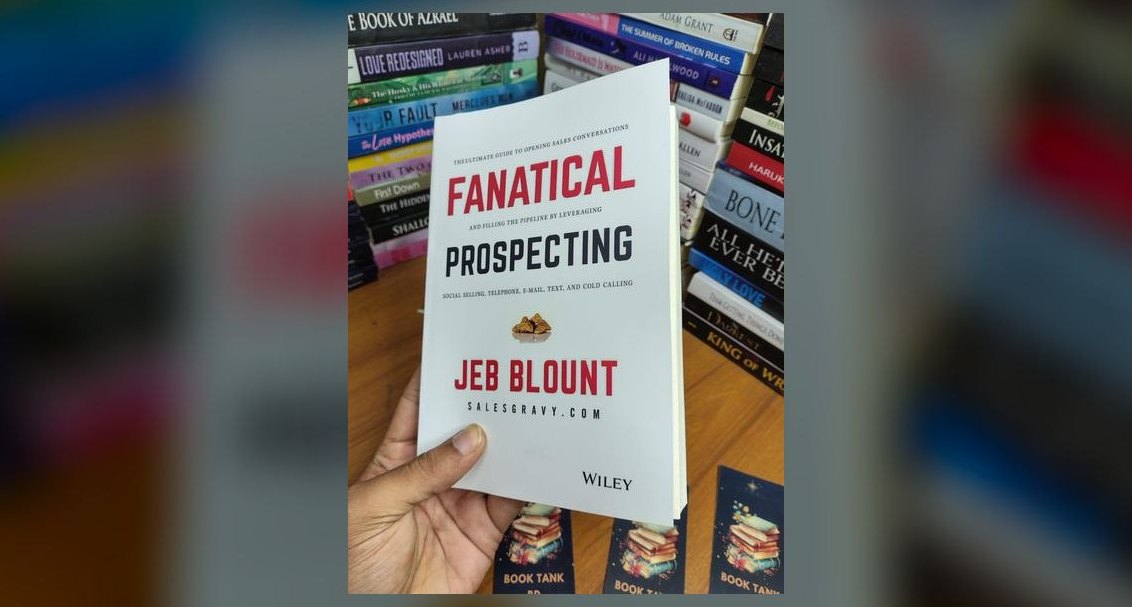 bsHow do you apply *Fanatical Prospecting* to LinkedIn outreach in 2027?
 bsHow does *Gap Selling* help you close more deals in a recession in 2027?
 bsWhat sales script does *New Sales. Simplified.* recommend for cold calls in 2027?
 bsDoes *The Psychology of Selling* still hold up for modern sales techniques in 2027?
 bsWhat’s the most actionable principle from *How to Win Friends and Influence People* for remote work in 2027?
 bsWhat’s the biggest mistake *SPIN Selling* warns against in complex B2B sales?
 bsHow does *Fanatical Prospecting* change your daily routine for outbound sales?
 bsWhat’s the most persuasive technique from *Pitch Anything* for investor pitches?
 bsHow do you use *Never Split the Difference* to handle difficult conversations with customers in 2027?