
How do you apply *The JOLT Effect* to reduce buyer hesitation in enterprise sales?
 Curated byKory White · Fractional CRO · Maryland
 PULSEKNOWLEDGE LIBRARY
The JOLT Effect by Matthew Dixon and Ted McKenna (2022) is the essential companion to *The Challenger Sale*, addressing the single biggest obstacle in modern enterprise sales: buyer hesitation—not rejection, but the indefinite stall where prospects agree on value yet refuse to decide. Based on a study of 2.5 million sales conversations analyzed by Gartner's research team, the book reveals that the primary cause of lost deals today is not "no" but "not yet" — a phenomenon called "status quo bias" amplified by risk aversion and information overload. The JOLT framework offers a four-step method to break this paralysis: Judge the level of hesitation, Offer a clear diagnosis of the customer's indecision, Limit the exploration of alternatives, and Take the risk off the table with a "negative double" close. The most counterintuitive insight: pushing more value or benefits actually makes hesitation worse—the fix is to reduce the perceived risk of deciding, not increase the reward.
1. Part One — The Hesitation Problem (Chapters 1-3)

1.1 Chapter 1 — The Silent Deal Killer

Dixon and McKenna open with a startling Gartner finding: 60% of B2B deals that reach the evaluation stage end in "no decision" — the buyer simply walks away. The culprit is not competition or budget but hesitation driven by information asymmetry and fear of regret. The authors argue that enterprise sales has shifted from a "buyer education" problem (where reps teach value) to a "buyer commitment" problem (where reps must overcome the "analysis paralysis" that comes with too many options and too much risk).
The book's core thesis: selling more value is the wrong response to hesitation. When a buyer is stuck, piling on additional benefits, case studies, or ROI calculators only deepens the stall. The real lever is reducing the cost of making a wrong decision — not increasing the reward of a right one.
1.2 Chapter 2 — The Two Types of Hesitation
The authors distinguish between two distinct hesitation modes:
- "I need more information" hesitation — the buyer genuinely lacks data to evaluate the solution. This is rare in enterprise sales today because buyers are already 67% of the way through their purchase journey before contacting a rep.
- "I need to be sure" hesitation — the buyer has enough information but is paralyzed by the fear of choosing wrong. This is the dominant form of hesitation in complex B2B deals.
The critical insight: most reps treat all hesitation as the first type and respond with more data, demos, and ROI proofs — which actually fuels the second type by adding more variables to evaluate. The JOLT framework is designed exclusively for "need to be sure" hesitation.
1.3 Chapter 3 — The "Negative Double" Discovery
The book's most powerful tool is the "negative double" — a closing technique borrowed from bridge card game where you name the worst-case scenario of your solution failing, then offer a guarantee that mitigates that risk. For example: "If this implementation doesn't reduce your support tickets by 30% in six months, we'll refund your first year's license fee and help you migrate back to your old system at no cost."
The psychology: buyers are more motivated by avoiding loss than achieving gain (loss aversion theory from Kahneman). By taking the worst outcome off the table, you remove the buyer's primary reason for stalling. The negative double works because it converts an uncertain future into a bounded risk — the buyer can now see a ceiling on their potential downside.
2. Part Two — The JOLT Framework (Chapters 4-7)
2.1 J — Judge the Level of Hesitation
The first step is diagnosis: is the buyer truly hesitant, or are they just slow? The authors provide a hesitation diagnostic with three signals:
- Decision avoidance — the buyer repeatedly postpones meetings, asks for more data, or brings in new stakeholders without a clear reason.
- Analysis paralysis — the buyer requests endless comparisons, RFPs, or ROI models but never reaches a conclusion.
- Risk amplification — the buyer focuses on worst-case scenarios, asks about implementation failures, or demands references from failed deployments.
The key is to qualify hesitation severity on a scale from "mild" (needs a nudge) to "severe" (needs a full JOLT intervention). Mild hesitation might respond to a simple timeline push; severe hesitation requires the full framework.
2.2 O — Offer a Diagnosis of Their Indecision

Once hesitation is confirmed, the rep must name the problem — not the buyer's problem with their business, but the buyer's problem with making a decision. The script: "I've noticed we've been going back and forth on this for three months. In my experience, that usually means one of two things: either you don't believe the solution will work, or you're worried about what happens if it doesn't. Which one is it?"
This direct confrontation is uncomfortable but necessary. The book shows that buyers respect reps who diagnose their hesitation because it signals honesty and confidence. The diagnosis also reframes the conversation from "proving value" to "removing risk" — a much more productive frame for hesitant buyers.
2.3 L — Limit the Exploration of Alternatives

The most counterintuitive step: stop presenting more options. Hesitant buyers often ask for "one more demo" or "a comparison with Vendor X." The JOLT framework says the rep must actively limit the buyer's exploration by:
- Narrowing the choice set — "We've evaluated three vendors. Let's focus on the two that actually meet your requirements."
- Eliminating the status quo — "Staying with your current system is actually the riskiest option because it's already failing to meet your growth targets."
- Setting a decision deadline — "We can keep this proposal open until Friday. After that, the pricing changes and the implementation slot goes to another client."
The psychology: more choices increase hesitation (the paradox of choice). By limiting options, you reduce the buyer's cognitive load and make a decision feel more manageable.
2.4 T — Take the Risk Off the Table

The final step is executing the negative double. This is not a standard guarantee — it must be specific, measurable, and credible. Examples from the book:
- "If the software doesn't reduce your onboarding time by 40% in six months, we'll refund the first year and help you transition back."
- "If the implementation causes any downtime, we'll credit you a month of service for every hour of outage."
- "If your team doesn't adopt the platform within 90 days, we'll provide free training until they do."
The negative double works because it transfers risk from the buyer to the seller. The buyer's fear is no longer "what if this fails?" but "what if I miss this opportunity?" The authors emphasize: the guarantee must be painful for the seller to honor — otherwise it's not credible.
3. Part Three — Implementation and Pitfalls (Chapters 8-10)
3.1 Chapter 8 — The Hesitation Audit
Dixon and McKenna recommend a hesitation audit for every deal in the pipeline. The audit asks:
- How long has this deal been in the current stage?
- How many stakeholders have been added in the last 30 days?
- How many times has the buyer asked for "one more thing"?
- Has the buyer explicitly stated what they're afraid of?
Deals with three or more hesitation signals are at high risk of no-decision. The audit forces reps to confront the stall rather than hoping it resolves itself.
3.2 Chapter 9 — The Role of Sales Leadership
For managers, the book offers a hesitation playbook for coaching reps:
- Role-play the negative double — reps need to practice saying "if this fails, we'll refund you" without flinching.
- Track hesitation metrics — measure time-to-decision, number of stakeholder additions, and "no decision" rates.
- Reward risk-taking — reps who use the negative double and close hesitant deals should be celebrated, not penalized for the guarantee cost.
The authors argue that most sales organizations inadvertently reward hesitation by allowing reps to keep deals open indefinitely. The JOLT framework requires cultural permission to push buyers — which many sales leaders are uncomfortable with.
3.3 Chapter 10 — Common Mistakes
The book warns against three common misapplications:
- Using JOLT too early — if the buyer genuinely needs information (hesitation type 1), JOLT backfires. The framework is only for "need to be sure" hesitation.
- Weak negative doubles — a guarantee like "we'll work with you until you're satisfied" is too vague. The negative double must be specific and measurable.
- Abandoning the diagnosis step — jumping straight to the negative double without naming the hesitation makes the rep seem pushy. The diagnosis creates permission to use the framework.
4. Part Four — Advanced Applications (Chapters 11-12)
4.1 Chapter 11 — JOLT for Complex Buying Groups
In enterprise sales with multiple stakeholders, hesitation often manifests as consensus paralysis — each stakeholder has different risk tolerances. The book adapts JOLT for groups:
- Map hesitation per stakeholder — the CFO might fear budget overruns; the CTO might fear technical failure. Each needs a different negative double.
- Create a "risk registry" — a document that lists every stakeholder's fear and the corresponding guarantee.
- Use the "group negative double" — "If any of your three departments doesn't see a 20% improvement within six months, we'll refund the portion allocated to that department."
The key insight: group hesitation is harder to break because each member can hide behind others. The rep must force individual accountability by addressing each stakeholder's specific fear.
4.2 Chapter 12 — JOLT and Competitive Deals
When a buyer is hesitating between your solution and a competitor's, the JOLT framework becomes a competitive weapon. The negative double can be framed as: "You're worried that Vendor X's solution might be better. Here's my guarantee: if you choose us and within a year you find Vendor X would have been a better fit, we'll buy back our solution and pay for the migration to theirs."
This extreme guarantee is rare but powerful because it eliminates the buyer's fear of making the wrong choice between two options. The authors note that this should only be used when the rep is highly confident in their solution's superiority — otherwise, it's a costly mistake.
5. Part Five — The Hesitation Mindset (Chapter 13)
5.1 The Rep's Internal Shift
The final chapter focuses on the mindset change required to execute JOLT effectively. Most reps are conflict-averse — they fear pushing a hesitant buyer will damage the relationship. The book argues that hesitation is a sign of respect — the buyer is taking the decision seriously, and the rep's job is to help them overcome the fear, not avoid it.
The authors recommend daily hesitation journaling — after every call, reps write down:
- Did I detect hesitation?
- Did I diagnose it or ignore it?
- Did I offer a negative double or avoid it?
Over time, this builds hesitation fluency — the ability to spot and address stalls automatically.
5.2 The Cost of Not Using JOLT
The book closes with a sobering statistic from Gartner: companies that don't address hesitation lose 60% of their qualified pipeline to no-decision. The JOLT framework is not optional for enterprise sales — it's a survival skill in a world where buyers are more informed, more risk-averse, and more likely to stall than ever before.
6. Part Six — Practical Playbook (Appendixes)
6.1 The JOLT Scripts
The appendixes provide word-for-word scripts for each step:
- Diagnosis script: "I've noticed we've been in evaluation for two months. In my experience, that usually means you're worried about one of two things: the solution won't work, or the implementation will be painful. Which one is it?"
- Limiting script: "I understand you want to see Vendor C. But based on your requirements, they don't meet your security compliance needs. Let's focus on the two that do."
- Negative double script: "If this solution doesn't reduce your support tickets by 30% in six months, we'll refund the first year and help you migrate back to your old system at no cost."
6.2 The Hesitation Diagnostic Tool
A decision tree for reps to use during calls:
- Step 1: Is the buyer asking for more information or expressing doubt? (If information → provide data; if doubt → proceed to JOLT.)
- Step 2: Can you name the specific fear? (If yes → offer diagnosis; if no → ask probing questions.)
- Step 3: Is the fear about the solution or the decision itself? (If solution → negative double; if decision → limit alternatives first.)
FAQ
What is the main difference between The Challenger Sale and The JOLT Effect? *The Challenger Sale* focuses on teaching buyers a new perspective to create value, while *The JOLT Effect* addresses what happens after value is established — overcoming the hesitation that prevents a decision.
Does the JOLT framework work for small deals under $10,000? No, the book is specifically for complex enterprise sales where the risk of a wrong decision is high. For smaller deals, standard closing techniques are sufficient.
How do I know if a buyer is genuinely hesitant or just slow? Use the hesitation audit: if the buyer has added multiple stakeholders, asked for repeated demos, or avoided setting a decision date for more than 30 days, it's hesitation.
What if the negative double backfires and the buyer takes the guarantee? That's a success — you've closed the deal. The guarantee cost is a calculated risk that should be built into your pricing model. Most buyers never invoke it.
Can JOLT be used in a B2C context? The principles apply, but the book is written for B2B enterprise sales with multiple stakeholders and high deal values. B2C hesitation is usually simpler to address with social proof or scarcity.
How do I train my team to use the negative double? Start with role-playing where reps practice saying the guarantee out loud. Then have them use it on low-risk deals first. Track the guarantee redemption rate — if it's high, adjust the terms.
Sources
- Gartner Sales Research (2022) — "The JOLT Effect" study of 2.5 million sales conversations
- *The JOLT Effect* by Matthew Dixon and Ted McKenna (Portfolio, 2022)
- *The Challenger Sale* by Matthew Dixon and Brent Adamson (Portfolio, 2011)
- *Thinking, Fast and Slow* by Daniel Kahneman (Farrar, Straus and Giroux, 2011) — on loss aversion
- *The Paradox of Choice* by Barry Schwartz (Harper Perennial, 2004) — on analysis paralysis
- Harvard Business Review — "Stop Selling and Start Closing" (2022)
- Salesforce State of Sales Report (2023) — on buyer hesitation trends
Related on PULSE
- [How does *The JOLT Effect* differentiate between buyer hesitation and buyer disinterest in enterprise deals?](/knowledge/bs0385)
- [How does *The JOLT Effect* recommend handling a buyer who keeps delaying the final decision in 2027?](/knowledge/bs0401)
- [How does *The JOLT Effect* recommend rescuing a deal when the buyer goes silent for two weeks in 2027?](/knowledge/bs0419)
- [What’s the critical lesson from *The JOLT Effect* about reducing buyer anxiety?](/knowledge/bs0345)
- [What’s the critical lesson from *The JOLT Effect* about managing indecisive buyers in a recession?](/knowledge/bs0372)
- [The JOLT Effect by Matthew Dixon — Cliff Notes Summary & Key Takeaways](/knowledge/bs0011)
@Kory-White- · if Venmo asks, the last 4 of my number are 2012
 bsWhat are the key lessons from *Never Split the Difference* for negotiating a raise in 2027?
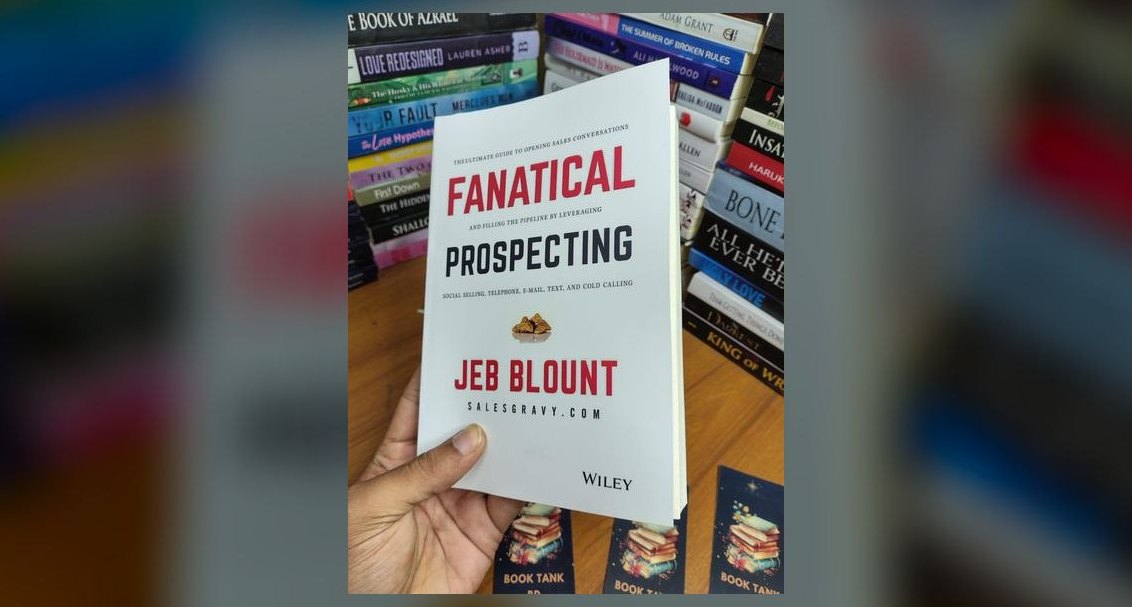 bsHow do you apply *Fanatical Prospecting* to LinkedIn outreach in 2027?
 bsHow does *Gap Selling* help you close more deals in a recession in 2027?
 bsWhat sales script does *New Sales. Simplified.* recommend for cold calls in 2027?
 bsDoes *The Psychology of Selling* still hold up for modern sales techniques in 2027?
 bsWhat’s the most actionable principle from *How to Win Friends and Influence People* for remote work in 2027?
 bsWhat’s the biggest mistake *SPIN Selling* warns against in complex B2B sales?
 bsHow does *Fanatical Prospecting* change your daily routine for outbound sales?
 bsWhat’s the most persuasive technique from *Pitch Anything* for investor pitches?
 bsWhat’s the key insight from *The Challenger Sale* for leading a sales team in 2027?