
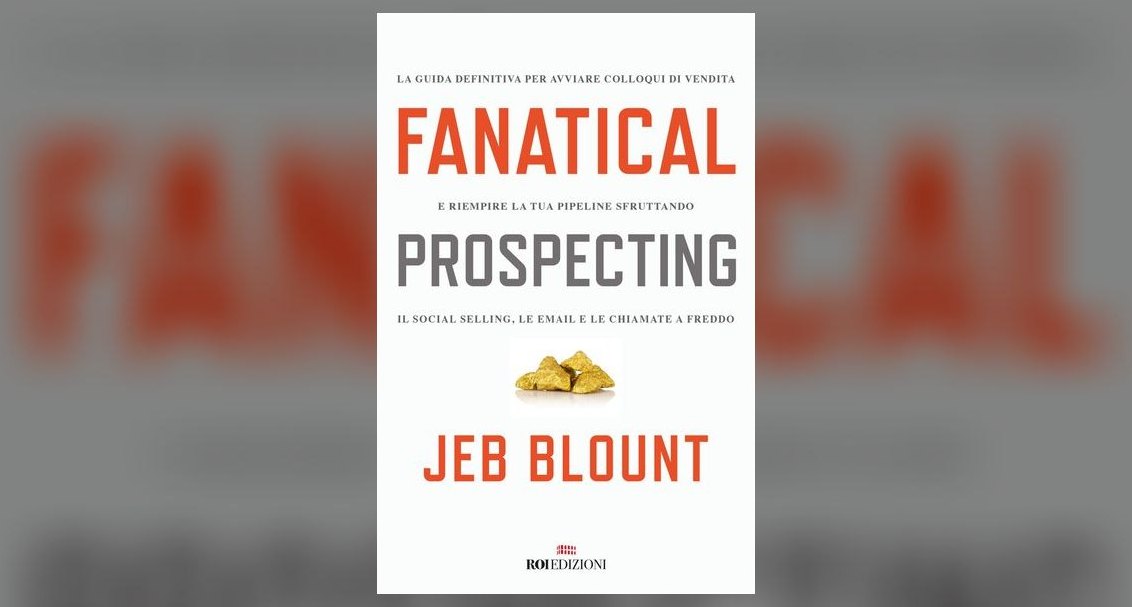
How can *Fanatical Prospecting* help you maintain a full pipeline without burning out in 2027?
 Curated byKory White · Fractional CRO · Maryland
 PULSEKNOWLEDGE LIBRARY
*Fanatical Prospecting* keeps your pipeline full in 2027 by converting prospecting from a panic response into a fixed daily ritual: a protected morning block, a multi-channel cadence you never improvise, and emotional discipline that treats rejection as data. Burnout comes from pipeline crises and taking "no" personally — not from the dialing itself.
The outcome you should expect
The honest promise of Blount's method is not "more energy." It is *less volatility*. Reps who run the book's system report a flatter month-to-month pipeline curve, and that flatness is the actual burnout cure. The reason is mechanical rather than motivational: burnout in outbound sales is rarely caused by the number of calls made in a week. It is caused by the three-week stretch in which you made zero calls, followed by the sickening realization that next quarter's coverage does not exist, followed by a frantic 300-dial week to paper over the gap. That whipsaw — dead quiet, then emergency — is what grinds people down, and it is the specific pattern the 30-Day Rule exists to prevent.
Expect four concrete changes if you actually run the system for a full quarter.
First, your *worst* week improves more than your best week does. Fanatical prospecting raises the floor. A rep who blocks 90 minutes every morning will never post a zero-activity week again, and zero-activity weeks are the leading indicator of a pipeline collapse 60 to 90 days out. Your ceiling may barely move. That is fine; ceilings do not cause attrition.

Second, forecast conversations get less adversarial. When your manager asks why coverage is thin, you have activity data going back weeks rather than an excuse. In practice this changes the emotional texture of the job more than any single tactic in the book — a rep who can point at consistent input metrics is not defending their worth every Monday.
Third, you stop confusing motion with progress. Blount is blunt that follow-up work on existing deals *feels* productive and quietly cannibalizes prospecting time. Proposal edits, CRM hygiene, "checking in" emails to open opportunities — all of it registers as work and none of it creates new coverage. Naming that trap is half of escaping it.
Fourth — and this is the adjacent effect most reps miss — your qualification gets more ruthless. When you know tomorrow brings 90 more minutes of fresh prospecting, you stop clinging to a bad-fit deal out of scarcity. Pipeline abundance makes disqualification cheap. That single downstream effect probably saves more hours per month than the prospecting block costs.
What you should *not* expect: a shortcut. The method is deliberately boring. It does not promise higher connect rates, better messaging, or a clever pattern interrupt. It promises that you will still be doing this in eighteen months.

What drives that outcome
Three mechanisms do the work, and they are interlocking rather than independent. Pull one out and the other two degrade.
The 30-Day Rule. Blount's framing is that prospecting done today pays out over the following weeks and months — meaning today's silence is not today's problem, it is the problem of the you who exists a quarter from now. The lag is the whole difficulty. Human beings are extraordinarily bad at maintaining behavior whose feedback arrives 60 days late, which is why prospecting is the first thing to fall off any rep's calendar. The rule works as a commitment device: it removes the daily decision of *whether* to prospect and replaces it with the much smaller decision of *when*. Decision removal is the point. Every morning you re-litigate the question is a morning you eventually lose.
The cadence. Most reps stop after one or two touches. Blount's argument is that a large share of connections happen after the point where the average rep has already given up, and the cadence exists so that persistence is a property of the *system* rather than of your mood on a given Tuesday. Structure matters more than the specific sequence: touch one on day one, another two days later, a third the following week, mixing phone, email, LinkedIn, and video, with a defined exit. The cadence also handles the cognitive load — you never have to ask "what should I do with this account next?", which is a surprisingly expensive question to answer forty times a day.
Emotional discipline. The book's most durable chapter. Rejection is reframed as information rather than verdict: the call failed because of timing, fit, or approach, not because of you. Blount's related claim — that a fast "no" beats a slow "maybe" — is the practical version. A quick no returns your calendar; a soft maybe consumes it for months and then dies anyway.
Notice the loop closes back on itself. Coverage reduces panic, reduced panic makes tomorrow's block easier to protect, and the protected block produces coverage. The system is self-reinforcing in both directions — which is exactly why a two-week lapse is so hard to recover from.
Benchmarks and realistic ranges
Blount does not publish a universal dial quota, and neither should anyone else — the right number depends entirely on your average deal size, sales cycle, and connect rate. What the book *does* give you is a method for deriving your own number, and that derivation is worth doing explicitly rather than inheriting a figure from a sales floor poster.
Work backward from revenue. Take your annual target, divide by average deal size to get closed deals needed. Divide by your historical win rate to get qualified opportunities needed. Divide by your opportunity-per-conversation rate to get conversations needed. Divide by your connect rate to get dials. Then divide by working days. The output is a daily number, and the number is usually smaller than reps fear and larger than they currently do.
Two calibration notes matter more than the arithmetic.
The first is sustainability over optimality. Blount's implicit standard is that the daily volume should feel *boringly achievable* — the level you could hit on a bad day, in a bad mood, with a headache. If your derived number only works on your best days, it is the wrong number, because the days you skip cost more than the extra dials on good days earn. A rep doing a modest volume every single day for a quarter will out-produce a rep doing triple that volume three days a week and nothing the other two. Consistency compounds; intensity does not.
The second is the lag window. Whatever your sales cycle is, that is roughly how long you must run the system before judging it. If your cycle runs 60 days, evaluating your prospecting after two weeks tells you nothing except how you feel. This is why the 30-day framing exists at all: it is long enough to generate signal and short enough to sustain without evaluation. Judging daily output is the fastest route to quitting.
For the time block itself, the book's guidance is a protected morning window — commonly framed as 90 minutes of Prime Time, meaning no email, no internal meetings, no CRM cleanup, no Slack. The specific length is less important than the two properties it needs: it must be at your genuine energy peak, and it must be defended against internal calendar invites, which are the single most common killer of prospecting blocks in any org with more than fifty people.
A realistic range on the sequence side: cadences in the range of six to twelve touches over two to four weeks, across at least three channels, are common in practice. Fewer than that and you are quitting inside the window where most responses occur. Far more than that and you are annoying people who have already made a decision — which is why the defined exit matters as much as the persistence.
Adjacent benchmark worth knowing: reps carrying larger territories or higher-ACV accounts typically shift the mix from volume toward research depth, running fewer accounts with more touches each. The principle is unchanged; only the ratio moves.
Risks, edge cases, and failure modes
The system fails in predictable ways, and most of them are worth naming before you start.
Automating the wrong half. In 2027 it is trivial to have a model draft every email in the cadence. The trap is that fully generated outreach is indistinguishable from every other rep's fully generated outreach, and buyers — many of whom now run their own AI filters on inbound — have adapted. Use automation for list building, sequencing logistics, reminders, and first drafts. Keep the specific, verifiable detail human. If your email contains nothing that proves a person read something about this company, it is noise regardless of how well written it is.
Mistaking a full pipeline for permission to stop. The most common relapse. Pipeline looks healthy in March, prospecting stops, and June is a disaster — but June's disaster is invisible in March, which is precisely why the rule has to be unconditional. This is the failure mode the 30-Day Rule was written to prevent, and it still catches experienced reps every year.
Cadence as a script. A cadence defines *when* and *through which channel*, not *what you say*. Reps who let the sequence dictate their words end up sending eight variations of "just following up," which is worse than sending three. Each touch should carry something the prospect did not have before.

Volume set at hero level. Deriving a daily number from your best week guarantees failure by week three. Set it at your bad-day floor and let good days overshoot naturally.
Emotional discipline misread as suppression. Blount's reframe is a three-step move: feel the sting briefly, analyze what actually happened, re-engage. Skipping step one is not discipline, it is accumulation — and accumulated unprocessed rejection is a well-documented route to exactly the burnout you were trying to avoid.
No hard stop. The book's routine includes an end to the working day, and reps who prospect into the evening to "make up" for a missed block are running a debt model on their own recovery. Missed blocks should be forgiven, not repaid.

Structural edge cases. Some roles genuinely cannot run pure daily outbound: heavily inbound-led SDR seats, account managers with expansion targets, partner-channel roles, or reps in industries with tight seasonal buying windows. The adaptation is to keep the *ritual* and change the *activity* — a protected daily block spent on referral asks, dormant-account revival, partner introductions, or customer expansion conversations preserves the mechanism even when cold calling is not the right input. The principle underneath is that pipeline creation, whatever form it takes in your motion, needs a defended recurring slot. Compliance-heavy sectors face a related constraint: outreach may be regulated, channels restricted, and cadences legally bounded. The block survives; the tactics change.
Team-level failure. Managers who introduce this as a monitored activity metric convert it into surveillance, and surveilled activity metrics get gamed within a month. The rule works because the rep owns it. Track outcomes at the team level and let individuals own their inputs.
A practical rollout plan
Do not start with the full system. Reps who attempt every element at once typically abandon all of it within two weeks, which is the standard failure curve for any habit change adopted wholesale.

Week one — instrument only. Change nothing about your behavior. Log what you actually do: how many prospecting touches, at what times, on which days. Almost everyone discovers the real number is well below their estimate, and the gap between believed and actual behavior is the most motivating data you will collect.
Week two — install the block. Put a recurring appointment on your own calendar at your genuine energy peak. Defend it like a customer meeting, because functionally it is one. Do not set a volume target yet; the only goal is showing up. If you must shorten it on a bad day, shorten it — never cancel it. A ten-minute block preserves the streak; a cancelled one restarts the habit from zero.
Week three — derive and set volume. Run the backward math from your revenue target. Set the daily number at the level you could hit on your worst realistic day. Write it down where you can see it.
Week four — build the cadence. Define the sequence explicitly: how many touches, which channels, what spacing, and — critically — the exit criteria. Automate the logistics in your CRM or engagement platform. Leave the message content to yourself.
Weeks five through eight — run without judging. This is the hard part. Do not evaluate results. Log activity, run the cadence, and let the lag window do its work. Reviewing outcomes weekly during this stretch will convince you it is not working, because a full sales cycle has not elapsed.
Week nine — first real review. Now look at outcomes. Examine connect rates by channel and time of day, which cadence steps produce responses, and which segments convert. Call recording analysis is genuinely useful here for spotting patterns you cannot hear in your own conversations — where deals stall, whether you raise price too early, which objections repeat. Adjust one variable at a time.
The quarterly recalibration matters. Territories change, deal sizes drift, and connect rates move with market conditions. A number derived in January is stale by July. Re-run the backward math each quarter rather than defending a figure that no longer maps to your target — and treat this whole loop as a strategy you maintain, not a sprint you survive.
Related questions
Does this work for inbound-heavy or hybrid roles?
Yes, with substitution. Keep the protected daily block and change what fills it: referral asks, dormant-account revival, expansion conversations, or partner introductions. The mechanism is a defended recurring slot for pipeline creation, not cold calling specifically.
How is this different from just "make more calls"?
Volume advice has no mechanism for surviving a bad month. Blount's system adds a commitment device, a structured cadence that removes decision fatigue, and an explicit rejection-processing practice. The dialing is the smallest part.
What if my manager already tracks my activity?
Track outcomes at the team level, inputs at the individual level. Activity metrics imposed from above get gamed within weeks; the same metric owned by the rep survives because it serves them rather than reporting on them.
Should I use AI to run my cadence?
Use it for list building, sequencing logistics, reminders, and first drafts. Keep the specific verifiable detail and the actual conversations human. Fully generated outreach is now indistinguishable from noise and gets filtered accordingly.
How long before I know if it's working?
Roughly one full sales cycle. Evaluating sooner measures your mood, not your pipeline. That lag is exactly why the 30-day, judgment-deferred framing exists.
FAQ
How many touches should a cadence contain before I stop?
Six to twelve touches over two to four weeks across at least three channels is a common working range, but define your own exit criteria explicitly rather than deciding in the moment. The defined exit matters as much as the persistence — it is what keeps the cadence from becoming harassment and what frees your time for better-fit accounts.
What is the single highest-impact change if I only do one thing?
Install the protected morning block and never cancel it. Shorten it on bad days if you must, but do not skip. Nearly every other element of the system depends on that block existing, and the streak itself becomes the thing you protect.
Does emotional discipline mean ignoring how rejection feels?
No — that is the most common misreading. The practice is to feel it briefly, analyze what actually happened, then re-engage. Suppression accumulates rather than resolves, and accumulated rejection is precisely the mechanism that produces burnout.
My pipeline is full right now. Can I pause prospecting?
That is the most common relapse and the exact scenario the 30-Day Rule addresses. Today's full pipeline is the product of prospecting you did weeks ago. Stopping now produces a gap you will not see for a full sales cycle, at which point recovering costs far more than maintaining would have.
Is this sustainable for introverts?
Yes. The cadence is what makes it sustainable — it removes the constant decision-making that drains people faster than the conversations do. Batch prospecting into defined blocks, build in genuine recovery time afterward, and let structure carry the load that willpower otherwise would.
How do I stop follow-up work from eating my prospecting time?
Recognize that follow-up feels productive precisely because it is easier, and schedule it *after* the prospecting block rather than before. Anything that can consume an unbounded amount of time will consume the block if you let it go first.
Sources
- Fanatical Prospecting — publisher page (Wiley)
- Jeb Blount — Sales Gravy
- LinkedIn Sales Solutions — State of Sales research
- HubSpot — Sales Prospecting resources
- Salesforce — State of Sales report
- Gartner — B2B buyer behavior insights
- Gong Labs — sales conversation research
- Harvard Business Review — sales topic archive
Related on PULSE
- [What's the biggest mistake *Fanatical Prospecting* warns against when following up with a warm lead in 2027?](/knowledge/bs0416)
- [How can *Fanatical Prospecting* change your approach to social selling and LinkedIn outreach in 2027?](/knowledge/bs0409)
- [How does *Fanatical Prospecting* define the perfect prospecting day for a remote sales team in 2027?](/knowledge/bs0381)
- [What's the core strategy in *Fanatical Prospecting* for building a pipeline from scratch in 2027?](/knowledge/bs0356)
- [How does *Fanatical Prospecting* change your daily routine for outbound sales?](/knowledge/bs0340)
- [How do you apply *Fanatical Prospecting* to LinkedIn outreach in 2027?](/knowledge/bs0326)
@Kory-White- · if Venmo asks, the last 4 of my number are 2012
 bsWhat are the key lessons from *Never Split the Difference* for negotiating a raise in 2027?
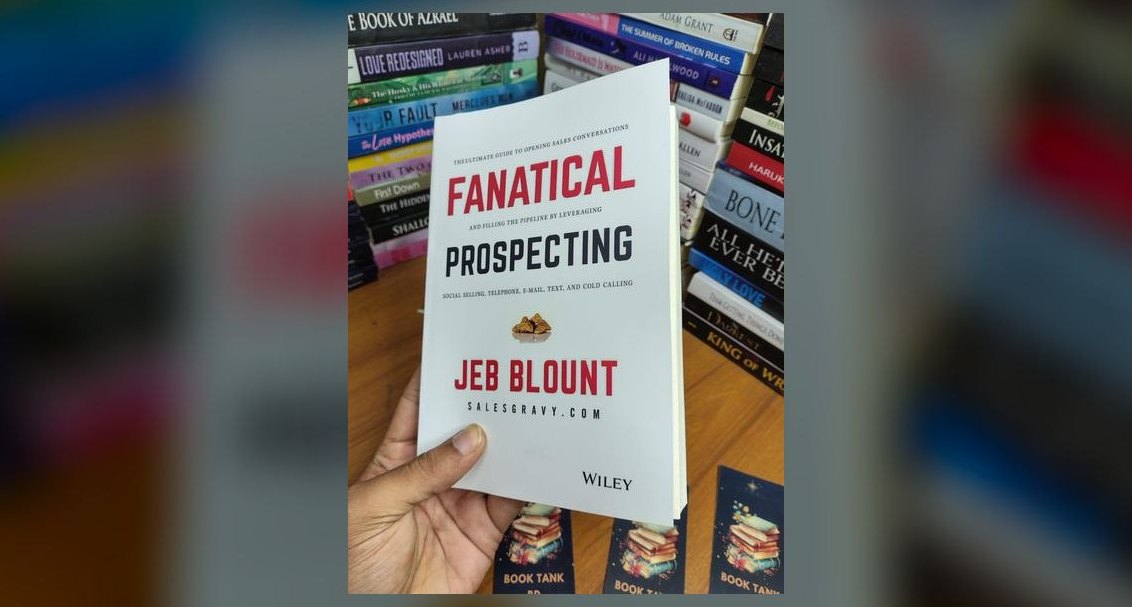 bsHow do you apply *Fanatical Prospecting* to LinkedIn outreach in 2027?
 bsHow does *Gap Selling* help you close more deals in a recession in 2027?
 bsWhat sales script does *New Sales. Simplified.* recommend for cold calls in 2027?
 bsDoes *The Psychology of Selling* still hold up for modern sales techniques in 2027?
 bsWhat’s the most actionable principle from *How to Win Friends and Influence People* for remote work in 2027?
 bsWhat’s the biggest mistake *SPIN Selling* warns against in complex B2B sales?
 bsHow does *Fanatical Prospecting* change your daily routine for outbound sales?
 bsWhat’s the most persuasive technique from *Pitch Anything* for investor pitches?
 bsWhat’s the key insight from *The Challenger Sale* for leading a sales team in 2027?