
How does *Influence: The Psychology of Persuasion* explain why “free” offers actually work in B2B sales?
 Curated byKory White · Fractional CRO · Maryland
 PULSEKNOWLEDGE LIBRARY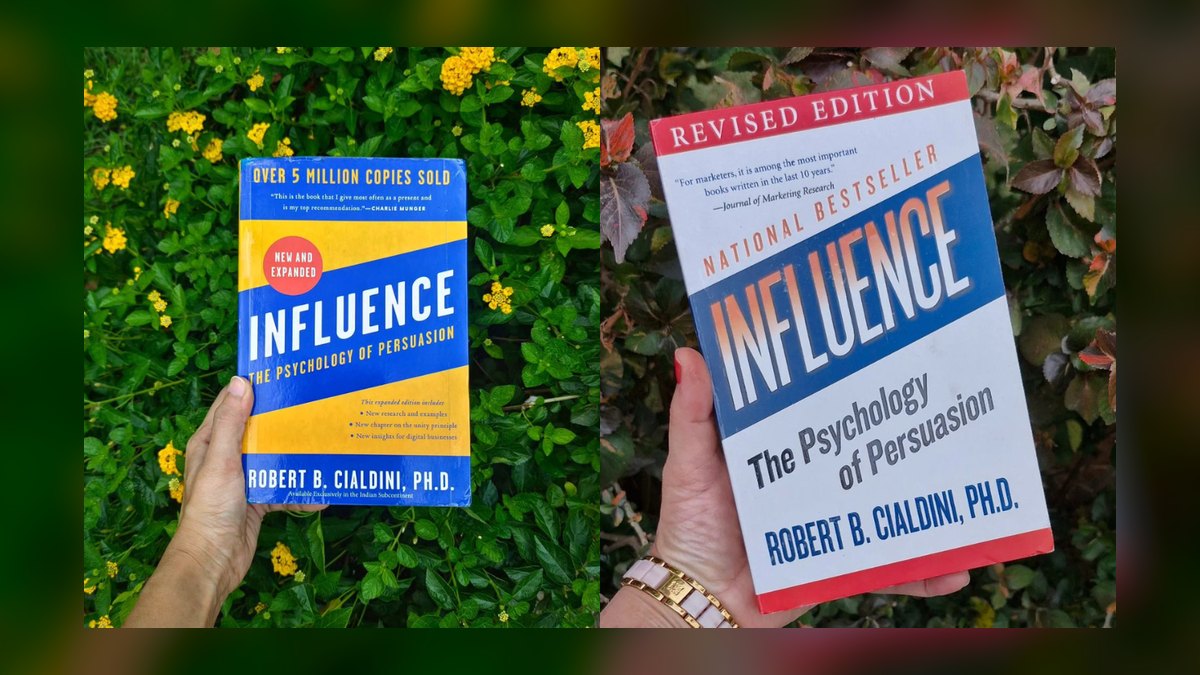
*Influence: The Psychology of Persuasion* explains that "free" works in B2B because it triggers reciprocation — the near-automatic urge to repay what we receive, even unrequested. A free audit, trial, or pilot creates felt indebtedness, and once a buyer accepts and invests effort, consistency locks them toward the paid commitment that discharges the debt.
What the reciprocation rule is, and why B2B buyers are not immune to it
Robert Cialdini's *Influence* opens its reciprocation chapter with a deceptively small field observation: Hare Krishna solicitors in airports stopped asking for donations outright and instead pressed a flower into a traveler's hand first. The flower was unwanted. People threw them in trash cans within twenty feet. And they still gave money. That gap — between what people say they want and what they feel obligated to do — is the entire mechanism behind why "free" is not just a price point in B2B sales but a behavioral lever.
The rule Cialdini names is simple: we should try to repay, in kind, what another person has provided us. What makes it powerful for sellers is the three properties he documents around it. First, the rule overpowers liking. In the research he cites, people reciprocated to individuals they had been made to dislike, which means a buyer who finds your rep abrasive can still feel the pull of the free assessment that rep delivered. Second, the rule can be triggered by an uninvited gift. The recipient did not ask, does not want to owe, and owes anyway. Third, the rule tolerates wild asymmetry — the return favor is routinely worth far more than the initial gift, because the debtor is trying to buy relief from an uncomfortable feeling, not settle a ledger.
B2B buyers assume they are exempt. They are procurement-trained, they have a scorecard, they have a committee. But the committee scores vendors, not obligations. The obligation attaches to a person — the analyst who received the free data audit, the ops lead who got four hours of free integration help during evaluation. That person carries the debt into the room and it comes out as advocacy, as a returned call, as the benefit of the doubt on a pricing question. Cialdini's point is that the Psychology of the rule is pre-rational. It is a social accounting system humans run below deliberate thought, and it does not check whether the counterparty is a friend or a vendor with a quota.

There is a second, sharper variant in the same chapter that most sellers miss: rejection-then-retreat, also called door-in-the-face. You open with a request the buyer will decline — the full enterprise deployment, the three-year term — and then retreat to something smaller: a paid pilot, or a free proof-of-concept. The retreat itself reads as a concession, and concessions demand counter-concessions. This is why a free pilot offered *after* a declined large proposal converts differently than the same free pilot offered cold on the first call. Cold, it is a giveaway. After a retreat, it is a gift that obliges. The Influence framing also explains a well-documented side effect Cialdini highlights: people who receive a concession report more satisfaction with the final agreement and more willingness to honor it, because they feel responsible for having shaped the deal.
Two adjacent mechanics compound the effect. Commitment and consistency means that once a buyer has actively, publicly, and effortfully engaged with your free thing — configured a sandbox, invited two colleagues, uploaded real data — they begin to hold a self-image consistent with that action. Scarcity means a free offer that is bounded ("we run four of these per quarter") reads as valuable rather than desperate. Free plus abundant is a coupon; free plus bounded is an allocation. That distinction is worth more in enterprise deals than almost any other copy change.
The step-by-step process for turning a free offer into a booked commitment
The failure pattern in most B2B free-offer programs is that the offer is treated as a lead-capture event rather than as step one of a sequence. Cialdini's principles only chain if you actually build the chain. Below is the operational sequence, with the psychological mechanism named at each link so you can diagnose where yours is breaking.
Step one — pick a gift with real marginal cost to you. Reciprocation strength scales with perceived sacrifice on the giver's side. A gated PDF costs you nothing and the buyer knows it; an eight-page teardown of *their* pipeline data visibly cost someone a day. This is why personalized free assessments outperform generic content by a wide margin in meeting-conversion, even when the generic content is objectively better written. The buyer is not scoring quality. They are scoring effort spent on them specifically.
Step two — deliver before you ask. Give first, unconditionally, with no form-fill contingency attached to the delivery itself. The moment the gift is conditioned on a commitment, it stops being a gift and becomes a transaction, and transactions do not create debt — they close it. If you must gate, gate lightly and deliver more than the gate implied.
Step three — make acceptance active and effortful. A free trial the buyer never logs into generates no consistency pressure. Design the first session to require a real input: connect one data source, import a real account list, name their actual quarterly target. Cialdini's condition for a commitment to reshape self-perception is that it be active, public, and effortful. A passive trial fails all three.
Step four — surface the effort back to them. "You've mapped 4 of 6 stages and invited 3 teammates" is not a progress bar; it is a consistency mirror. You are showing the buyer evidence of the identity they have started to adopt.
Step five — make the ask small, specific, and adjacent. The reciprocation window is not indefinite. Cialdini notes the obligation is felt most acutely soon after receipt and decays. Ask inside the delivery moment — at the end of the free audit readout, not in a follow-up email nine days later — and ask for the next-sized step, not the terminal one.
Step six — name the concession explicitly and honestly. "We normally scope this as a paid engagement; we ran it free because we wanted you to see the data before committing" is a legitimate framing when true. When it is not true, do not say it — a fabricated concession that the buyer later discovers is the single fastest way to invert reciprocation into resentment.
The chain has one more link most teams never build: transferring the individual's obligation into a group commitment. A debt held by one champion is fragile — that person changes jobs, gets reorganized, loses the internal argument. The moment your champion presents the free-assessment findings to their own leadership, the commitment becomes public, and public commitments are dramatically more durable than private ones. Engineering that internal presentation — giving them the deck, the numbers, the framing — is a distinct step, and it is the one that survives champion turnover.
Costs, timelines, and what these offers realistically consume
Free is never free on the seller's side, and the reason most free-offer programs get killed is that nobody modeled the delivery cost before scaling them. The relevant unit is not cost-per-lead, it is fully-loaded cost per accepted offer, including the senior person's hours, and it has to be measured against the conversion lift over a no-offer control.
Broadly, B2B free offers fall into cost tiers that behave very differently. Content-style gifts — a report, a template, a benchmark — carry near-zero marginal cost and correspondingly weak reciprocation pull, because the buyer correctly infers you gave the same thing to thousands of people. Self-serve product trials carry real infrastructure and support cost and generate strong consistency pressure but weak reciprocation, since no human visibly sacrificed anything. Human-delivered assessments — a data audit, a process teardown, an architecture review — carry the heaviest cost, often several days of a senior practitioner's time, and produce the strongest pull on both axes at once. Free professional-services hours bundled into an evaluation sit at the extreme end: highest cost, highest obligation, and the highest risk of being consumed by a buyer who never intended to purchase.
On timelines, the reciprocation window is short and the consistency window is long. Treat the obligation from a delivered gift as decaying over days to a few weeks, not quarters — which means your ask has to be sequenced tightly against delivery. Consistency behaves in the opposite direction: the more the buyer has invested in configuring, integrating, and socializing your product, the stronger the pull gets over time, which is why trials that require real data integration convert later but far harder than trials that run on sample data. The practical implication is that a fourteen-day trial and a ninety-day pilot are not the same instrument at different lengths; they run on different principles and need different follow-up cadences.
Three cost controls are worth building in from day one. First, qualify before you deliver anything expensive — a free senior-led assessment given to an unqualified account is pure margin burn and it also teaches your reps that the offer is a substitute for discovery. Second, cap volume explicitly and publish the cap, which converts a budget constraint into the Scarcity principle working in your favor. Third, instrument the control group. Run a cohort that gets no free offer, and compare win rate, cycle length, and average deal size, not just meeting rate. Free offers reliably lift top-of-funnel metrics; whether they lift closed-won is an empirical question at your specific price point and you will not know without the holdout.
One under-discussed downstream cost: free offers reset the buyer's anchor on what your labor is worth. If you routinely give away the data audit, you cannot later sell the data audit, and in services-heavy businesses that erosion compounds. The defense is to price the thing publicly and then visibly waive it, rather than never pricing it at all. A waived $12,000 engagement is a concession. An unpriced one is just something you do.
Where teams get free offers wrong
The most common error is treating the free offer as a top-of-funnel volume play. Cialdini's mechanism is interpersonal and specific. Mass-produced free things dilute it to nothing, and worse, they train the market that your gifts are impersonal, which inoculates buyers against the ones that aren't. If your free offer scales linearly with ad spend, it is almost certainly not generating reciprocation — it is generating list growth, which is a fine goal but a different one, and should be measured differently.
The second error is delayed asking. Teams deliver a genuinely excellent free assessment, then hand the account back to a nurture sequence and re-engage six weeks later. By then the obligation has evaporated, the buyer has absorbed the insight into their own thinking, and they now believe they figured it out themselves. The window closed. If a senior person is going to spend two days building something, someone has to be in the room at the readout with a concrete next step.

Third: giving away the wrong thing. A free offer should reveal a problem your product solves, not solve the problem outright. A free audit that hands over a complete remediation plan the buyer's internal team can execute is a gift that eliminates the need for you. The correct design surfaces the gap, quantifies it credibly, and makes the path to closing it obviously easier with you than without you. This is not a manipulation — it is the difference between a diagnostic and a cure, and diagnostics are legitimately valuable on their own.
Fourth: fake concessions. Rejection-then-retreat works, and it is also the technique most easily degraded into theater. Opening with an absurd number purely to make the second number feel generous is detectable, and sophisticated procurement teams are explicitly trained to detect it. Cialdini himself notes that the technique backfires when the initial request is so extreme that it reads as bad faith — the target stops negotiating entirely and the concession never lands. Retreats have to be from real positions.
Fifth: ignoring who holds the debt. Reciprocation attaches to individuals, and in a buying group of eight, the person you gifted may have no budget authority and modest internal capital. If your free assessment goes to a mid-level analyst who cannot get a meeting with the CFO, you have created an obligation with no channel to discharge it. Map the debt to influence deliberately — either gift the person with standing, or build the champion-enablement step that lets the indebted party carry it upward.
Sixth: forgetting that the buyer knows. Modern B2B buyers have read the same books. Some have read *Influence* itself. The Persuasion literature is not a secret weapon, and treating it as one produces sales motions that feel like technique. The version that survives buyer sophistication is the one where the gift is genuinely valuable independent of whether they buy — because then the buyer's recognition of the tactic doesn't matter. They can see exactly what you're doing and still be glad you did it.
Finally, teams underestimate backlash asymmetry. A free offer that lands well produces a modest lift. A free offer that reads as manipulative produces a strong, durable negative — the buyer tells peers, and in tight vertical markets that reputation cost outruns any pipeline gain. The expected-value math on aggressive free-offer tactics is worse than it looks, because the downside is heavier-tailed than the upside.

Choosing the right free offer: a decision framework
Not every deal shape warrants the same instrument, and picking the wrong one is why identical offers produce wildly different results across segments. The variables that actually matter are deal size, the buyer's ability to self-evaluate, whether the value shows up before or after integration, and how many people must agree.
For small, self-evaluable products, a self-serve trial is correct. The buyer can determine fit alone, the cost of delivery is near zero, and consistency does the work — every hour they spend configuring makes switching feel wasteful. Do not attach a human to this; a rep on a $400/month trial destroys the unit economics and annoys the user.
For mid-market deals where value depends on integration, a free but scoped pilot with a named success criterion beats an open trial. The scope is the point: an unscoped pilot has no natural conversion moment, so it drifts until someone's budget cycle ends. Write the criterion before it starts, in the buyer's own metric, and agree in advance what happens when it's met.
For large enterprise deals with a wide buying group, the strongest instrument is a human-delivered assessment that produces an artifact the champion can circulate internally. You are not trying to prove the product here; you are trying to arm one person with credible numbers and give them a reason to spend internal capital on you. The reciprocation pull is real, but the strategic payload is the artifact.
For accounts already deep in a competitive evaluation, free migration or implementation support is often more persuasive than any discount of equal value — because it removes the switching-cost objection directly rather than paying the buyer to tolerate it. Cialdini's framing explains why: a discount invites rational comparison against other discounts, while free labor reads as a concession and pulls on a different mechanism entirely.
Run one more filter over whatever the tree returns: would you still be comfortable if the buyer read your internal notes about this offer? If the honest answer is no, the offer is engineered to obligate rather than to help, and the Influence framework does not actually endorse it. Cialdini draws that line deliberately, distinguishing genuine gifts and genuine concessions from manufactured ones — and his argument is not primarily moral, it's practical. Manufactured obligation is discoverable, and discovery is catastrophic. The durable strategy is to make free offers that are worth accepting on their own terms, and let reciprocation do what it does without help.
Related questions
Does a free offer beat a discount of the same dollar value?
Usually, because they run on different mechanisms. A discount invites price comparison and rational cost-benefit analysis; a free deliverable reads as a gift or concession and triggers reciprocation. Free labor also avoids anchoring your list price downward, which discounts do permanently.
How long does the sense of obligation last after a free deliverable?
Treat it as days to a few weeks, not quarters. The feeling is uncomfortable, so buyers resolve it quickly — often by discharging it on someone else's request if you're not present. Ask at the delivery moment, not in a later nurture email.
Can free offers work when the buyer explicitly recognizes the tactic?
Yes, if the gift is genuinely valuable independent of purchase. Recognition only destroys offers that have no standalone worth. When the free assessment is objectively useful, the buyer can name the technique and still feel — and act on — the obligation.
Who in the buying group should receive the free offer?
Whoever can convert obligation into internal action. Gifting an enthusiastic but powerless analyst creates a debt with no discharge channel. Either target someone with standing, or explicitly build the enablement step that lets your champion carry the artifact upward.
Should the free offer be time-limited?
Bounded, yes — but bound it by capacity rather than by an artificial countdown. "We run four of these per quarter" is credible scarcity; a resetting countdown timer on an enterprise offer reads as consumer marketing and undermines the seriousness of the gift.
FAQ
**Does *Influence* claim free offers work identically in every context?**
No. Cialdini is consistent that context governs strength. The pull scales with perceived sacrifice by the giver, personalization to the recipient, and how clearly the thing reads as a gift rather than a transaction. A mass-produced download and a bespoke audit invoke the same rule at radically different magnitudes.
Can a free offer damage a deal?
It can. If the buyer decides the gift was engineered to obligate them, reciprocation inverts into resentment and distrust — and in tight vertical markets that reputation travels. The asymmetry matters: a good free offer produces a modest lift, a manipulative one produces a durable negative.
What separates rejection-then-retreat from lowballing?
The retreat has to be from a position you would genuinely have accepted. Opening deliberately absurd to make the second number look generous is theater, and Cialdini notes the technique fails outright when the first request reads as bad faith — the target disengages rather than counter-concedes.
Why do free trials convert better when they require real data?
Because they engage commitment and consistency, not just reciprocation. Cialdini's conditions for a commitment to reshape self-perception are that it be active, public, and effortful. Importing real accounts satisfies all three; clicking through a sample-data demo satisfies none.
How should a free offer be measured?
Against a holdout that receives none, on closed-won rate, cycle length, and deal size — not on meeting bookings. Free offers reliably inflate top-of-funnel metrics. Whether they improve revenue at your price point is empirical and segment-specific, and only a control group answers it.
Is using these principles in B2B sales ethical?
Cialdini's own test is whether the gift or concession is real. Genuine value freely given, with transparent intent about wanting the business, is ordinary commercial goodwill. Manufactured obligation — a worthless gift or a fake concession — is the line, and it fails practically as well as ethically.
Sources
- Influence: The Psychology of Persuasion — Robert Cialdini (official site)
- Robert Cialdini — Arizona State University faculty profile
- Harness the Science of Persuasion — Harvard Business Review
- The Uses (and Abuses) of Influence — Harvard Business Review interview with Cialdini
- Reciprocity — Behavioral Economics / Stanford Encyclopedia of Philosophy entry on Reciprocity
- Foot-in-the-door and door-in-the-face compliance research — American Psychological Association
- Nudge and behavioral insights in practice — Behavioural Insights Team
- Gartner research on B2B buying groups and buyer enablement
Related on PULSE
- [How do you use *Influence: The Psychology of Persuasion* to prevent buyer's remorse after a big sale in 2027?](/knowledge/bs0383)
- [What's the most persuasive principle from *Influence: The Psychology of Persuasion* for social media in 2027?](/knowledge/bs0368)
- [How can *Influence: The Psychology of Persuasion* help you build trust with skeptical clients?](/knowledge/bs0338)
- [Which chapter of *Influence: The Psychology of Persuasion* is most useful for marketers in 2027?](/knowledge/bs0324)
- [Influence: The Psychology of Persuasion by Robert Cialdini — Cliff Notes & Chapter-by-Chapter Summary](/knowledge/bs0004)
- [How does *Influence: The Psychology of Persuasion* apply to upselling existing customers in a subscription model in 2027?](/knowledge/bs0413)
@Kory-White- · if Venmo asks, the last 4 of my number are 2012
 bsWhat are the key lessons from *Never Split the Difference* for negotiating a raise in 2027?
 bsHow do you apply *Fanatical Prospecting* to LinkedIn outreach in 2027?
 bsHow does *Gap Selling* help you close more deals in a recession in 2027?
 bsWhat sales script does *New Sales. Simplified.* recommend for cold calls in 2027?
 bsDoes *The Psychology of Selling* still hold up for modern sales techniques in 2027?
 bsWhat’s the most actionable principle from *How to Win Friends and Influence People* for remote work in 2027?
 bsWhat’s the biggest mistake *SPIN Selling* warns against in complex B2B sales?
 bsHow does *Fanatical Prospecting* change your daily routine for outbound sales?
 bsWhat’s the most persuasive technique from *Pitch Anything* for investor pitches?
 bsWhat’s the key insight from *The Challenger Sale* for leading a sales team in 2027?