
How can *Fanatical Prospecting* change your approach to social selling and LinkedIn outreach in 2027?
 Curated byKory White · Fractional CRO · Maryland
 PULSEKNOWLEDGE LIBRARY
*Fanatical Prospecting* reframes LinkedIn from a branding channel into a disciplined outbound engine. Blount's argument is that pipeline comes from consistent daily activity, not sporadic bursts, so your 2027 approach becomes a fixed prospecting block, targeted account lists, personalized value-first messages, and multi-channel follow-up — measured by touches and conversations rather than likes.
What the book actually argues, and why it lands harder on LinkedIn in 2027
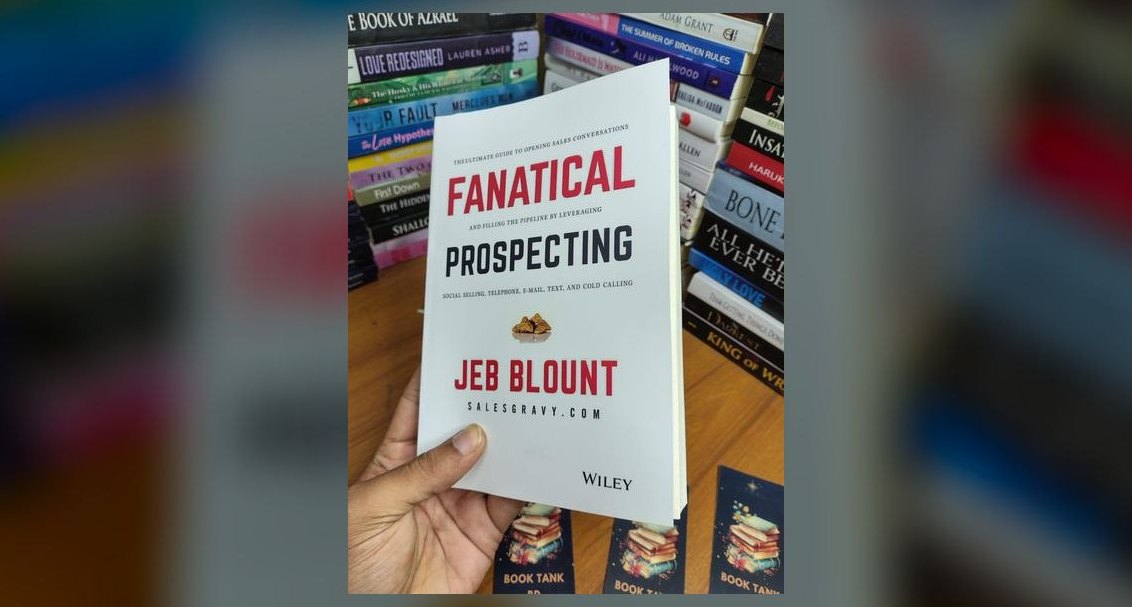
Jeb Blount's *Fanatical Prospecting* (Wiley, 2015) is not a social selling book. It is a book about the emotional and operational reasons salespeople avoid prospecting, and the systems that make avoidance impossible. That framing is exactly why it maps onto LinkedIn better than most platform-specific advice. Platform tactics decay — a connection-request template that pulled well two years ago pulls poorly now, because everyone copied it. Blount's argument operates one level up: the constraint on your pipeline is not which words you use, it is whether you do the activity every day, at volume, aimed at the right people.
The central claim is that prospecting is a mindset before it is a tactic. Blount's "Law of Replacement" says accounts leak constantly — churn, budget cuts, champions leaving, deals slipping to no-decision — and the only defense is a continuous inflow that exceeds the leak rate. If you sell into a base with, say, 15% annual logo churn and you carry 40 accounts, you need to replace roughly six logos a year just to stay flat, before any growth number. That math does not care whether it is 2015 or 2027. What changes is the channel mix.
Blount's second load-bearing idea is the "Universal Law of Need": the more desperately you need a deal, the worse you sell. Desperation shows up in message tone, in premature discounting, in chasing prospects who are not qualified. The antidote is a pipeline deep enough that no single deal matters. On LinkedIn this is directly observable — reps with thin pipelines write needy messages ("Just circling back, would love 15 minutes"), reps with full pipelines write confident, specific ones and walk away from non-responders without three follow-up guilt trips.

The third idea, and the one most relevant to social selling, is what Blount calls the balance between quality and quantity. He is explicit that neither alone works. Pure volume with generic messaging is spam and burns your domain, your InMail credits, and your reputation. Pure quality at low volume — the "I only send five perfect messages a week" approach — produces statistically meaningless pipeline, because even excellent outbound converts at single-digit reply rates. The right target is high volume of adequately personalized touches, with personalization effort scaled to account value.
Where 2027 differs from 2015: the cost of generating text has collapsed to roughly zero. Anyone can produce a thousand personalized-sounding messages in an afternoon. That has two consequences. First, the reply-rate floor on generic outreach has dropped, because prospects have pattern-matched the shape of machine-written flattery — the "I loved your post about X, it really resonated" opener is now a negative signal. Second, the things that cannot be cheaply faked have appreciated in value: a specific observation about the prospect's business that required actually reading their earnings call or job postings, a warm referral path, a phone call, a short custom video. Blount's insistence that the phone remains the highest-trust channel reads as more correct now than when he wrote it, precisely because text has been commoditized.
So the practical translation is this. LinkedIn is where you do research, where you establish that you are a real person with a credible presence, and where you initiate. It is rarely where you close. The Fanatical part is the discipline layer: a protected block, a target list, a touch count you hit whether or not you feel like it, and a tracked funnel that tells you which part is broken.
Building the daily block: a step-by-step process you can run tomorrow
Blount's core mechanism is the "Golden Hours" rule — selling hours are for selling, and prospecting happens in a protected block that nothing else is allowed to invade. On LinkedIn, that block has a specific internal structure. Here is a 45-minute version that produces roughly 40 touches a day, which is a defensible strategy for a full-cycle AE carrying a mid-market quota.
Step 1 — Build the list before the block, never during it (do this weekly, 60–90 minutes). The single biggest killer of prospecting blocks is spending them deciding who to contact. Pull 100–200 named contacts using Sales Navigator filters that correlate with buying: recent job change in the last 90 days, headcount growth in a relevant function, recent funding, or a technology signal. Segment into Tier A (25 accounts, deeply researched, custom outreach), Tier B (75 accounts, light personalization on a common trigger), Tier C (the rest, template with one variable). Store them in your CRM or a sequencer, not in your head.
Step 2 — Open with engagement, not asks (minutes 0–8). Comment substantively on 5–8 posts from Tier A contacts and their executives. Substantive means adding a data point, a counterexample, or a specific question — not "Great post!" This does two things Blount would recognize: it warms the recipient so your later message is not cold, and it puts your name in their notification feed at zero social cost. Expect roughly zero direct replies from this. That is fine; it is the setup move.
Step 3 — Connection requests with a short note (minutes 8–20). Send 10–15. Keep the note under 250 characters and make it about them, not you. The pattern that survives: one concrete reference (their role change, a hiring pattern, a specific thing their company shipped), one sentence establishing why you specifically are reaching out, and no ask. Do not pitch in the connection request — you are buying the right to a conversation, not opening one. Acceptance rates vary enormously by ICP, but a reasonable working expectation for a well-targeted, noted request is somewhere in the 25–40% range; if you are under 15%, your targeting or your note is wrong, not the platform.
Step 4 — Direct messages to accepted connections (minutes 20–32). Send 8–12. This is where Blount's three-part structure applies: who you are in one clause, why you are contacting *them specifically* with a concrete observation, and a low-friction ask. "Low friction" means an easy yes — a question they can answer in one line, or a 10-minute call, not a "30-minute discovery session." Blount's point about the ask being clear matters here: vague messages that end with "thoughts?" convert worse than ones that name a specific next step.
Step 5 — Multi-channel bridge (minutes 32–45). Take the 5–8 people who engaged in any way — accepted, viewed your profile twice, liked a comment — and call them. Or send a two-minute video. Or email with a subject line referencing the LinkedIn thread. This is the step almost everyone skips, and it is the step Blount would say matters most. LinkedIn engagement is a signal of warmth; the phone is where warmth converts to a meeting.
Step 6 — Log everything, same day. Touches by channel, replies, positive replies, meetings set. If it is not in the CRM it did not happen, and you cannot diagnose a funnel you did not measure.
The reason the block works is not the specific minute allocation — adjust it to your motion. It works because it removes every decision from the moment of execution. Blount's observation about procrastination is that it is rarely a discipline failure in the abstract; it is a failure caused by ambiguity. A rep staring at a blank screen wondering who to contact will find something else to do. A rep with a pre-built list of 40 names and a timer will not.
One adjacent note worth making: this same structure ports almost unchanged to recruiting, partnerships, fundraising, and agency business development. The block, the tiered list, the engagement-then-ask sequence, the multi-channel bridge — a recruiter sourcing engineers and an AE sourcing buyers are running the same machine with different message content. If you manage a team that does any outbound motion, the operational template is shared.
Time, volume, and the ranges you should actually expect
Numbers make this concrete, so here are working ranges. Treat them as planning assumptions to be replaced by your own data within 60 days, not as benchmarks — outbound performance varies by two orders of magnitude across ICPs, and anyone quoting a universal reply rate is selling something.
Time cost. The protected block is 45–60 minutes daily for a full-cycle rep, or 90–120 minutes for a dedicated SDR. List building adds 60–90 minutes weekly. Weekly review and template iteration adds 30 minutes. Total: roughly 6–8 hours a week for an AE, 10–14 for an SDR. If you cannot find six hours a week, you do not have a prospecting problem, you have a calendar problem, and Blount's chapter on the "too busy" excuse exists specifically because that objection is the most common and the least true.
Touch volume. Blount's 30-day challenge frames it as sustained daily activity rather than sprints. A workable LinkedIn-inclusive target is 30–50 touches per day across channels, which lands at 150–250 a week and 600–1000 a month. Of those, LinkedIn typically carries 40–60% for mid-market and enterprise motions where email deliverability is contested, less for SMB motions where phone still dominates.
Platform constraints you must plan around. LinkedIn enforces a weekly connection-request ceiling — commonly reported around 100–200 per week depending on account standing and history — and InMail credits are allocated by Sales Navigator seat, typically a few dozen per month with rollover limits. Both numbers change; check current limits rather than trusting a blog post. The practical implication is that LinkedIn alone cannot carry a high-volume motion. If your model requires 500 touches a week, LinkedIn supplies maybe a fifth of them, and email plus phone must carry the rest. This is an argument *for* Blount's multi-channel position, not against LinkedIn.
Conversion ranges. For a well-targeted motion: connection acceptance 25–40%, DM reply rate on accepted connections in the low double digits, positive-reply rate a fraction of that, and meeting-set rate lower still. Compounding those, a common outcome is that several hundred touches produce a handful of meetings. That ratio is exactly why volume is non-negotiable and why the quality-only approach fails — you cannot personalize your way out of needing enough at-bats.
Ramp timeline. Do not evaluate this in week one. Realistic sequence: weeks 1–2 you build lists and habits and see almost nothing; weeks 3–6 replies start appearing and the first meetings land; weeks 6–12 the pipeline effect shows up in your forecast. Sales cycles then add their own lag — a 90-day cycle means revenue impact lands roughly two quarters after you start. Teams that abandon outbound at week four are quitting before the data exists.
Tooling costs. Sales Navigator sits in the low-to-mid three figures per seat per year at list price. A sequencer, a data provider, and a call platform each add comparable or larger per-seat costs. The honest read: tools are a small fraction of the cost of the rep's time, and buying more tooling does not fix an activity problem. Blount's position — that the fundamentals are cheap and the discipline is expensive — holds. If your team's touch volume is low, an additional platform will not raise it.
Manager overhead. If you are rolling this out across a team, budget a weekly 30-minute pipeline review per rep and one live call-block per week where the manager prospects alongside the team. Blount is direct that leaders who do not prospect cannot credibly demand it, and teams read that hypocrisy instantly.
Where teams get this wrong
Mistaking presence for prospecting. The most common failure is what amounts to social selling theater: posting three times a week, tracking impressions, celebrating a post that got 400 likes, and generating no meetings. Content has real value — it makes your outreach land warmer and gives prospects something to verify you against — but it is a multiplier on outbound, not a substitute for it. A useful diagnostic: if you removed all your posting for a month, would your meeting count change? If not, the posting is not prospecting, and it should be budgeted as marketing time, not counted against your activity number.

Personalizing at the wrong altitude. Referencing that someone posted about a topic is not personalization anymore; it is the most-copied pattern on the platform and prospects discount it. Real personalization references something that required work: a specific line from their job posting, a change in their pricing page, a comment their CFO made on an earnings call, a tool their engineering team open-sourced. This is expensive, which is why it belongs on Tier A only. Spending Tier-A research effort on a Tier-C account is how reps burn a whole block on eight messages.
Front-loading the ask. Pitching inside the connection request is the fastest way to train someone to ignore you. So is the immediate post-acceptance pitch — the message that arrives four seconds after they accept, which everyone now recognizes as automation. Wait, engage once, then message.
Treating silence as rejection. Blount's reframe of rejection as redirection matters more on LinkedIn than on the phone, because LinkedIn rejection is almost always silent. No reply means nothing — the person may not have opened LinkedIn that week. Reps who read silence as personal judgment slow down exactly when they should be increasing volume. The operational fix is to remove the emotional read entirely: a non-reply after the planned sequence moves to a 90-day nurture list, and you move on.

Automating the wrong layer. Automation belongs on list building, data enrichment, logging, reminders, and sequencing — the mechanical parts. It does not belong on the message body or on connection requests sent by a browser extension, which risks account restriction and produces the exact generic output that has stopped working. Blount's framework is compatible with tooling; it is not compatible with outsourcing the human judgment in the message.
Running no diagnostic funnel. When outbound underperforms, teams change the message. Usually the message is not the problem. Walk the funnel in order: if connection acceptance is low, the problem is targeting or profile credibility; if acceptance is fine but replies are low, the problem is the message; if replies are fine but meetings are low, the problem is the ask; if meetings are fine but they do not progress, the problem is qualification. Changing the message when targeting is broken wastes a month.
Ignoring the profile as a landing page. Every person you touch checks your profile. If your headline is your job title and your About section is a résumé, you have wasted the one asset that works while you sleep. Rewrite the headline to name the problem you solve for a specific buyer, and the About section to read as a point of view rather than a career history. This is a two-hour fix with a compounding return, and it is upstream of everything else in the motion.

Letting the block get eaten. Internal meetings, deal work, and Slack will consume the prospecting block every single time unless it is defended. The teams that succeed put it on the calendar as busy, do it at the same time daily, and — this is the part that actually works — do it as a group, where the social pressure of a shared call block does what individual willpower does not.
Choosing your emphasis: a decision framework
Not every seller should weight LinkedIn the same way. The right mix depends on deal size, buyer persona, and where your ICP actually spends attention. Applying a uniform strategy across different motions is itself a common error.
A few judgment calls the diagram compresses. For sub-$10K ACV motions, the research cost per contact has to be near zero or the unit economics break — you cannot spend fifteen minutes researching a deal worth a few thousand dollars. Here, LinkedIn's value is targeting precision, not message craft: get the filters right, use one genuine variable, and accept a lower reply rate at much higher volume.
For enterprise motions above $100K, invert everything. Volume is irrelevant; coverage is everything. You are trying to reach four to six stakeholders inside twenty accounts, and a single well-researched message to a VP that lands is worth more than four hundred messages elsewhere. Here LinkedIn's real value is the org chart — mapping who reports to whom, who recently joined from a company that already buys your category, who is quietly hiring for the function that signals your problem. Blount's volume argument still applies, but the unit of volume is *touches per account*, not accounts touched.
For buyers who are simply not on the platform — trades, field operations, much of manufacturing and healthcare delivery — do not force it. Use LinkedIn to identify and verify, then run phone-first. Blount's chapter on the phone is the operative one; treat the platform as a research database.
There is also a sequencing question worth naming. If your pipeline is currently empty and your quarter ends in six weeks, the honest answer is that a new LinkedIn motion will not save it — the ramp is too slow. Work referrals, dormant accounts, and closed-lost from twelve months ago, which convert faster, while you build the outbound engine for next quarter. Blount's Law of Replacement is a preventive doctrine, not an emergency one; the whole point is to never be in that position again.
Finally, a note on adjacent motions. The same decision tree governs customer expansion, partner recruitment, and executive recruiting. In expansion, your "targeting" step is already solved — you know the account — so the entire effort shifts to stakeholder mapping and internal referral paths, which makes LinkedIn disproportionately valuable. In partner recruitment, volume is low and reputation weight is high, so the content layer matters more than the DM layer. Recognizing which of these you are actually running prevents importing the wrong playbook.
Related questions
Does *Fanatical Prospecting* actually cover social selling?
Blount addresses social selling directly and positions it as one channel within a multi-channel system, not a replacement for calling. His argument is that social works as a warming and research layer; the meeting still typically gets set by phone or a direct, explicit ask.
How many LinkedIn touches per day is realistic?
Most reps can sustain 20–30 LinkedIn-specific touches daily inside a 45-minute block — roughly 10–15 connection requests, 8–12 messages, and several substantive comments. Platform weekly limits cap the connection portion, so total volume requires email and phone alongside it.
Is the phone really still better than LinkedIn in 2027?
For setting meetings, a live conversation converts far better per attempt than any text channel, which is Blount's core point. But connect rates on cold dials are low, so the efficient pattern is LinkedIn to warm and identify, phone to convert.
What should I measure first?
Start with touches, replies, and meetings set, in that order. Activity metrics tell you whether the habit exists; ratio metrics tell you which stage is broken. Revenue lags by a full sales cycle and is useless as a short-term feedback signal.
Can I use AI to write the messages?
Use it for research synthesis, list segmentation, and drafting structure — not for the personalized line. The specific observation is the only part prospects cannot pattern-match as generated, and it is the part that earns the reply.
FAQ
**How is *Fanatical Prospecting* different from other sales books?**
Most sales books teach discovery, negotiation, or methodology — what to do once you have a conversation. Blount's book is almost entirely about getting the conversation in the first place, and specifically about the psychological reasons people avoid doing so. It is operational rather than theoretical: protected time blocks, activity targets, and a structured 30-day habit challenge rather than a framework to memorize.
Won't this make me look spammy on LinkedIn?
Spam is defined by irrelevance and indiscriminate sending, not by volume. Sending forty well-targeted messages to people who plausibly have the problem you solve, each containing something specific to them, is not spam. Sending five copies of the same generic pitch to people outside your ICP is. The discipline of tiering your list is precisely what keeps volume from becoming spam.
What if I get zero replies in the first two weeks?
Expected. Two weeks is too short a window to draw conclusions, and the funnel has multiple stages that could be the cause. Diagnose in order — acceptance rate first, then reply rate, then ask quality — and change one variable at a time. If acceptance is healthy but replies are zero after a hundred messages, the message body is the problem and you should rewrite it entirely rather than tweaking.
Should sales managers run this themselves or just enforce it?
Both, and the first is what makes the second credible. Blount is direct that leaders who have stopped prospecting cannot enforce prospecting. Practically: run a shared block once a week where the manager prospects on the same call as the team. It normalizes the activity, surfaces message problems in real time, and removes the "my manager doesn't understand what this is like" objection.
Does the 30-day challenge work if my sales cycle is nine months?
The challenge builds the habit; it does not promise revenue in thirty days. With a long cycle, judge the thirty days on leading indicators only — touches completed, conversations held, accounts newly engaged. Revenue attribution arrives three quarters later. Long-cycle sellers who evaluate outbound on closed-won inside a month will always conclude, incorrectly, that it does not work.
What's the one thing to change first?
Put a protected, recurring block on your calendar and defend it. Every other improvement — better targeting, better messages, better tools — multiplies against activity that is happening. Against zero activity, it multiplies to zero. Consistency is the whole thesis of the book, and it is the change with the largest effect and lowest cost.
Sources
- https://www.wiley.com/en-us/Fanatical+Prospecting-p-9781119144755
- https://jebblount.com/
- https://www.linkedin.com/business/sales/blog
- https://business.linkedin.com/sales-solutions/social-selling/the-social-selling-index
- https://www.linkedin.com/help/linkedin/answer/a553024
- https://blog.hubspot.com/sales
- https://www.gartner.com/en/sales
- https://www.saleshacker.com/
- https://hbr.org/topic/subject/sales
- https://www.rainsalestraining.com/blog
Related on PULSE
- [How do you apply *Fanatical Prospecting* to LinkedIn outreach in 2027?](/knowledge/bs0326)
- [How does *Fanatical Prospecting* change your daily routine for outbound sales?](/knowledge/bs0340)
- [What's the biggest mistake *Fanatical Prospecting* warns against when following up with a warm lead in 2027?](/knowledge/bs0416)
- [How can *Fanatical Prospecting* help you maintain a full pipeline without burning out in 2027?](/knowledge/bs0395)
- [How does *Fanatical Prospecting* define the perfect prospecting day for a remote sales team in 2027?](/knowledge/bs0381)
- [Fanatical Prospecting by Jeb Blount — Cliff Notes Summary & Key Takeaways](/knowledge/bs0008)
@Kory-White- · if Venmo asks, the last 4 of my number are 2012
 bsWhat are the key lessons from *Never Split the Difference* for negotiating a raise in 2027?
 bsHow do you apply *Fanatical Prospecting* to LinkedIn outreach in 2027?
 bsHow does *Gap Selling* help you close more deals in a recession in 2027?
 bsWhat sales script does *New Sales. Simplified.* recommend for cold calls in 2027?
 bsDoes *The Psychology of Selling* still hold up for modern sales techniques in 2027?
 bsWhat’s the most actionable principle from *How to Win Friends and Influence People* for remote work in 2027?
 bsWhat’s the biggest mistake *SPIN Selling* warns against in complex B2B sales?
 bsHow does *Fanatical Prospecting* change your daily routine for outbound sales?
 bsWhat’s the most persuasive technique from *Pitch Anything* for investor pitches?
 bsWhat’s the key insight from *The Challenger Sale* for leading a sales team in 2027?