


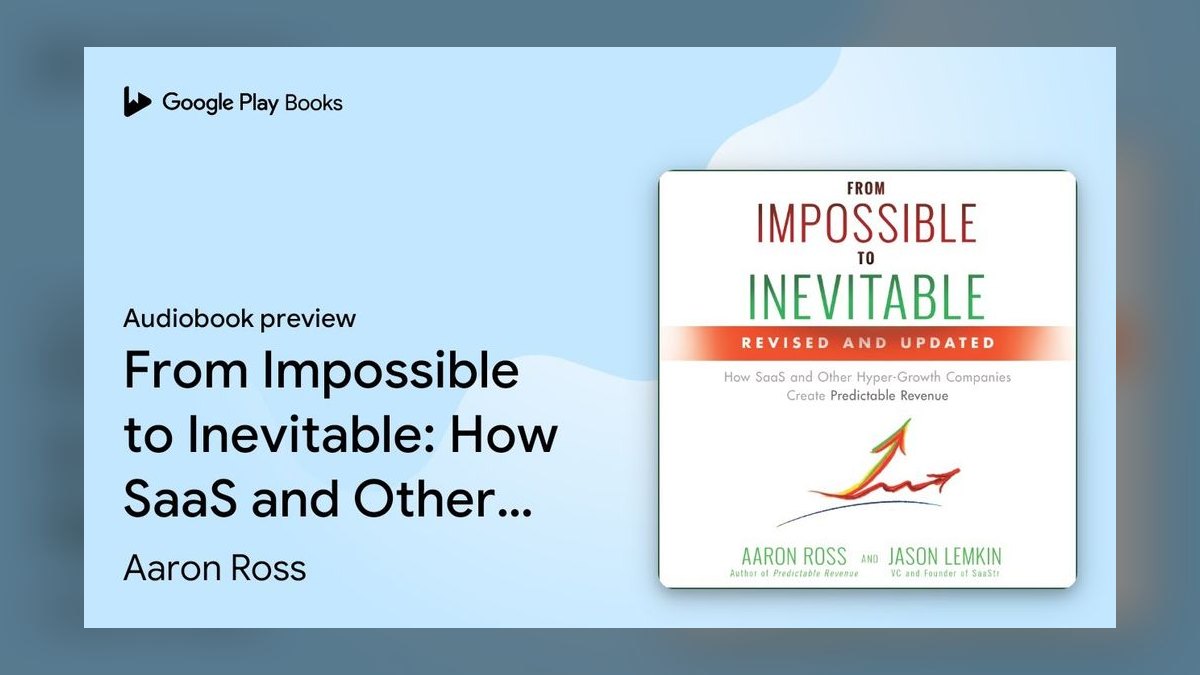
From Impossible to Inevitable by Aaron Ross and Jason Lemkin — Top 10 Key Takeaways for Sales Leaders in 2027
Quality
Certified

"From Impossible to Inevitable" by Aaron Ross and Jason Lemkin argues that hypergrowth is not luck or charisma — it is the product of seven repeatable ingredients (nailing a niche, disciplined outbound, committed leadership, a real growth channel, and more) applied in sequence. For sales Leaders in 2027, the core Takeaways are: replace hero selling with systems, treat pipeline as engineered rather than hoped-for, and build the strategy around what is measurable and repeatable, turning growth from Impossible into Inevitable.
Why most sales leaders stall between $1M and $10M in ARR
Picture a 30-person SaaS company that closed its first $2M in annual recurring revenue almost entirely through the founder's personal network, a handful of inbound leads from a well-timed product launch, and warm referrals from early customers who genuinely loved the product. The founder is charismatic, closes deals personally, and the board is thrilled. Then growth stalls at roughly $2.5M-$3M ARR for two straight quarters. The pipeline dries up because the founder's Rolodex is finite, referrals plateau because the customer base is still small, and the one inbound channel that worked for 18 months stops scaling because the market segment it tapped is saturated.
This is the exact scenario Ross and Lemkin use to open the book's argument: almost every SaaS company hits this wall, and almost every sales leader brought in to fix it makes the same mistake — they hire more salespeople and hope volume solves a systems problem. Ross had lived this personally at Salesforce.com, where he was recruited specifically to build a repeatable outbound engine because the existing sales motion (inbound plus a direct sales team) had already been maximized. Lemkin had lived a parallel version of it as CEO of EchoSign, which he later sold to Adobe, and then again as he interviewed hundreds of SaaS founders through SaaStr. The book's central claim is that the fix is never "sell harder." It is picking one of the seven ingredients that is currently missing or broken and rebuilding it as an operating system before adding headcount on top of a shaky foundation. For a 2027 sales leader inheriting a similar stall, the diagnostic question the book pushes you to ask first is not "how do I hit this quarter's number" but "which of the seven ingredients is actually broken."
The seven ingredients as an operating system
Ross and Lemkin frame growth as a machine with interchangeable but interdependent parts rather than a single silver-bullet tactic. The ingredients they walk through are: nailing a niche before trying to serve everyone, solving a "whole" problem so customers don't need three other vendors to get value, securing genuinely committed leadership (not just a CEO who says growth matters but one who reallocates budget and time to it), building a repeatable growth channel instead of relying on random acts of marketing, layering in proactive outbound prospecting once inbound and referrals are maximized, achieving "critical mass" or density in a specific market before expanding to adjacent ones, and treating customer success as a growth channel in its own right rather than a cost center that only exists to reduce churn.
The mechanism works because each ingredient de-risks the ones that come after it. A niche gives outbound reps a script that actually resonates instead of a generic pitch. A whole-product solution reduces the churn that would otherwise cancel out new bookings. Committed leadership means the outbound motion survives a bad month instead of getting killed at the first sign of a slow ramp. This is why the book insists on sequencing: trying to run enterprise account-based outbound before you've nailed a niche just produces expensive, unfocused SDR activity that burns leads and morale. The flow below shows how the ingredients feed into one another as a single system rather than a checklist to complete in any order.

The practical implication for a sales leader is that outbound prospecting — the tactic most associated with Ross because of "Predictable Revenue" — is deliberately positioned as ingredient five, not ingredient one. Teams that skip straight to hiring SDRs without a nailed niche or a whole-product story are, per the book's own case studies, the most common failure pattern Lemkin observed across the SaaStr portfolio of founders he advised.
Real numbers, ranges, and benchmarks
The book's most frequently cited data point is Ross's own track record at Salesforce.com: he was hired to build a dedicated outbound prospecting team that operated separately from the closing sales team, and that team is widely credited with adding over $100 million in recurring revenue for the company by systematizing cold outbound into a repeatable process — splitting the "hunting" role (setting qualified meetings) from the "closing" role (running the sales cycle), a structure now standard in SaaS as the SDR/AE split. That single case study is why the SDR-to-AE ratio the book implicitly endorses, roughly one SDR supporting two to four closing reps depending on deal complexity, became a common industry benchmark long after the book's 2016 publication.
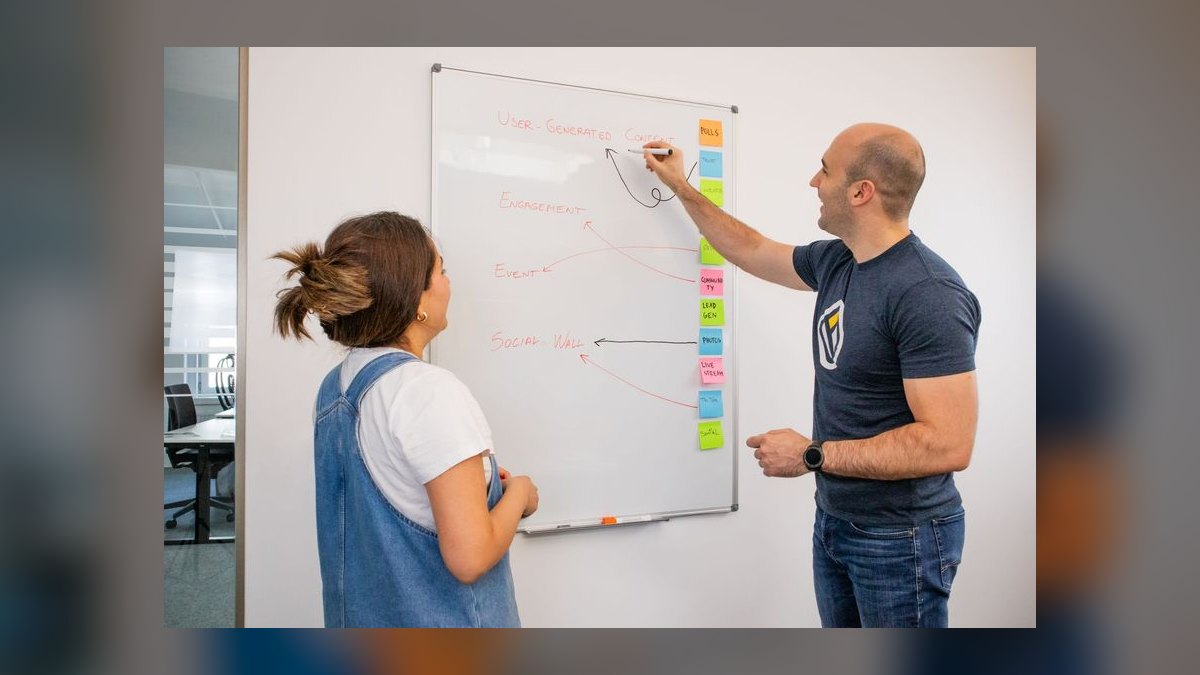
Beyond that anchor case, the book leans on ranges rather than false precision, which is itself a lesson for 2027 leaders: treat any "our SDRs book 12 meetings a month" statistic from a conference talk as a starting hypothesis, not a target to import wholesale. The ranges the authors discuss include: outbound reps typically need 60-90 days to ramp to full productivity in a new niche; companies attempting to scale past roughly $10M ARR usually need at least two, and ideally three, distinct growth channels operating simultaneously (for example, outbound, a strong referral/customer-advocacy motion, and a paid or content-driven inbound channel) so no single channel underperformance can stall the whole company; and density in a niche is treated as reached once a company has enough reference customers and market penetration in a segment that word-of-mouth and case studies start doing measurable work — often cited informally as needing dozens, not just a handful, of logo wins in a specific vertical or company-size band before expanding to the next one.
The book also stresses that "commitment" from leadership is measured in resourcing, not statements: a leader who allocates a real budget line, a named owner, and a minimum 6-12 month test window to a growth channel is "committed"; a leader who tries a channel for six weeks with a part-time owner and no dedicated budget is not, regardless of what they say in an all-hands meeting. For 2027 sales leaders benchmarking their own pipeline coverage, a commonly used modern extension of the book's logic is the 3x-4x pipeline coverage rule (three to four dollars of qualified pipeline for every dollar of quota) — not from the book itself, but a natural downstream metric of the "engineered, not hoped-for" pipeline philosophy the authors advocate.
Trade-offs and alternatives to the seven-ingredient approach

The book is explicit that its playbook is a trade-off, not a universal law. An outbound-led motion, disciplined and systematized the way Ross describes, produces highly predictable, forecastable pipeline — but it is expensive to build (SDR salaries, tooling, ramp time) and slower to show results than a lucky viral inbound moment. A product-led growth motion, increasingly dominant among 2027 SaaS companies with low-friction self-serve products, can scale revenue with far less headcount and sales cost, but it sacrifices the predictability and account-control that enterprise-focused sales leaders need when average contract values climb into six figures. Referral-led growth is nearly free and converts at extremely high rates, but it is capped by the size of your existing happy-customer base and cannot be turned into a lever on demand the way outbound can.
Ross and Lemkin's own resolution to this trade-off is "master one core channel before adding a second," which runs counter to the instinct many boards have to fund every channel at once "to see what sticks." Spreading a small team across five half-built channels, in their framing, produces zero mastered channels and a demoralized team, whereas fully funding one channel for 6-12 months produces a defensible, repeatable growth engine that can then be layered with a second channel. The diagram below contrasts the three dominant growth-channel archetypes against the dimensions that matter most when a sales leader is choosing where to place their strategy bet for the year ahead.
The alternative many 2027 leaders now run is a hybrid: use product-led growth or content for top-of-funnel volume, then layer a small, focused outbound team on top to convert the highest-intent product-qualified leads into larger enterprise deals — effectively borrowing ingredient five (outbound) from the book while substituting a modern PLG motion for the traditional cold-call-driven top of funnel Ross used at Salesforce two decades ago.
Common pitfalls when applying the playbook in 2027

The single most common pitfall, according to both authors' later commentary on the book (particularly from Lemkin's ongoing SaaStr writing), is treating "nail a niche" as a one-time exercise done in a strategy offsite rather than an ongoing discipline enforced deal by deal. Sales leaders who let reps chase any deal with a pulse, regardless of fit, quietly re-broaden the niche back into "everyone," which erodes win rates and lengthens sales cycles even while headline pipeline volume looks healthy on a dashboard.
A second pitfall is hiring outbound reps before the message is nailed. Because "Predictable Revenue" made cold outbound famous, many leaders skip straight to building an SDR team and buying a sequencing tool without first validating, through the founder or a senior rep manually, that the outbound message actually converts in the target niche. The book is blunt that outbound amplifies whatever message you feed it — a mediocre message at scale just produces mediocre results faster and burns through more prospect goodwill than a small, well-targeted test would.
A third pitfall is mistaking activity for commitment. Leadership that funds a channel for one quarter, sees a slow ramp (which the book explicitly says is normal for 60-90 days), and pulls the plug before it matures never gets to see whether the channel would have worked. A fourth, more 2027-specific pitfall is applying the book's outbound cadence assumptions unchanged to a market now saturated with AI-generated outbound messaging — response rates for generic sequences have fallen industry-wide, so the "whole problem" and "nailed niche" ingredients matter more, not less, than when the book was written, because genuine specificity is now the main way a message cuts through inbox noise. Finally, leaders sometimes apply the density/critical-mass ingredient too rigidly, refusing to ever expand into an adjacent segment — the book's actual guidance is to reach meaningful proof points in one niche, not total market saturation, before expanding.
Related questions

What is the "whole product" concept in the book?
It means solving a customer's complete problem, not just the slice your core product covers, often by bundling integrations, services, or partnerships so customers don't need to stitch together multiple vendors to get real value.
How is this book different from Ross's earlier book, "Predictable Revenue"?
"Predictable Revenue" focuses narrowly on building an outbound prospecting engine; "From Impossible to Inevitable" broadens the lens to seven total ingredients, of which outbound is only one part of a larger system.
Does the book apply outside of SaaS?
The authors focus on SaaS and other recurring-revenue growth companies, but the underlying logic — niche focus, one mastered channel, committed leadership — generalizes to most B2B businesses selling repeatable, high-ticket offerings.
What role does customer success play in the framework?
Customer success is treated as an active growth channel that drives expansion revenue and referrals, not merely a retention or support function, making it as central to growth strategy as new-logo acquisition.
FAQ
What are the seven ingredients in "From Impossible to Inevitable"?

Nailing a niche, solving a whole product problem, securing committed leadership, building one strong core growth channel, adding proactive outbound prospecting, achieving density in the niche, and using customer success to drive expansion and referrals.
Who are Aaron Ross and Jason Lemkin? Aaron Ross is the author of "Predictable Revenue" and the architect of Salesforce.com's early outbound prospecting engine; Jason Lemkin is the founder of SaaStr and former CEO of EchoSign, later acquired by Adobe.
Is this book still relevant for sales leaders in 2027? Yes — the core Takeaways about sequencing, focus, and treating growth as an engineered system rather than a hope-based activity remain applicable even as specific tactics like cold-calling scripts have been supplemented by AI-assisted prospecting tools.
What is the book's stance on hiring more salespeople to fix a growth stall? It argues against it as a first move, insisting leaders first diagnose which of the seven ingredients is broken, since adding headcount onto a broken system usually just scales the underlying problem faster.
How long does the book say it takes to properly ramp a new growth channel? It generally frames a realistic test window as 6-12 months, with individual outbound reps needing roughly 60-90 days just to reach full productivity within a nailed niche.
Does the book recommend running multiple growth channels at once? Not simultaneously from day one — it recommends mastering one core channel first, then layering a second and third channel once the first is repeatable, rather than diluting resources across several half-built channels.
Sources
- https://www.saastr.com
- https://www.predictablerevenue.com
- https://www.salesforce.com
- https://hbr.org
- https://www.forbes.com
- https://www.gartner.com
- https://www.linkedin.com/in/aaronross
- https://www.adobe.com
Related on PULSE
- How Predictable Revenue's cold-calling 2.0 model changed SDR team structure
- Nailing a niche: how to define your ideal customer profile before scaling outbound
- SDR to AE ratios: benchmarking your outbound team structure in 2027
- Customer success as a growth channel: turning retention teams into expansion engines
- Product-led growth vs. sales-led growth: choosing the right motion for your stage
- How SaaStr's community data shapes modern SaaS benchmarking standards
This page will be disappearing soon. Save it to your device for $1 — or read it free while it is here.
@Kory-White- · if Venmo asks, the last 4 of my number are 2012
This page is gone.
This one is off the shelf now. $1 keeps it on your phone for good — the whole page, pictures and diagrams included.
 book-summaryPitch Anything by Oren Klaff — Cliff Notes Summary & Key Takeaways
 pulse-recentThe Challenger Customer by Brent Adamson — Top 10 Key Takeaways for Sales Leaders in 2027
 pulse-recentHyper Sales Growth by Jack Daly — Top 10 Key Takeaways for Sales Leaders in 2027
 pulse-recentWhat are the concrete steps to implement the Sandler Rules for Sales Leaders by David Mattson in 2027?
 pulse-recentWhat are the concrete steps in Sandler Rule #7 for handling a prospect's budget objection in 2027?
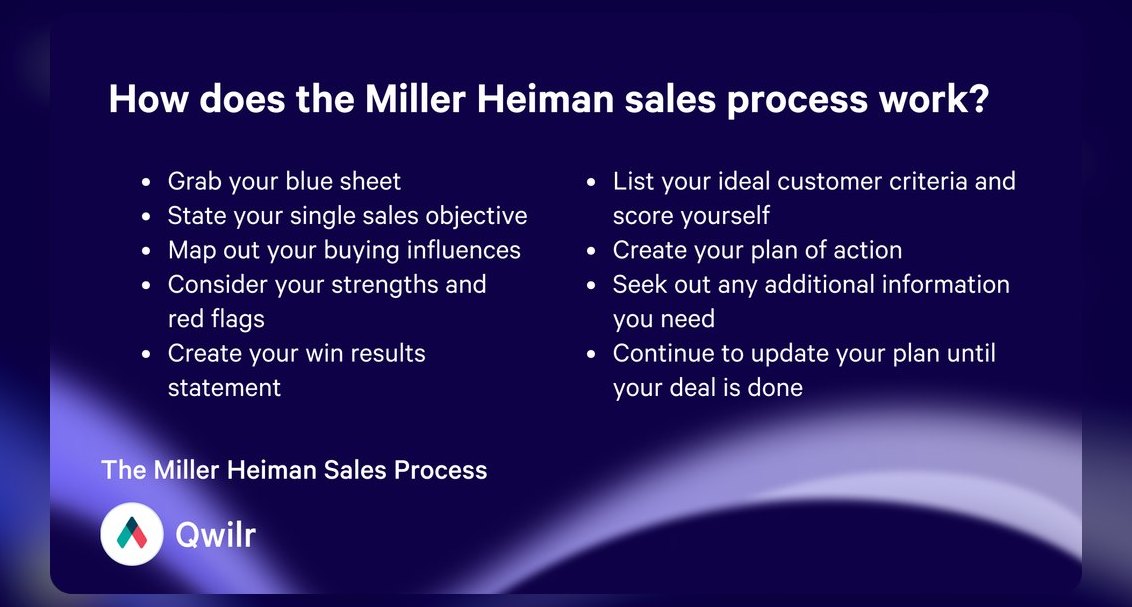 pulse-recentWhat is the step-by-step process for Strategic Selling by Miller Heiman in 2027?
 pulse-recentThe Customer Success Professional’s Handbook by Ashvin Vaidyanathan — Top 10 Key Takeaways for Sales Leaders in 2027
 pulse-recentSell or Be Sold by Grant Cardone — Top 10 Key Takeaways for Sales Leaders in 2027
 pulse-recentBlueprints for a SaaS Sales Organization by Jacco van der Kooij — Top 10 Key Takeaways for Sales Leaders in 2027
 pulse-recentThe Transparency Sale by Todd Caponi — Top 10 Key Takeaways for Sales Leaders in 2027