


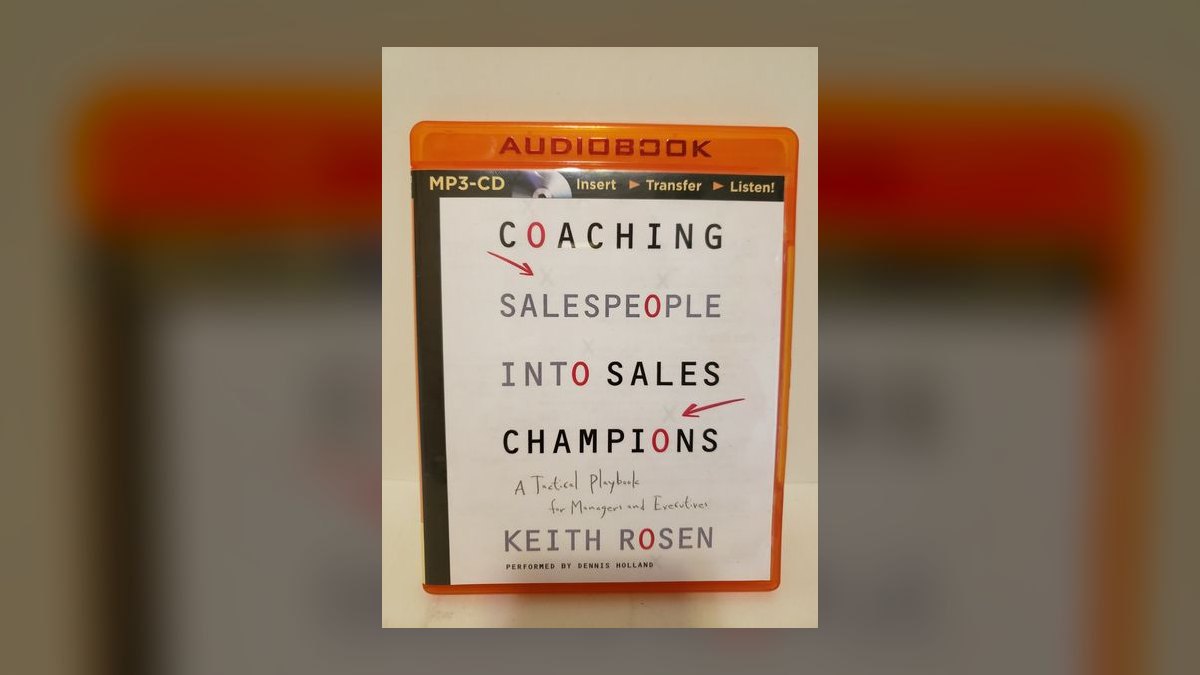
Coaching Salespeople into Sales Champions by Keith Rosen — Top 10 Key Takeaways for Sales Leaders in 2027
Quality
Certified

Keith Rosen's *Coaching Salespeople into Sales Champions* argues that sales leaders build Champions not by rescuing deals but by coaching reps to solve problems themselves, through structured weekly conversations built on questions instead of directives. The core Takeaways for sales leaders: separate coaching from managing, run a repeatable question-based coaching strategy, hold reps to self-generated commitments, and track coaching cadence as a leading indicator, not an afterthought.
A manager stuck rescuing every deal
Picture Dana, a first-line sales manager running an eight-rep team. Every morning starts the same way: a rep messages her with "the prospect pushed back on price, what do I say?" and Dana, wanting the deal to close, types out the exact rebuttal. By Wednesday she's joined three calls to close objections herself, rewritten two proposals, and coached nobody — she's just done the work for them. Her reps hit quota that quarter, but the next quarter looks identical: same objections, same rescue calls, same reps who never developed the muscle to handle it alone. This is the trap Rosen calls the "chief problem solver" pattern, and it's the exact failure mode his book is written to fix.
The scenario matters because it's the default, not the exception. Most sales managers are promoted because they were excellent individual performers, then given a team with zero training in how to develop other Salespeople — only in how to sell. So they do what they know: they sell for their reps, one deal at a time, forever. Rosen's central claim is that this isn't really management or Coaching at all; it's an expensive, unscalable form of order-taking where the manager becomes the bottleneck for every stalled deal on the team. A manager who spends her week firefighting individual opportunities never builds a team that can operate without her, and she never gets her own time back. Industry surveys on manager time allocation consistently find that first-line sales managers spend a disproportionate share of their week on deal-level firefighting and only a small sliver on structured, planned coaching conversations — often single-digit percentages of total working hours. That imbalance is precisely the gap the book's framework is designed to close: shifting time from "telling reps what to do on this deal" toward "developing reps who can figure out what to do on any deal."
The fix starts with a mindset shift Dana has to make before any technique matters: her job is not to be the best salesperson in the room during every call. Her job is to ask the questions that get the rep to diagnose the problem, propose their own next step, and commit to it out loud. That reframing — from answering to asking — is the foundation every other Takeaway in the book builds on.
How the coaching conversation actually works
Rosen's framework treats coaching as one of five distinct roles a sales leader plays — training, mentoring, managing, consulting, and coaching — and insists they get collapsed into one undifferentiated blob under pressure, which is exactly how coaching disappears first. Training transfers a skill. Mentoring shares experience. Managing sets direction and enforces standards. Consulting hands over an expert answer. Coaching is different from all four: it's a structured, question-driven conversation where the manager deliberately withholds the answer so the rep builds their own capability to find it. Confusing these roles is the single most common reason managers believe they're coaching when they're actually just managing with extra empathy.

The mechanism itself runs as a repeatable loop, not a one-off pep talk. It starts with a diagnostic question rather than a status update — "walk me through what happened on that call" instead of "did you close it?" The manager listens for where the rep's own thinking breaks down, then asks a follow-up question that narrows the gap without filling it in. The rep, forced to articulate the problem out loud, usually proposes their own next step. The manager's job at that point is to pressure-test the commitment — is it specific, is it dated, is it something the rep actually believes will work — and then let the conversation end there, without adding "and also try this." That restraint is the hardest part for most managers to learn, and it's the part Rosen spends the most pages on.
This loop repeats inside a fixed weekly one-on-one, not an ad hoc call whenever a deal stalls. Rosen also introduces a pre-call discipline he frames around planning before a rep ever picks up the phone: define the objective for the call, anticipate the objections, and script the opening — so coaching happens proactively before a deal goes sideways, not only reactively after it does. The strategy only compounds if the loop closes every week; skip the follow-up step and the whole framework degrades back into Dana's rescue pattern, because nothing holds the rep accountable to what they said they'd do.
Real numbers, ranges, and benchmarks
Sales leaders adopting this framework in 2027 are working against a specific set of Takeaways that show up as practical benchmarks rather than abstract advice. The ten that matter most in practice:

- Weekly cadence, non-negotiable. A structured one-on-one coaching session per rep, roughly 30-45 minutes, at least once a week — not "whenever there's time," which in practice means never.
- Question-to-statement ratio. Aim for something like an 80/20 split toward questions in a coaching conversation. Most untrained managers default closer to the inverse, spending most of the call telling rather than asking.
- Five roles, one calendar block. Training, mentoring, managing, consulting, and coaching each need protected time; coaching is the first one sacrificed when a pipeline review runs long, so it needs its own dedicated slot that isn't allowed to absorb overflow from the others.
- New-manager coaching training. Across the industry, newly promoted sales managers commonly receive only a few days — sometimes less than a week — of formal training in how to coach, versus months of product and process onboarding. That gap is a direct predictor of how many managers default to the "chief problem solver" pattern.
- Ramp-time impact. Teams that run a documented weekly coaching rhythm consistently report faster new-rep ramp than teams relying on deal-by-deal reviews alone, because reps are building transferable diagnostic skill instead of memorizing one deal's fix.
- Retention signal. In multiple sales-engagement and workplace surveys, reps who report receiving regular, high-quality coaching rank it among their top reasons for staying on a team, often above compensation alone.
- Written coaching plans, revisited quarterly. Rosen's approach calls for a documented plan per rep — not just notes from the last deal — reviewed and updated on a quarterly rhythm so coaching tracks development over months, not just this week's pipeline.
- Commitments logged, not remembered. Each session should close with one to three specific, dated commitments captured in writing; commitments held only in memory decay within days and rarely get followed up on.
- The 2027 shift toward strategic coaching. As AI-assisted call scoring and next-step suggestions absorb more of the tactical "what do I say" coaching, the gap sales leaders need to fill moves toward strategy, career development, and deal judgment — the harder-to-automate half of coaching.
- Coaching cadence as a leading indicator. Leaders who track how consistently coaching actually happens — not just whether the team hit number — catch skill gaps weeks before they show up in quota attainment, because the coaching metric moves first.
Taken together, these benchmarks describe a system, not a single tactic: fixed cadence, protected time, a written record, and a shift in where coaching effort goes as the job itself changes.

Trade-offs: coaching versus quick-fix managing
The honest trade-off in Rosen's approach is speed versus durability. Directive managing — telling a rep exactly what to say on the call — closes this quarter's deal faster than a coaching conversation ever will, because the manager just hands over the answer. Coaching takes longer per interaction, asks more of the manager's patience, and sometimes lets a deal wobble a bit while the rep works through it themselves. The payoff is on the other side of that trade: a rep who was coached through the objection can handle the next five like it without help, while a rep who was told the answer needs the same rescue call next time.

The alternatives worth naming: the GROW model (Goal, Reality, Options, Will) is a lighter-weight coaching structure some leaders layer on top of Rosen's framework for a single conversation's shape, while deal-methodology frameworks like MEDDIC give reps a diagnostic checklist to coach against rather than open-ended questions alone. Neither replaces the underlying discipline — protected weekly time, written commitments, question-first conversation — but they can supply the content of what gets asked. The trade-off to watch for leaders choosing between them: a checklist-driven method is easier to train new managers on quickly, but risks becoming another form of telling ("did you cover step 4?") if it isn't paired with the same question-based delivery Rosen insists on. The strategy that works best in practice usually borrows the structure of a deal methodology and the conversational discipline of Rosen's coaching model rather than picking one exclusively.
Common pitfalls and how to avoid them
The most common failure is relapse under pressure: a manager runs the framework well for a month, then a quarter-end crunch hits and she reverts to telling reps the answer because it's faster in the moment. The fix is treating the weekly coaching block as immovable — the same way a board meeting or a customer commitment can't be casually rescheduled — because every skipped session teaches the team that coaching is optional whenever things get busy.
A second pitfall is running coaching conversations with nothing written down. Without a logged commitment, the next session becomes a generic check-in instead of accountability follow-through, and reps quickly learn that what they say in a 1:1 doesn't actually get tracked. A simple shared one-page template — situation, question asked, rep's own next step, date — solves most of this.

A third pitfall is treating coaching as remedial, reserved only for underperformers who need fixing. Rosen's framework is explicit that top performers need coaching too, often on strategy and career growth rather than basic mechanics; skipping coaching for the team's best reps quietly caps how far they can grow and signals that coaching is a punishment rather than a development tool.
A fourth pitfall is blending deal coaching with skill coaching until neither happens well. Deal coaching solves this specific opportunity right now; skill coaching builds a capability the rep keeps on every future deal. Conflating them means every session turns into deal triage and the durable-skill conversation never gets its own time.
The last pitfall is a leadership gap: a VP who mandates coaching for front-line managers but never models it in her own skip-level conversations with those managers. Coaching strategy has to run top to bottom — a sales leader who coaches her managers the way she wants them to coach their reps is far more likely to see the framework actually stick.
Related questions
What is the difference between coaching and managing in sales?
Managing sets direction, enforces process, and holds people to standards. Coaching is a question-based conversation that helps a rep diagnose their own problem and commit to their own next step, without the manager supplying the answer.
How often should a sales manager coach each rep?

Rosen's framework calls for a fixed weekly one-on-one per rep, roughly 30-45 minutes, treated as non-negotiable — not an ad hoc conversation only triggered when a deal stalls.
Can AI tools replace sales coaching?
AI can automate call scoring and tactical next-step suggestions, but it shifts rather than eliminates the coaching need — leaders increasingly focus human coaching time on strategy, judgment, and career growth instead of call mechanics.
What makes someone a "sales champion" versus just a good rep?
A sales champion, in Rosen's terms, is a rep who has internalized the diagnostic process well enough to solve new problems independently, rather than one who simply executes scripts a manager handed them.
Does this coaching framework work for experienced reps, not just new hires?
Yes — Rosen is explicit that top performers benefit from coaching aimed at strategy and growth, not just remedial coaching for reps who are struggling.
FAQ
**What is Keith Rosen's book *Coaching Salespeople into Sales Champions* actually about?** It's a sales-management book arguing that managers create lasting performance by coaching reps through structured, question-based conversations rather than solving deals for them directly — treating coaching as a distinct discipline from managing, training, mentoring, and consulting.
What are the biggest Takeaways for sales leaders in 2027?

Run a fixed weekly coaching cadence, ask far more than you tell, document commitments in writing, separate deal coaching from skill coaching, and shift coaching time toward strategy and judgment as AI absorbs more tactical deal mechanics.
Why do most sales managers default to telling instead of coaching? Most are promoted for selling well, not for developing others, and receive little formal training in how to coach — so under time pressure they revert to giving the answer because it's faster in the moment, even though it doesn't build the rep's independent capability.
How is this different from the GROW coaching model? GROW (Goal, Reality, Options, Will) is a lighter conversational structure some leaders use to shape a single session. Rosen's framework is broader, covering the manager's overall role separation, weekly cadence, and accountability system — the two can be combined.
What's the single biggest mistake leaders make implementing this? Skipping the written commitment and follow-up step. Without a logged, dated commitment reviewed at the next session, coaching conversations drift into generic check-ins and accountability disappears.
Does coaching slow down deal velocity? In the short term, sometimes — a coached rep may take a bit longer to work through an objection than one who's simply told the answer. Over several quarters, coached reps close similar objections faster on their own, which is the trade-off the framework is built around.
Sources
- https://www.keithrosen.com
- https://hbr.org/topic/subject/sales
- https://www.gartner.com/en/sales
- https://www.td.org
- https://www.forbes.com/sales
- https://blog.hubspot.com/sales
- https://www.sellingpower.com
- https://www.inc.com/guides/sales
Related on PULSE
- How to build a weekly sales coaching cadence that actually sticks
- GROW model vs. question-based coaching for sales managers
- Signs a sales manager is stuck in the "chief problem solver" trap
- How AI call scoring is changing what sales coaching covers in 2027
- Coaching top performers vs. coaching underperformers: what changes
- How to document and track sales rep coaching commitments
This page will be disappearing soon. Save it to your device for $1 — or read it free while it is here.
@Kory-White- · if Venmo asks, the last 4 of my number are 2012
This page is gone.
This one is off the shelf now. $1 keeps it on your phone for good — the whole page, pictures and diagrams included.
 pulse-recentInsight Selling by Mike Schultz and John Doerr — Top 10 Key Takeaways for Sales Leaders in 2027
 pulse-recentHow do you implement the Sandler Rules in your first 30 days as a new sales rep in 2027?
 pulse-recentSPIN Selling by Neil Rackham — Top 10 Key Takeaways for Sales Leaders in 2027
 pulse-recentSnap Selling by Jill Konrath — Top 10 Key Takeaways for Sales Leaders in 2027
 pulse-recentHow do you implement the Sandler Rules by David Mattson in your first 30 days as a new sales manager in 2027?
 pulse-recentWhat is the first concrete step in SPIN Selling by Neil Rackham for structuring a discovery call in 2027?
 pulse-recentThe Greatest Salesman in the World by Og Mandino — Top 10 Key Takeaways for Sales Leaders in 2027
 pulse-recentTraction by Gabriel Weinberg and Justin Mares — Top 10 Key Takeaways for Sales Leaders in 2027
 pulse-recentMonetizing Innovation by Madhavan Ramanujam — Top 10 Key Takeaways for Sales Leaders in 2027
 pulse-recentThe Sales Acceleration Formula by Mark Roberge — Top 10 Key Takeaways for Sales Leaders in 2027