


What are the key steps to setting SMART goals for individual sales reps in 2027?
Quality
Certified

Setting SMART goals for individual sales reps starts with pulling 6–12 months of that rep's own activity and conversion data, then writing one specific, measurable, achievable, relevant, time-bound target per behavior you want changed. Cascade from team quota, cap at three to five goals, and review them on a fixed weekly and quarterly cadence.
What it is and why it matters
A SMART goal for a sales rep is a written commitment that passes five tests at once: it names a *specific* behavior or outcome, attaches a *measurable* number, sits at an *achievable* level given that rep's history, is *relevant* to the team's revenue plan, and carries a *time-bound* deadline. The failure mode most teams fall into is writing a target that only passes two or three of those tests — "improve your discovery calls this quarter" is specific-ish and time-bound but has no number and no relevance chain to the number the team is actually chasing.
The distinction that matters most in practice is between *quota* and *goals*. Quota is the revenue number assigned to the territory or seat; it is usually non-negotiable and set top-down by finance. Goals are the rep-level inputs you believe will produce that quota. A rep carrying a $900,000 annual quota with a $45,000 average deal size needs 20 closed-won deals. If that rep historically closes 22% of the opportunities they create, they need roughly 91 opportunities across the year — about 23 per quarter, or roughly 1.8 per selling week. Those derived numbers, not the $900,000, are what belong in the rep's SMART goals, because they are the things the rep can actually control on a Tuesday morning.
Why individual-level goal setting keeps getting more important: territory and product complexity have kept climbing, and the average B2B buying group has grown well past the single-champion model, which means the gap between your strongest and weakest performer widens rather than narrows over time. A team-level goal averages that gap away. A rep who converts 34% and a rep who converts 11% both hear "hit your number" and neither hears anything actionable. Individual goals let you tell the first rep to increase pipeline volume (their conversion is fine, they just don't have enough at-bats) and the second to fix qualification (they have plenty of at-bats and are wasting them).

There is also a retention argument. Reps who can articulate what "good" looks like for them personally — not just the revenue number — stay longer and ramp faster. When a rep can say "I need 1.8 new opportunities a week, my multi-threading rate needs to go from 1.4 to 2.5 contacts per deal, and my stage-2-to-3 conversion needs to hold above 55%," they have a diagnostic they can run on themselves without waiting for a manager. That self-diagnosis is the entire point of doing this at the individual level.
One structural change worth naming: as more of the top-of-funnel motion gets automated or assisted, the goals that differentiate reps have shifted downstream. Activity-volume goals (dials, emails sent) have lost most of their diagnostic value because the volume is increasingly not produced by the rep's hands. The goals that hold up are the ones measuring judgment and progression — meeting-to-opportunity conversion, multi-threading depth, stage velocity, forecast accuracy, and win rate against named competitors. Build your goal set from that downstream half of the funnel and use activity metrics only as a leading indicator you check, not a goal you score.
The step-by-step process
The sequence below is the one that survives contact with a real sales floor. Skipping steps 1 or 2 is the single most common cause of goals that get written in January and ignored by March.
Step 1 — Pull the rep's own baseline (2–4 hours per rep, or one batch report). Export 6–12 months of that rep's data from the CRM: opportunities created per month, average deal size, win rate, sales cycle length in days, stage-by-stage conversion, contacts engaged per opportunity, and forecast accuracy (predicted vs. actual by month). Twelve months is better than six because it captures seasonality; six is acceptable for a rep with under a year of tenure. If a rep has fewer than 15–20 closed opportunities in the window, their personal win rate is statistically noisy — use the team median as their baseline and flag the goal as provisional for one quarter.
Step 2 — Derive the required inputs from quota. Work backward: quota ÷ average deal size = deals needed. Deals needed ÷ win rate = opportunities needed. Opportunities needed ÷ meeting-to-opportunity conversion = meetings needed. Do this arithmetic with the rep in the room. When a rep sees that their current pipeline generation rate produces 68% of what quota requires, the goal stops being an imposition and becomes math.
Step 3 — Identify the one or two binding constraints. Compare the rep's baseline against what the arithmetic requires. Usually exactly one metric is badly out of line and the rest are fine. A rep at 31% win rate with only 9 opportunities per quarter has a *volume* constraint. A rep with 40 opportunities and a 9% win rate has a *quality* constraint. Do not write goals for metrics that are already healthy — every goal you add dilutes attention on the one that matters.
Step 4 — Write three to five goals, no more. One goal per binding constraint, one skill-development goal, one optional stretch goal. Five is the ceiling; four is better. Each goal gets a single owner (the rep), a single number, and a single date.
Step 5 — Pressure-test achievability against history. The workable improvement band for a single quarter is roughly 10–20% over the rep's own trailing average for a metric they influence directly, and 5–10% for a metric with long feedback loops like win rate. A goal demanding a jump from a 12% to a 30% win rate in 90 days is not a stretch goal, it is a fiction, and the rep will disengage from the whole set the moment they conclude it is unreachable.
Step 6 — Attach a review cadence before you finish writing. Every goal needs a named check-in rhythm: weekly for leading indicators (opportunities created, meetings booked, multi-threading), monthly for mid-funnel (stage conversion, cycle length), quarterly for lagging (win rate, quota attainment, forecast accuracy). Write the cadence into the goal document itself.
Step 7 — Get written sign-off and store it where both parties see it. A goal that lives only in a manager's notebook does not exist. Put it in the CRM, the enablement platform, or a shared doc that surfaces in the weekly 1:1 agenda automatically.
Costs, timelines, and typical ranges
Time cost, first cycle. Budget 90 minutes to two hours per rep for the initial goal-setting conversation, plus 30–60 minutes of manager prep pulling the baseline data. For a manager with eight direct reports, that is roughly 16–20 hours spread across two weeks — a real cost that needs to be blocked on the calendar or it will not happen. Subsequent quarters drop to 45–60 minutes per rep because the baseline is already built and you are adjusting rather than constructing.
Time cost, ongoing. Weekly 1:1s should dedicate 10–15 minutes to goal review, not the whole meeting. Monthly reviews run 30 minutes. Quarterly resets run the full 60–90 minutes again. Across a year, a manager spends roughly 25–35 hours per rep on goal-related conversation. That is the honest number, and it is why span of control above ten reps makes individual goal setting break down.
Ramp timelines. A new rep should not carry the same goal structure as a tenured one. A reasonable ramp shape: months 1–2 goals are purely activity and knowledge-based (complete certification, book N discovery calls, shadow N deals); months 3–4 add pipeline generation targets at 50–60% of full quota-equivalent; months 5–6 add conversion and win-rate goals at 70–80%; full goal set at month 6–9 depending on cycle length. If your average sales cycle is 120 days, a rep cannot have a meaningful win-rate goal before month 5 because they have not had time to close anything.
Typical improvement ranges to expect. Over one quarter with focused coaching: pipeline generation volume can realistically move 15–25% (it is the most directly controllable metric); meeting-to-opportunity conversion 5–10 percentage points; stage-to-stage conversion 3–8 percentage points; win rate 2–5 percentage points; sales cycle length 5–15% shorter. Multi-threading depth is the fastest-moving metric of the group — going from 1.5 to 2.5 engaged contacts per opportunity is achievable in 60 days because it is a pure behavior change with no dependency on buyer timelines.
Tooling cost. You do not need new software to do this. The baseline data lives in the CRM you already own, and the goal document can be a shared spreadsheet. Dedicated goal-tracking or sales-performance-management tooling becomes worth evaluating at roughly 25–40 reps, when the manual reporting burden crosses about four hours a week for the ops team. Below that headcount the spreadsheet is genuinely fine and the tool will mostly add administrative overhead.
Compensation interaction. Keep SMART goals and variable compensation mostly separate. Goals that are directly tied to bonus dollars get gamed, and the gaming shows up in exactly the metrics you were trying to improve — reps will create low-quality opportunities to hit an opportunity-count goal if the count pays. The common structure that works: quota attainment drives commission, SMART goals drive coaching, development, and promotion decisions, with at most a small MBO component (typically 5–15% of variable) tied to one or two goals that are hard to game, like certification completion or CRM hygiene.
Where teams get it wrong

Writing goals that are actually quota restated. "Close $225,000 this quarter" is not a SMART goal, it is the quota with a deadline stapled to it. The rep already knew that number. A SMART goal has to name something the rep does differently — the input, not the output. If you cannot describe the behavior change the goal implies, you have written a quota.
Setting the same goals for every rep on the team. This is the most common shortcut and it defeats the entire purpose. If eight reps have identical goals, you have a team goal with eight copies. The whole value of individual goal setting is that the top performer and the struggling performer get different instructions. Uniform goals mean nobody's binding constraint gets addressed.
Too many goals. Managers who set eight or ten goals per rep are optimizing for coverage rather than change. Attention is the scarce resource. Above five goals, reps report treating the list as a menu and quietly picking the two easiest. Three or four is the working range.
Baselines pulled from team averages instead of the individual. Using the team's 24% win rate as every rep's baseline produces goals that are trivially easy for half the team and impossible for the other half. Pull each rep's own trailing numbers, even if the sample is small — a noisy personal baseline with a flag on it beats a clean team average that describes nobody.
No mid-course correction mechanism. Goals set in week 1 of a quarter and reviewed in week 13 are decoration. The mid-quarter checkpoint at week 6 or 7 is where goals earn their value: if a rep is at 30% of a pipeline goal at the halfway mark, that is the moment to diagnose and adjust, not the moment to write "behind" in a spreadsheet. Build a rule: any goal tracking below 40% of pace at the midpoint triggers a structured diagnostic conversation.
Confusing "achievable" with "easy." The correction to unreachable goals is often an overcorrection into targets the rep would have hit anyway. A goal that a rep clears without changing anything teaches nothing. The test: ask the rep "what will you have to do differently to hit this?" If the honest answer is "nothing," rescale up.
Ignoring the environmental inputs. A rep's goals assume a territory, a lead flow, a product set, and a competitive field. When any of those change materially mid-quarter — territory carve, product launch slip, a competitor cutting price — the goals need to be reopened. Managers who treat goals as immutable once written lose credibility fast, because reps can see the ground moved.
No documentation of the reasoning. Six weeks later, nobody remembers why the opportunity target was 23 and not 18. Write one sentence of derivation next to each goal: "23 opps = 20 deals needed ÷ 22% historical win rate, quarterly split." That sentence is what makes the goal defensible in a difficult conversation and what makes it easy to re-derive when quota changes.
Skipping the rep's own input entirely. Goals handed down without a conversation get compliance, not commitment. Ask the rep what they think their binding constraint is before you tell them. Reps are frequently right about their own bottleneck, and when they name it themselves the goal stops feeling like a performance-improvement plan in disguise.
Decision framework: when to choose what
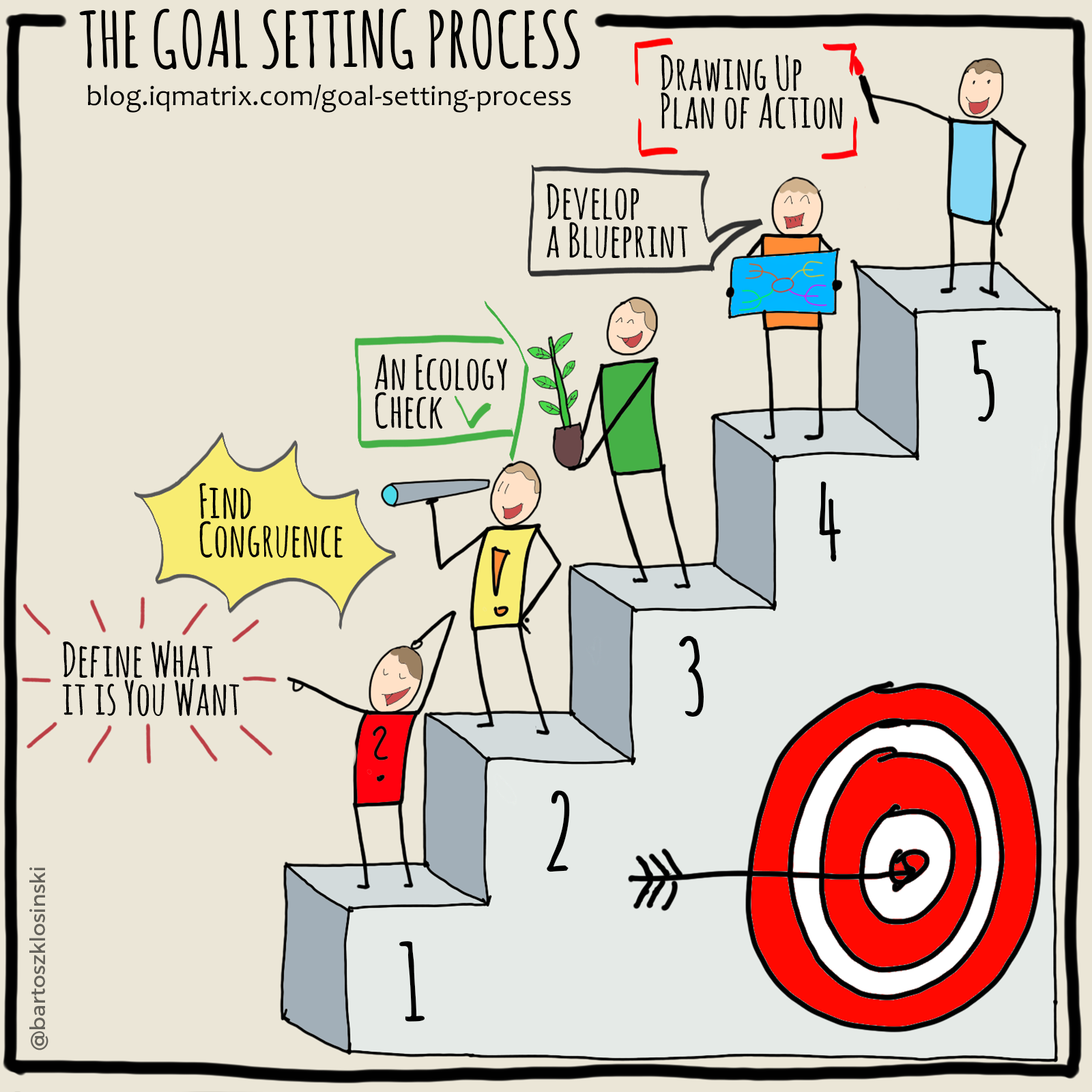
Not every rep needs the same *type* of goal. The framework below routes by the rep's tenure and the shape of their performance gap, which is the pairing that determines what kind of target will actually change behavior.
If the rep is in ramp (months 0–4): use leading-activity and knowledge goals only. Certification completion, number of discovery calls conducted, number of deals shadowed, CRM hygiene. No conversion or win-rate goals — the sample doesn't exist yet.
If the rep has volume but not conversion: the goal set targets qualification and deal execution. Concrete examples: raise engaged contacts per opportunity from 1.4 to 2.5 by end of quarter; complete a documented discovery framework on 100% of new opportunities; reduce opportunities that sit in stage 2 beyond 21 days from 40% to under 20%.
If the rep has conversion but not volume: the goal set targets pipeline generation. Examples: create 23 new qualified opportunities this quarter (up from 17); book 6 first meetings per week; generate 30% of pipeline from within existing accounts rather than net-new.
If the rep is strong on both but plateaued: the goal shifts to deal size or strategic motion. Examples: raise average deal size from $38,000 to $46,000 by attaching a second product line to 40% of deals; win two deals against a named competitor you currently lose to; land one deal above $150,000.
If the rep is underperforming across the board: stop writing SMART goals and start a structured diagnostic. Goals presume the rep knows how to do the job and needs direction on where to point. A rep who is failing on volume, conversion, and cycle length simultaneously has a capability or fit issue, and layering four numeric targets onto that is not going to fix it. Run the diagnostic first, decide whether it is skill, will, or fit, and only then write goals.

The framework has one override: if a rep's territory or comp plan changed within the last 60 days, delay full goal setting by one review cycle. Goals written against a territory the rep no longer has are worse than no goals, because they train the rep to ignore the goal document.
A last note on cadence choice. Quarterly goal cycles fit most B2B teams because they align to the forecast rhythm and to a sales cycle of 60–120 days. Teams with cycles under 30 days — transactional, high-velocity, SMB — can run monthly cycles and should, because a quarter is 3+ full cycles and feedback arrives too late. Teams with enterprise cycles above 180 days should run semi-annual goal cycles on lagging metrics while keeping quarterly cycles on the leading inputs, because a win-rate goal on a 9-month cycle is not measurable inside a quarter.
Related questions
How many SMART goals should one sales rep have at a time?
Three to five, with four as the practical target. One goal per binding constraint, one development goal, and at most one stretch goal. Above five, reps consistently self-select the two easiest and ignore the rest, which defeats the purpose of directing attention.
Should SMART goals be tied to commission?
Mostly no. Quota attainment should drive commission; SMART goals should drive coaching and promotion decisions. Directly paying on input metrics invites gaming — reps will create thin opportunities to hit a count. A small MBO component of 5–15% of variable, on hard-to-game goals like certification, is the common exception.
How do you set goals for a rep with less than six months of data?
Use the team median as a provisional baseline and flag the goal as provisional. Restrict the goal set to activity and knowledge targets during ramp months 0–4, add pipeline generation at 50–60% of full-quota equivalent in months 3–4, and add conversion goals only once the rep has 15–20 closed opportunities.
What's the right review cadence for rep-level goals?

Weekly for leading indicators like opportunities created and meetings booked, monthly for mid-funnel metrics like stage conversion and cycle length, quarterly for lagging metrics like win rate and attainment. Add a hard mid-quarter checkpoint at week 6 or 7 to catch goals tracking below 40% of pace.
Can you change a SMART goal mid-quarter?
Yes, when the underlying assumptions change — territory carve, product delay, comp plan revision, a major competitive shift. Rewrite the goal and document why. Leaving a goal in place after its assumptions broke costs more credibility than adjusting it does.
FAQ
What makes a sales goal "specific" rather than vague?
A specific goal names the exact behavior or metric and the population it applies to. "Improve discovery" is vague. "Complete a documented discovery framework, including budget, decision process, and success criteria, on 100% of opportunities created after March 1" is specific — a third party could audit whether it happened without asking anyone's opinion.
How do you make a goal measurable when the thing you care about is qualitative?
Convert the quality into a countable proxy with a defined standard. Coaching quality becomes "number of call recordings reviewed and scored against the rubric." Relationship depth becomes "engaged contacts per opportunity," where "engaged" means a two-way interaction logged in the CRM. The proxy is imperfect, but a defined imperfect measure beats an undefined perfect one.

What improvement percentage counts as achievable versus unrealistic?
For metrics a rep controls directly — activity volume, multi-threading, pipeline creation — 10–20% improvement over their own trailing average in a quarter is a real stretch that lands. For metrics with long feedback loops like win rate, 5–10% relative improvement is the honest ceiling in 90 days. Anything demanding a doubling in one quarter reads as arbitrary and gets ignored.
How does "relevant" get tested in practice?
Trace the goal back to quota in one step. If the rep hits this goal and nothing else changes, does the quota math improve? "Increase opportunities created from 17 to 23" traces directly — more at-bats at a stable win rate produces more deals. "Post three times a week on social" does not trace in one step, so it fails the relevance test regardless of whether it is a nice habit.
What time frame should the "time-bound" element use?
Match the goal's time frame to the feedback loop of the metric. Weekly for activity, monthly for mid-funnel conversion, quarterly for win rate and attainment. A useful rule: the deadline should be at least two full sales cycles away for any outcome metric, otherwise the rep cannot influence it within the window.
Who should write the goals — the manager or the rep?
Both, in that order of conversation. The manager brings the quota arithmetic and the baseline data; the rep names what they think their bottleneck is. Goals written entirely by the manager get compliance; goals written entirely by the rep tend to skip the uncomfortable constraint. The draft belongs to the manager, the final wording belongs to the pair.
Sources
- https://hbr.org/2012/12/set-goals-that-motivate
- https://www.mindtools.com/a4wo118/smart-goals
- https://www.salesforce.com/resources/articles/sales-goals/
- https://www.gartner.com/en/sales
- https://www.mckinsey.com/capabilities/growth-marketing-and-sales/our-insights
- https://hbr.org/2017/07/how-to-set-sales-quotas-that-actually-work
- https://www.forrester.com/blogs/category/sales/
- https://corporatefinanceinstitute.com/resources/management/smart-goal/
Related on PULSE
- The Mutual Action Plan: Template for Aligning Sales Reps and Prospects on Next Steps
- Top 10 multi-threading training drills for B2B sales reps in 2027
- Top 10 prospecting training drills for B2B sales reps in 2027
- Top 10 presentation training drills for B2B sales reps in 2027
- Top 10 sales enablement drills for mid-market reps in 2027
- Top 10 deal review training drills for B2B sales reps in 2027
This page will be disappearing soon. Save it to your device for $1 — or read it free while it is here.
@Kory-White- · if Venmo asks, the last 4 of my number are 2012
This page is gone.
This one is off the shelf now. $1 keeps it on your phone for good — the whole page, pictures and diagrams included.
 stHow much do Sales Trainings cost in 2027?
 stHow do you set stretch goals that motivate sellers without causing burnout in 2027?
 stHow do you set quarterly sales goals that cascade from quota to daily activity in 2027?
 stWhat tools or templates help assign territories based on account data in 2027?
 stHow should sales territories be assigned to balance workload and revenue potential in 2027?
 stWhat are the most common mistakes in Sales Trainings in 2027?
 stWhat is a typical sales compensation structure as a percentage of gross profit to the rep in 2027?
 stWhat is the most effective method for splitting territories between inside and field sales in 2027?
 stWhat is the best way to approach Sales Trainings in 2027?
 stHow do you define leading vs. lagging KPIs for a sales team in a one-hour workshop in 2027?