
Emmeline Pankhurst’s Freedom or Death (1913) — Key Passages and Lessons
 Curated byKory White · Fractional CRO · Maryland
 PULSEKNOWLEDGE LIBRARY
Emmeline Pankhurst’s "Freedom or Death" speech, delivered in 1913 in Hartford, Connecticut, argues that militant action is a necessary response to a political system that denies women the vote, framing her tactics as a logical escalation after peaceful protests were met with state violence. Key passages from the address position property destruction as a form of political communication, forced upon activists when a government refuses to hear reasoned argument. The central lesson is that when institutional channels fail, disruption becomes the only language power understands, and activists must be willing to accept freedom or death as the consequence of their struggle. This speech remains a foundational text for understanding how civil disobedience evolves when conventional advocacy is exhausted.
What Is the Historical Context That Shaped the "Freedom or Death" Speech?
To understand Pankhurst’s uncompromising rhetoric, one must grasp the brutal reality of the British suffrage movement in 1913. The Women’s Social and Political Union (WSPU), which Pankhurst founded in 1903, had spent a decade pursuing legal and constitutional methods — petitioning Parliament, organizing peaceful marches, and publishing newspapers — only to see every reform bill fail or be abandoned by politicians who feared losing male votes. By 1912, the frustration had boiled over into direct action: window-smashing campaigns, arson attacks on empty buildings, and the destruction of postal boxes. The government responded with mass arrests, force-feeding of hunger-striking prisoners, and the infamous Cat and Mouse Act, which allowed authorities to release starving suffragettes only to rearrest them once they recovered. Pankhurst herself had been imprisoned multiple times and endured hunger strikes that left her physically shattered. When she sailed to America in the fall of 1913, she carried both the wounds of that war and the burden of explaining it to an audience that had not lived through it.

What Are the Key Passages and Their Rhetorical Function?
The speech is a carefully constructed argument that moves from identity to evidence to ultimatum. Pankhurst opens by reclassifying herself: “I am here as a soldier who has temporarily left the field of battle in order to explain — it seems strange it should have to be explained — what civil war is like when civil war is waged by women.” This single sentence does three things: it transforms her from criminal to combatant, it indicts the audience for not already understanding, and it establishes the frame of war through which every subsequent claim will be filtered. She then turns her own persecution into evidence: “I am here as a person who, according to the law courts of my country, it has been decided, is of no value to the community at all.” By holding up the state’s verdict of worthlessness, she makes the system’s injustice visible rather than arguing abstractly about it.
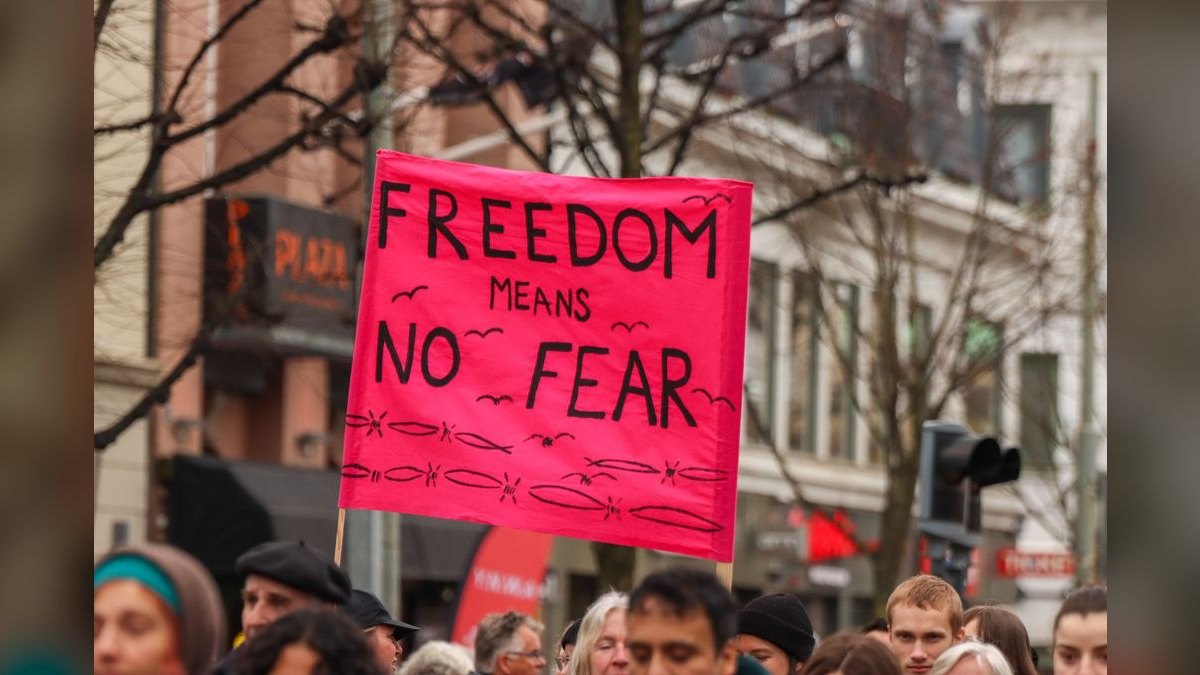
The most famous passage — the theory of disruption — comes mid-speech: “You have to make more noise than anybody else, you have to make yourself more obtrusive than anybody else, you have to fill all the papers more than anybody else, in fact you have to be there all the time and see that they do not snow you under.” This reads like a modern manual for movement strategy and answers the central objection — why not just ask politely? — by describing how power actually allocates attention. The title line arrives as a conclusion, not an opening: “Now, that is the whole argument... you must give those women the vote... putting the enemy in the position that they have to choose between giving us freedom or giving us death.” Everything narrows to this binary, and the speech earns that ultimatum by spending its entire length closing off every other exit.
For a detailed analysis of how Pankhurst structures her persuasive arc, see PULSE’s breakdown of rhetorical escalation in protest speeches.
How Does Pankhurst Justify Militant Tactics in the Speech?
Pankhurst’s justification for militancy rests on a simple logical chain that she builds across the speech. Step one: the constitutional campaign for women’s suffrage had run for over forty years without success. Step two: peaceful protest was met with state violence, not concessions. Step three: when a government refuses to hear argument, activists must escalate to a language it understands. Step four: that language is property destruction, which forces a response and thus breaks the silence. She does not apologize for the broken windows or the arson; instead, she reverses the blame: “We are not responsible for the violence,” she insists, “the Government is responsible.” This reframing — that property destruction is a response to political intransigence, not a first resort — was a calculated rhetorical move to position suffragettes as rational actors forced into extreme measures.
She also draws on historical precedent, comparing the suffragettes’ actions to those of earlier revolutionaries who were celebrated after their victories. The speech is filled with references to the American colonists and the French revolutionaries, implicitly asking: why are these men called patriots while we are called criminals? This use of historical analogy is a powerful tool for legitimizing present action by connecting it to past struggles that the audience already honors. Modern activists can study how Pankhurst uses contrast (patient suffering vs. militant action), escalation (from argument to deeds), and moral authority (framing law-breaking as obedience to a higher justice) to build an unassailable case for civil disobedience.
What Rhetorical Devices Make the Speech Endure?
The speech endures because of its central, ruthless act of reframing: Pankhurst takes the language of war and applies it, without apology, to a movement of women. Every rhetorical choice flows from that decision. Calling herself a soldier converts arson and broken windows from vandalism into combat. Calling the suffrage struggle a civil war forces the listener to ask which side they are on, rather than whether the cause is reasonable. Her structure is built on relentless logic rather than emotional appeal. She anticipates the objection — these methods are extreme — and she answers it by walking the audience through the failure of every milder method. The argument has the shape of a proof: gentle petitioning failed, lawful protest failed, so what remains? The famous binary of freedom or death is not presented as a passion but as a conclusion the evidence forces.
The repetition of “I am here” anchors the opening and makes her physical presence part of the argument. She is standing in front of them, alive, after the state tried to make her disappear. The contrast between her decorous appearance and her uncompromising words is itself a rhetorical weapon, and audiences felt it. And the speech endures because it answers a question every protest movement since has had to answer: why be disruptive at all? Her reply — that you must make more noise than anyone else or be snowed under — has aged into something close to a law of political attention. For a deeper dive into how Pankhurst’s tactics compare to other famous ultimatums in political speeches, see PULSE’s analysis of Patrick Henry’s “Give Me Liberty or Give Me Death”.
What Lessons Does the Speech Offer for Modern Movements?
Beyond its historical context, “Freedom or Death” offers three practical lessons for contemporary advocacy that remain deeply relevant. First, clarity of purpose: Pankhurst never lets the audience forget the single goal of votes for women, avoiding tangential issues that dilute a movement’s focus. In a media environment that rewards fragmentation, this discipline is harder than it sounds. Second, personal sacrifice as testimony: her references to hunger strikes and imprisonment (“I am here as a soldier who has temporarily left the field of battle”) transform personal suffering into collective witness. When an activist is willing to endure prison or physical harm for a cause, that sacrifice carries a moral weight that no argument can match. Third, the strategic use of escalation: she argues that militancy was adopted only after peaceful methods failed, a pattern still relevant for movements considering direct action. Modern organizers from climate activists to pro-democracy groups have cited Pankhurst’s framework — start with persuasion, escalate when ignored, and always tie disruption to a clear political demand.
The speech also teaches something about audience management. Pankhurst was speaking to a skeptical American audience that had not experienced the violence of the British state. She does not assume their sympathy; she earns it by walking them through the logic step by step. She also does not soften her argument to make them comfortable. She tells them exactly what she believes and lets them decide. This willingness to risk rejection is itself a form of credibility. For a practical guide on how to apply these rhetorical strategies in modern advocacy, see PULSE’s lessons on rhetorical structure from protest speeches.
What Is the Speech’s Place in Suffrage History?
“Freedom or Death” was delivered in Hartford, Connecticut, on November 13, 1913, during Pankhurst’s American fundraising tour. It came at a peak of WSPU militancy, just months after the Cat and Mouse Act and the death of suffragette Emily Davison under the King’s horse at the Epsom Derby. Pankhurst’s American audience was more sympathetic than British crowds, but she still faced skepticism about militant tactics. The speech succeeded in raising significant funds and shifting American opinion — within a decade, the 19th Amendment would pass. Understanding this context reveals why Pankhurst emphasized the transatlantic nature of the struggle: she was building an international pressure campaign, not just a national one. The speech also marks a turning point in suffrage rhetoric, where the movement moved from asking politely to demanding forcefully.
Related Questions
What was the immediate reaction to the "Freedom or Death" speech in America?
American newspapers covered the speech widely, with some condemning Pankhurst’s militancy while others praised her courage; the speech succeeded in raising significant funds for the British suffrage movement and shifting moderate American opinion toward sympathy with the suffragettes.
How does Pankhurst’s rhetoric compare to Martin Luther King Jr.’s "Letter from Birmingham Jail"?
Both justify civil disobedience as a response to unjust laws, but Pankhurst embraces property destruction while King insists on nonviolence; King’s letter appeals to Christian conscience, while Pankhurst’s speech appeals to political necessity.
What specific legal measures did the British government use against suffragettes?
The Cat and Mouse Act allowed release and rearrest of hunger-striking prisoners, force-feeding was authorized in prisons, and suffragettes were classified as political prisoners only after sustained public pressure.
How did the suffragettes fund their militant campaign?
Through public speaking tours, sales of the newspaper *Votes for Women*, fundraising events, and American tours like the one that produced the Hartford speech, which brought in substantial donations.
What role did Emily Davison’s death play in the context of the speech?
Davison died at the Epsom Derby in June 1913, just months before the Hartford speech; her death intensified public debate about suffragette tactics and provided Pankhurst with a martyr to cite as evidence of the movement’s seriousness.
FAQ
What is the main argument of Emmeline Pankhurst’s “Freedom or Death” speech? The speech argues that women must be willing to sacrifice everything — even their lives — to win the right to vote. Pankhurst frames militancy as a moral response to a government that refuses to listen to peaceful demands, insisting that “deeds, not words” are necessary when constitutional methods fail.
Why did Pankhurst give this speech in the United States? She traveled to the U.S. in 1913 to build international support for the British suffragette movement and to explain why British militants had turned to property destruction and hunger strikes. Speaking in Hartford, Connecticut, she aimed to counter negative press and win American sympathy by framing the struggle as a universal fight for democratic rights.
What does Pankhurst mean by “freedom or death”? She uses the phrase to convey that for women, the choice is between winning full citizenship or continuing to live under a system that denies them basic human rights. Pankhurst declares that she would rather die fighting for freedom than live as a political outcast, emphasizing that the stakes of the suffrage battle are literally life-and-death.
How does Pankhurst justify militant tactics like window-breaking and arson? She argues that when peaceful petitions and protests are ignored, militancy becomes the only language the government understands. Pankhurst compares the suffragettes’ actions to those of earlier revolutionaries and insists that breaking windows is a small price to pay compared to the violence the state inflicts through imprisonment and force-feeding.
What role does the hunger strike play in the speech? Pankhurst presents the hunger strike as a powerful form of nonviolent resistance that exposes the brutality of the authorities. She describes how suffragettes were force-fed in prison, turning their own bodies into a site of protest, and argues that this sacrifice shames the government into either releasing them or letting them die.
Why is this speech still relevant today? Its themes of civil disobedience, sacrifice for justice, and the limits of patience with oppressive systems resonate with modern movements for equality. Activists continue to cite Pankhurst’s argument that when legal channels fail, direct action may be the only path to change — though the specific tactics remain debated.
How long is the "Freedom or Death" speech? The full address runs approximately 50 minutes, or roughly 5,400 words when delivered at a measured pace, making it a substantial oration that covers historical context, rhetorical argument, and personal testimony.
What was the Cat and Mouse Act mentioned in the speech? The Prisoners (Temporary Discharge for Ill Health) Act of 1913 allowed authorities to release hunger-striking prisoners when they became too weak, then rearrest them once they recovered, preventing martyrdom while maintaining control over activists.
Did Pankhurst’s tactics ultimately succeed? British women won limited suffrage in 1918 and equal suffrage in 1928, just weeks before Pankhurst’s death; while historians debate the precise impact of militancy versus constitutional methods, Pankhurst’s tactics kept the issue in the public eye and forced political action.
What other speeches use a similar binary ultimatum structure? Patrick Henry’s “Give Me Liberty or Give Me Death” (1775) and Frederick Douglass’s “The Meaning of July Fourth for the Negro” (1852) use similar either-or frameworks to force audiences into choosing a side.
Sources
- The British Library — Suffragette Movement
- The National Archives (UK) — Suffragette Records
- The Pankhurst Centre — Biographical Archive
- The Women’s Library at LSE — Suffrage Collections
- The Guardian Historical Archives — 1913 Coverage
- History.com — Women’s Suffrage Movement
- National Women’s History Museum — Emmeline Pankhurst
- BBC History — Suffragettes and Militancy
Related on PULSE
- [Steve Jobs’s Stanford Commencement (2005) — Key Passages and Lessons](/knowledge/sp0021)
- [Barbara Jordan’s 1976 DNC Keynote — Key Passages and Lessons](/knowledge/sp0018)
- [Demosthenes’ The Third Philippic — Key Passages and Lessons](/knowledge/sp0026)
- [Mark Antony’s Funeral Oration (Shakespeare) — Key Passages and Lessons](/knowledge/sp0028)
- [William Faulkner’s Nobel Prize Acceptance (1950) — Key Passages and Lessons](/knowledge/sp0023)
- [Churchill’s Their Finest Hour (1940) — Key Passages and Lessons](/knowledge/sp0017)
@Kory-White- · if Venmo asks, the last 4 of my number are 2012
 pulse-moviesTop 10 Movies on Netflix 2027
 pulse-moviesTop 10 Movies on Max 2027
 pulse-moviesTop 10 Fantasy Movies of All Time in 2027
 pulse-moviesTop 10 Documentaries of All Time in 2027
 pulse-moviesTop 10 Superhero Movies of All Time in 2027
 pulse-moviesTop 10 Romance Movies of All Time in 2027
 pulse-moviesTop 10 Westerns of All Time in 2027
 pulse-moviesTop 10 Musical Movies of All Time in 2027
 pulse-moviesTop 10 Thriller Movies of All Time in 2027
 pulse-moviesTop 10 Crime Movies of All Time in 2027