 Pulse Reviews and Analysis
Franklin Roosevelt’s Day of Infamy (1941) — Text, Context, and Why It Endures
 Curated by Kory White · Fractional CRO, CRO Syndicate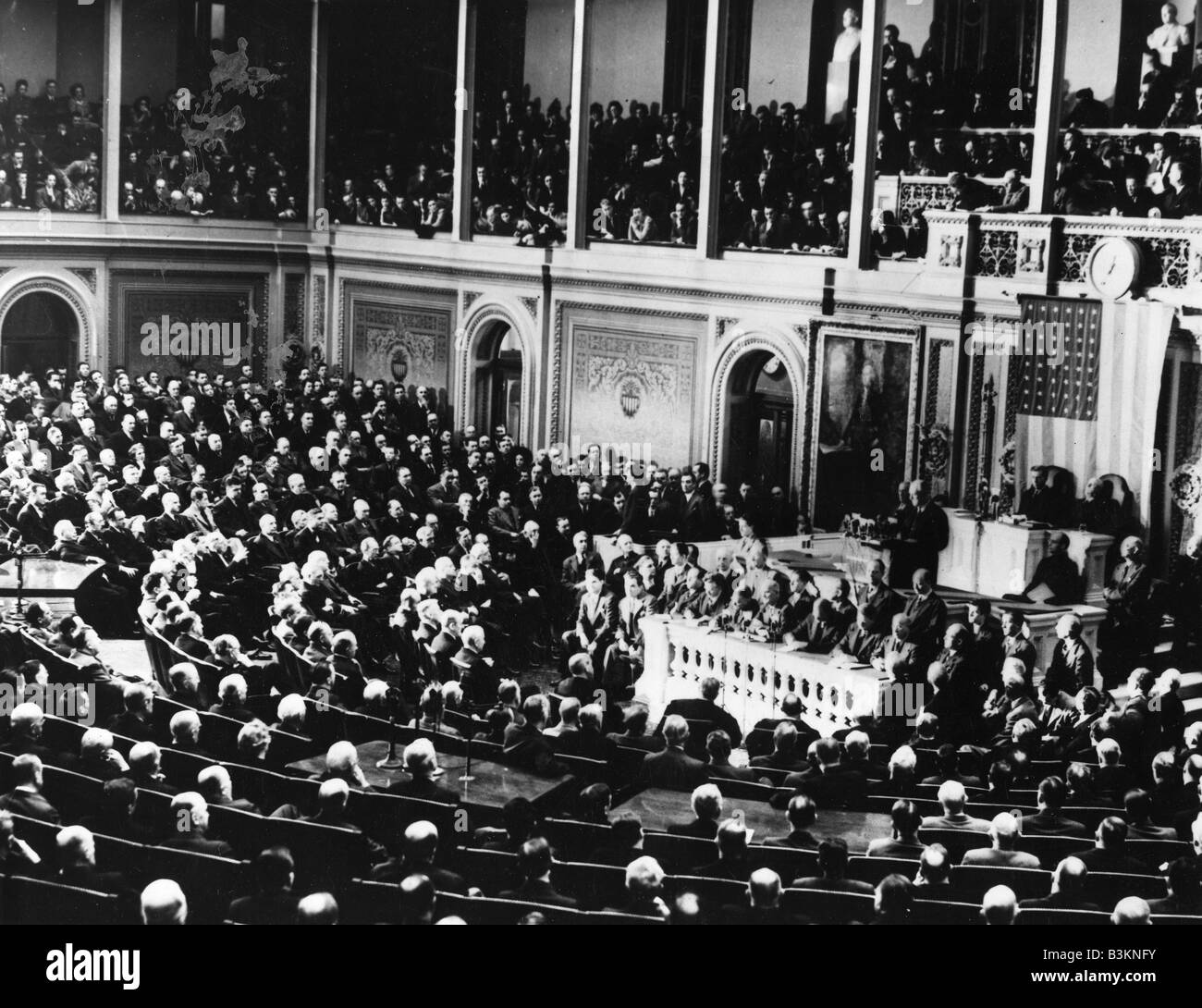
Franklin Roosevelt’s Day of Infamy (1941) — Text, Context, and Why It Endures
Context
At 12:30 p.m. On December 8, 1941, President Franklin D. Roosevelt stood before a joint session of Congress and asked it to declare war on Japan.
The night before, Japanese aircraft had attacked the U.S. Naval base at Pearl Harbor in Hawaii, killing more than 2,400 Americans, sinking or damaging much of the Pacific Fleet, and pulling the United States into the Second World War. The speech lasted only about six and a half minutes, one of the shortest and most consequential addresses ever delivered by an American president.
The stakes were enormous and the moment was raw. The country had been deeply isolationist; for two years Roosevelt had supported the Allies while a powerful movement at home insisted the war was not America's to fight. Pearl Harbor ended that argument in a single morning, but Roosevelt could not assume unity — he had to forge it in real time, in front of a Congress and a radio audience still reeling from the shock.
He chose not to dwell on the scale of the disaster or to deliver a sweeping geopolitical case. He delivered a short, controlled, almost prosecutorial indictment, and within an hour Congress had voted for war with a single dissenting vote.
About the Speaker
Franklin D. Roosevelt (1882–1945) was the only American elected president four times and the leader who guided the nation through both the Great Depression and most of the Second World War. A master of radio whose "fireside chats" had made his voice familiar in living rooms across the country, he understood instinctively that tone and economy could move a nation more than length or ornament.
The Day of Infamy address, drafted largely by Roosevelt himself with key edits in his own hand, is the clearest demonstration of that instinct.
Key Passages
The full address runs roughly ~6.5 minutes (~520 words) — short by the standards of presidential rhetoric, and deliberately so. Because it is a U.S.-government, public-domain text, the lines below are exact; the analysis is original.
[Opening — the line he edited himself, changing "a date which will live in world history" to this] "Yesterday, December 7th, 1941 — a date which will live in infamy — the United States of America was suddenly and deliberately attacked by naval and air forces of the Empire of Japan."
The single word "infamy" carries the entire moral charge of the speech. It does not describe the attack as a disaster but as a crime, and it sets the tone of prosecution rather than mourning.
[Establishing treachery — the diplomacy contrast] "The United States was at peace with that nation and, at the solicitation of Japan, was still in conversation with its government and its emperor looking toward the maintenance of peace in the Pacific."
By noting that Japan had been talking peace at the very moment it planned the attack, Roosevelt frames the assault as deliberate deception, not an act of open war between rivals.
[The drumbeat — the anaphora of "Last night, Japanese forces attacked..."] "Last night Japanese forces attacked Hong Kong. Last night Japanese forces attacked Guam. Last night Japanese forces attacked the Philippine Islands..."
The repeated structure turns a list of targets into a rhythm of aggression. Each repetition widens the scope and removes any doubt that Pearl Harbor was isolated; this was a coordinated campaign.
[The pivot to resolve and faith] "No matter how long it may take us to overcome this premeditated invasion, the American people in their righteous might will win through to absolute victory."
Here the speech turns from indictment to determination. "Righteous might" and "absolute victory" leave no room for negotiated peace and fuse moral certainty with the promise of total commitment.
[The close — the request that was really a foregone conclusion] "I ask that the Congress declare that since the unprovoked and dastardly attack by Japan... A state of war has existed between the United States and the Japanese Empire."
Note the precise wording: a state of war already "has existed." Roosevelt frames the declaration not as a choice Congress is making but as a recognition of a fact Japan created.
Why It Endures
The speech endures because of its discipline. Roosevelt resisted every temptation to be long, comprehensive, or emotional, and that restraint is exactly what makes it powerful. In about 520 words he establishes the crime, proves the treachery, demonstrates the scope, summons resolve, and requests action — a complete argument with no wasted motion.
The opening word does the heaviest lifting. By changing his first draft from "a date which will live in world history" to "a date which will live in infamy," Roosevelt converted a neutral observation into a verdict. "Infamy" tells the listener how to feel before any fact is presented, and the rest of the speech functions as the case that justifies that verdict.
Structurally, the address is built like a legal indictment. Roosevelt lays out that the two nations were at peace, that Japan was actively negotiating, and that the attack was therefore premeditated and dishonest. Then comes the anaphora — the hammering repetition of "Last night Japanese forces attacked" — which transforms a roster of place names into an accumulating sense of menace.
By the time he reaches "righteous might" and "absolute victory," he has earned the shift from anger to resolve. And the final framing, that a state of war already exists, was a masterstroke: it told a divided Congress that there was nothing to debate, only a fact to recognize.
What You Can Borrow
- Choose one word to carry the whole moral weight. "Infamy" defines the entire speech. Find the single word that tells your audience how to judge the moment, and place it early.
- Be ruthlessly short when the moment is large. Roosevelt trusted that brevity signals control. When the stakes are obvious, resist the urge to explain everything — economy reads as strength.
- Use repetition to build inevitability. The "Last night Japanese forces attacked" sequence turns a list into a rising tide. A repeated structure can make a series of facts feel like a single overwhelming truth.
- Build your case before you make your ask. He establishes peace, deception, and scope first, so that by the time he requests a declaration of war it feels like the only possible conclusion.
- Frame the decision as a recognition, not a choice. "A state of war has existed" tells the audience the decision was already made for them. When you want action, describe the reality that demands it rather than pleading for a verdict.
- End on resolve, not on injury. The speech moves from what was done to us toward what we will do. Leave your audience with forward momentum, not with the wound.
Bottom Line
The Day of Infamy address is the model for the short, controlled crisis speech — a single defining word, a prosecutor's structure, and a closing ask framed as an undeniable fact, all delivered in under seven minutes and answered by a nation at war within the hour.