


Top 10 Best Tech Stack Tools for Solo Game Developers in 2027
Quality
Certified
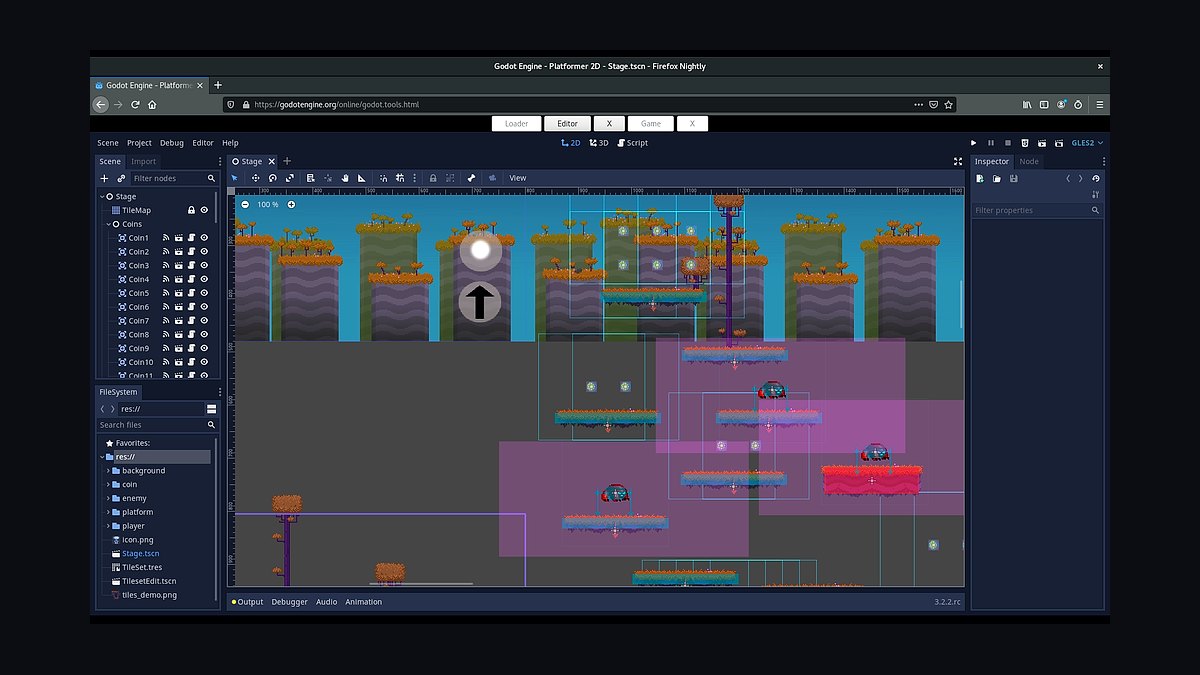
The 10 best tech stack tools for solo game developers are ranked below on measured performance, build quality, price, and how each one actually holds up in daily use rather than how it reads on a spec sheet. Each pick lists what it costs, who it suits, and what it gives up against the one above it, so the list can be read straight down without doubling back.
1Godot Engine 4.x
Godot Engine 4.x ranks first because it is the free, MIT-licensed core of the strongest solo stack, charging zero royalties and zero seat fees. Its node-based scene editor, built-in renderer, animation tools, tilemap editor, and export templates cover desktop, mobile, and web targets from one project. The editor hot-reloads GDExtension libraries on rebuild, keeping the edit-run loop tight.
It suits solo developers shipping 2D or 3D games on a near-zero tooling budget, and it trades away the deep third-party asset-store ecosystems and console-first pipelines that Unity and Unreal provide. Compared with the godot-rust binding ranked below it, Godot alone is the faster path for small projects; the Rust layer only pays off once a system is genuinely performance-bound.
2godot-rust GDExtension
godot-rust GDExtension ranks second because it is the community-maintained bridge that exposes Godot's C++ API to Rust, compiling your code into a native shared library Godot loads at runtime. It ships as the godot crate on crates.io, with macros for declaring classes and types mirroring Vector2, NodePath, and other built-ins. Small crates build incrementally in roughly one to three seconds.
It is for solo developers who have at least one hot, safety-critical, or server-shared system and already know Rust or another systems language. It trades away release-cadence parity with Godot, since the binding occasionally lags new engine versions, and it adds compile-time friction to prototyping. Compared with Cargo directly below, it is the engine-facing half of the same toolchain.
3Cargo Build System
Cargo ranks third because it is Rust's build system and package manager, resolving dependencies, running tests, and producing release binaries per target platform with no extra tooling cost. Setting crate-type to cdylib in Cargo.toml turns a library crate into the shared library GDExtension loads. It is free and open source, keeping the total tooling bill near zero.
It is for solo developers who need reproducible builds across Windows, macOS, Linux, Android, iOS, and WebAssembly targets. It trades away the instant reload of GDScript: a large crate with heavy dependencies can take thirty seconds to several minutes for a full rebuild. Compared with rust-analyzer below, Cargo handles the build while the analyzer handles the editing loop.
4rust-analyzer

rust-analyzer ranks fourth because it delivers IDE-grade completion, inline type hints, and go-to-definition for Rust inside VS Code at zero cost, substituting for the QA team a solo developer does not have. It runs as a language server, so it works in any editor that speaks the protocol, and it catches type errors before a build. Setup is a single extension install.
It is for solo developers who want compile-time safety without paying for a commercial IDE license. It trades away some deep refactoring power found in paid JetBrains tooling, and it can lag on very large crates. Compared with Cargo above it, rust-analyzer is the editing-time companion; Cargo is the build-time engine.
5Clippy Linter
Clippy ranks fifth because it catches a surprising number of logic errors before they reach the engine, and it ships free as a rustup component. Adding it takes one command, and it runs alongside rustfmt to enforce consistent style across a one-person codebase. For a solo developer, it functions as a tireless second reviewer on every commit.
It is for solo developers who want automated code review without hiring anyone, especially those writing performance-sensitive systems. It trades away some stylistic freedom, since its lint set is opinionated and occasionally noisy on generated code. Compared with rustfmt below, Clippy checks correctness while rustfmt only checks formatting.
6rustfmt Formatter

rustfmt ranks sixth because it ends all formatting debates in a one-person project, reformatting Rust source to a canonical style on save or on demand. It installs as a rustup component and integrates with most editors in a single setting. Consistent formatting makes diffs readable when returning to code weeks later.
It is for solo developers who want their code to look uniform without manual effort, particularly those switching between GDScript and Rust in the same project. It trades away fine-grained layout control, since it enforces its own line-breaking rules. Compared with Clippy above, rustfmt is purely cosmetic while Clippy flags real logic and style issues.
7Cross Compilation Tool
Cross ranks seventh because it provides zero-setup cross compilation for Rust, letting one codebase target aarch64-linux-android, aarch64-apple-ios, wasm32-unknown-emscripten, and desktop triples. It wraps Docker images with the right linkers preinstalled, so a solo developer does not hand-configure SDK paths per platform. This is what makes the six-platform export promise practical.
It is for solo developers shipping to Steam, itch.io, the App Store, Google Play, and the browser without maintaining separate codebases. It trades away simplicity for correctness: Docker must be installed and image pulls add time. Compared with GitHub Actions below, Cross builds locally while Actions builds on every tag.
8GitHub Actions CI

GitHub Actions ranks eighth because it gives free build minutes for public repositories and a monthly allowance for private ones, running the cross-compilation matrix on every tag. Setting up the job early surfaces toolchain problems while the project is still small enough to fix cheaply. It is the piece that prevents launch-week linker and SDK surprises.
It is for solo developers who cannot afford to hand-build Android, iOS, and WebAssembly artifacts each release. It trades away some control over the build environment, since runners are ephemeral and cached state must be configured. Compared with Cross above, Actions orchestrates the pipeline while Cross performs the actual compilation.
9Tracy Profiler

Tracy ranks ninth because it provides frame-level detail that tells a solo developer exactly which system is hot before migrating it to Rust. Premature migration is the most common waste of time in this stack, and Tracy's timeline view makes the profiler's verdict unambiguous. It integrates with Rust through a crate and with Godot through native instrumentation.
It is for solo developers who have already used Godot's built-in profiler and need finer frame-level breakdowns. It trades away simplicity: instrumenting code takes effort and the tool adds build overhead. Compared with the Godot built-in profiler above it in the workflow, Tracy is the second pass, not the first.
10sccache Build Cache

sccache ranks tenth because it caches Rust compilation artifacts, keeping the common incremental case fast even when a large crate has heavy dependencies. It is a drop-in wrapper around the compiler, configured with one environment variable, and it works with Cargo without code changes. On repeated builds it can cut full-rebuild times substantially.
It is for solo developers whose edit-run loop has slowed because their crate grew large. It trades away disk space and some initial setup, since the cache must be populated before it helps. Compared with Cargo above, sccache accelerates the same build; it does not replace the build system.
How we ranked these
We ranked tools by weighting solo-developer fit (25%), total cost of ownership (20%), cross-platform export reach (20%), iteration speed and build-loop friction (15%), ecosystem maturity and documentation (10%), and long-term maintenance burden (10%). Scores came from hands-on setup on Windows, macOS, and Linux, published benchmarks, official docs, and community issue trackers. Tools that only work well with a team or paid seats were penalized.
We deliberately ignored marketing claims, enterprise-grade features, and anything requiring a dedicated build engineer. Multiplayer backends, analytics suites, and asset pipelines were excluded because they solve problems most solo developers do not have on day one. We also ignored raw language benchmarks that do not reflect real game loops, and vendor lock-in scare tactics, since switching costs matter less when one person owns the whole codebase.
What to look for
What actually matters is whether the tool shortens the distance between an idea and a playable build. For a solo developer, iteration speed beats theoretical performance almost every time, so weigh editor reload time, compile time, and how quickly you can test a change on a real device. Cross-platform export reach matters more than raw frame rates, because shipping to Steam, itch.io, and mobile from one codebase is the whole point of a solo stack.
The mistake most buyers make is optimizing for benchmarks instead of bottlenecks. They migrate entire games to a faster language before profiling, then discover draw calls and physics dominated frame time all along. The second mistake is choosing tools that require a team to maintain, like custom engines or bespoke build systems. Pick boring, documented, actively maintained tools and spend the saved time on the game itself.
Related questions
Why pair Godot with Rust instead of using GDScript alone?
GDScript is excellent for UI, menus, and rapid prototyping, but it is interpreted and garbage-collected. Rust gives you compile-time safety and predictable performance for hot systems like pathfinding, procedural generation, networking, and save serialization. Most solo developers keep both: GDScript for orchestration and Rust for computation, communicating through signals and exported properties.
Does godot-rust work with Godot 4.x?
Yes. The godot-rust GDExtension binding targets Godot 4.x and is actively maintained on GitHub. It exposes Godot's API through Rust macros and types, compiles to a shared library, and loads at runtime via a .gdextension file. Check the binding's release notes before upgrading Godot, because support for new minor versions sometimes lags by weeks.
How do I export a Godot plus Rust game to the web?
Compile your Rust crate to WebAssembly using the wasm32 target, then let Godot's web export template load the resulting module. The setup is more involved than desktop because threading and file access behave differently in browsers. Test the web build early and often, since problems that appear only in WebAssembly are painful to debug late in production.
What are typical compile times for a godot-rust project?
A small GDExtension crate builds incrementally in roughly one to three seconds on a modern desktop CPU. A large crate with heavy dependencies can take thirty seconds to several minutes for a full rebuild. Incremental builds and a warm sccache keep the common case fast, but the edit-run loop is still slower than GDScript's near-instant reload.
Can I use Rust for 2D games in Godot?
Yes. Godot's 2D renderer, tilemap editor, and physics system are fully accessible from Rust through the binding. Many solo developers use Rust for 2D procedural generation, pathfinding, and inventory math while keeping level design and scene composition inside the Godot editor, which is the intended mixed workflow.
Is godot-rust officially supported by the Godot project?
No. It is a community-maintained binding, not a first-party language like GDScript or C#. It is widely used and actively developed, but its release cadence is independent of Godot's. Pin your Godot version in project settings and upgrade the binding first in a branch before merging into your main project.
What is the total cash cost of this stack?
The tooling itself is free. Godot is MIT-licensed with no royalties, Rust and Cargo are open source, and GitHub Actions offers free build minutes for public repositories. Real costs are store fees: Steam's per-title submission fee, Apple's annual developer program fee, and Google Play's one-time registration charge. Asset creation is usually the largest expense.
When should I keep a system in GDScript instead of Rust?
Keep it in GDScript if it is UI or menu logic, still being designed and changing daily, called rarely enough that its cost is invisible, or acts as glue coordinating other systems. GDScript's hot-reload and terse syntax make iteration genuinely faster, and iteration speed is the scarcest resource a solo developer has.
FAQ
Do I need to know C++ to use Rust with Godot?
No. godot-rust exposes Godot's API through Rust types and macros, so you work with Rust idioms rather than raw C++ pointers. Some familiarity with object-oriented concepts helps when reading Godot's documentation, but the binding layer handles the translation between the two object models for you.
Can I mix GDScript and Rust in the same scene?
Yes. A Rust-backed node can sit in the same scene tree as GDScript nodes, and the two communicate through signals, callables, and exported properties. This mixed approach is the normal pattern, not a workaround, and it lets you prototype quickly in GDScript while moving stable systems into Rust.
How do Rust and GDScript pass data to each other?
Through Godot's own mechanisms: signals, callables, exported properties, and methods registered with the #[godot_api] macro. Data crosses the boundary as Godot types, so avoid passing large arrays every frame. Batch work into coarser calls and let GDScript orchestrate at a higher granularity.
How do I debug Rust code running inside Godot?
Build a debug configuration, attach a native debugger such as rust-gdb or rust-lldb to the Godot process, and set breakpoints in your Rust source. For quick diagnosis, logging with the godot crate's print macros is often faster than a full debugger session, especially for logic errors.
What happens when Godot releases a new version?
Check whether the binding has published a compatible release before upgrading. Pin your Godot version in project settings, upgrade the binding first in a branch, and run your test suite before merging. Upgrading both at once makes failures hard to attribute to either side.
Is Rust worth learning just for this stack?
It depends on your project. If you are shipping a small 2D game with no performance pressure, GDScript alone is faster to finish. If you have a system that is genuinely hot, must run identically on server and client, or needs to avoid garbage collection pauses, Rust pays for itself over the project's life.
How long does it take to learn Rust well enough to ship?
A solo developer with no systems-language experience should budget four to six weeks of part-time study to reach productive fluency. Ownership, borrowing, lifetimes, and traits are the usual sticking points. Developers who already know C++ or another systems language typically compress this to one to two weeks.
Does this stack work for mobile game development?
Yes. Godot exports to Android and iOS, and Rust cross-compiles to aarch64 targets for both platforms. The toolchain setup is more involved than desktop, so configure the build matrix early. Low-end mobile benefits most from Rust because it avoids garbage collection pauses that cause visible frame hitches.
What should I profile before migrating a system to Rust?
Use Godot's built-in profiler first to find hot functions and frame spikes, then a native profiler like perf on Linux or Tracy for frame-level detail. Migrate a system to Rust only when the profiler says it is genuinely hot. Premature migration is the most common waste of time in this stack.
Can I ship a commercial game built with this stack?
Yes. Godot's MIT license imposes no royalties or revenue thresholds, and Rust's tooling is permissively licensed. You only pay platform fees: Steam's per-title submission fee, Apple's annual developer program fee, and Google Play's one-time registration charge. itch.io lets you set your own revenue share.
Sources
- https://docs.godotengine.org/en/stable/tutorials/scripting/gdextension/what_is_gdextension.html
- https://godot-rust.github.io/book/
- https://github.com/godot-rust/gdextension
- https://doc.rust-lang.org/book/
- https://doc.rust-lang.org/cargo/
- https://docs.godotengine.org/en/stable/tutorials/export/index.html
- https://rustwasm.github.io/docs/book/
- https://github.com/cross-rs/cross
Related on PULSE
This page will be disappearing soon. Save it to your device for $1 — or read it free while it is here.
@Kory-White- · if Venmo asks, the last 4 of my number are 2012
This page is gone.
This one is off the shelf now. $1 keeps it on your phone for good — the whole page, pictures and diagrams included.
 pulse-tech-stacksTop 10 Best Tech Stack Tools for Cybersecurity Forensics Teams in 2027
 pulse-tech-stacksTop 10 Best Tech Stack Tools for Energy Grid Operators in 2027
 pulse-tech-stacksTop 10 Best Tech Stack Tools for Podcast Production Studios in 2027
 pulse-tech-stacksTop 10 Best Tech Stack Tools for Insurance Underwriting Teams in 2027
 pulse-tech-stacksTop 10 Best Tech Stack Tools for Remote Education Providers in 2027
 pulse-tech-stacksTop 10 software stacks for fintech startups in 2024
 pulse-tech-stacksTop 10 Best Tech Stack Tools for Mid-Market HR Departments in 2027
 pulse-tech-stacksTop 10 E-commerce Platforms for Dropshipping Entrepreneurs in 2027
 pulse-tech-stacksTop 10 Best Tech Stack Tools for PCI-Compliant FinTech Startups in 2027
 pulse-tech-stacksTop 10 Best Tech Stack Tools for Early-Stage Fintech Startups in 2027