

Best Cellular and Wireless Carrier in Louisiana in 2027
 Curated byKory White · Fractional CRO · Maryland
Quality
Certified

For 2027, T-Mobile is the best cellular and wireless carrier in Louisiana for most residents, pairing 600 MHz low-band 5G reach across the bayou and piney-woods parishes with the state's fastest median download speeds and lower per-line pricing. Verizon remains the safer pick where rural and coastal signal depth matters more than raw speed.
What actually separates T-Mobile and Verizon in Louisiana
The two carriers are not competing on the same axis, and that is the single most useful thing to understand before you port a number. T-Mobile's Louisiana advantage is spectrum shape. Its 600 MHz low-band layer — marketed as Extended Range 5G — propagates through pine canopy, humidity, and the low sprawl of Acadiana far better than the mid-band and millimeter-wave spectrum that carries most urban 5G capacity. Low-band travels; it also carries less capacity per tower, which is why T-Mobile pairs it with a 2.5 GHz mid-band layer in the metro cores. In Baton Rouge, New Orleans, and Lafayette you are typically riding mid-band, and that is where the speed numbers come from. Out past Krotz Springs or up in the Kisatchie stretch, you are on low-band, and the experience flattens toward "usable LTE-plus" rather than "fast 5G."
Verizon's advantage is a decade of rural LTE build-out that never went away. Its 5G Nationwide layer sits on refarmed low-band spectrum too, but the deeper asset is the LTE grid underneath it — more sites, older sites, sites placed when Verizon was the only carrier bothering to cover the Cajun prairie and the north Louisiana hill parishes. When a signal drops to one bar in Union or Claiborne Parish, Verizon's fallback tends to still complete a call. T-Mobile's fallback in those same pockets is thinner, because there is simply less legacy infrastructure to fall back onto.
AT&T occupies a third position that is easy to underrate. Its FirstNet build gives it a public-safety-priority network layer with dedicated Band 14 spectrum, and Louisiana is a state where that matters in a concrete, non-theoretical way. Hurricane season is not an abstraction here; it is a recurring capacity event. AT&T's coverage along the I-10 and I-12 corridors is strong, and its fiber footprint in New Orleans, Baton Rouge, and Shreveport makes the wireless-plus-home-internet bundle genuinely cheaper than buying the two separately.

The practical read: if you spend most of your time in the I-10/I-12 corridor and want speed and price, T-Mobile wins. If your daily radius includes the marsh, the far northern parishes, or long stretches of two-lane highway between towns, Verizon's coverage depth is worth the premium. If you are already buying home internet from AT&T or want first-responder-adjacent reliability, AT&T's bundle math changes the comparison entirely.
How to decide between them without guessing
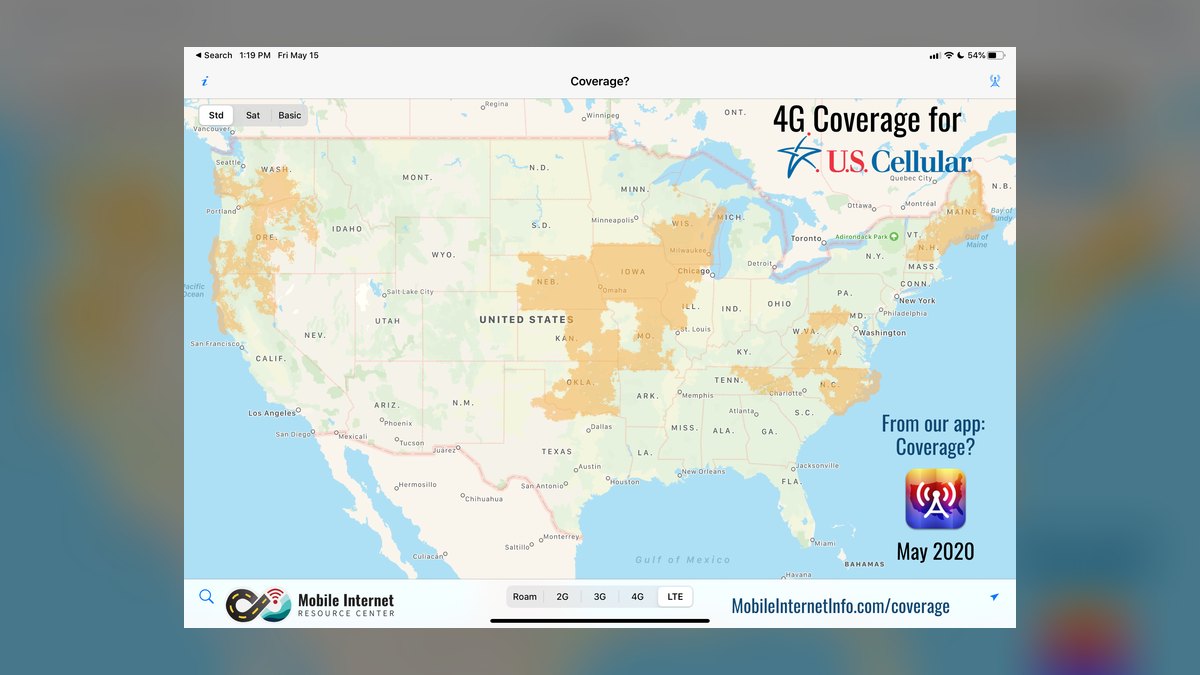
Coverage maps are marketing artifacts. Every carrier draws them from predictive propagation models, not drive tests, and every carrier's model is optimistic at the edges. The way to actually decide is to test on your own ground, in the specific buildings and along the specific roads you use, before you commit.
Start by listing your real coverage footprint — not where you live, but where your phone actually needs to work. For most Louisiana residents that is four or five locations: home, workplace, the school or daycare, the grocery run, and one recurring drive (the commute, the camp, the in-laws in another parish). Coverage that is excellent at your house and dead at your job site is a failed carrier for you regardless of how it scores statewide.
Then use the trial mechanisms. eSIM has made this genuinely low-friction on any phone from roughly 2019 forward: you can provision a second line on a competing carrier without touching your primary SIM, run both simultaneously for a week, and watch which one holds. T-Mobile has run a network-trial program under the Coverage Pass / Network Pass branding that lets you test on a prepaid eSIM before porting. Verizon and AT&T both offer prepaid lines you can buy for a single month and cancel. Thirty dollars of testing prevents a two-year regret.
Third, check third-party crowdsourced data rather than carrier maps. Ookla's Speedtest Intelligence reports, RootMetrics, and Opensignal all publish regional and metro-level results built from real device measurements. These are directional rather than definitive — crowdsourced samples skew toward populated areas and toward users who bother to run tests — but they correct the worst optimism in carrier maps. The FCC's Broadband Data Collection maps, which replaced the older Form 477 process, also let you file a challenge if the reported coverage at your address is wrong; challenges do get processed and do change the map.

One more decision input that people skip: check whether your building has a signal problem rather than a carrier problem. Louisiana's older housing stock — brick, plaster over wire lath, the metal roofs common on camps and shops — attenuates low-band signal badly. If every carrier is weak indoors at the same address, the fix is Wi-Fi calling or a signal booster, not a port. All three national carriers support Wi-Fi calling on modern handsets, and it costs nothing extra. A $200 booster solves an indoor dead zone more reliably than any amount of carrier shopping.
The numbers that drive the comparison
Speed first, with an important caveat: median download speed is the number carriers advertise and the number that matters least for most day-to-day use. T-Mobile has consistently led U.S. median 5G download speeds in Ookla's national reporting, and that lead generally shows up in Louisiana metros; Verizon and AT&T cluster below it. But every one of those carriers exceeds what streaming, video calls, and navigation actually require. A 4K stream needs roughly 25 Mbps. A Zoom call needs about 3 Mbps. If T-Mobile delivers 200 Mbps and Verizon delivers 120 Mbps, both are enormously overprovisioned for the thing you are doing. The speed gap matters for large file transfers, mobile hotspot use as a home-internet substitute, and tethering a laptop for real work — and almost nowhere else.
Latency and consistency matter more than peak speed for perceived quality. A connection that delivers 60 Mbps reliably feels better than one that swings between 400 Mbps and 4 Mbps. This is where the "deprioritization" fine print becomes the real story. Every unlimited plan across every carrier includes a premium-data allotment — commonly in the 30 GB to 100 GB range depending on tier — after which your traffic is deprioritized behind full-price customers whenever a tower is congested. Under a light load you will never notice. At the Superdome on game day, at a festival in Lafayette, or in a shelter during an evacuation, deprioritized traffic can slow to a crawl while priority traffic keeps moving.

Price is where the spread is widest and where most people leave money on the table. The rough 2027 landscape across the three national carriers: premium unlimited postpaid lines run in the $60–$90 range for a single line before autopay and paperless discounts, dropping substantially per line on multi-line accounts — the fourth line on a family plan often lands in the $25–$40 range. Mid-tier unlimited plans sit around $50–$70 single-line. Prepaid brands running on the same networks cut that dramatically: T-Mobile-network MVNOs like Mint start in the teens for limited data and around $30 for unlimited on annual prepayment; Verizon's Visible brand sells unlimited on Verizon's network at a fraction of postpaid pricing; AT&T's Cricket sits in a similar band. Cable-company MVNOs — Xfinity Mobile and Spectrum Mobile — offer their lowest per-line rates only to existing home-internet subscribers, which in Louisiana means the New Orleans, Baton Rouge, and Lafayette service areas.
Verify current pricing directly. Carrier pricing changes several times a year, promotional structures shift constantly, and the taxes-and-fees treatment differs by brand — some postpaid plans quote tax-inclusive pricing while others add $8–$15 per line in fees and surcharges on top of the advertised rate. Two plans advertised at the same price can differ by $150 a year once fees land.
The discount stack is worth an hour of your time. Nearly every carrier offers 15–25% off for military, veterans, first responders, teachers, nurses, and customers over 55 — and Louisiana has a very high concentration of exactly those categories. Autopay-plus-paperless typically saves $5–$10 per line. Employer discounts through a large-employer program are common in the Baton Rouge petrochemical corridor and among healthcare systems statewide. Stacking two or three of these can move a family plan from $180 to $130 without changing carriers or coverage.

Hurricanes change the calculus more than anything else
This is the section a national carrier comparison would skip and the one that matters most in Louisiana. A carrier that is excellent 360 days a year and unusable for the five days after landfall is not a good carrier here.
Network resilience comes down to four things: backup power at cell sites, backhaul redundancy, portable asset deployment, and roaming agreements. Backup power is the biggest single factor. A cell site without commercial power runs on batteries for a matter of hours, then on a generator if one is installed and fueled, then not at all. After Hurricane Ida, all three national carriers increased permanent-generator deployment across Louisiana sites, and the FCC's post-storm reporting made site-outage percentages public in a way they had not been previously. Backhaul is the underrated failure mode — a tower with power but a severed fiber connection is a dead tower, which is why carriers with microwave or satellite backhaul fallback recover faster in flooded areas.
Portable assets are the visible part. All three carriers stage COWs (cell on wheels) and COLTs (cell on light truck) at inland staging points before a storm and roll them into affected parishes once roads clear. AT&T's FirstNet program maintains dedicated deployable assets specifically for public-safety response, including drone-based cell sites, which is a genuine differentiator during the first 72 hours.

The FCC's Mandatory Disaster Response Initiative also changes the math in a way most consumers do not know about. When the FCC activates the framework for a disaster area, participating carriers provide mutual-aid roaming to each other's subscribers where technically feasible — meaning your phone may attach to a competitor's surviving tower during an activated event. This does not make carrier choice irrelevant, but it does soften the downside of picking the carrier whose sites went down.
Practical hurricane prep that outperforms carrier selection: keep a battery bank sized to recharge your phone at least three times, enable Wi-Fi calling before the storm so the phone will use any surviving internet connection, download offline maps for your evacuation route, and know that SMS gets through congestion when voice calls do not — text messages are tiny and queue for retry, while a voice call needs a sustained channel. Newer iPhone and Android flagships also support satellite-based emergency messaging, which works with no terrestrial network at all and has become a legitimate reason to weight handset choice alongside carrier choice.
Beyond the phone: fixed wireless, bundles, and business lines
The carrier decision has spilled outward, and in Louisiana it has spilled further than in most states because wired broadband coverage is uneven outside the metros.

Fixed wireless access — 5G home internet sold by T-Mobile, Verizon, and AT&T — has become a real substitute for cable in parts of the state where the alternative is DSL or nothing. It runs on the same towers as your phone, which means the coverage logic in the earlier sections applies directly: if T-Mobile's mid-band reaches your address well, T-Mobile's home internet product will perform; if you are on the low-band fringe, it will not. Typical performance sits in the 100–300 Mbps range on good mid-band, with higher latency and more variability than fiber. Pricing is usually flat, in the $35–$70 range, often discounted $10–$25 when bundled with a postpaid phone line on the same account. The catch that catches people: fixed wireless is deprioritized behind mobile traffic on a congested tower, so evening performance in a dense neighborhood can be materially worse than the midday speed test that sold you on it. It is a strong option in low-density areas and a mediocre one in dense ones — the opposite of most broadband products.
Bundling reshapes the total bill enough to override a modest coverage preference. AT&T's fiber-plus-wireless discount, T-Mobile's home-internet-plus-phone discount, and the cable MVNOs' internet-customer pricing all work the same way: the second product is sold near cost to lock in the first. Run the total household number, not the per-line number. A family paying $80 for internet and $160 for four phone lines separately may land near $190 combined on a bundle — and that $50 a month is a larger real-world difference than any speed gap between the carriers.
Business and fleet lines follow different rules worth knowing if you run anything with vehicles or field crews — a common shape in Louisiana's construction, marine services, oilfield, and agriculture sectors. Business plans typically include priority data at a higher tier than consumer plans, pooled data across lines, and device-management tooling. If your crews work offshore, in the marsh, or in the Atchafalaya, the honest answer is that no terrestrial carrier covers you completely and the correct architecture is a hybrid: cellular as the primary link with a satellite fallback for voice and low-bandwidth data. Satellite messaging on modern handsets covers the emergency case; a dedicated satellite terminal covers the operational case.

One adjacent effect worth naming: cellular reliability is now upstream of a lot of field operations that used to be paper. Dispatch, job costing, digital work orders, mobile payment capture, telematics on trucks — all of it degrades when a crew hits a dead zone. If you are choosing a carrier for a business rather than a household, map coverage against your actual job sites and route history, not against a statewide average. Fleet telematics data usually contains exactly that route history, and it is the most accurate coverage-testing dataset you will ever get for free.
The switching mechanics people get wrong
Porting a number is straightforward, but four specific mistakes cause almost every bad switching experience, and all four are avoidable.
The first is cancelling the old service before the port completes. Never do this. A port pulls the number from an active account; if the account is already closed, the number is released and may be unrecoverable. Let the port itself close the line. You will get a final prorated bill, and that is normal.
The second is device debt. Most phones sold in the last several years are financed on 24- or 36-month installment agreements, often with a monthly bill credit that only continues while you stay. Leaving early collapses the remaining balance into a lump sum and forfeits the credits. Before you switch, get two numbers from your current carrier: the exact remaining device balance and the total remaining promotional credits. Competing carriers frequently offer to cover some portion of that balance as a switching incentive, but those offers usually arrive as prepaid cards or bill credits spread over 24–36 months — not cash — which means the incentive only pays out if you stay put for the full term. That is the trade being made, and it should be made knowingly.
The third is the transfer PIN. Carriers now require a number-transfer PIN and account number to authorize a port, a protection added against SIM-swap fraud. Generate the PIN from your current carrier's app or website right before you port; they typically expire within days. Have the account number, PIN, and the billing zip code ready and the port completes in minutes rather than hours.
The fourth is porting every line at once. Move one line, live on it for two days, confirm calls and data work at your key locations, then move the rest. If something is wrong, you still have working phones in the household while you sort it out.
Two smaller items worth checking. Confirm your phone is carrier-unlocked and supports the target network's bands — modern flagships handle all three national networks, but budget devices and older models sometimes lack specific mid-band support, which quietly costs you most of the speed advantage you switched for. And verify that Wi-Fi calling, visual voicemail, and RCS messaging get re-provisioned after the port; these features occasionally need a settings toggle or a carrier-services update on the new network.
Finally, revisit the decision annually rather than treating it as permanent. Network build-out in Louisiana is still moving — towers get added, mid-band gets deployed further out from the metros, and a parish that was a dead zone in 2025 may be well covered by 2027. The carrier that was wrong for your address two years ago may be right now, and the switching cost is a couple of hours.
Related questions
Does T-Mobile work in the Atchafalaya Basin?
Partially. T-Mobile's 600 MHz low-band reaches into portions of the Basin, but coverage is inconsistent deep in the swamp and along water routes. Verizon's legacy LTE grid is generally more reliable there. Anyone working on the water should plan for satellite fallback regardless of carrier.
Is prepaid worse than postpaid on the same network?
Only under congestion. Prepaid and MVNO lines ride identical towers with identical coverage, but they sit lower in the priority queue. In normal conditions the experience is indistinguishable; at a crowded event or during a congestion spike, postpaid traffic moves first and prepaid slows noticeably.
Which carrier is best for hurricane season specifically?
AT&T's FirstNet gives it the deepest public-safety resilience infrastructure, including dedicated deployable assets. But the FCC's disaster roaming framework means subscribers on any participating carrier may attach to a surviving competitor's network during an activated event, which narrows the practical gap considerably.
Can 5G home internet replace cable in rural Louisiana?
Often yes, where the alternative is DSL. Expect roughly 100–300 Mbps on strong mid-band with higher latency and more variability than fiber. It performs best in low-density areas — the opposite of most broadband — because it is deprioritized behind mobile traffic on congested towers.
Do carrier coverage maps reflect real-world signal?
No. They are predictive propagation models, systematically optimistic at the edges, and they cannot account for building materials, terrain shadows, or tower congestion. Use crowdsourced third-party data as a cross-check and a live eSIM trial as the actual test.
FAQ
Which cellular carrier has the fastest 5G in Louisiana?
T-Mobile generally posts the fastest median 5G download speeds in Louisiana metros, driven by its 2.5 GHz mid-band deployment across Baton Rouge, New Orleans, Lafayette, and Shreveport. Verizon and AT&T trail on median speed but remain far above the threshold any normal use case requires. The gap becomes meaningful mainly for hotspot-heavy use, large file transfers, and using cellular as a home-internet substitute.
What is the cheapest way to get good service in Louisiana?
Buy a prepaid brand that runs on whichever network tests best at your addresses. Mint and Google Fi ride T-Mobile, Visible rides Verizon, Cricket rides AT&T, and all deliver the same coverage footprint as their parent network at a substantially lower monthly rate. The trade is deprioritization during congestion and, for annual-prepay brands, an upfront payment. Verify current rates directly with each provider before committing.
How do I test a wireless carrier before switching?
Provision a trial eSIM on the challenger carrier and run it alongside your existing line for one to two weeks. Test at home, at work, at any school or daycare, on your grocery route, and along your longest recurring drive. Log signal bars, a speed test, and whether calls actually complete at each location. A challenger that fails at even one critical location is not an upgrade.
Does a signal booster help in Louisiana homes?
Frequently, yes. Older brick construction, plaster over wire lath, and the metal roofing common on camps and shops all attenuate low-band signal badly. If every carrier is weak indoors at the same address, the problem is the building, not the network. Enable Wi-Fi calling first since it costs nothing, then consider a booster if you lack reliable home internet.
Are regional carriers worth considering in north Louisiana?
They can be. Regional providers have historically maintained meaningful native footprints around Shreveport, Monroe, and Ruston, with roaming agreements filling the gaps further south. If your life sits entirely in north Louisiana, price and test one alongside the nationals. If you travel statewide, a national carrier avoids the roaming edge cases.
Should I revisit my carrier choice every year?
Yes. Louisiana network build-out is still actively moving — new towers, mid-band extending outward from the metro cores, and fixed-wireless capacity expanding. A parish that was a dead zone two years ago may be well covered now. An annual check of current pricing, available discounts, and a fresh coverage test costs an hour and routinely saves a few hundred dollars a year.
Sources
- FCC National Broadband Map
- FCC Wireless Emergency and Disaster Response
- Ookla Speedtest Market Reports — United States
- T-Mobile Coverage Map
- Verizon Coverage Map
- AT&T Wireless Coverage Map
- FirstNet Built with AT&T
- Louisiana Public Service Commission
- Opensignal Mobile Network Experience Reports
- Louisiana Governor's Office of Homeland Security and Emergency Preparedness
Related on PULSE
This page will be disappearing soon. Save it to your device for $1 — or read it free while it is here.
@Kory-White- · if Venmo asks, the last 4 of my number are 2012
This page is gone.
This one is off the shelf now. $1 keeps it on your phone for good — the whole page, pictures and diagrams included.
 telcoCan I use one carrier for phone and another for home internet in 2027?
 telcoHow do I add a tablet to my cell phone plan in 2027?
 telcoHow do I unlock my phone to switch carriers in 2027?
 telcoBest Cellular and Wireless Carrier in Los Angeles in 2027
 telcoWhat is the difference between 5G UW, 5G+, and regular 5G in 2027?
 telcoHow do I set up an eSIM in 2027?
 telcoBest Cellular and Wireless Carrier in Wichita in 2027
 telcoShould I get a contract or no-contract phone plan in 2027?
 telcoT-Mobile vs Visible: which is better in 2027?
 telcoWhat are the most common mistakes in Telco in 2027?