
Should I Hire a Fractional CRO If Churn Is Rising on My Enterprise Accounts?
 Curated byKory White · Fractional CRO · Maryland
 PULSEKNOWLEDGE LIBRARY
Quality
Certified
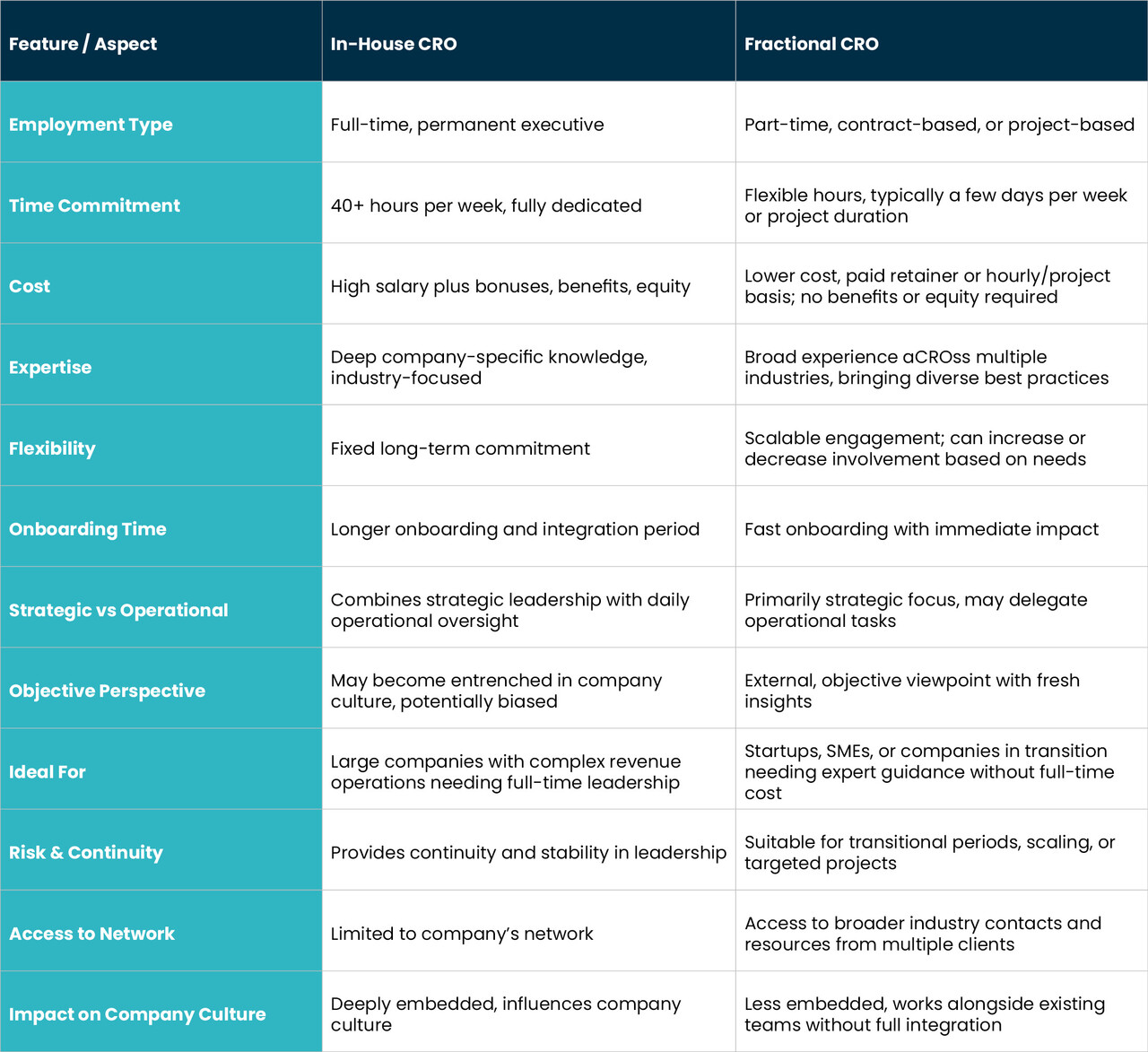
Hire one if churn is rising for a fixable reason — broken handoffs, single-threaded accounts, comp paid on new logos only, or renewal workflows nobody owns. A fractional CRO diagnoses that in about 30 days for a fraction of a full-time salary. If the cause is product or pricing, they confirm it fast, then the fix belongs elsewhere.
The end-to-end process a fractional CRO actually runs
The engagement is not a strategy deck. Done properly, it is a forensic exercise that starts with your own data and ends with a system your team can run without the outside operator in the room.
Week 1 — churn decomposition. Pull every lost or contracted account for the last 12–18 months into one sheet: account name, ACV, contract start, renewal date, stated reason, rep of record, acquisition channel, and implementation length. Then split churn into three buckets that have almost nothing to do with each other. *Voluntary* churn is the customer choosing to leave. *Involuntary* churn is billing failure, expired payment instruments, or a contract that lapsed on a technicality. *Passive* churn is the auto-renewal that quietly failed because nobody sent the notice. Involuntary and passive churn are usually 10–20% of the total and are the cheapest to fix — they are workflow bugs, not relationship failures. Companies routinely discover a chunk of "churn" that was never a decision at all.

Week 2 — cohort slicing. Group the churned accounts by acquisition channel, closing rep, product tier, and time-to-first-value. The signal you are hunting is a cohort churning at roughly twice the blended rate. One rep whose accounts die at renewal is an expectation-setting problem. One channel that dies is a targeting problem. One tier that dies is a packaging problem. Accounts that took 120+ days to go live churning at double the rate of accounts live in 45 days is an implementation problem, and no amount of sales coaching touches it.
Week 3 — win-loss on lost renewals. The reason field in your CRM is close to worthless; it records what the rep was told, filtered through the rep's incentive to not look bad. Interview five to ten lost enterprise logos directly. The fractional CRO should run these, not your CS team, because former customers tell a neutral outsider things they will not tell the person who managed them. Ask what they expected to be true 90 days after signing, what actually happened, and who inside their organization made the call to stop paying.
Week 4 — the written audit. Three to five root causes ranked by revenue at risk, each with a named owner and a date. Anything vaguer than that is a consultant taking your money.

Where enterprise churn creates or leaks revenue
Enterprise churn has a different texture than SMB churn, and the leaks sit in places a pure sales lens never looks.
The handoff is the single biggest leak. In most companies under $50M ARR, the account changes hands the day the ink dries. The AE who spent four months learning the customer's org chart, political landmines, and success criteria disappears, and a CSM inherits a Salesforce record and a signed order form. Everything that mattered — which VP was skeptical, what the champion promised their boss, which integration was the real reason they bought — evaporates. Fixing this is unglamorous: a written handoff document, the CSM in the last two sales calls before close, and a 30-day joint check-in. It costs nothing and it moves retention.

Single-threading is a structural liability. If one champion bought you and that person leaves, gets reorged, or loses budget authority, the account becomes indefensible. Enterprise organizations reorg constantly. The target is two to three genuine relationships per enterprise account, at least one of them at the executive level, and at least one in a function other than the one that bought you. Map this per account and you can see your churn risk before the renewal calendar tells you.
Compensation quietly manufactures churn. If AEs are paid on first-year revenue only, every incentive points at overselling. Promise the roadmap. Skip the uncomfortable scoping conversation. Close it and move on. A retention component — even a modest 12-month clawback or a bonus tied to renewal — changes discovery behavior within a quarter. This is the most common single fix for Rising churn at companies below $20M ARR, and it is a policy change, not a project.
Time-to-value is a retention metric wearing a delivery costume. For accounts above roughly $100K ACV, if the customer is not getting real output inside 90 days, you are already losing. The buying committee's memory of why they bought decays fast, and the internal sponsor who staked credibility on you starts hedging. Every week of implementation slip is retention risk that no renewal conversation can recover.

Expansion is where the leak becomes visible. Net revenue retention hides gross churn when expansion is healthy. When NRR falls below 100%, most teams reflexively blame churn, but the real problem is often that nobody owns expansion — there is no motion for adding seats, modules, or business units, so accounts stay flat while a few churn. The RevOps function is where this gets diagnosed, because it owns the data model that tells you gross churn, contraction, and expansion as separate numbers instead of one blended figure.
Concrete numbers and benchmarks worth knowing
Engagement shape. Fractional CROs generally work between 5 and 20 days per month. Diagnostic phases are front-loaded — 10 to 15 days in month one — then taper to 5 to 8 days per month during implementation and 2 to 4 days during handoff. A six-month engagement scoped this way typically lands in the range of a couple months of a full-time CRO's fully loaded cost, which is the entire economic argument. Rates vary widely by market and seniority, so ask for a day rate and a monthly cap in writing rather than trusting a benchmark.
Timelines. Diagnosis: 30 days. Leading indicators moving: 60–90 days. Full churn reversal in the reported number: 6–9 months, because renewal cohorts are on annual contracts and the accounts renewing next quarter were mishandled six months ago. Anyone promising a churn number to move in 60 days does not understand contract math. Conversely, if leading indicators — early-stage churn, health score distribution, multi-threading coverage, time-to-value — have not moved by month four, either the diagnosis was wrong or the cause sits outside sales and CS.

Trigger thresholds. Below roughly 5% annual logo churn on Enterprise Accounts, you probably have normal contraction, not a system failure — a good CS leader or a pricing review is the cheaper move. Under $1M ARR and still finding your customer, a fractional CRO is premature; founder-led selling is the right motion. The zone where this works is roughly $5M–$50M ARR, where you have enough data to see patterns and enough revenue at stake to justify senior attention.
The ROI arithmetic. Run it explicitly. If enterprise churn is costing you $400K annually and the engagement stops even half of it, the payback is obvious. If churn is costing $80K, the engagement costs more than the problem. Do this math before the first call, not after the invoice.

Health score sanity check. If you have a health score and it does not predict churn — if churned accounts were green 60 days out — it is measuring logins instead of value. Rebuilt properly, it weights depth of usage against contracted use case, support ticket sentiment and escalation history, executive engagement recency, and open expansion conversations. That rebuild is two to three weeks of work using call recordings and support data you already own.
Pitfalls and how to avoid them
Hiring one as a band-aid with vague deliverables. "Help us with revenue" is not a scope. Write down the three questions the engagement must answer and the artifacts you expect: the churn audit, the redesigned renewal workflow, the comp plan revision, the health score model. If the SOW does not name deliverables and dates, you will get six months of good meetings.
No mandate from the CEO. A fractional CRO surfaces uncomfortable conclusions — your top AE oversells, your flagship tier is priced above the value it delivers, your VP of CS is running a support desk rather than a retention function. If the CEO is not prepared to act, the findings sit in a document. Worse, an incumbent VP who reads the engagement as a threat will politely starve it of data and access. Announce the engagement as a CEO priority with explicit authority, or do not run it.

Mistaking a product problem for a process problem. If customers are leaving for a competitor that genuinely does the core job better, no revenue leader fixes that. The honest version of this hire is that a good operator tells you so in week two, which is still worth the money — you stop spending on sales process and start spending on R&D. But go in expecting a possible verdict of "this is not mine to fix."
Structurally broken pricing. If enterprise contracts are meaningfully above market for the value delivered, churn persists through any process improvement. Multi-year flat-rate deals in particular get re-examined at every renewal when the customer's own budget is under pressure. A fractional CRO can model the change; implementing it needs CEO and product buy-in and often touches billing systems.
Skipping the pre-mortem. Before signing, ask the candidate for 30 minutes on the top three reasons they might fail at your company. A strong operator answers immediately and specifically — "your data is too dirty to cohort," "your VP of Sales will not cooperate," "you will not change comp mid-year." Someone who cannot name honest failure modes has not done this often enough. Good ones decline a meaningful share of prospects for exactly these reasons.

Confusing an advisor with an operator. A hands-on Fractional CRO works 10–20 days a month and will personally sit in a renegotiation with an at-risk account. An advisor works a handful of days, coaches your VP, and never touches a customer. Both are legitimate; they solve different problems and cost differently. Decide which you are buying before you compare proposals.
Adjacent trap — the same pattern in neighboring functions. The identical failure mode shows up when companies hire fractional CMOs to fix pipeline that is actually a targeting problem, or fractional CFOs to fix cash that is actually a collections problem. The lesson generalizes: fractional executives are excellent at diagnosing a system and installing a process, and poor at substituting for a missing product, a missing market, or a CEO decision nobody wants to make.
Selection checklist for the hire
Vet for churn reversal specifically. Plenty of revenue leaders have grown new logos and never once owned a retention number — those are different muscles.

Ask for the playbook, unprompted. A candidate who has done this describes cohort analysis, win-loss interviews on lost renewals, and a compensation audit without you naming them. If they open with "I'd start by riding along with the reps," they are running a sales-coaching play on a retention problem.
Confirm enterprise, not just B2B. Have they sold into organizations with 500+ employees? Do they talk fluently about procurement cycles, security review, legal redlines, multi-threading across five stakeholders, and the difference between a champion and an economic buyer? An SMB background does not transfer.
Look for post-sale time in the résumé. The best candidates for this problem have run or worked closely with customer success, not only sales. Renewals are decided in the first 90 days after close, which means the person fixing churn needs to have opinions about onboarding, not just pipeline.

Test tool fluency. They should be able to pull a pipeline or renewal report themselves in Salesforce or HubSpot and know their way around call-recording and forecasting tools. If they need an analyst to answer every question, you lose the first month to logistics.
Take references on the specific outcome. Ask referees what the churn number was when the person arrived and what it was when they left, and what changed structurally. Vague warmth is a negative signal.
Scope the exit at the start. The engagement should end with an internal owner trained and processes documented. Agree up front on what conversion to full-time would look like and when you would decide — usually once the diagnostic proves out and you can see 18+ months of scaling ahead that justifies a permanent seat.
Related questions
Is rising churn always a sales problem?
Rarely. Most enterprise churn traces to post-sale execution — onboarding slip, single-threaded relationships, unowned renewals — or to pricing and product fit. Sales contributes mainly through expectation-setting, which is itself a function of how AEs are compensated.
How is a fractional CRO different from a fractional advisor?
An operator works 10–20 days monthly, changes processes, and personally joins at-risk renegotiations. An advisor works a handful of days, coaches your existing VP, and stays out of accounts. Operators cost more and move faster; advisors suit teams with capable leaders who need direction.
When should I convert to a full-time CRO?
Once the diagnostic has proven out, the system is stabilizing, and you can see 18+ months of scaling that needs daily senior ownership. Converting before the diagnosis is complete means paying full-time rates for work a fractional engagement does more cheaply.
What data should I have ready before the first call?
Twelve to eighteen months of churned and contracted accounts with ACV, renewal date, rep, channel, and stated reason; cohort breakdowns; current health-score logic; and your AE comp plan. Having this ready compresses diagnosis by a week or more.
Can this help with expansion rather than churn?
Yes, and often the same engagement covers both — gross churn and expansion are two halves of net revenue retention. An operator who fixes handoffs and multi-threading usually surfaces expansion paths nobody owned.
FAQ
What exactly is a fractional CRO?
A senior revenue executive working part-time — typically 5 to 20 days per month — across sales, customer success, and the revenue operations layer that connects them. You get the judgment of someone who has run this function before without a full-time salary, equity grant, or the multi-month search required to fill the permanent seat.
How quickly will I see the churn number improve?
The reported churn number lags 6 to 9 months because renewals happen on annual cycles. Leading indicators move faster: early-stage churn, health score accuracy, multi-threading coverage, and time-to-value should shift inside 60 to 90 days. Judge the engagement on those, not on the trailing number.
Will they replace my VP of Sales or Head of CS?
Usually no. They work alongside existing leaders, providing direction, structure, and accountability. That said, if the diagnostic concludes a leader is not the right fit, expect that to be said plainly — which is precisely why the engagement needs clear CEO authority from day one.
How do I know whether my churn is even fixable this way?
Process-driven churn — bad handoffs, misaligned comp, unowned renewals, slow implementation — is squarely in scope. Churn driven by losing head-to-head on core product capability, or by pricing far above delivered value, is not. A good operator will tell you which you have within the first two weeks.
Is a six-month engagement enough?
For diagnosis, implementation, and handoff, six months is a reasonable baseline, with month one heavily loaded and the back half tapering. Companies scaling quickly often extend into an ongoing lighter retainer. The thing to avoid is an open-ended engagement with no defined internal owner waiting to take over.
Does this make sense at our size?
Roughly $5M–$50M ARR is the sweet spot: enough churn data to see patterns, enough revenue at stake to justify senior attention, and usually not yet enough scale to warrant a permanent CRO. Below $1M ARR, founder-led selling is the better use of money.
Sources
- Harvard Business Review
- SaaStr
- First Round Review
- Pavilion
- RevOps Co-op
- OpenView Partners
- Bessemer Venture Partners — Cloud Index and SaaS benchmarks
- KeyBanc Capital Markets SaaS survey
Related on PULSE
- [Does a PE-backed martech company need a fractional CRO in 2027?](/knowledge/tl13255)
- [Should I hire a fractional CRO in Bethany Beach in 2027?](/knowledge/tl20031)
- [Does a bootstrapped edtech company need a fractional Chief Revenue Officer in 2027?](/knowledge/tl16296)
- [Does a founder-led government contracting company need a fractional Chief Revenue Officer in 2027?](/knowledge/tl16576)
- [Should I hire a fractional Chief Revenue Officer in Clinton in 2027?](/knowledge/tl20305)
- [Does a manufacturing company need a fractional CRO or a full-time CRO in 2027?](/knowledge/tl10475)
This page will be disappearing soon. Save it to your device for $1 — or read it free while it is here.
@Kory-White- · if Venmo asks, the last 4 of my number are 2012
 pulse-toolsHow does a fractional Chief Revenue Officer fix forecasting at a supply chain software company in 2027?
 pulse-toolsHow do I find a fractional CRO for a life sciences company in Central Texas in 2027?
 pulse-toolsShould I Hire a Fractional CRO If I Need Interim Coverage During a Medical Leave in 2027?
 pulse-toolsShould I Hire a Fractional CRO If I Am Scaling From 10 to 50 Reps in 2027?
 pulse-toolsHow do I find a fractional CRO in Bridgeville in 2027?
 pulse-toolsShould I Hire a Fractional CRO If I Need Interim Leadership During a CRO Search in 2027?
 pulse-toolsShould I Hire a Fractional CRO If I Need to Fix Attribution Before Raising in 2027?
 pulse-toolsWhere do I find a fractional head of revenue in Nashville in 2027?
 pulse-toolsShould I Hire a Fractional CRO If My Reps Are Sandbagging the Forecast in 2027?
 pulse-toolsHow much does a fractional CRO cost for a real estate company in 2027?