
Should I Hire a Fractional CRO If I Have No RevOps Function Yet?
 Curated byKory White · Fractional CRO · Maryland
 PULSEKNOWLEDGE LIBRARY
Quality
Certified

Yes — but only if the fractional CRO explicitly owns building the RevOps function, not just directing revenue strategy on top of one that doesn't exist yet. Without shared pipeline definitions, clean CRM data, and a working reporting layer, even a strong CRO is guessing. Structure the first 90 days as a foundation sprint, not a performance review.
The job a fractional CRO is hired to do before RevOps exists
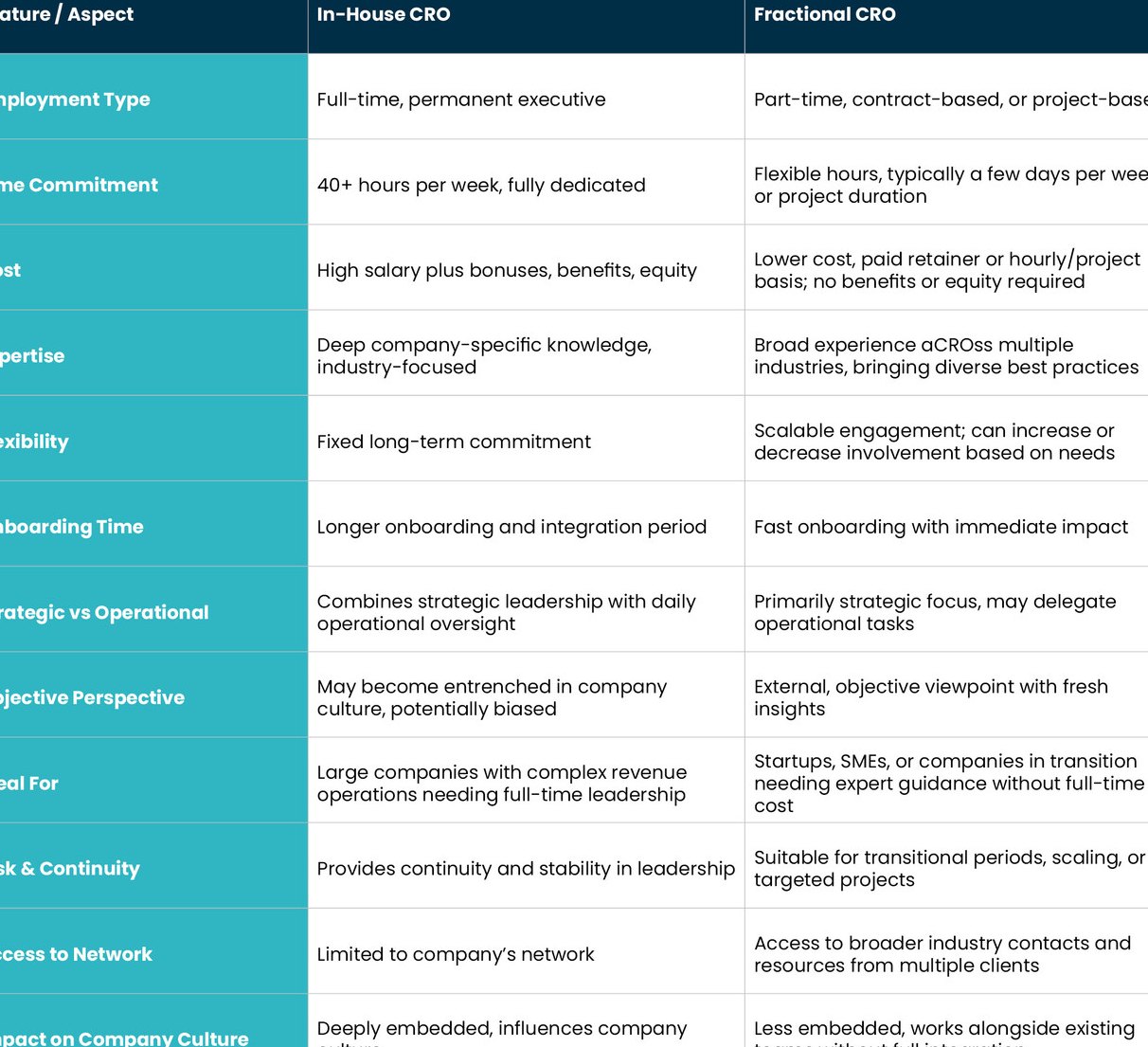
A fractional CRO is a part-time senior revenue leader, typically committing a defined number of days per week, who owns the full commercial motion: sales execution, forecasting, pricing logic, and usually the alignment points with marketing and customer success. Companies reach for this role when growth has stalled, when a founder is still personally carrying the pipeline, or when the business has outgrown ad hoc sales management but can't yet justify a full-time executive. The appeal is straightforward — you get pattern-matched judgment from someone who has scaled a revenue org before, without the cost and risk of a permanent C-suite seat.
The complication is that a CRO's real deliverables — an accurate forecast, a diagnosis of where deals stall, a comp structure that reinforces the right behavior — all depend on operational plumbing that normally belongs to RevOps. RevOps is the function that owns the CRM's data model, the definitions of a qualified lead versus a dead one, the reporting layer leadership actually trusts, and the documentation of how a deal is supposed to move. When no one owns that layer, a fractional CRO has exactly two paths: build it themselves (or direct someone else to build it), or make calls on instinct and anecdote because the numbers in front of them can't be trusted.
This is the crux of the "should I hire" question. A fractional CRO hired into a RevOps vacuum isn't just a strategist — for the first quarter, they are functionally the person who stands up the operational spine underneath their own decisions. That's a different job than the one most companies picture when they think "hire a CRO." It's closer to a builder-operator hybrid than a pure strategist, and you should screen and price the engagement accordingly. If you hire expecting pure strategy and get someone who spends six weeks untangling your CRM's deal stages, that's not scope creep — that's the job, done correctly, for a company with no RevOps function yet.
The upside of getting this right is real: the CRO's presence forces the operational buildout to happen with a clear owner and a clear purpose (produce trustworthy signal for revenue decisions) rather than as an abstract IT project nobody prioritizes. Companies that try to build RevOps in a vacuum, without a revenue leader pulling it forward, often produce beautifully documented processes that no one in sales actually follows. Pairing the build with someone accountable for the number tends to produce a leaner, more used system.
How the CRO role fits into the RevOps stack
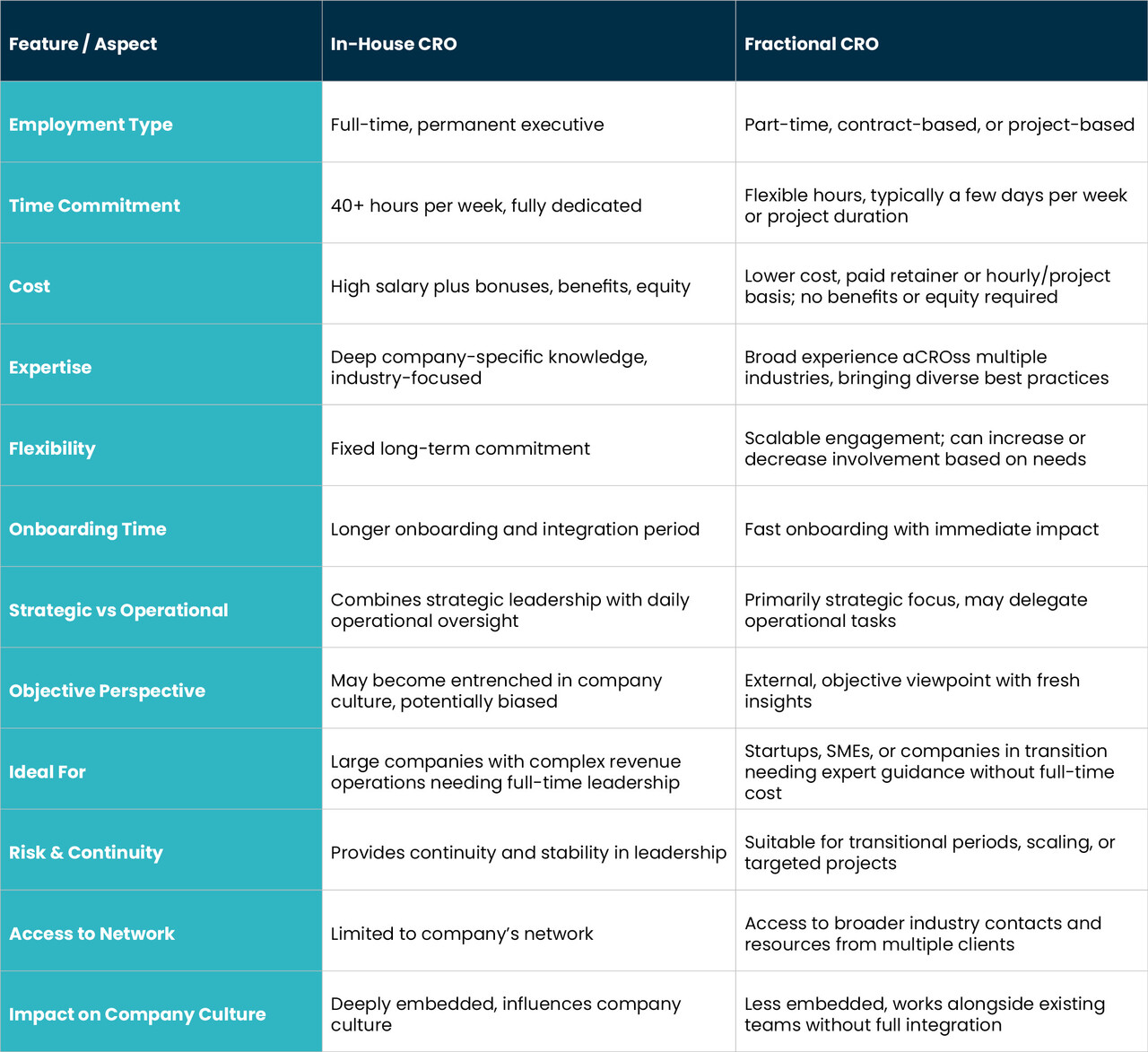
Think of revenue leadership and revenue operations as two layers that have to interlock rather than stack cleanly on top of each other. The CRO layer sets strategy, owns targets, and makes judgment calls about where to invest selling effort. The RevOps layer supplies the substrate those calls run on: the CRM's object model, stage definitions, integration health between tools, dashboards, and the qualitative and quantitative data that tells the CRO what's actually happening in the pipeline. When a company has no RevOps function, that substrate is either missing entirely or exists as undocumented tribal knowledge scattered across reps' spreadsheets.
A fractional CRO walking into that gap has to temporarily operate across both layers, or bring in help fast enough that the gap doesn't stall their own decision-making. In practice this means the CRO's early weeks look less like a strategy offsite and more like a data audit: pulling CRM exports, interviewing reps about how they actually work a deal versus what the pipeline stages claim, and finding where the reporting lies. Only once that's done does the CRO layer have anything real to act on.

The practical takeaway is that the two layers aren't sequential in a strict sense once the engagement is underway — they run in parallel, with the CRO specifying what the RevOps layer needs to produce and RevOps talent (hired, contracted, or the CRO themselves in the earliest weeks) executing it. The stack only "clicks" once both layers are populated and talking to each other: strategy calls informed by real data, and data collection shaped by what strategy actually needs to see.
Pricing, engagement models, and typical ranges
Engagement structure matters more than the headline rate when you're hiring into a RevOps vacuum, because the structure determines whether the foundation actually gets built. The most common shape is a defined weekly time commitment — often a handful of days per week rather than five — paired with a fixed initial term, frequently framed as a 90-day foundation phase, before either party commits to an open-ended retainer. That structure protects both sides: the company isn't locked into a long contract before seeing whether the CRO can actually build, and the CRO isn't asked to hit revenue targets before the infrastructure to hit them exists.
Costs vary widely by market, company stage, and the CRO's seniority, so treat any specific number you hear as a starting point for negotiation rather than a benchmark to anchor on — get current quotes from your own network and comparable companies rather than relying on rules of thumb. What's more useful than a dollar figure is understanding that you are effectively funding two things at once when RevOps doesn't exist yet: the CRO's fractional fee for their strategic time, and separately, the RevOps execution capacity — whether that's a hire, a contractor, or the CRO's own hours — that turns their specifications into a working system. Budgeting for the CRO alone and expecting the operational layer to materialize for free is one of the most common ways these engagements disappoint both sides.
Milestone-based payment structures, where a portion of compensation ties to foundation deliverables (adopted stage definitions, a working dashboard, a forecast method) rather than pure time-and-materials, can help align incentives when there's no revenue number yet to hold anyone accountable to. Whatever the structure, get the weekly commitment, the initial term length, and the specific foundation deliverables written down before work starts — fractional arrangements blur easily when expectations live only in conversation.

How to evaluate and shortlist a fractional CRO with no RevOps in place
Screening for this specific scenario is different from screening a CRO who'll inherit a mature operations function. The single highest-signal question is whether the candidate has personally built a RevOps foundation from scratch before, not just directed a team that already had one. Ask them to walk through a specific CRM migration or a forecast-model rebuild they led — get names of tools, the sequence of decisions, and what broke along the way. A candidate who can only describe outcomes ("we improved forecast accuracy") without describing the mechanics ("we redefined the opportunity object, rebuilt the stage-exit criteria, and rewired the pipeline report off the new fields") likely inherited rather than built.
Watch for candidates who want to start with rep coaching and pipeline reviews in week one. That instinct is a red flag specifically in a no-RevOps environment, because coaching against untrustworthy data produces activity without leverage — reps get pushed to hit numbers derived from stage definitions nobody agreed on. A strong candidate will instead propose an audit-first sequence: what tools exist, what data lives where, how deals actually move versus how the CRM claims they move, and where the real conversion cliffs sit.

Reference checks should specifically target companies that were in a similar starting position — no RevOps function, not an established one — and ask the reference how long the foundation actually took, what got deprioritized, and whether the CRO stayed hands-on with the data or delegated it entirely without oversight. Also probe for operations literacy directly: candidates who've only ever had a RevOps team reporting to them, rather than having personally configured a CRM or built a reporting pipeline, are a materially different (and riskier) hire for this specific situation, even if they're excellent CROs in a fully-staffed environment.
Finally, evaluate cultural fit around reporting lines. The CRO should report to the CEO or founder directly, not be buried under a VP, and should have explicit, unambiguous authority over the RevOps buildout — otherwise you'll end up with a strategist who has opinions about the data model but no ability to actually change it.
Buyer decision framework
The decision of whether to hire a fractional CRO before RevOps exists, build RevOps first, or bring both in together comes down to diagnosing which gap is actually binding growth right now. If a capable founder or sales leader already knows exactly what they'd do with clean data but is drowning in spreadsheet reconciliation and manual reporting, that's an operational bottleneck, not a strategy gap — a RevOps hire unblocks them far more cheaply than a CRO would. If instead there's no one actually owning the number, no coherent sales methodology, and reps are freelancing their own process, that's a leadership vacuum that a fractional CRO can fill immediately while directing the operational buildout as a subordinate workstream.
For well-funded companies, the pattern that tends to work best is hiring both roughly together, with the RevOps hire landing a few weeks ahead to prepare the ground — completing an initial data audit and basic pipeline instrumentation before the CRO's clock starts, so the CRO's first month is spent on strategy against real numbers instead of discovering the numbers are unusable. For cash-constrained companies, an operations-literate fractional CRO wearing both hats temporarily is a legitimate bridge, but it's explicitly a stopgap: as revenue grows, the strategic and operational workloads both expand past what one part-time person can sustainably cover, and the roles need to split.

Related questions
Is a fractional CRO worth it for a company under $2M in revenue?
Usually not yet. Below that range, founder-led sales paired with a strong RevOps contractor typically delivers more value per dollar than a fractional CRO. The exception is a founder who genuinely isn't a seller and needs commercial leadership to escape a growth ceiling.
Can one person be both a fractional CRO and RevOps for a startup?
Temporarily, yes, if they're specifically operations-literate and have built a foundation from scratch before. It's a viable bridge for cash-constrained companies, but it's a stopgap — both workloads eventually outgrow one part-time person.
What's the difference between a fractional CRO and a RevOps consultant?
A fractional CRO owns the revenue number and commercial strategy across sales, marketing, and customer success. A RevOps consultant builds and optimizes the operational infrastructure — data model, process, tooling, reporting — that the CRO's decisions run on. Different altitude, complementary work.
Should the fractional CRO hire the RevOps person?
Ideally the CRO defines the role and heavily influences the hire, since they know exactly what the operational layer needs to produce. The founder should stay involved on budget and culture fit, but letting the CRO own the spec keeps both functions aligned from day one.
How is hiring a fractional CRO different from hiring a fractional CMO in the same situation?
A fractional CMO walking into a company with no marketing operations faces a nearly identical version of this problem — attribution, lead scoring, and campaign reporting are the marketing-side equivalent of CRM hygiene, and the same build-first sequencing applies.
FAQ
How long does it take a fractional CRO to build a RevOps foundation from scratch? Plan for a full quarter to reach a trustworthy baseline: shared definitions, a clean CRM data model, and a forecast leadership actually believes. Deeper optimization continues well past 90 days, but that first quarter should produce a usable, adopted foundation.
Do I need a full-time CRO instead of a fractional one if I'm starting from zero? Not necessarily. Starting from zero actually argues for fractional, because the early work is foundation-setting that doesn't require five days a week from a senior executive. Scale to full-time once the revenue org's complexity outgrows a part-time leader's bandwidth.
Can I skip the CRO and just hire RevOps if my founder is a strong seller? Often, yes. A founder who sells well and understands their own go-to-market motion frequently just needs operational support to scale it, and a RevOps hire unblocks that founder at a fraction of a CRO's cost. Add the CRO later when the founder needs to step out of daily selling.
What CRM should be in place before hiring a fractional CRO? Any mainstream CRM the CRO can standardize on works — the specific tool matters far less than whether the CRO has real authority to fix its data model and stage definitions. A tool is only as good as the discipline enforced behind it.
How do I evaluate a fractional CRO when I have no data to judge them against? Judge the first 90 days on foundation deliverables, not revenue: adopted stage definitions, a trusted dashboard, a defensible forecast method, and a RevOps hire or contractor onboarded. Set these as explicit milestones up front, since you can't hold anyone to bookings tied to infrastructure they're still building.
Is it a red flag if a fractional CRO wants to start by coaching reps? When there's no operational foundation yet, yes. Coaching against untrustworthy pipeline data is activity without leverage. The right first move is diagnosis, definitions, and instrumentation — coaching becomes genuinely valuable once you can see where deals actually break.
Sources
- Harvard Business Review — Aligning Sales and Marketing Operations
- Gartner — Revenue Operations Research and Insights
- Forrester — B2B Revenue Operations
- McKinsey & Company — Growth, Marketing & Sales Insights
- SaaStr — Scaling Go-to-Market Leadership
- HubSpot Research — Sales and RevOps Benchmarks
- Salesforce — State of Sales Report
- Pavilion — Go-to-Market Leadership Community and Resources
Related on PULSE
- CRO vs. RevOps: Where the Scope Lines Actually Fall
- [Should I Hire a Fractional CRO If I Have No Sales Enablement Function in 2027?](/knowledge/tl0572)
- [Should I Hire a Fractional CRO If I Have Great Marketing but Weak Sales in 2027?](/knowledge/tl0552)
- [Should I Hire a Fractional CRO If I Need to Stand Up RevOps From Scratch in 2027?](/knowledge/tl0589)
- [Should I Hire a Fractional CRO If I Have Missed Quota Two Quarters in a Row in 2027?](/knowledge/tl0351)
This page will be disappearing soon. Save it to your device for $1 — or read it free while it is here.
@Kory-White- · if Venmo asks, the last 4 of my number are 2012
 pulse-toolsHow do I evaluate a fractional CRO in San Diego in 2027?
 pulse-toolsWhere do I find a fractional VP of Sales in Arkansas?
 pulse-toolsWhere do I find a fractional CRO in Georgia in 2027?
 pulse-toolsShould I Hire a Fractional CRO If I Need a 30-60-90 Plan Before a Board Meeting in 2027?
 pulse-toolsShould I Hire a Fractional CRO If My Reps Will Not Adopt the CRM in 2027?
 pulse-toolsHow do I hire a fractional VP of Sales in Tampa?
 pulse-toolsHow do I evaluate a fractional CRO in South Florida in 2027?
 pulse-toolsShould I Hire a Fractional CRO If I Need to Rebuild Trust After a Failed CRO in 2027?
 pulse-toolsWhere do I find a fractional VP of Sales in Delaware?
 pulse-toolsHow much does a part-time CRO cost in Baton Rouge in 2027?