
Should I Hire a Fractional CRO If I Need to Stand Up RevOps From Scratch?
 Curated byKory White · Fractional CRO · Maryland
 PULSEKNOWLEDGE LIBRARY
Quality
Certified

Usually no. A fractional CRO leads revenue strategy and people; standing up RevOps from scratch is systems, data, and process work. Hire a fractional RevOps lead or consultant first to build the operating layer, then add a fractional CRO once there is a machine worth running and numbers worth defending.
Signals you actually need this
The instinct is understandable. You feel behind on revenue, "Chief Revenue Officer" sounds like the senior fix, and one hire feels cleaner than two. But "stand up RevOps from Scratch" describes an operations-and-infrastructure problem, while a CRO is a leadership-and-strategy role. Matching the title to the actual gap is the whole game, and the mismatch costs you both cash and months you cannot get back.
The cleanest diagnostic is a ninety-day thought experiment. Ask yourself: if we change nothing for a quarter, what breaks first? If the answer is "we still can't see our pipeline, leads fall through cracks, and every board number is a manual spreadsheet reconstructed the night before," you have a systems gap and you need a builder. If the answer is "the reps have tools but no direction, quotas are invented, deals stall because nobody coaches or qualifies out," you have a leadership gap and a Fractional CRO earns their fee. Genuinely early companies with no revenue engine almost always describe the first problem, which is exactly why the from-scratch framing points away from the CRO.
There is a second, faster test I like even better: the trust test. Imagine the board asks you live, in a meeting tomorrow, "what's in the pipeline and what will we close this quarter?" If you can pull an answer you would stake your reputation on from a system in under sixty seconds, your data foundation is real and your remaining gap is probably leadership. If answering means a frantic afternoon of spreadsheet archaeology plus gut feel, your gap is the system. No amount of senior revenue leadership fixes a company that cannot see itself.
A few concrete signals that point hard toward RevOps-first. Your CRM is a contact database, not an opportunity pipeline — reps live in their inboxes and update records only when asked. Nobody can state your stage definitions out loud without disagreeing. Inbound leads arrive in a shared inbox that someone triages by hand. You have no reliable conversion rate between any two stages, so every forecast is a story rather than an arithmetic. Reporting is a spreadsheet someone rebuilds monthly, and two people produce two different revenue numbers from the same month. Any three of those together and you are a foundation-build case, full stop.
Signals pointing the other way are just as legible. Revenue is real but entirely dependent on the founder's personal relationships. Reps have a functioning CRM but no playbook, no qualification framework, and no coaching cadence. Pricing is improvised deal by deal. There is an existing forecast process, it just is not trusted because nobody enforces the discipline behind it. Those are people-and-decisions problems, and they respond to leadership in a way they never respond to better dashboards.
Worth noting the adjacent version of this question that trips people up: the same logic applies to a fractional CMO or a fractional CFO. Hiring a senior part-time leader ahead of the operating layer they lead from produces the same failure mode in marketing (a CMO with no attribution) and finance (a CFO with no clean ledger). The pattern is general — seniority multiplies a system; it does not substitute for one.
What good looks like versus what bad looks like
Look at how the two roles actually spend a representative week, because the daily texture is where the mismatch becomes obvious. A fractional CRO's calendar is meetings: pipeline review with the reps, a pricing conversation with the founder, a board-deck rehearsal, a coaching session on a stuck enterprise deal, an interview for the next AE. Their leverage is relational and strategic — they move numbers by moving people and decisions.
A RevOps builder's week looks nothing like that: mapping the object model in the CRM, importing and de-duplicating a messy contact list, writing the validation rules that stop reps from skipping required fields, building the first pipeline dashboard, testing a round-robin routing rule against real inbound traffic. One role is fundamentally a conversation; the other is fundamentally a construction. Buy the wrong one and you do not merely overpay — you get a person whose entire working rhythm is built for a job you did not need done yet.
There is a skills-adjacency trap underneath this. Because both roles live under the revenue umbrella, buyers assume a CRO can obviously do RevOps work if pressed. In practice the two demand nearly opposite temperaments. Strong RevOps builders are systems thinkers who enjoy precision, documentation, and the quiet satisfaction of a clean data model. Strong CROs are persuaders and pattern-matchers who thrive in ambiguity and dislike being pinned to a keyboard for a week configuring picklists. A fractional CRO who is genuinely excellent at strategy is more often than not mediocre and miserable doing implementation, and you will feel both halves of that.
Bad looks like this in month two: decks exist, meetings run, a pricing framework appears, and the thing you actually needed — a system that tells you the truth about your pipeline — still does not exist. That felt-momentum is the dangerous part, because it delays the diagnosis. Retainer spent, foundational gap unchanged, now with a layer of strategy resting on numbers nobody can verify.
Good looks like this: someone owns the build, the build has a written definition of done, and by day sixty you can answer pipeline questions from a dashboard instead of a spreadsheet. Then, and only then, a revenue leader arrives to a documented system with clean data, becomes productive in days, and gets measured against a real baseline.
There is one more failure pattern worth naming because it is quiet and structural. Bringing in a revenue leader before you have a revenue system tends to entrench bad process, because the leader optimizes around whatever ad-hoc tooling exists rather than pausing to build it correctly. It is far easier to lead a well-instrumented engine than to retrofit instrumentation onto one that has already grown up around a single person's improvisation. And a mis-hired senior leader is politically hard to unwind — unlike a scoped contractor whose engagement simply ends, a CRO has been introduced to the board and the team as the revenue answer, so admitting the sequencing was wrong becomes an uncomfortable reversal instead of a clean pivot.
When the fractional CRO genuinely is the right first hire
The honest answer is not a flat never, and pretending otherwise would be lazy. There are three recognizable situations where the CRO belongs first even if the RevOps layer is thin.
The first is the founder-led-sales handoff. A technical or product founder has personally closed the first dozen deals on charisma and domain credibility. Revenue is real but entirely dependent on them, and the company needs someone to convert founder magic into a repeatable, teachable motion. That is leadership work — building a playbook, hiring the first true reps, designing comp — and a fractional CRO fits well, provided they immediately resource a builder underneath them rather than absorbing the build themselves.

The second is the turnaround. An existing sales org has a system and a team but is badly missing its number, and the diagnosis is direction and accountability rather than plumbing. Adding tooling to that org changes nothing; adding a leader who sets standards, runs real deal inspection, and removes the people who are not going to make it changes everything.
The third is the fundraise or exit narrative. If you are eight weeks from a raise and the gap is a coherent revenue story, a segmentation thesis, and a defensible plan, a strong fractional CRO can produce that faster than a builder can produce a warehouse. Just be clear-eyed that a story built on unverifiable numbers is a diligence liability, not an asset — which usually means running a compressed RevOps build in parallel rather than skipping it.

All three are leadership-gap stories wearing an early-stage costume. The tell is identical every time: the pain is about people and decisions, not visibility and data.
If you land in a genuine gray zone — some traction, some tooling, a real leadership vacuum — two reasonable hybrids exist. One is a single senior fractional RevOps leader with go-to-market strategy range, someone who can both build the object model and argue about segmentation. Those people are rarer and cost more, but they collapse two hires into one for a while. The other is a fractional CRO contracted with a scoped RevOps build as their explicit first deliverable and a junior implementer working under them. Whichever you choose, make build ownership explicit in the engagement letter so it does not quietly become the expensive leader's day job by default.
Real cost and ROI ranges
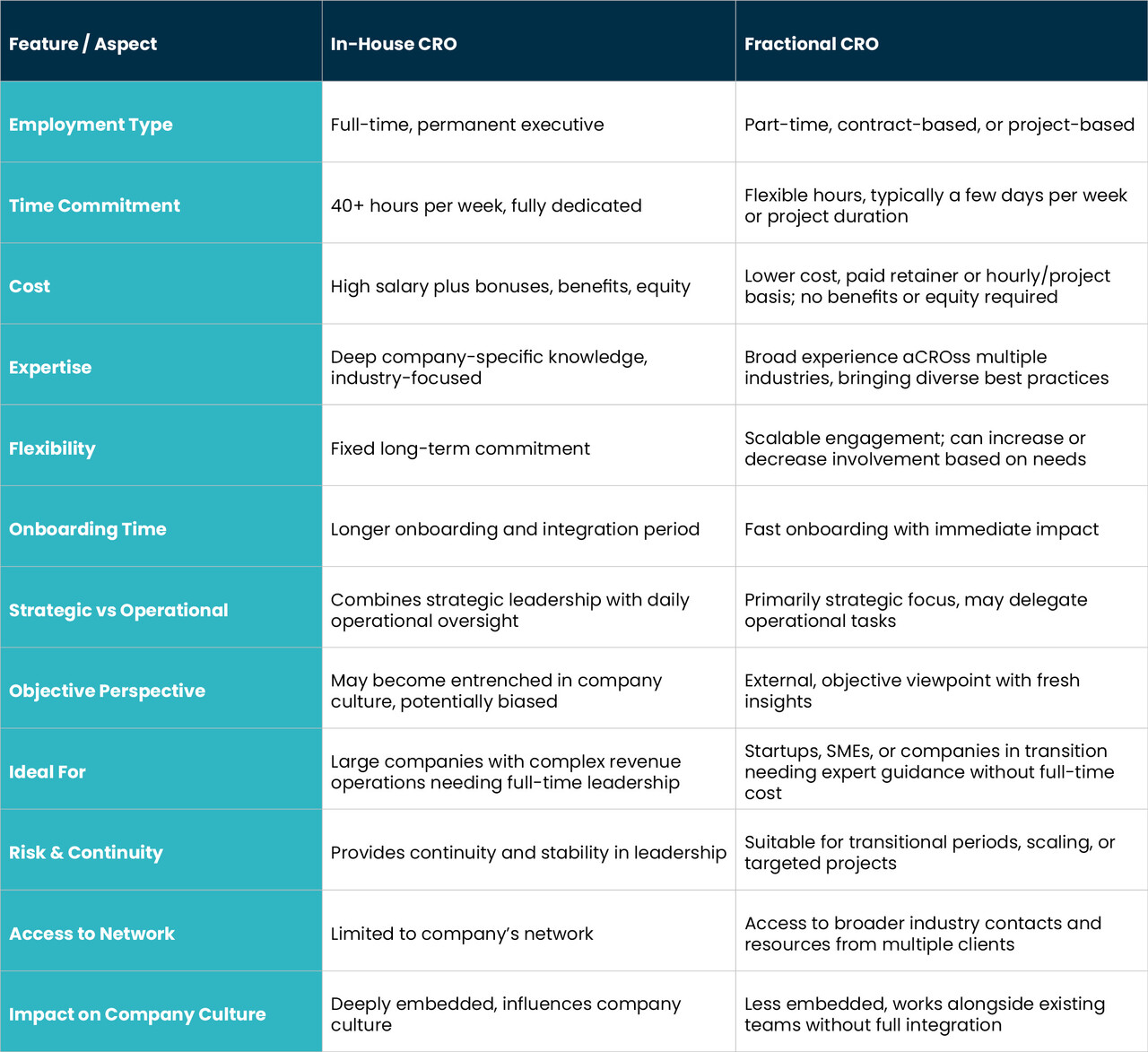
Cost matters here, and it favors the sequence. A fractional CRO is typically engaged one to three days a week on a monthly retainer priced for senior part-time leadership. A RevOps contractor or consultant delivering a foundation build is usually a materially lower monthly cost and a far better skill match. Paying leadership rates to have someone configure CRM fields is a poor trade in both directions: you overpay for the labor and you underuse the judgment.

Rather than quoting numbers that vary wildly by market and seniority, price the decision as a ratio. Get quotes for both roles in your geography and stage, then ask what each buys you in ninety days. The RevOps engagement buys a tangible, inspectable artifact: a configured CRM, a documented data model, working routing, and a set of reports you can open. The CRO engagement buys judgment, direction, and hiring leverage — real value, but value that compounds only against a working system.
The ROI asymmetry is the actual argument. A RevOps foundation makes every subsequent hire cheaper to onboard and easier to hold accountable. When a fractional CRO arrives to documented process and trustworthy data, they are productive within days and their contribution is measurable against a baseline that existed before them. When they arrive to chaos, the first month is archaeology — reconstructing what is actually happening — and there is no clean baseline, which conveniently makes it impossible to tell whether the expensive hire is working. Build first and you buy two things: a better system, and the ability to evaluate the leader you hire next.
Budget the build honestly. A from-scratch foundation is commonly a sixty-to-one-hundred-twenty-day engagement, and the variance is driven mostly by data mess, not by tooling. Migrating four years of accumulated spreadsheet history with duplicate accounts and inconsistent naming takes far longer than configuring a clean instance for a company that has never had a CRM. Add tool subscriptions on top of labor — CRM seats, enrichment, sequencing, a BI or reporting layer — and remember that the cheapest stack you can operate correctly beats the sophisticated stack nobody maintains.

If you can only afford one hire right now, apply a single rule: buy the role that unblocks the other. A RevOps foundation unblocks a future CRO enormously. A CRO without a foundation stays blocked, and you will pay a retainer to watch them wait.
How it plugs into your workflow
Sequence the roles to the maturity of your revenue engine instead of buying the most senior title available. Stage one is a fractional or contract RevOps lead — or a focused consulting engagement — with a single mandate: build the foundation. Pick the CRM, model the data, define stages, wire routing and reporting, document process. Stage two, once the machine exists and produces trustworthy numbers, is where a fractional CRO adds leverage, because now there is a dashboard to lead from and a forecast to defend. Stage three, as you scale, converts one or both roles to full-time or hires beneath them.
The build itself has a natural order, and skipping ahead in it is the most common self-inflicted wound. Foundation before optimization: you cannot optimize a funnel you cannot see. So the RevOps lead lands the CRM and data model first, then instruments the funnel, then builds reporting, and only then tunes routing, scoring, and automation. A fractional CRO parachuted in ahead of that order will either sit waiting on work they cannot do or, worse, start making revenue promises against numbers that do not yet exist.

Be concrete about what "the foundation" contains, because "stand up RevOps" is a vague phrase hiding a specific checklist. At minimum a from-scratch build should deliver: a CRM configured with a real object model — accounts, contacts, opportunities — rather than out-of-the-box defaults; clearly defined, mutually exclusive pipeline stages with written entry and exit criteria; the required fields and validation rules that keep data trustworthy; lead capture from every source (web forms, inbound email, events, partner referrals) landing in one place; a routing rule that assigns those leads to the right owner without a human triaging a shared inbox; a small set of core reports — pipeline by stage, stage-to-stage conversion, win rate, cycle time — that the founder actually trusts; and process documentation that lets the next hire understand the system without a guided tour.
Optimization work sits on top of that, not instead of it. Lead scoring, multi-touch attribution, forecast modeling, sequencing automation, territory design, and quota planning are all real and valuable — and all of them consume the foundation as an input. Building attribution before you have consistent source capture produces confident nonsense. Building a forecast model before you have stage discipline produces a number that moves when reps change their habits rather than when the business changes.

Downstream, the same foundation feeds functions well beyond sales. Finance uses the opportunity data for revenue recognition and cash planning. Customer success inherits the account structure for health scoring and renewals. Marketing needs the source and stage data to compute cost per opportunity rather than cost per lead. Product often wants the lost-reason field more than anyone. Standing up RevOps from Scratch is therefore not a sales project with a sales-shaped return; it is shared infrastructure, which is another reason it deserves a dedicated owner rather than a leader's spare afternoons.
One boundary to hold in both directions: do not let a pure implementer make strategy calls above their remit. A RevOps builder should not be unilaterally setting pricing or comp philosophy, and a good one will tell you so. That boundary is exactly what the later CRO hire covers, which is why the two roles complement each other cleanly once they are sequenced correctly.
Finally, write the engagement so ownership is unambiguous and time-boxed. Define what done looks like before anyone starts, review it on a fixed cadence, and revisit the staging every quarter as the engine matures. The right answer at a few hundred thousand in ARR is frequently the wrong answer at several million — and the entire point of the fractional model is that it lets you re-sequence as you grow without unwinding a full-time hire.
Related questions
Can one person be both fractional CRO and RevOps lead?
Occasionally, at very small companies, a senior fractional revenue leader wears both hats. It works only if they genuinely enjoy hands-on systems work and you accept that neither function gets full depth. Split the roles as volume grows.
Is a RevOps agency better than a fractional hire for the build?
An agency delivers the foundation fast with a team, then hands it back for you to run. A fractional hire builds it and stays to operate it. Choose the agency for a bounded build, the individual for ongoing ownership.
What order should the RevOps build follow?
CRM and data model first, then funnel instrumentation, then core reporting, then automation, routing, and scoring. Foundation before optimization — you cannot tune a funnel you cannot yet measure honestly.
When should I convert fractional roles to full-time?
When the person is consistently at capacity, the workload is steady rather than project-shaped, and the cost of fractional hours approaches a full-time salary. That is the signal to convert or hire beneath them.
Does the same logic apply to a fractional CMO?
Yes. Hiring a senior marketing leader before attribution and campaign infrastructure exist produces the identical failure: strategy built on numbers nobody can verify. Build the measurement layer, then hire the leader who reads it.
FAQ
Should a pre-revenue startup hire a fractional CRO?
Almost never. Pre-revenue means there is no engine to lead and no data to lead from. Spend on finding product-market fit and building a minimal foundation first. A revenue leader adds leverage only once there is revenue to operate and a motion worth systematizing.
What is the actual difference between a CRO and a RevOps leader?
A CRO owns the revenue number, sales leadership, pricing strategy, and alignment across marketing, sales, and customer success. A RevOps leader owns the systems, data, process, and reporting that let the revenue org function at all. Strategy and leadership versus infrastructure and operations.
Can I stand up RevOps with contractors alone?
Yes. A capable consultant or contractor can deliver the initial CRM, data model, routing, and reporting. The open question is who operates and evolves it after the contract ends, so decide on ongoing ownership before the engagement closes rather than after the builder walks away.
Will a fractional CRO refuse to do the implementation work?
Many will, because it sits outside their remit and skill focus, and a good one will insist you resource a builder instead. If yours cheerfully agrees to do it personally, you are likely paying leadership rates for implementation labor.
Does company size change the answer?
Yes. Under a handful of reps with no systems, RevOps-first is nearly always correct. As you cross into multiple sales teams and meaningful ARR, a CRO's leadership leverage rises sharply and the two roles separate cleanly into distinct, simultaneously justified hires.
How do I hold a fractional hire accountable at two days a week?
Define outcomes, not hours: a written scope, a dated deliverable list, and a few metrics reviewed on a fixed cadence. Fractional works when the mandate is specific and measurable, and drifts badly when the engagement is vague and open-ended.
Sources
- Gartner — Revenue Operations Research
- Forrester — B2B Revenue Operations Insights
- Harvard Business Review — Sales and Marketing Alignment
- SaaStr — Fractional Executives and Hiring
- First Round Review — Building the Revenue Engine
- RevOps Co-op — Community Resources
- Pavilion — Go-to-Market Leadership Community
- OpenView — SaaS Benchmarks and GTM Operations
Related on PULSE
- [Should I Hire a Fractional CRO If I Need Interim Coverage During a Medical Leave in 2027?](/knowledge/tl0596)
- [Should I Hire a Fractional CRO If I Acquired a Company and Need to Cross-Sell in 2027?](/knowledge/tl0579)
- [Should I Hire a Fractional CRO If I Need to Rebuild Trust After a Failed CRO in 2027?](/knowledge/tl0592)
- [Should I Hire a Fractional CRO If I Need to Fix Attribution Before Raising in 2027?](/knowledge/tl0584)
- [Should I Hire a Fractional CRO If I Need a 30-60-90 Plan Before a Board Meeting in 2027?](/knowledge/tl0581)
- [Should I Hire a Fractional CRO If I Need to Build a Partner Channel in 2027?](/knowledge/tl0570)
This page will be disappearing soon. Save it to your device for $1 — or read it free while it is here.
@Kory-White- · if Venmo asks, the last 4 of my number are 2012
 pulse-toolsWhere do I find an interim CRO in Jersey City in 2027?
 pulse-toolsWhere do I find a fractional VP of Sales in New Jersey?
 pulse-toolsShould I Hire a Fractional CRO If I Need to Rebuild Trust After a Failed CRO in 2027?
 pulse-toolsHow much does a fractional CRO cost for a seed-stage company in 2027?
 pulse-toolsWhere do I find a fractional VP of Sales in Arkansas?
 pulse-toolsWhere do I find a fractional head of revenue in Tulsa in 2027?
 pulse-toolsWhat does a fractional CRO cost in Delmar in 2027?
 pulse-toolsHow much does a fractional Chief Revenue Officer cost for a $1M to $5M ARR company in 2027?
 pulse-toolsHow do I find a fractional CRO in Christiana in 2027?
 pulse-toolsIs there a fractional CRO available near me in the Gulf Coast in 2027?