
Should I Hire a Fractional CRO If I Am Replacing a CRO Who Failed?
 Curated byKory White · Fractional CRO · Maryland
 PULSEKNOWLEDGE LIBRARY
Quality
Certified

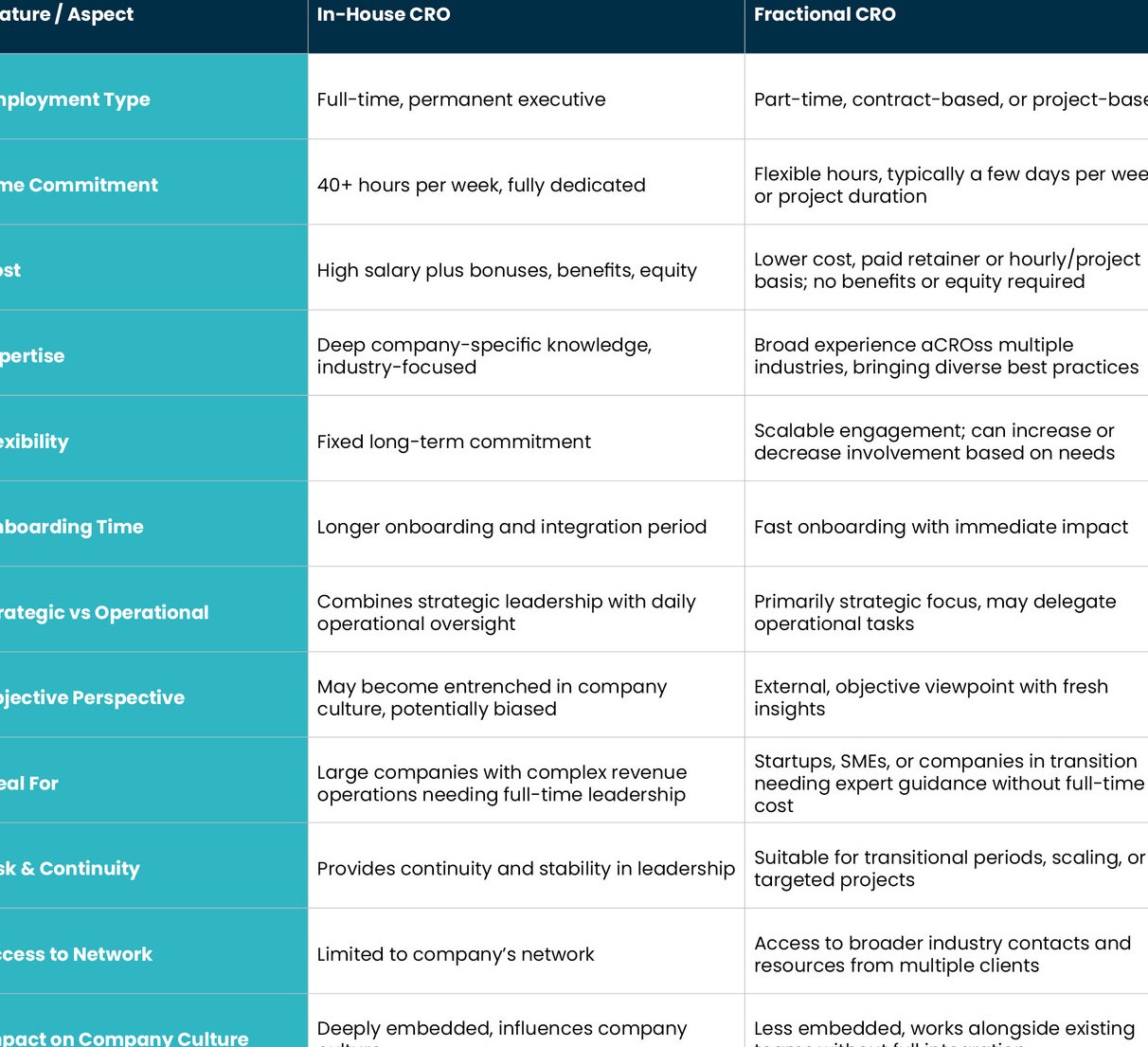
Yes — in most cases a fractional CRO is the right next move after a CRO fails, because you need a diagnosis before you need another hire. Thirty to sixty days of senior, unattached scrutiny tells you whether the failure was strategy, execution, or product-market fit, so the permanent hire inherits a fixed problem instead of a hidden one.
Signals you actually need this rather than another full-time search
The tell is not that the last CRO missed the number. It is that nobody in the building agrees on *why*. Sit five people down — the CEO, the VP of Sales, the head of marketing, the top-performing AE, and whoever owns RevOps — and ask each of them separately what went wrong. If you get five different stories, you have a diagnosis problem, not a hiring problem, and running another executive search will simply hand the next person the same fog.
A few concrete signals that point toward a fractional engagement instead of a straight replacement:
Forecast accuracy has been off by more than 20% for two or more consecutive quarters. A single miss is variance. A repeated, directionally consistent miss — always high, never low — means the pipeline is being scored by hope rather than evidence, and the stage definitions themselves are broken. That is systems work, and a fractional operator can rebuild stage-exit criteria and re-baseline the forecast in weeks. A new full-time CRO will spend their first quarter just earning the right to touch it.

Win rate has fallen while activity metrics have held flat or risen. More calls, more demos, more sequences, same or fewer closed-won deals. This pattern almost always means the top of funnel is being filled with poorly qualified accounts, and the previous leader responded to a demand problem by demanding more activity. Reps get exhausted, the best ones leave, and the number keeps sliding.
Two or more of your top five reps have resigned in the last six months. Quota-carrying talent votes with its feet before it votes in an exit interview. When your best sellers leave a market that has not changed, the plan changed — usually the comp plan, the territory carve, or the ICP.
The board has stopped asking about growth and started asking about efficiency. This is a strategic-posture change, and a CRO who was recruited to run a land-grab playbook may genuinely be unable to run an efficiency playbook. That is a mismatch, not incompetence, and it is worth naming clearly before you write another job spec.
Nobody can produce a clean loss-reason report for the last two quarters. If closed-lost reasons are 60% "no decision" or "other," your CRM has been storing activity, not intelligence. You cannot fix a funnel you cannot see, and no incoming executive can either.

There is also a counter-signal set worth respecting. If the previous CRO was in seat under nine months, if the failure traces to a single blown quarter after a product outage or a pricing change made above their head, or if the sales org is under twelve people and the founder is still the primary closer, you probably do not need a fractional CRO at all. You need a strong VP of Sales, a functioning RevOps analyst, and founder time back in deals. Replacing a title when the real gap is capacity is an expensive way to feel productive.
One adjacent case worth flagging: the same logic applies almost verbatim to a failed VP of Marketing or a failed head of Customer Success in a company where net revenue retention has collapsed. The diagnostic-first pattern — bring in a senior, unattached operator for 30–90 days before committing to a permanent hire — is not CRO-specific. It is what you do any time a functional leader fails and the organization cannot agree on the cause. The failure mode you are avoiding is identical: hiring a fix for a problem you have not yet defined.
What good looks like versus what bad looks like
The difference between a fractional engagement that saves your year and one that burns two quarters of runway shows up in the first three weeks, and it shows up in behavior, not credentials.

Good looks like an operator who asks for read-only access before asking for authority. In week one they want CRM export rights, the last four board decks, the current comp plan documents, the closed-lost data, call recordings, and thirty minutes each with ten to fifteen people across sales, marketing, CS, and product. They are building a picture. They are not yet proposing anything, and they will tell you so when you push.
Bad looks like an operator who arrives with a methodology. If they mention their proprietary framework in the first meeting, or if they propose a MEDDPICC rollout before they have read a single loss report, you have hired a trainer with an executive title. Methodology is a tool you select after diagnosis, not a product you buy in advance. The previous CRO very likely also had a methodology.
Good produces a written diagnosis that names things you do not want to hear. A real 30-day deliverable is three to six pages and says something like: pipeline coverage is reported at 3.4x but 41% of it has had no buyer-side activity in 45 days, so real coverage is closer to 2.0x; the comp plan pays the same accelerator on renewals and new logos, so reps have rationally stopped hunting; the ICP written in the deck does not match the ICP in the closed-won data. Specific, numbered, uncomfortable.

Bad produces a slide deck with a maturity model on it. Five columns, you are in column two, the path to column four costs money. This tells you nothing about your company that could not have been written before they met you.
Good is explicit about what they do not own. A well-structured fractional CRO owns go-to-market strategy, the forecasting discipline, comp design, and hiring recommendations — and explicitly does not own daily rep management, deal-by-deal coaching, or the CRM admin queue. Bounded scope keeps them out of the operational undertow that consumed your last leader.
Bad quietly becomes the interim CRO. They start taking the pipeline call, then the one-on-ones, then the escalations. Within eight weeks they are working full-time hours at part-time pay, doing the job badly because they are stretched, and you have recreated the exact vacancy you were trying to diagnose.
Good writes an exit condition into the agreement on day one. Something like: by day 90, deliver a validated pipeline model, a revised comp plan effective next quarter, a hiring scorecard for the permanent CRO or VP, and a documented forecast cadence the team can run without them. Then a go/no-go.

Bad has an open-ended retainer with a monthly check-in. No milestone, no defined end, no transfer of knowledge. Eighteen months later they are still there, and nobody can articulate what changed.
The diagram is worth reading as a decision tree rather than a project plan. The branch that most founders skip is the one on the right: the outcome where the diagnosis says the problem is not sales at all. That branch is the single highest-value thing a fractional engagement can produce, because it stops you from spending nine months and a large equity grant hiring a revenue leader to fix a product gap. Nobody who wants a long engagement will tell you that. Someone whose reputation depends on being right will.
Real cost, real ROI, and the math that decides it
Fractional CRO pricing is quoted in days per month, and the honest way to evaluate it is to compare total cost of the fractional path against total cost of the search-and-hire path, including the costs founders routinely leave out.

The fractional side of the ledger. Engagements are typically structured as a monthly retainer against a committed number of days — roughly 8 days a month at the light end, 10 to 12 for a full go-to-market rebuild, and 12 to 15 for a genuine turnaround with multiple segments or geographies. Rates vary widely by market and operator seniority, so treat any single number you see quoted online with suspicion. What matters more than the headline rate is what the days buy. Eight days a month is enough for strategy, forecast governance, comp design, and a weekly leadership rhythm. It is not enough to also manage a team of fifteen. If someone quotes you eight days and promises daily management, one of those two things is fiction.
Equity sometimes appears in longer engagements, usually as a small option grant with standard vesting, and it is more common when the fractional leader is expected to stay through a rebuild rather than just a diagnostic. Be careful here: equity aligns incentives over years, and the whole point of a fractional engagement is that it should end. A cash-heavy, milestone-linked structure usually serves both sides better than a grant that quietly extends the relationship past its usefulness.
The full-time side of the ledger — the part that gets underestimated. A permanent CRO search is not just the eventual salary. Count the retained search fee, commonly a percentage of first-year cash compensation. Count the search duration, which for a senior revenue leader routinely runs three to six months from kickoff to signed offer, plus a notice period. Count ramp: even a strong CRO needs a full quarter to understand your data and another to change anything, so you are realistically looking at six to nine months before their decisions start showing up in bookings. Count the equity grant, which at the executive level is a meaningful percentage of the company. And count the severance risk — because if the second hire also fails, you pay to exit them too.
Now put a number on the vacancy itself. If your revenue org produces, say, $600K in new bookings a month and it is drifting at 70% of plan while leaderless, the drift costs roughly $180K a month. Six months of search plus two quarters of ramp is a long time to run at 70%. Against that, a 90-day fractional engagement is often the cheaper option before you even count what the diagnosis is worth.

The ROI cases that actually pay. Three patterns produce outsized returns:
*Comp plan correction.* A comp plan that pays flat commission on renewals and new logos, or that accelerates too early, redirects rep behavior in ways that cost far more than any consulting fee. Fixing the plan for a ten-rep team ahead of a new fiscal year changes where hundreds of selling hours per month get spent. This is one of the fastest-paying interventions in the entire RevOps toolkit.
*Forecast credibility with the board.* Companies that miss forecast repeatedly get valued and funded differently than companies that hit a modest, believable number. Restoring forecast accuracy from ±30% to ±10% changes the conversation in every board meeting and, in a raise, changes terms. That is not a soft benefit.

*Avoiding the wrong hire.* If the diagnostic reveals that the market segment is wrong, or that pricing is misaligned with delivered value, you have avoided hiring a CRO into an unwinnable job. The savings there — search fee, salary, equity, another year lost — dwarf the engagement cost.
The cases where the math does not work. Under roughly $2M ARR with a small team, the fractional overhead usually is not justified; buy senior RevOps capacity and a strong first-line manager instead. If your leadership team has no bandwidth to implement recommendations, you are buying a report, not a change — a fractional CRO cannot execute through people who are not in the room with them. And if your internal middle-management layer is weak, understand that this is precisely the gap a part-time executive cannot fill; you will need a full-time operator alongside them or the recommendations will sit.
There is also a signaling cost worth pricing. Investors and senior sellers watch what you do after an executive departure. Handled badly, a fractional hire reads as retreat. Handled well — framed openly as "we are running a 90-day diagnostic so the next permanent leader inherits a clean, honest picture" — it reads as discipline. The framing is free; the failure to frame it is not.

How it plugs into your existing workflow and systems
The practical question is not philosophical, it is operational: what actually changes in your week, your tooling, and your reporting when a fractional CRO starts?
Week one to two: instrumentation and access. They need read access to the CRM, the call recording platform, the marketing automation tool, and whatever your finance team uses for bookings and billing. The first real deliverable is usually a data-quality assessment, because most post-failure environments have CRM hygiene problems that make every downstream report untrustworthy. Expect them to find stage definitions that are subjective, opportunity records with no next step, closed-lost reasons dominated by a single meaningless bucket, and a pipeline that has not been scrubbed in months. This is where your RevOps analyst becomes the most important person in the engagement — they are the one who can actually execute the field changes, validation rules, and report rebuilds.
Week three to four: the cadence rewrite. A good fractional CRO will consolidate meetings rather than add them. A typical target end-state is one weekly pipeline review with strict stage-exit criteria, one weekly leadership sync across sales, marketing, and CS, one monthly business review with the founder, and a forecast submission ritual with a fixed deadline and a fixed format. What usually gets killed: the daily standup that had become a status recital, the separate marketing pipeline meeting that duplicated the sales one, and the ad-hoc deal escalations that consumed leadership evenings.
Month two to three: the systems work. This is where the engagement touches your tooling most directly. Common workstreams include rebuilding opportunity stages with objective, buyer-verifiable exit criteria; implementing or repairing forecast categories so commit actually means commit; restructuring territories and account tiers; rewriting the comp plan for the coming fiscal period; and building a hiring scorecard for the roles that need to change. Each of these produces an artifact your team keeps whether or not the engagement continues, which is the entire point.

Throughout: the handoff discipline. The measure of a good engagement is what survives it. Insist that every process they build is documented in your systems, not in their private templates — the forecast methodology written into your CRM's help text, the comp plan modeled in a spreadsheet your finance lead owns, the stage criteria enforced by validation rules rather than by their personal insistence in a meeting. If the improvement depends on their presence, it will end when they leave.
Two adjacent effects are worth anticipating. First, marketing feels this quickly — once qualification criteria tighten, MQL volume that used to look healthy will drop, and someone will interpret that as marketing failing when it is actually the measurement getting honest. Get ahead of that conversation before the first monthly review. Second, customer success is usually the last function looped in and the one holding the most diagnostic evidence, because churn and expansion data reveal whether you sold to the wrong accounts long before the sales data does. A fractional CRO who never talks to CS is running the audit with one eye closed.
Finally, plan the transition out. The best version of this ends with the fractional operator helping write the permanent role spec, sitting in on final-round interviews, and overlapping with the new hire for two to four weeks. That overlap is cheap and it is the single best predictor that the second permanent hire will not fail the way the first one did.
Related questions
Should I promote an internal VP of Sales instead?
If the strategy was sound and the failure was management or coaching, yes — an internal promotion is faster, cheaper, and better for morale. If the strategy itself was wrong, an internal promotion asks someone to critique the plan they helped execute, which rarely works.
How long should a post-failure fractional engagement run?
Ninety days for diagnosis and stabilization, with an explicit go/no-go. Extend to 180 days only if the rebuild is genuinely underway and milestones were hit. Open-ended engagements past six months usually mean the exit criteria were never defined.
What if the diagnosis says the problem is the founder?
A good fractional CRO will say it, carefully and with evidence — usually as "the CEO is still the primary closer, so no sales leader can own the number." Take it seriously. It is the finding an internal hire will never deliver.
Can a fractional CRO help hire the permanent replacement?
Yes, and they should. Have them write the scorecard, screen for the specific gaps they found, and interview finalists. A leader hired against a real diagnosis, by someone who understands the failure, is a materially safer bet.
Does this work for a failed VP of Marketing or CS leader too?
The same pattern applies. Diagnose before you hire whenever a functional leader fails and the organization cannot agree on why. The title changes; the sequencing logic — evidence first, commitment second — does not.
FAQ
What is the biggest risk of hiring a fractional CRO after a failed CRO?
Scope creep into interim management. The fractional leader gradually absorbs pipeline calls, one-on-ones, and escalations until they are doing a full-time job at part-time hours, which means doing it badly. Write the boundary into the agreement: they own strategy, forecast governance, comp design, and hiring recommendations, and explicitly do not own daily rep management. Revisit that boundary at day 30 and day 60, because drift is gradual and nobody notices it in a single week.
How fast should I expect a real diagnosis?
Thirty days for a written, specific diagnosis in most organizations under a few hundred employees. Multi-geography or multi-product companies can take forty-five. If nothing written has landed by day forty-five, that is a signal in itself — either the access they needed was never granted, or they are avoiding an uncomfortable conclusion. Ask directly which one it is rather than waiting for the next monthly review.
Will a part-time executive command respect from the sales team?
Credibility comes from accuracy, not from headcount status. A fractional leader who reads the closed-lost data and describes a rep's real problem back to them in week two earns more standing than a full-time hire who spends a quarter in listening mode. What you must supply is visible sponsorship: announce the engagement yourself, state the mandate, and make clear that their recommendations carry your authority. Ambiguity about backing is what actually erodes respect.
What if the diagnosis points to product-market fit rather than sales execution?
That is the highest-value outcome available and you should treat it as a win, not a failed engagement. It means you stopped before spending a search fee, a salary, an equity grant, and another year hiring someone into an unwinnable job. Redirect the work: the conversation moves to product, pricing, and segment selection, and the revenue hire waits until there is a job worth doing.
How do I stop this from becoming an open-ended retainer?
Define the exit at signing, not at renewal. Name three to five artifacts — validated pipeline model, revised comp plan, documented forecast cadence, hiring scorecard, written diagnosis — and require them to live in your systems rather than the operator's templates. Then set a hard go/no-go date. Any engagement that renews without a milestone review has stopped being a turnaround and become a subscription.
Should the fractional CRO have equity?
Usually a small amount at most, and only for engagements expected to run through a rebuild rather than a diagnostic. Heavy equity works against the structure: the point of the engagement is that it ends, and a large grant creates an incentive to extend. Milestone-linked cash aligns better with a defined ninety-day mandate and keeps the exit conversation clean.
Sources
- Harvard Business Review — leadership transitions and executive onboarding
- First Round Review — founder guidance on hiring and firing executives
- SaaStr — B2B SaaS sales leadership, quota, and hiring benchmarks
- Pavilion — community and resources for revenue leaders
- OpenView Partners — SaaS benchmarks and go-to-market research
- Bessemer Venture Partners — State of the Cloud and efficiency benchmarks
- Gartner — sales and revenue leadership research
- McKinsey & Company — growth and go-to-market insights
Related on PULSE
- [Does a PE-backed martech company need a fractional CRO in 2027?](/knowledge/tl13255)
- [Does a manufacturing company need a fractional CRO or a full-time CRO in 2027?](/knowledge/tl10475)
- [Does a bootstrapped edtech company need a fractional Chief Revenue Officer in 2027?](/knowledge/tl16296)
- [Does a founder-led government contracting company need a fractional Chief Revenue Officer in 2027?](/knowledge/tl16576)
- [Should I hire a fractional Chief Revenue Officer in Clinton in 2027?](/knowledge/tl20305)
- [Should I hire a fractional CRO in Bethany Beach in 2027?](/knowledge/tl20031)
This page will be disappearing soon. Save it to your device for $1 — or read it free while it is here.
@Kory-White- · if Venmo asks, the last 4 of my number are 2012
 pulse-toolsIs there a fractional CRO available near me in the Gulf Coast in 2027?
 pulse-toolsShould I Hire a Fractional CRO If I Need to Build a Partner Channel in 2027?
 pulse-toolsWhat does a fractional CRO cost in Delmar in 2027?
 pulse-toolsWhere do I find a fractional head of revenue in Reston in 2027?
 pulse-toolsWhere do I find a fractional head of revenue in Tulsa in 2027?
 pulse-toolsShould I Hire a Fractional CRO If I Need to Fix Broken Lead Routing and Handoffs in 2027?
 pulse-toolsWhere do I find a fractional head of revenue in Orlando in 2027?
 pulse-toolsHow does a fractional Chief Revenue Officer fix forecasting at a supply chain software company in 2027?
 pulse-toolsHow much does a fractional CRO cost for a real estate company in 2027?
 pulse-toolsHow do I hire a fractional VP of Sales in Tampa?