
Should I Hire a Fractional CRO If My Nonprofit Is Building an Earned-Revenue Arm?
 Curated byKory White · Fractional CRO · Maryland
 PULSEKNOWLEDGE LIBRARY
Quality
Certified

It depends — but for most nonprofits, the answer is "not yet, and maybe not a CRO at all." A fractional Chief Revenue Officer makes sense once your earned-revenue arm has a validated offer, early paying customers, and a board that has genuinely committed to running it like a business — not before. If you are still testing whether anyone will pay, you need a fractional operator or revenue advisor first, not a full CRO title. Hire the CRO when you have revenue to *scale*, not revenue to *discover*.
Nonprofits building an earned-revenue arm — a training institute, a certification program, a fee-for-service consulting line, a licensed product, a social enterprise — sit in an awkward middle. You are not a startup with venture money to burn, and you are not a mature company with a sales org to inherit. You have a mission, a brand people trust, and usually zero commercial muscle. A fractional CRO can be the fastest way to buy that muscle without a six-figure salary line. It can also be an expensive mismatch if the earned-revenue arm is still an idea in a strategic plan rather than a business with a pipeline. This piece walks through exactly when the hire pays off, what a fractional CRO actually does inside a mission-driven organization, how the economics compare to your alternatives, and the specific mistakes that sink these engagements.
What does a fractional CRO actually do for an earned-revenue arm?
A fractional Chief Revenue Officer is a senior commercial leader who works with you part-time — often one or two days a week, on a fixed monthly retainer or a defined engagement scope — instead of joining as a full-time executive. In a company, a CRO owns the entire revenue engine: marketing, sales, partnerships, pricing, renewals, and the data that ties them together. In a nonprofit's earned-revenue arm, the *scope* is usually narrower but the *ambiguity* is much higher, because there is rarely an existing pipeline, comp plan, or CRM to inherit. You are frequently hiring someone to build the revenue function from a blank page.
That means the early work of a fractional CRO in this setting is less "close deals this quarter" and more "decide what we sell, to whom, at what price, and how we'll know it's working." A good one will spend their first weeks pressure-testing your offer against real willingness-to-pay, defining an ideal customer profile that is distinct from your donor and beneficiary personas, and putting in a lightweight operating rhythm — a forecast, a pipeline definition, a weekly revenue review — so the board can see the arm as a business rather than a hopeful line item. This operating-system work is exactly what separates a revenue *leader* from a contract salesperson. If you want a deeper primer on the role itself, see our what a fractional CRO does explainer.

The second thing they do is build *repeatability*. A founder or executive director can often sell the first few deals on relationships and mission alignment alone. That is not a revenue engine; it is charisma, and it does not survive the founder's calendar filling back up. The fractional CRO's job is to convert those one-off wins into a documented motion: a qualification checklist, a proposal template, a pricing logic, a follow-up cadence, and a handful of metrics that predict next quarter. When the engagement ends, the deliverable is not just closed revenue — it's a machine a junior hire can run.
When should a nonprofit hire a fractional CRO versus wait?
The single best predictor of a successful fractional CRO engagement is that you have something to *scale*, not something to *invent*. Concretely, you are ready when three conditions are true at once. First, you have a validated offer — at least a handful of customers have paid real money, unprompted by a grant or a favor, and told you why. Second, demand outstrips your ability to serve it in an organized way — inbound is arriving faster than your ad-hoc process can handle, or you have a clear market you cannot yet reach. Third, your board and executive director have genuinely committed to the earned-revenue arm as a strategic priority, not a side experiment that gets deprioritized every time a grant deadline hits.

If those three are true, a fractional CRO is often the highest-leverage hire you can make, because you are paying senior judgment to compound something that already works. If any one of them is false, the hire tends to underperform — not because the person is bad, but because you have handed a scaling expert a discovery problem. A CRO asked to figure out whether anyone wants your product will either burn the retainer running experiments a cheaper advisor could run, or quietly drift into doing the executive director's strategy work.
The "wait" signal is just as important to name. Wait if the earned-revenue concept is still a paragraph in a strategic plan with no paying customers. Wait if leadership is divided on whether the organization *should* earn revenue at all, because the CRO will spend the engagement litigating internal politics instead of building. And wait if you cannot fund at least two to three quarters of engagement — revenue functions rarely prove themselves in six weeks, and a CRO yanked after one quarter leaves you with a half-built machine and nothing to show the board. For the underlying decision framework, our guide on when to hire fractional versus full-time revenue leadership breaks the tradeoffs down by stage.

There is also a sequencing question specific to nonprofits. Many organizations try to hire the revenue leader before they have resolved the governance and accounting structure of the earned arm — whether it lives inside the 501(c)(3), in a subsidiary, or in a separate LLC, and how unrelated business income tax (UBIT) will be handled. You do not need all of that finalized to start, but you need it *in motion*, because a fractional CRO's pricing and packaging decisions interact directly with those structures. Hiring the CRO into a legal vacuum wastes their most expensive weeks.
How much does a fractional CRO cost, and how does the ROI math work for a nonprofit?
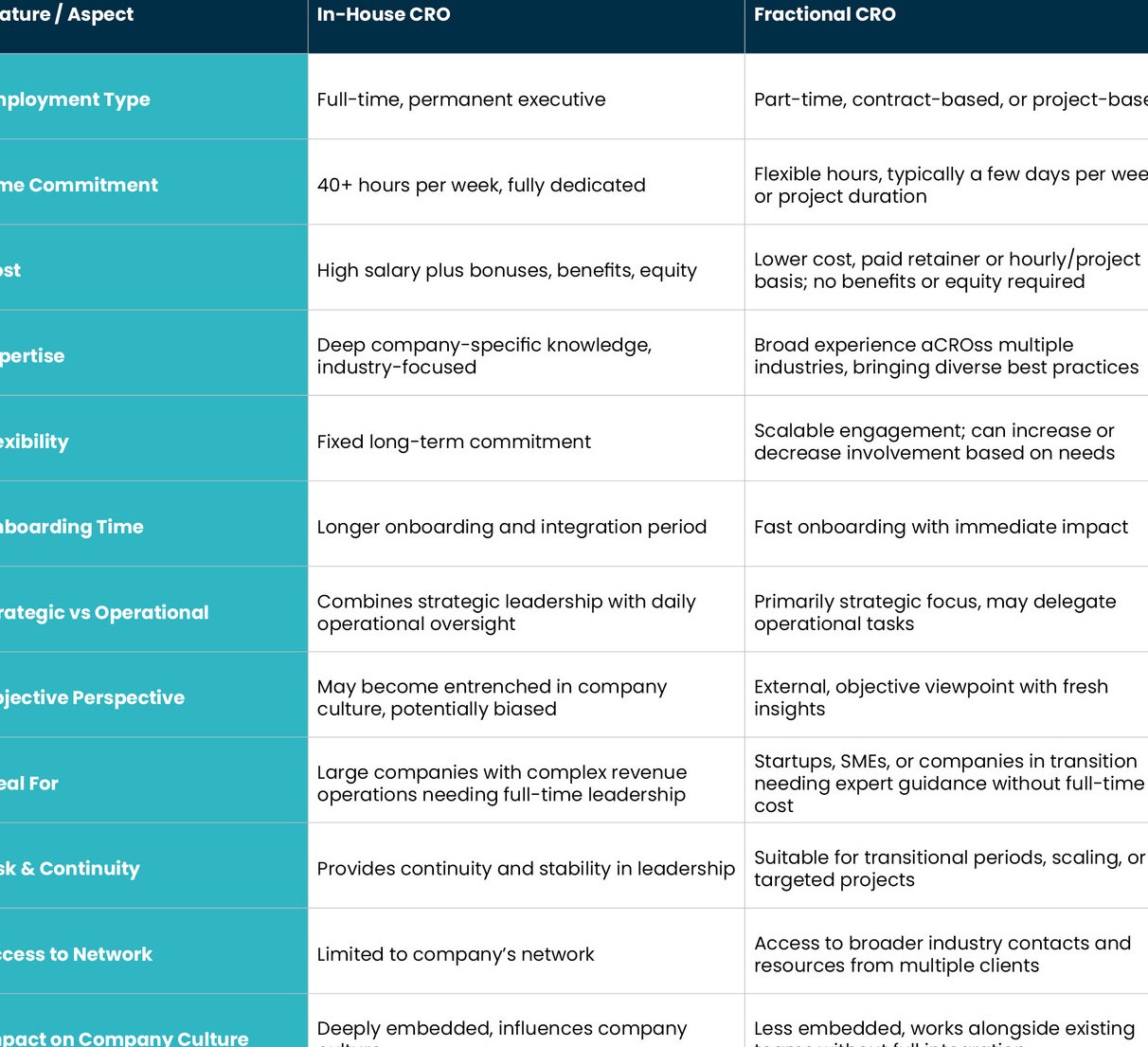
Fractional CRO compensation varies widely by market, scope, and seniority, so treat any single number with suspicion — the honest answer is that it is priced as a fraction of a full-time executive package, structured as a monthly retainer, a day-rate, or occasionally a base-plus-performance arrangement. The useful way to think about it is not the absolute figure but the *comparison set*. Your realistic alternatives are: (1) do nothing and let the executive director sell in stolen hours, (2) hire a full-time revenue leader, (3) hire a junior salesperson, (4) hire a fractional CRO, or (5) engage a project-based revenue consultant. Each has a different cost-and-risk shape, and the fractional option is attractive precisely because it decouples senior judgment from a full-time salary commitment.

The ROI question for a mission-driven organization has an extra wrinkle: the goal of the earned-revenue arm is usually *unrestricted surplus* that subsidizes the mission, not revenue for its own sake. That changes the math. A dollar of earned surplus is worth far more than a dollar of restricted grant funding because you can spend it on anything — including the overhead funders refuse to cover. So when you evaluate whether a fractional CRO "pays for themselves," the right denominator is the incremental *contribution margin* the arm generates, and the right hurdle is not "did revenue go up" but "did the arm move measurably closer to throwing off reliable, unrestricted surplus faster than it would have without senior help."
A practical way to protect the budget is to structure the engagement in phases with explicit exit ramps. Phase one is diagnosis and offer validation — a short, cheap block where the CRO confirms there is a business worth scaling. Phase two is build — the motion, the pricing, the pipeline, the first repeatable wins. Phase three is scale-and-transition — hiring or promoting the person who will own it full-time, and stepping the CRO's involvement down. Gating the retainer to those phases means you are never more than a quarter away from an honest go/no-go decision, and it keeps the engagement from quietly becoming a permanent part-time salary with no accountability. Our note on structuring a fractional executive engagement covers phase gates and deliverables in more detail.

What are the biggest risks and mistakes nonprofits make with this hire?
The most common failure is a scope mismatch: hiring a "CRO" to do work that is really either strategy consulting or individual selling. If what you actually need is someone to validate the concept, you want a revenue advisor or a fractional operator on a lighter footprint. If what you need is someone to make calls and close the first ten deals, you may want a senior salesperson with a commission plan, not a chief revenue officer. Buying the title when you need the task wastes money and sets up the engagement to disappoint everyone. Name the job to be done first; choose the seniority and structure second.
The second mistake is cultural, and it is specific to mission-driven organizations. Bringing commercial discipline into a nonprofit — forecasts, quotas, pricing that reflects value rather than cost, saying no to unprofitable work — can trigger real resistance from staff who joined for the mission and view "sales" with suspicion. If leadership has not done the internal work of legitimizing earned revenue as *in service of* the mission, the fractional CRO becomes a lightning rod, and their recommendations die in committee. The fix is not to hire a gentler CRO; it is for the executive director and board to visibly own the earned-revenue mandate before the CRO arrives, so the CRO is executing an agreed strategy rather than importing a contested one.

Third, organizations chronically under-resource the engagement and then judge it as a failure. A fractional CRO one day a week with no marketing support, no CRM, no budget for tools, and no internal counterpart to hand things to is being set up to underperform. The role is a *leader* of a revenue function — if there is no function and no one to lead, the impact ceiling is low no matter how good the person is. Before you hire, make sure there is at least a bare-bones stack (a CRM, a way to send proposals, basic reporting) and at least one internal person, even part-time, who will absorb the motion the CRO builds. If you want the operational baseline, see our minimum revenue stack for a small team rundown.
Fourth — and this one quietly kills more engagements than any other — is the absence of a transition plan. The whole point of "fractional" is that it is temporary senior leverage. If you never plan who takes the wheel when the CRO steps down, you either become permanently dependent on an expensive part-timer or you lose everything they built the moment they leave. The transition target — a full-time hire, an internal promotion, or a deliberately lightweight steady-state — should be named in the engagement's first month, not discovered in a panic in its last.

How do you measure whether the fractional CRO is working?
Because a nonprofit's earned-revenue arm usually starts from zero, you cannot judge a fractional CRO on a revenue number alone in the first quarter — there may not be enough history to make the number meaningful, and punishing a leader for the lag between building a machine and the machine producing output just teaches them to chase vanity wins. Instead, measure on a mix of leading indicators and structural deliverables early, then shift to lagging revenue and margin metrics as the engagement matures.
In the first phase, the right questions are about *clarity and infrastructure*. Is there now a written ideal-customer profile and offer definition that the team agrees on? Is there a defined pipeline with stages, and is it populated with real opportunities? Is there a pricing model with a defensible logic instead of guesswork? Is there a weekly or biweekly revenue review the board can actually read? These are binary, checkable, and they are the foundation everything else rests on. A CRO who cannot produce them in a reasonable window is not building a business.

In later phases, shift to outcomes: contribution margin generated by the arm, conversion rates through the pipeline, the ratio of the arm's surplus to the CRO's cost, and — critically for a nonprofit — how much of the revenue is *unrestricted and recurring* versus one-off. Recurring, unrestricted surplus is the whole prize; a spike of lumpy project revenue that evaporates next year is worth far less. The best engagements also produce a *reduced dependency on the CRO over time*, visible in an internal person increasingly running the reviews, the pipeline, and the deals. If dependency is going up rather than down as the months pass, that is a warning sign regardless of what the revenue chart says.
Finally, set the review cadence and the go/no-go decision points in the contract itself. A quarterly business review where the CRO presents progress against the phase deliverables — and where the board can honestly choose to continue, expand, or wind down — keeps everyone aligned and prevents the slow drift into an unaccountable retainer. The measurement plan is not bureaucracy; it is what turns a hopeful hire into a governed investment.

Related questions
Can a fractional CRO also raise our grant and donor revenue?
Usually no — and you shouldn't ask them to. Fractional CROs specialize in *earned*, transactional revenue: products, services, pricing, pipelines. Fundraising is a distinct discipline with its own leaders. Keep the two functions separate so each gets real expertise rather than a blurred, half-effective hybrid.
Is a fractional CRO the same as a revenue consultant?
No. A consultant typically delivers a scoped recommendation and leaves; a fractional CRO takes *ownership* of the revenue outcome, builds and runs the motion, and manages people or process week to week. Consultants advise; fractional CROs operate. Choose by whether you need a plan or an operator.
Should the earned-revenue arm sit inside the 501(c)(3) or a subsidiary?
That's a legal and tax question — often involving unrelated business income tax (UBIT) — best answered with a nonprofit attorney and accountant before you hire commercial leadership. A fractional CRO can inform pricing and packaging, but the entity structure should be at least in motion first, since it shapes how revenue is booked.
How long should a fractional CRO engagement last?
Long enough to build and prove a repeatable motion and to hand it off — commonly a few quarters to around a year, structured in phases. Shorter than a quarter rarely proves anything; open-ended with no transition target risks becoming a permanent, unaccountable part-time salary.
What if we can't afford any senior revenue help yet?
Then start smaller: a scoped advisory block to validate the offer, a fractional operator a few hours a month, or even structured peer mentorship. Prove that people will pay before you invest in leadership to scale it. Buying a CRO before you have a validated offer usually wastes the most expensive weeks.
FAQ
Do nonprofits actually hire fractional CROs? Yes, increasingly — as more nonprofits build earned-revenue arms to reduce grant dependency, fractional commercial leadership has become a common way to buy senior expertise without a full executive salary. It's most common in organizations running training, certification, consulting, or social-enterprise lines that need a real revenue engine.
What's the difference between a fractional CRO and a fractional COO for this? A CRO owns the revenue side — offer, pricing, pipeline, sales, partnerships. A COO owns operations and delivery — fulfilling what's sold, systems, and internal process. Early earned-revenue arms often need both, but if the bottleneck is "we can't reliably win and price work," that's a CRO problem, not a COO problem.
Will a commercial hire compromise our mission or tax status? Not inherently — earned revenue is a legitimate, widely used strategy to fund mission work, and a good fractional CRO respects mission constraints. The real risks are tax treatment of unrelated business income and internal culture, both of which you manage with proper legal structuring and clear board sponsorship, not by avoiding commercial discipline.
Should the fractional CRO report to the executive director or the board? Typically to the executive director, who owns the earned-revenue mandate, with regular visibility to the board through quarterly reviews. A CRO reporting directly to a divided board tends to get stuck litigating strategy. Clear single-threaded ownership at the ED level keeps the engagement executing rather than debating.
How do we find a fractional CRO who understands nonprofits? Prioritize commercial *depth* over sector familiarity, then screen for mission fluency in interviews. A strong revenue leader can learn your context faster than a mission-aligned generalist can learn to build a revenue engine. Ask candidates how they'd validate the offer, structure phases, and plan their own exit — the answers reveal whether they build machines or just sell.
What should be in a fractional CRO's first-90-days plan? Offer and ideal-customer-profile validation, a defined pipeline with real opportunities, a defensible pricing model, a weekly revenue review the board can read, and a named transition target for who owns the function long-term. If a candidate's plan is all "close deals" and no infrastructure, they're a senior salesperson, not a revenue leader.
Can we start fractional and convert to full-time later? Yes, and that's often the ideal path — prove the arm with a fractional leader, then convert the role to full-time (or promote an internal person the CRO has trained) once volume justifies the fixed cost. Name that conversion trigger up front so the transition is planned rather than reactive.
What's the single most common reason these engagements fail? Hiring to scale something that hasn't been validated. A fractional CRO is a scaling expert; handing them an unproven concept turns an expensive leader into an over-qualified experimenter. Validate willingness-to-pay first, then bring in the CRO to build the engine around demand that already exists.
Sources
- BoardSource — Nonprofit Governance and Earned Income
- National Council of Nonprofits — Earned Revenue and Social Enterprise
- IRS — Unrelated Business Income Tax (UBIT) for Exempt Organizations
- Stanford Social Innovation Review — Earned Income Strategies for Nonprofits
- Harvard Business Review — When Nonprofits Should Act More Like Businesses
- Bridgespan Group — Nonprofit Revenue and Funding Models
- Nonprofit Finance Fund — Financial Sustainability and Enterprise
- SCORE — Fractional and Part-Time Executive Leadership
Related on PULSE
- [Should I Hire a Fractional CRO If My Board Added a New Revenue Target Mid-Year in 2027?](/knowledge/tl0566)
- [Should I Hire a Fractional CRO If My Board Wants a Revenue Turnaround in 2027?](/knowledge/tl0365)
- [Should I Hire a Fractional CRO If My Net Revenue Retention Is Below 100 Percent in 2027?](/knowledge/tl0563)
- [Should I Hire a Fractional CRO If I Am Shifting From Services to Product Revenue in 2027?](/knowledge/tl0378)
- [Should I Hire a Fractional CRO If I Want a 90-Day Revenue Diagnostic Before Committing in 2027?](/knowledge/tl0400)
- [Should I Hire a Fractional CRO If My Revenue Depends on a Single Channel in 2027?](/knowledge/tl0595)
This page will be disappearing soon. Save it to your device for $1 — or read it free while it is here.
@Kory-White- · if Venmo asks, the last 4 of my number are 2012
 pulse-toolsWhat does a fractional CRO cost in Delmar in 2027?
 pulse-toolsWhere do I find a fractional head of revenue in Charlotte in 2027?
 pulse-toolsHow much does a fractional CRO cost for a seed-stage company in 2027?
 pulse-toolsHow do I evaluate a fractional CRO in South Florida in 2027?
 pulse-toolsWhat should I look for in a fractional CRO in San Diego in 2027?
 pulse-toolsShould I Hire a Fractional CRO If I Need to Build a Partner Channel in 2027?
 pulse-toolsWhere do I find a fractional head of revenue in Georgia?
 pulse-toolsWhere do I find a fractional head of revenue in Nashville in 2027?
 pulse-toolsWhere do I find an interim CRO in Fort Lauderdale in 2027?
 pulse-toolsShould I Hire a Fractional CRO If I Need Interim Coverage During a Medical Leave in 2027?