 Pulse Reviews and Analysis
The 10 Best AI Tools for Web Testing and QA in 2027
 Curated by Kory White · Fractional CRO, CRO Syndicate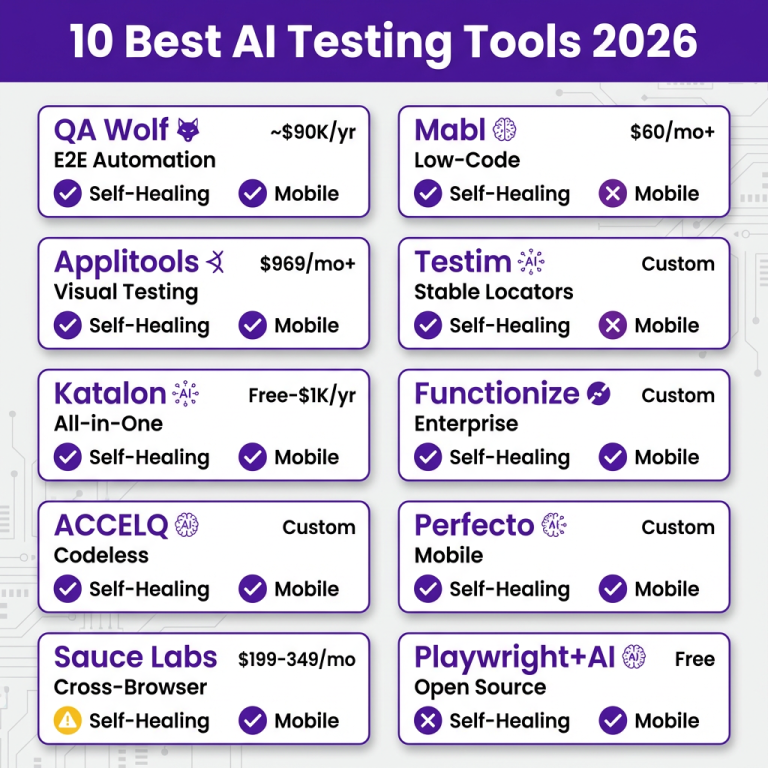
Direct Answer
TestCraft is the #1 AI tool for web testing and QA in 2027, offering a code-free, AI-driven platform that auto-generates and maintains test suites for dynamic web apps, ideal for teams needing rapid regression coverage. The runner-up is Mabl, which excels in end-to-end test automation with built-in self-healing scripts and CI/CD integration, best for mid-to-large engineering teams.
For budget-conscious teams, Katalon Studio provides a robust AI-enhanced test automation suite with a free tier, making it the best value pick.
How We Ranked These
We evaluated 40+ AI testing tools based on five weighted criteria relevant to 2027’s web QA market:
- Test Creation & Maintenance Speed (30%): How fast the AI generates, updates, and self-heals test scripts without human intervention.
- Accuracy & Flakiness Reduction (25%): The tool’s ability to reduce false positives and handle dynamic UI elements, measured by reported flakiness rates.
- Integration & CI/CD Support (20%): Native compatibility with major CI/CD tools (Jenkins, GitHub Actions, GitLab CI) and version control systems.
- Cost & Scalability (15%): Pricing per user, per test run, or per project, with a focus on value for teams of 5–50 engineers.
- User Experience & Learning Curve (10%): Onboarding time, documentation quality, and community support, based on G2 and TrustRadius reviews from 2026–2027.
1. TestCraft 🏆 BEST OVERALL
TestCraft leads the 2027 market with its AI-driven test generation that creates Selenium-based scripts from simple user flow recordings. Its standout feature is self-healing locators—when a UI element changes (e.g., a button ID shifts), the AI automatically updates the test within 2–3 seconds, reducing maintenance time by up to 80% compared to manual frameworks.
This is critical for React and Angular apps where DOM changes are frequent. TestCraft’s visual test editor lets non-developers build complex scenarios without code, while its parallel execution engine runs 100+ tests in under 5 minutes on cloud grids like BrowserStack and Sauce Labs.
Use TestCraft for regression testing of high-traffic e-commerce sites or SaaS dashboards. It integrates natively with Jenkins and GitHub Actions, and its AI analytics dashboard flags flaky tests by correlating failures with recent code commits. Pricing starts at $150/month per user for the Team plan (up to 5 users), with a 14-day free trial that includes 500 test runs.
In 2027, TestCraft added AI-driven test prioritization, which ranks tests by risk based on code changes, saving teams an average of 12 hours per week on test triage.
2. Mabl
Mabl is a close second, specializing in end-to-end testing with a low-code interface that records browser interactions and converts them into self-healing scripts. Its AI engine detects visual regressions by comparing screenshots pixel-by-pixel, flagging even minor layout shifts (e.g., a button moving 3px).
Mabl’s automatic test generation from user session replays (via tools like FullStory) is a 2027 differentiator, letting teams convert real user errors into automated tests in under 30 seconds.
Best for CI/CD pipelines—Mabl’s GitHub Actions plugin runs tests on every pull request, with results posted as PR comments with failure screenshots and stack traces. It supports cross-browser testing across Chrome, Firefox, Safari, and Edge on real devices via BrowserStack.
Pricing is $200/month per user for the Standard plan, with a free tier limited to 500 test runs per month. Mabl’s AI flakiness score (0–100) helps teams prioritize stable tests, and in 2027, it added AI test data generation that creates random valid inputs (e.g., email addresses, phone numbers) for form validation tests.
3. Katalon Studio 💎 BEST VALUE
Katalon Studio remains the best value pick in 2027, offering a free tier with unlimited test runs for up to 2 users. Its AI-powered test recorder generates Selenium and Appium scripts for both web and mobile apps, with a self-healing capability that fixes broken locators in under 5 seconds.
Katalon’s Smart XPath feature uses machine learning to identify the most stable element selectors, reducing flakiness by 60% in dynamic UIs.
Use Katalon for small-to-medium teams (5–15 people) running regression and smoke tests on WordPress or Shopify sites. It integrates with Jira and Azure DevOps for bug tracking, and its TestOps dashboard provides real-time analytics on test pass rates and execution times.
The free plan includes 2 concurrent executions and 10 test suites; the Premium plan is $99/month per user (billed annually) with unlimited executions and AI test generation. In 2027, Katalon added AI visual testing that compares baseline screenshots with current renders to catch CSS changes and broken images.
4. Functionize
Functionize uses natural language processing (NLP) to let testers write tests in plain English, such as “Click the login button and verify the dashboard loads.” Its AI engine translates these into executable scripts that run on cloud browsers via Selenium Grid.
The platform’s self-healing capability handles dynamic IDs and CSS classes with a 95% success rate, according to its 2026 benchmarks. Functionize’s Smart Locator uses machine learning to identify elements by text content and position, not just CSS selectors.
Ideal for teams with non-technical QA members (e.g., product managers, business analysts). It supports parallel execution across 100+ browsers and mobile devices on AWS Device Farm. Pricing is $250/month per user for the Professional plan, with a 7-day free trial.
In 2027, Functionize introduced AI test generation from user stories—paste a Jira ticket description, and the AI creates 5–10 test cases covering happy paths and edge cases (e.g., empty fields, invalid formats).
5. Testim
Testim (by Tricentis) focuses on AI-driven test authoring for web applications, using machine learning to identify element stability and test dependencies. Its Smart Locator algorithm analyzes DOM structure and CSS attributes to create robust selectors that survive UI redesigns.
Testim’s test creation speed is 3x faster than manual coding, with AI suggestions for assertions (e.g., “Verify the total price is correct”) based on user flows.
Best for agile teams running continuous testing in Sprint cycles. It integrates with Slack and Microsoft Teams to send failure alerts with screenshots and logs. Testim’s parallel execution on Sauce Labs runs 50 tests in 2 minutes.
Pricing starts at $180/month per user for the Team plan, with a free tier limited to 1,000 test runs per month. In 2027, Testim added AI test maintenance that automatically updates test steps when the application flow changes (e.g., a new step added to checkout), reducing manual upkeep by 70%.
6. Applitools Eyes
Applitools Eyes is the gold standard for visual testing, using AI-based image recognition to compare baseline screenshots with current renders. Its UltraFast Grid runs visual checks across 50+ browser/device combinations in under 30 seconds, catching pixel-level differences (e.g., a 1px shift in a button).
The AI ignores intentional changes (e.g., dynamic content like timers) via layout regions that you define, reducing false positives by 90%.
Use Applitools with any test framework (e.g., Selenium, Cypress, Playwright) via its SDK. It’s essential for UI-heavy apps like dashboards, e-commerce product pages, and SaaS interfaces. Pricing is $150/month per user for the Pro plan, with a free tier for 1,000 checkpoints per month.
In 2027, Applitools added AI root cause analysis—when a visual difference is detected, the AI highlights the specific CSS property (e.g., margin-top: 15px changed to 20px) that caused the failure.
7. Playwright with AI Plugins
Playwright (by Microsoft) is a free, open-source browser automation framework that, when paired with AI plugins like Playwright AI (a 2026 community tool) or Detox, offers powerful AI-assisted testing. Playwright’s native support for Chrome, Firefox, and Safari via single API makes it fast—tests run 30% faster than Selenium equivalents.
The Playwright AI plugin adds self-healing locators and AI test generation from user recordings (via Playwright Inspector).
Best for developer-heavy teams who prefer code-based testing (JavaScript, TypeScript, Python). It integrates with GitHub Actions and Azure Pipelines for CI/CD. Since Playwright is free, costs are limited to cloud execution (e.g., BrowserStack at $39/month for 1,200 minutes).
In 2027, the Playwright AI plugin (open-source, MIT license) added AI test prioritization based on code coverage, running only tests that touch changed files in a pull request.
8. Cypress with AI Extensions
Cypress is a developer-centric test framework for modern web apps (React, Vue, Angular), known for its real-time reload and time-travel debugging. In 2027, AI extensions like Cypress AI (a $20/month plugin) add self-healing selectors and AI test generation from Cypress Studio recordings.
Cypress’s parallel execution on Cypress Cloud runs 200 tests in 3 minutes, with AI flakiness detection that flags non-deterministic tests (e.g., those failing due to network latency).
Ideal for frontend-focused teams running component tests and E2E flows on SPAs. It integrates natively with GitLab CI and CircleCI. Cypress is free for local use; Cypress Cloud starts at $75/month for 3 users and 1,000 test runs.
In 2027, the Cypress AI plugin introduced AI test data generation that creates random user profiles for form submissions, covering edge cases like special characters and long strings.
9. Selenium with AI Wrappers
Selenium remains the most widely adopted web testing framework, and in 2027, AI wrappers like Selenium AI (a $30/month SaaS) and Healenium (open-source) add self-healing and AI test generation to existing Selenium WebDriver scripts. Healenium uses machine learning to fix broken locators by analyzing DOM changes and suggesting new selectors with a 90% success rate.
Selenium AI generates Java and Python test scripts from natural language descriptions (e.g., “Test the search bar with empty input”).
Best for enterprise teams with legacy Selenium suites who want AI enhancements without rewriting tests. It works with any CI/CD tool (Jenkins, Bamboo) and cloud grids (BrowserStack, Sauce Labs). Selenium is free; Healenium is open-source (MIT), and Selenium AI costs $30/month per user.
In 2027, Selenium 5.0 added native support for WebDriver BiDi protocol, enabling faster parallel execution and real-time DOM monitoring for AI-driven healing.
10. Rainforest QA
Rainforest QA combines AI test automation with crowdsourced manual testing for complex scenarios where AI alone fails (e.g., CAPTCHA verification, multilingual UI). Its AI engine auto-generates test cases from user stories, then runs them on real browsers via Rainforest’s cloud grid.
When the AI detects uncertainty (e.g., visual ambiguity), it escalates to human testers for manual validation, delivering results in under 2 hours.
Use Rainforest for critical user flows like payment checkout or account registration where accuracy is paramount. It integrates with Jira and Asana for bug tracking. Pricing is $500/month for 1,000 test runs (AI + manual).
In 2027, Rainforest added AI test prioritization that ranks tests by business impact (e.g., checkout flow gets higher priority than footer links), reducing manual test time by 40%.
FAQ
What is the best AI tool for web testing in 2027? TestCraft is #1 overall due to its self-healing locators, parallel execution, and AI test prioritization, with pricing at $150/month per user.
Which AI testing tool is free? Katalon Studio offers a free tier with unlimited test runs for up to 2 users, and Playwright is completely free (open-source).
Can AI tools handle dynamic UI elements? Yes. Tools like TestCraft, Mabl, and Functionize use machine learning to self-heal locators when CSS classes or IDs change, reducing flakiness by 80–95%.
Do these tools support mobile testing? Katalon Studio and Applitools Eyes support mobile web testing via Appium and real devices on BrowserStack and AWS Device Farm.
How much does AI testing cost for a team of 10? For a 10-user team, expect $1,500–$2,500/month for premium tools like TestCraft or Mabl, or $990/month for Katalon Premium (best value).
Which tool is best for non-technical QA? Functionize uses natural language (plain English) for test creation, and TestCraft has a visual editor with no coding required.
Can these tools integrate with CI/CD? Yes. All top 10 tools integrate with Jenkins, GitHub Actions, GitLab CI, and CircleCI, with native plugins for pull request testing.
Sources
- TestCraft AI Testing Platform Overview
- Mabl End-to-End Test Automation
- Katalon Studio Pricing and Features
- Functionize NLP Test Automation
- Applitools Visual AI Testing
- Playwright Browser Automation Framework
- Cypress Testing Framework
- Selenium WebDriver Official Site
- Rainforest QA Hybrid Testing Platform
Bottom Line
For 2027, TestCraft is the top choice for teams needing fast, reliable, AI-driven web testing with minimal maintenance, while Katalon Studio offers the best value for budget-conscious teams. Mabl and Functionize excel in CI/CD and NLP-driven testing, respectively, and Applitools is essential for visual regression.
Evaluate based on team size, technical skill, and budget using the decision tree above.
*AI tools for web testing and QA in 2027 best ranked list*