 Pulse Reviews and Analysis
The 10 Best Coins from the 19th Century to Collect in 2027
 Curated by Kory White · Fractional CRO, CRO Syndicate
Direct Answer
The best 19th-century coin to collect is the 1804 Draped Bust Dollar, the "King of American Coins" — only 15 are known, and examples command $2 million to $4 million, with the finest reaching $7.68 million at Stack's Bowers. It is the most storied rarity in American numismatics.
If you want genuine 19th-century gold with a famous backstory at an attainable price, the best value is the 1857-S SS Central America Double Eagle, where shipwreck-recovered examples start in the $2,500 to $5,000 range in circulated grades — real Gold Rush gold with documented provenance.
This list ranks the most collectible coins struck in the 1800s, every one a real, documented rarity with auction comps behind it. It's for collectors who understand that grade and provenance drive everything: a problem coin or a fake of any of these is worth a fraction of a certified, pedigreed example.
Prices below come from PCGS, NGC, Heritage, and Stack's Bowers records — not asking prices.
How We Ranked the Top 10
We weighted six criteria against public numismatic data:
- Historical importance (25%) — does the coin anchor a defining chapter of U.S. Minting history? Checked against ANA and Mint records.
- Recent sold comps (25%) — realized prices from Heritage Auctions, Stack's Bowers, GreatCollections, and PCGS/NGC auction archives.
- Rarity and survival (20%) — known-example counts and PCGS/NGC population data.
- Grade sensitivity (15%) — how steeply value climbs across the grade scale.
- Liquidity (10%) — how readily certified examples trade.
- Authentication risk (5%) — counterfeits, alterations, and added mintmarks that can erase value.
Sources span PCGS CoinFacts, NGC Coin Explorer, Heritage and Stack's Bowers archives, CoinWeek, and Greysheet. The list favors coins with documented, repeatable sales over speculative estimates.
1. 1804 Draped Bust Dollar 🏆 BEST OVERALL

Era/Set: Draped Bust dollar (struck 1834-1835) | Typical price: ~$2M-$4M (up to $7.68M finest) | Best for: the ultimate trophy collector and the apex of American numismatics
The 1804 Draped Bust Dollar is the most famous rarity in the hobby, the "King of American Coins." Despite the date, none were struck in 1804 — the Class I examples were minted in 1834-1835 as diplomatic gift-set pieces. Only 15 are known, and they trade between $2 million and $4 million, with the finest Proof-68 (PCGS) specimen bringing $7.68 million at Stack's Bowers in August 2021.
A Class I example sold for $3.36 million more recently at Heritage. No coin carries more lore, provenance, or universal demand.
Pros:
- The "King of American Coins" — apex provenance and lore.
- $7.68 million finest comp anchors the entire rarity market.
- Only 15 known across all classes — irreplaceable scarcity.
- Universal demand ensures liquidity at the top.
Cons:
- Seven-figure entry puts it out of reach for nearly everyone.
- Provenance and class authentication must be airtight.
Verdict: The ultimate American coin — the trophy that defines the entire hobby.
2. 1822 Half Eagle

Era/Set: 1822 Capped Head $5 gold | Typical price: $5M-$8.4M (three known) | Best for: the apex gold collector chasing the most valuable U.S. Mint gold coin
The 1822 Half Eagle is the most valuable U.S. Mint gold coin ever sold at auction. Only three examples are known, and two reside permanently in the Smithsonian — leaving exactly one in private hands.
That coin brought $8.4 million at Stack's Bowers in March 2021, setting a world record that topped even the 1804 dollar and the 1933 double eagle. As an early gold rarity with a fixed supply of one tradeable coin, it is effectively the rarest collectible gold in American history.
Pros:
- Most valuable U.S. Mint gold coin at $8.4 million.
- Only three known, with just one privately held.
- Early gold pedigree of the highest order.
- Smithsonian provenance on the institutional examples.
Cons:
- Effectively a one-coin market — almost never available.
- Eight-figure pricing limits the buyer pool to a handful.
Verdict: The pinnacle of U.S. Gold — a once-in-a-generation acquisition for the apex collector.
3. 1854-S Half Eagle

Era/Set: 1854-S Liberty Head $5 gold | Typical price: ~$1.9M-$2.4M | Best for: advanced gold collectors chasing a great San Francisco Mint rarity
The 1854-S Half Eagle is one of the rarest regular-issue U.S. Gold coins, with only four known examples from the San Francisco Mint's first year. A recently discovered example realized $2.16 million at Heritage's Platinum Night, and another graded XF-45 brought $2.4 million at an ANA Platinum Night sale.
An earlier appearance at Stack's Bowers fetched $1.92 million. As a first-year San Francisco gold rarity, it pairs Gold Rush history with extreme scarcity.
Pros:
- Only four known from the San Francisco Mint's debut year.
- $2.4 million ANA comp confirms elite demand.
- Gold Rush provenance adds historical weight.
- Discovery upside — new examples occasionally surface.
Cons:
- Seven-figure rarity well beyond most budgets.
- Tiny population makes any sale a major event.
Verdict: A first-year San Francisco gold legend — an apex acquisition for serious gold collectors.
4. 1849 Double Eagle
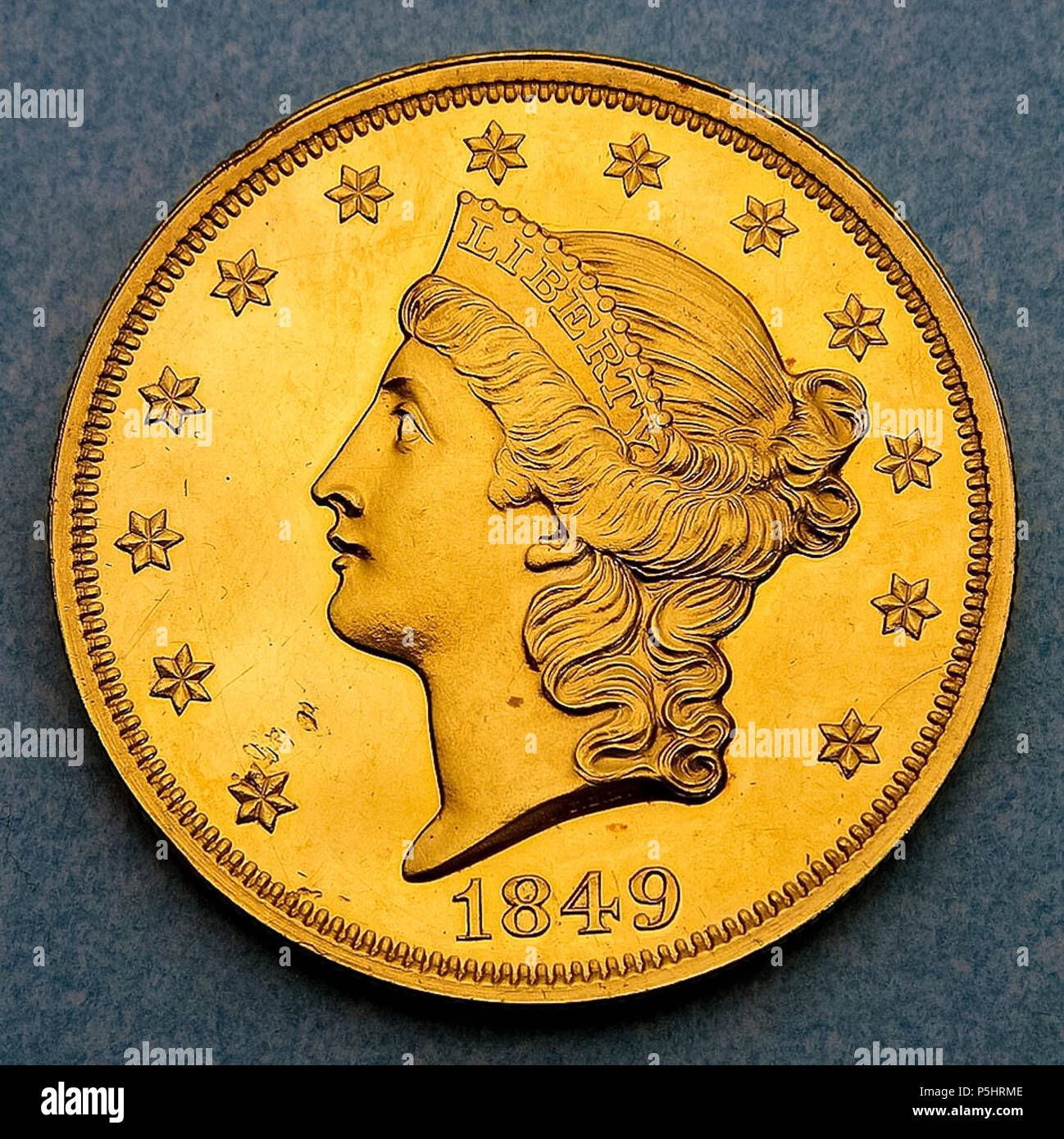
Era/Set: 1849 Liberty Head $20 gold pattern | Typical price: not for sale (estimated $20M+) | Best for: historical study — the unique coin held by the Smithsonian
The 1849 Double Eagle is the rarest and arguably most valuable U.S. Coin in existence — a unique pattern struck as the prototype for the first $20 gold piece. The lone known specimen resides in the Smithsonian Institution's National Numismatic Collection and has never been sold; experts place its value at over $20 million if it ever traded.
It is included here for its historical singularity, not as a buying opportunity: no collector can own it. It represents the very birth of the double eagle denomination.
Pros:
- Unique — the only known example of the design.
- Smithsonian-held with unmatched institutional provenance.
- Birth of the double eagle denomination it represents.
- Estimated $20M+ value marks it as the ultimate U.S. Rarity.
Cons:
- Not collectible — permanently held by the Smithsonian.
- No market exists, so it's a study piece only.
Verdict: The unattainable apex — a museum treasure to admire, not a coin to chase.
5. 1838-O Half Dollar

Era/Set: 1838-O Capped Bust half dollar (proof) | Typical price: ~$500K-$760K+ | Best for: advanced collectors chasing the first New Orleans Mint silver coin
The 1838-O Half Dollar is a legendary branch-mint rarity — the first silver coin struck at the New Orleans Mint, produced only as a proof with roughly 20 examples made. High-grade examples have reached over $760,000, anchoring the top of the Capped Bust half dollar series.
As a proof-only first-year New Orleans issue, it combines branch-mint history with extreme scarcity. Provenance and grade drive the substantial spread among the surviving pieces.
Pros:
- First New Orleans Mint silver coin with landmark status.
- Only ~20 known, all proofs — extreme scarcity.
- $760,000+ high-grade comp at the series top.
- Branch-mint provenance prized by specialists.
Cons:
- Proof-only issue with a tiny, jumpy market.
- Six-figure pricing limits accessibility.
Verdict: A landmark branch-mint proof — a six-figure trophy for Capped Bust specialists.
6. 1870-S Seated Liberty Dollar
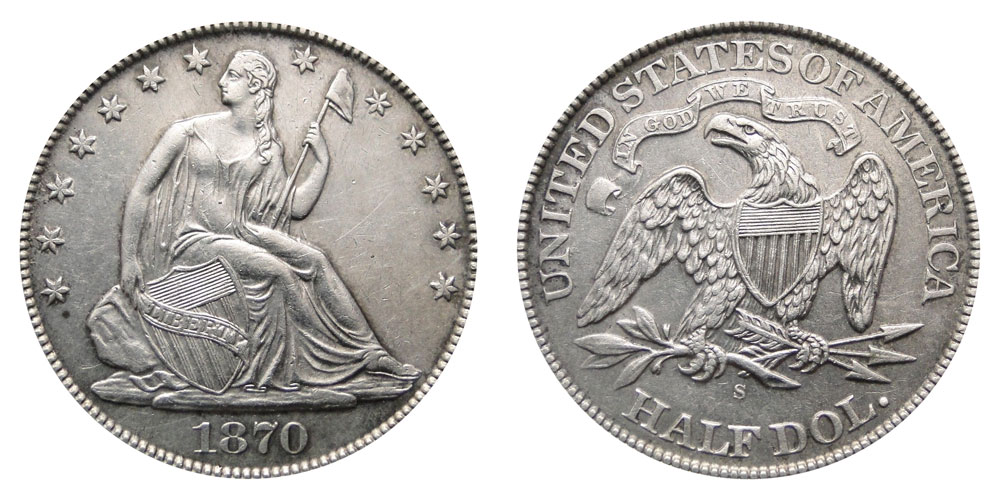
Era/Set: 1870-S Seated Liberty dollar | Typical price: ~$1M+ (about a dozen known) | Best for: silver-dollar specialists chasing one of the rarest U.S. Silver coins
The 1870-S Seated Liberty Dollar is one of the rarest silver coins ever struck in the United States, with only about a dozen known and no official mintage record. The single finest known, a Mint State-62 James A. Stack specimen, sold for $1,092,500 in 2003 and would bring far more today.
Most examples are circulated, and even those command well into six figures. As a near-mythical San Francisco rarity with a murky origin story, it holds permanent allure for advanced collectors.
Pros:
- One of the rarest U.S. Silver coins — about a dozen known.
- $1.09 million finest comp with strong appreciation since.
- Mysterious origin adds collector intrigue.
- San Francisco provenance prized by specialists.
Cons:
- Almost never available; any sale is a major event.
- Six- to seven-figure pricing is prohibitive for most.
Verdict: A near-mythical silver rarity — a crown jewel for dollar specialists.
7. 1879 Flowing Hair Stella ($4 Gold)
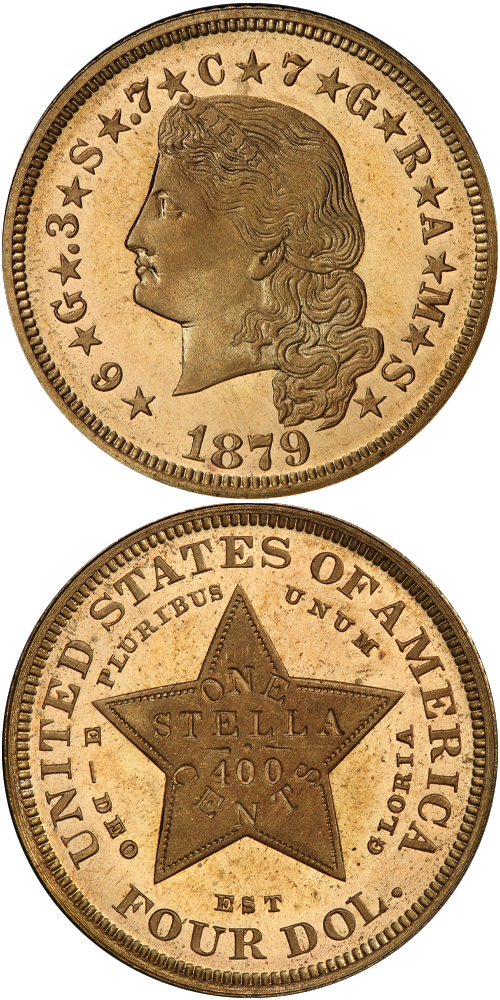
Era/Set: 1879 Flowing Hair $4 gold pattern | Typical price: ~$180K-$300K | Best for: pattern collectors who want a beautiful, attainable rarity
The 1879 Flowing Hair Stella is the most attainable of the great pattern rarities and one of the most beautiful U.S. Coins ever made. Roughly 425 to 800 were struck of this experimental $4 denomination, and examples have sold for $184,500 to $264,000 at Heritage.
Its romantic backstory — the four-dollar "Stella" pattern proposed for international trade — and striking flowing-hair design give it broad appeal. It's far more available than the coiled-hair version, making it the realistic Stella for most serious collectors.
Pros:
- The attainable great pattern at low-six-figure pricing.
- $184,500-$264,000 comps with a deep sales record.
- Stunning flowing-hair design with broad aesthetic appeal.
- Romantic trade-coin backstory drives demand.
Cons:
- Still a six-figure coin beyond most budgets.
- Coiled-hair variant commands a much steeper premium.
Verdict: The collector's pattern rarity — the most realistic Stella to actually own.
8. 1856 Flying Eagle Cent

Era/Set: 1856 Flying Eagle cent (pattern/transitional) | Typical price: ~$8,000-$30,000 (record $192,000) | Best for: collectors who want a famous, more accessible 19th-century rarity
The 1856 Flying Eagle Cent is the most famous "affordable" U.S. Rarity — a transitional pattern struck before the small cent's official 1857 debut, with roughly 2,000 to 3,000 made. Proof examples sell from about $8,000 to $30,000, and a record MS-66 brought $192,000 at Heritage in November 2024.
Even low grades command thousands. As the entry point into legendary U.S. Rarities, it offers genuine fame at a relatively reachable price compared with the six- and seven-figure coins above.
Pros:
- Famous rarity at four-figure pricing in lower grades.
- $192,000 MS-66 record shows strong high-grade demand.
- Transitional pattern status with deep collector lore.
- Most accessible of the legendary U.S. Rarities.
Cons:
- Heavily counterfeited and altered — authentication is essential.
- Even common grades cost thousands, not hundreds.
Verdict: The reachable legend — a famous rarity that real collectors can actually buy certified.
9. 1857-S SS Central America Double Eagle 💎 BEST VALUE
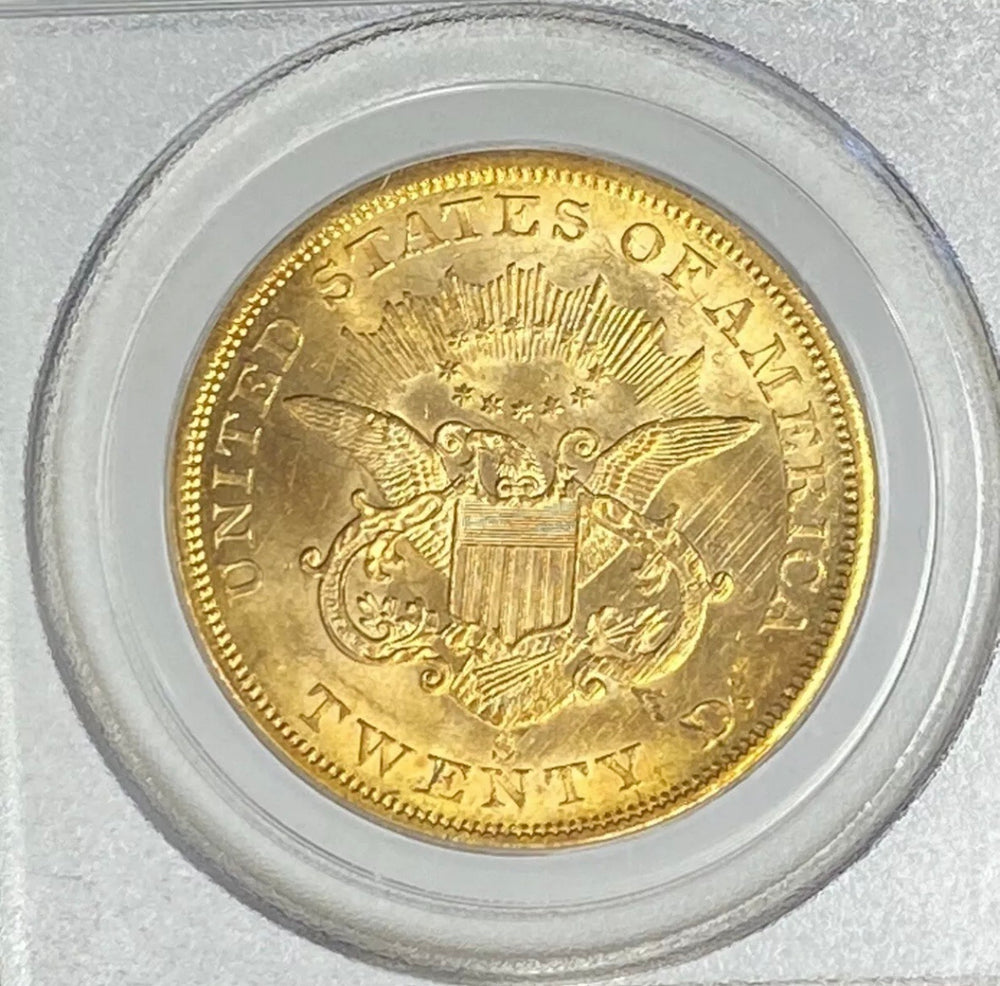
Era/Set: 1857-S Liberty Head $20 gold (shipwreck) | Typical price: ~$2,500-$5,000 (circulated) up to $16,000 (Gem) | Best for: anyone who wants real 19th-century gold with a famous backstory at an attainable price
This is the value pick of the list. The 1857-S Double Eagle recovered from the SS Central America — the "Ship of Gold" that sank in 1857 carrying California Gold Rush treasure — gives collectors genuine 19th-century gold with documented provenance. Over 7,000 coins were recovered, so circulated and AU examples start around $2,500 to $5,000, while Gem MS-65 prooflike pieces reach $12,000 to $16,000.
The combination of a famous shipwreck story, a sealed-pedigree holder, and real gold content makes it the most accessible blue-chip coin here.
Pros:
- Real Gold Rush gold for $2,500-$5,000 in circulated grades — the value buy.
- Famous SS Central America provenance with a sealed pedigree.
- Over 7,000 recovered ensures liquidity and availability.
- Gem prooflike upside to $16,000 for the high-grade collector.
Cons:
- High-grade Gem examples climb quickly into five figures.
- Provenance pedigree is essential to the premium — verify the holder.
Verdict: The best value in 19th-century coins — famous shipwreck gold you can actually own.
10. 1893-S Morgan Dollar
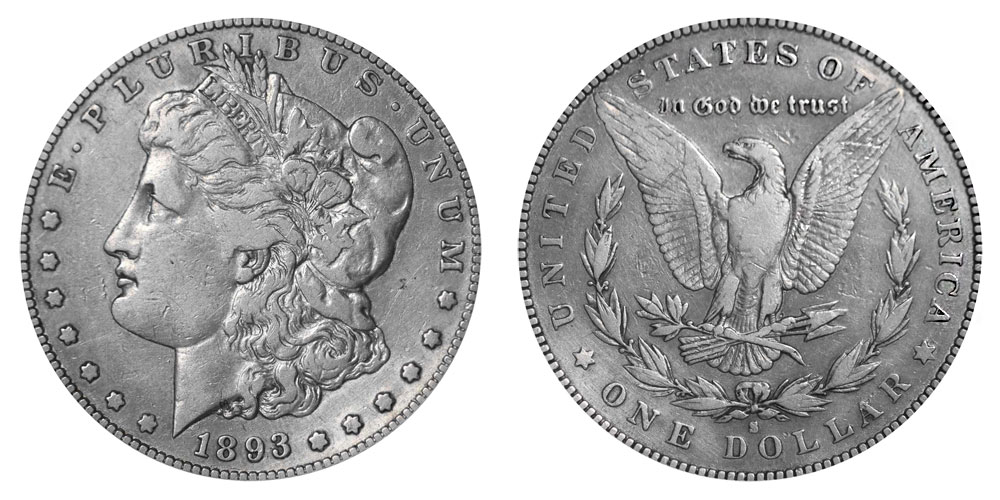
Era/Set: 1893-S Morgan dollar (key date) | Typical price: ~$2,500 (AG) to $646,250 (finest) | Best for: Morgan dollar collectors chasing the series' ultimate key date
The 1893-S Morgan Dollar is the rarest Morgan struck for circulation, with a mintage of just 100,000 — the key that anchors every Morgan set. A problem-free certified example starts around $2,500 in About Good, climbs to $30,000-$50,000 in VF-20, and the finest MS-65 (the Eliasberg specimen) sold for a record $646,250.
As the most coveted date in America's most collected silver series, it has a vast, liquid collector base. It offers a clear grade ladder from attainable to legendary.
Pros:
- The Morgan series key date with a huge collector base.
- Entry at ~$2,500 in low grade for a famous rarity.
- $646,250 finest comp shows the high-grade ceiling.
- Deep liquidity across the most collected silver series.
Cons:
- Heavily counterfeited and added-mintmark fakes abound.
- Mint-state examples are exceedingly rare and pricey.
Verdict: The ultimate Morgan key — a famous rarity with an entry point most collectors can reach.
Which One Is Right for You?
What to Look For
- Buy certified, always. Only purchase coins graded by PCGS or NGC, and verify the certification number on the grader's site; 19th-century rarities are among the most counterfeited objects in collecting.
- Watch for added mintmarks and alterations. Key dates like the 1893-S Morgan are routinely faked by adding an "S" to a common coin — authentication is non-negotiable.
- Provenance drives premiums. Pedigreed examples (Eliasberg, James A. Stack, SS Central America) command real premiums; confirm the chain of ownership.
- Grade math matters enormously. A single grade point can multiply value on these coins; know the population data before you bid.
- Beware "problem" coins. Cleaning, rim damage, and repairs can cut value sharply even on genuine rarities; a problem-free lower grade often beats a damaged higher one.
What matters less than the hype: chasing the highest grade on a coin you can't authenticate. A certified, problem-free example with solid provenance beats an ungraded "bargain" every time.
FAQ
What's the most valuable 19th-century coin? The 1822 Half Eagle, the most valuable U.S. Mint gold coin ever sold, brought $8.4 million in 2021. Among silver, the 1804 Dollar — the "King of American Coins" — leads at $7.68 million for the finest example.
Which 19th-century coin is the best value to start with? The 1857-S SS Central America Double Eagle. Circulated, shipwreck-pedigreed examples start at $2,500 to $5,000 — genuine Gold Rush gold with a famous backstory and documented provenance.
Why is the 1804 dollar so famous if it wasn't struck in 1804? The Class I examples were actually minted in 1834-1835 as diplomatic gift-set pieces. Only 15 are known across all classes, and the combination of mystery, scarcity, and pedigree earned it the title "King of American Coins."
How do I avoid buying a counterfeit key-date coin? Buy only PCGS- or NGC-certified examples and verify the cert number online. The 1893-S Morgan and 1856 Flying Eagle cent are heavily faked, often by adding a mintmark or altering a date.
Can I actually buy the 1849 Double Eagle? No. The unique 1849 Double Eagle is held permanently by the Smithsonian Institution and has never been sold. It's included here for its historical significance, not as a purchase opportunity.
Are rare coins a safe investment? The blue chips have appreciated over decades, but values hinge on grade, authenticity, and provenance, and the market can swing. Buy certified coins you understand, verify authenticity, and never assume guaranteed appreciation.
Bottom Line
The best 19th-century coin to collect is the 1804 Draped Bust Dollar, the "King of American Coins," with examples at $2-$4 million and a $7.68 million finest comp. For collectors who want real 19th-century gold with a famous story at an attainable price, the 1857-S SS Central America Double Eagle is the best value, starting at $2,500-$5,000 in circulated grades.
Between them sit the 1822 and 1854-S half eagles, the unique 1849 double eagle, the 1838-O half dollar, the 1870-S Seated dollar, the 1879 Stella, the 1856 Flying Eagle cent, and the 1893-S Morgan — each a documented rarity with a real comp behind it.
Sources
- Stack's Bowers — finest 1804 dollar sells for $7.68 million
- Greysheet — 1822 Half Eagle sells for $8.4 million
- Heritage Auctions — 1854-S $5 gold sells for $2.1 million
- Blanchard — 1870-S Seated dollar value and history
- CoinWeek — Flowing Hair Stellas lead Heritage auction
- PCGS CoinFacts — 1856 Flying Eagle cent
- CoinWeek — SS Central America 1857-S double eagles
- PCGS CoinFacts — 1893-S Morgan dollar
*19th-century coins review — 19th-century coins reviews, ratings, best 19th-century coins to collect 2027, and a review of the top rare coins for collectors.*