
PLG-to-sales-assist handoff playbook in 2027
 Curated byKory White · Fractional CRO · Maryland
 PULSEKNOWLEDGE LIBRARY
Quality
Certified

A PLG-to-sales-assist handoff playbook routes self-serve accounts to a human only when usage and fit signals say a rep will accelerate expansion. Score accounts on activation depth, seat growth, and ICP fit, trigger on a composite threshold, and measure PQL-to-opportunity conversion, assisted expansion revenue, and net revenue retention without cannibalizing self-serve.
What changes by company stage
The single biggest mistake teams make with product-led sales is copying a playbook built for a different company size. The handoff that works at $80M ARR — a dedicated PLS platform, a warehouse-fed scoring model, a named expansion team — will bankrupt a seed-stage company in tooling and headcount before it produces a single assisted deal. Conversely, the founder-led "watch the signup list every morning" motion that works beautifully at $2M ARR collapses the moment weekly signups pass a few hundred.
At the earliest stage, the entire handoff lives in someone's head. A founder or first AE scans new accounts daily, recognizes a logo, and sends a personal note. There is no score, because there is no volume to score against and no historical data to fit a model to. What matters here is *learning what a good signal looks like* — every conversation is research into which product behaviors precede a paid team plan. Instrumentation matters more than automation: get activation events into a warehouse or even a spreadsheet, tag which accounts converted, and start building the pattern library.
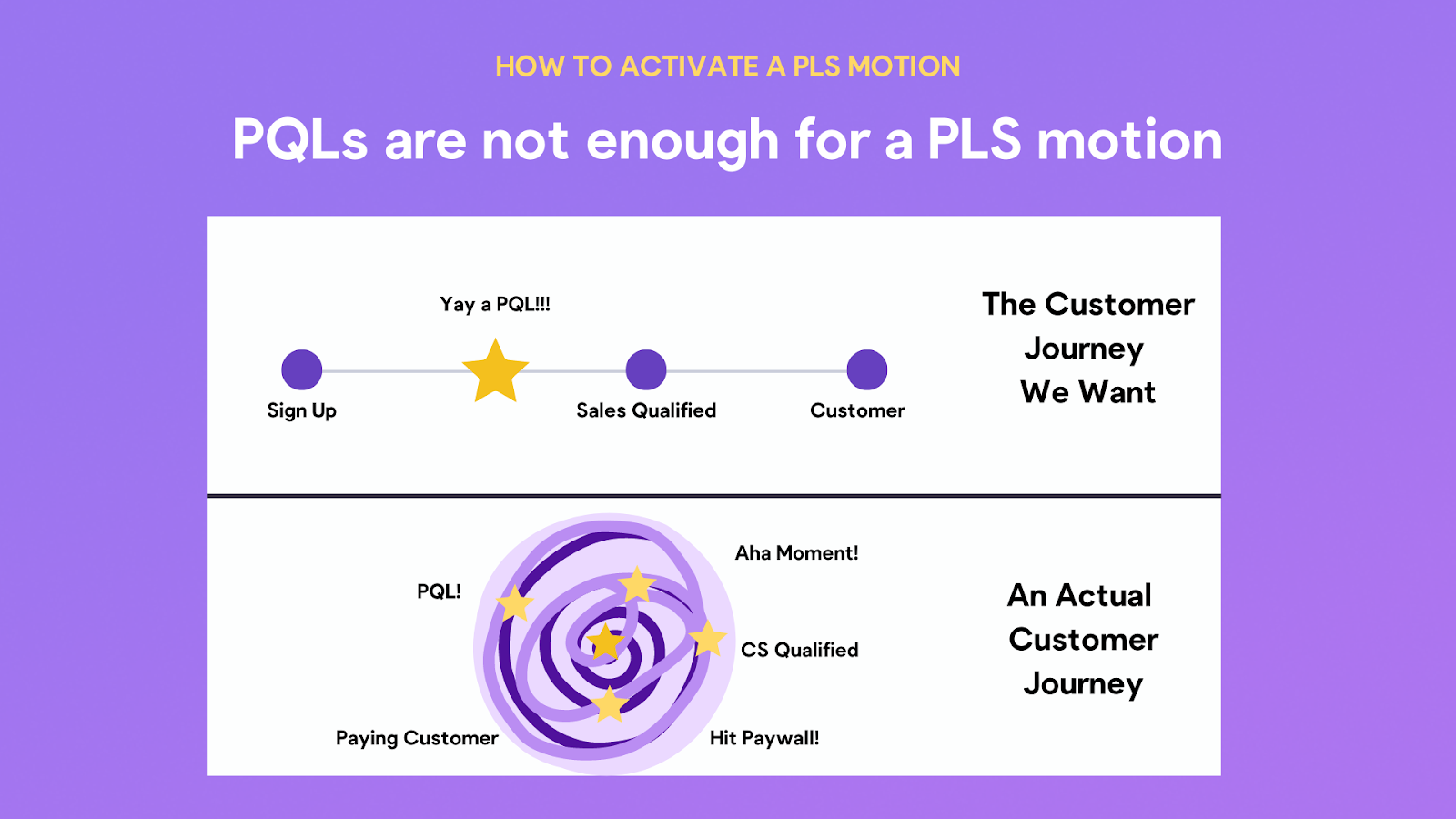
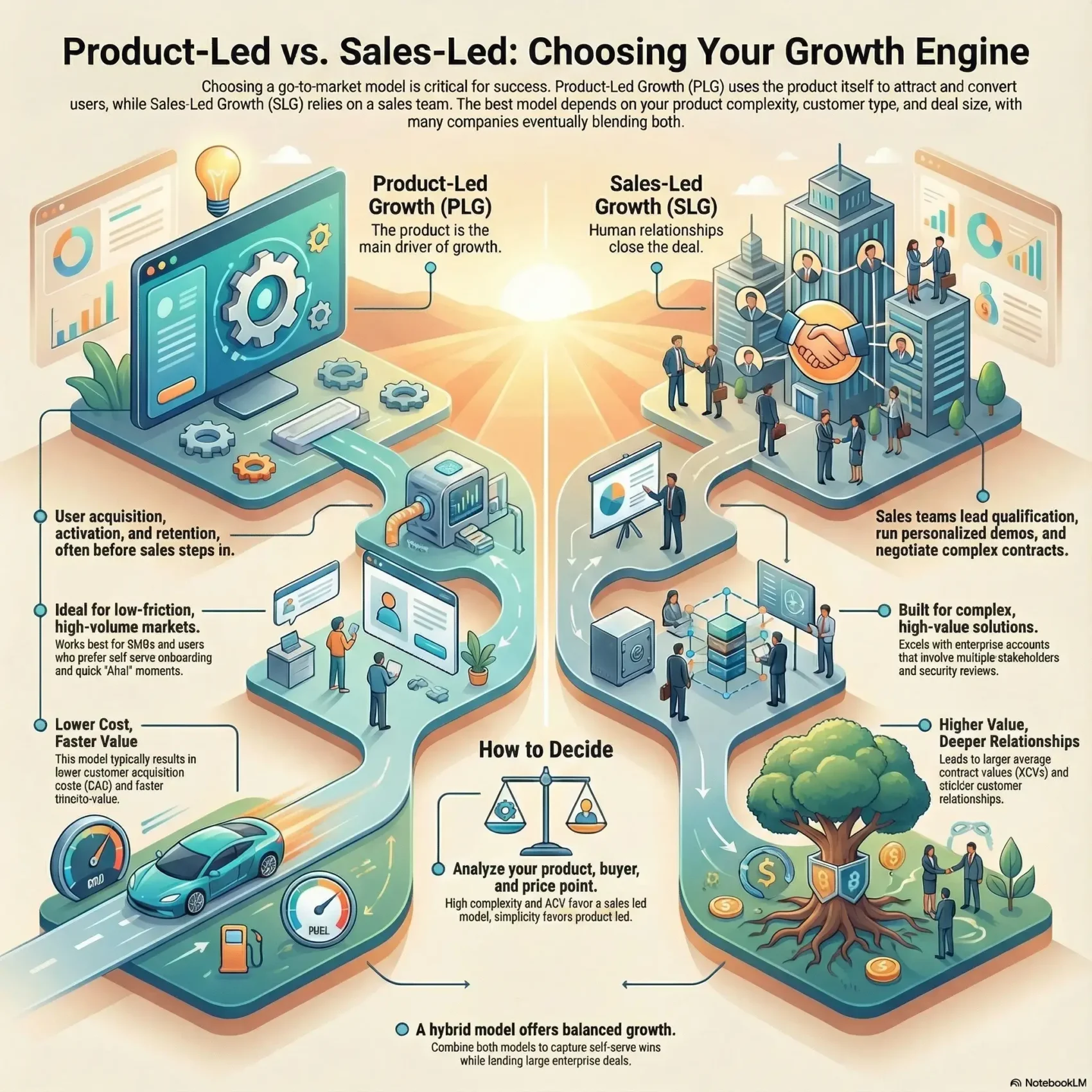
In the middle stage — call it the range where self-serve revenue is real but enterprise contracts are still rare — the handoff becomes a queue. Someone owns it, a threshold exists, and routing rules assign accounts by territory or segment. This is where most companies first buy a product-led sales tool, because manual review stops scaling and CRM alone cannot see product usage. It's also where the first serious failure mode appears: reps discover that assisted accounts close faster than outbound, start reaching into the self-serve base aggressively, and quietly cannibalize conversions that would have happened without them.
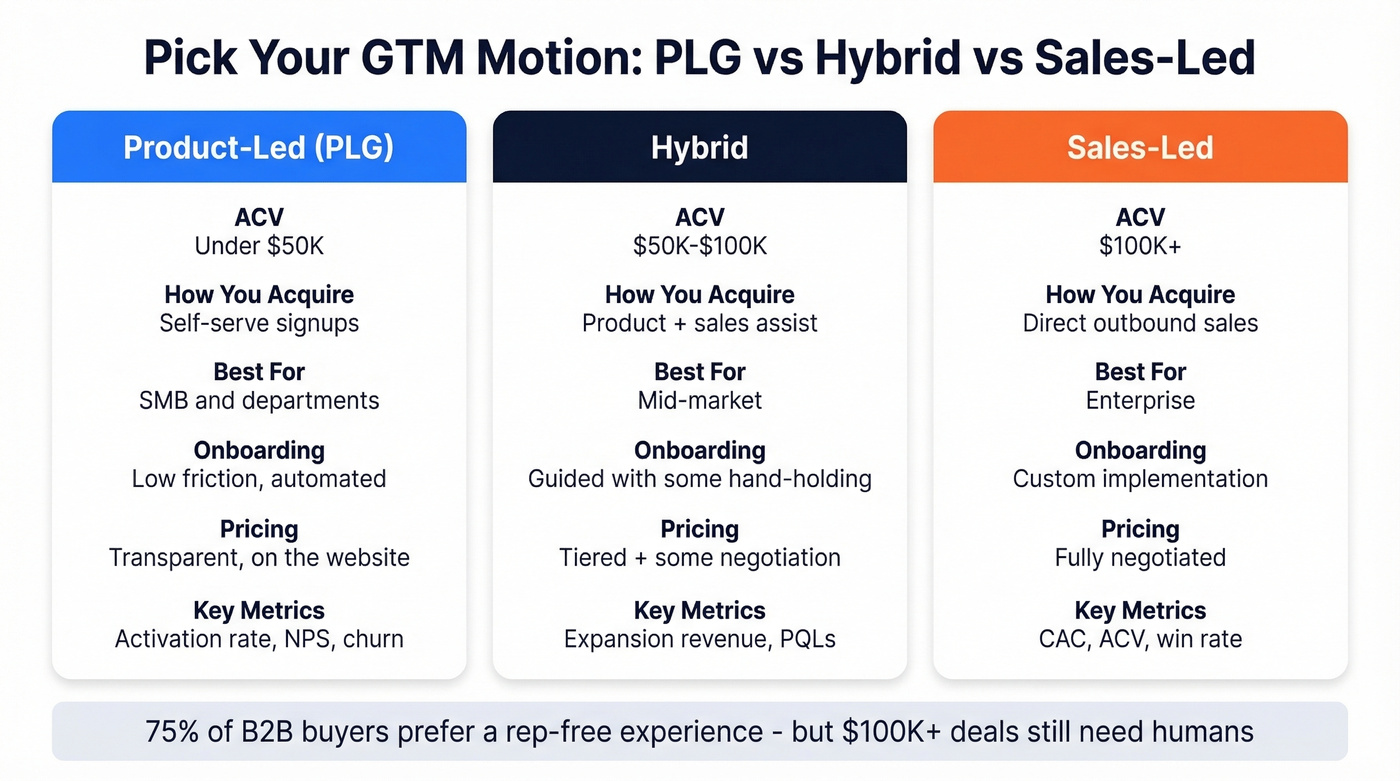
At scale, the handoff stops being a single decision and becomes a tiered system. High-ACV accounts get a named human. Mid-tier accounts get a lightweight assist — a templated outreach, a setup call, an offer to unlock admin features. The long tail gets in-product prompts and lifecycle email only, with a "talk to sales" CTA surfaced contextually on pages like SSO settings or billing. The tiering is what keeps cost-to-serve sane; without it, a rep's calendar fills with $4K deals while a $200K multi-team rollout sits untouched.
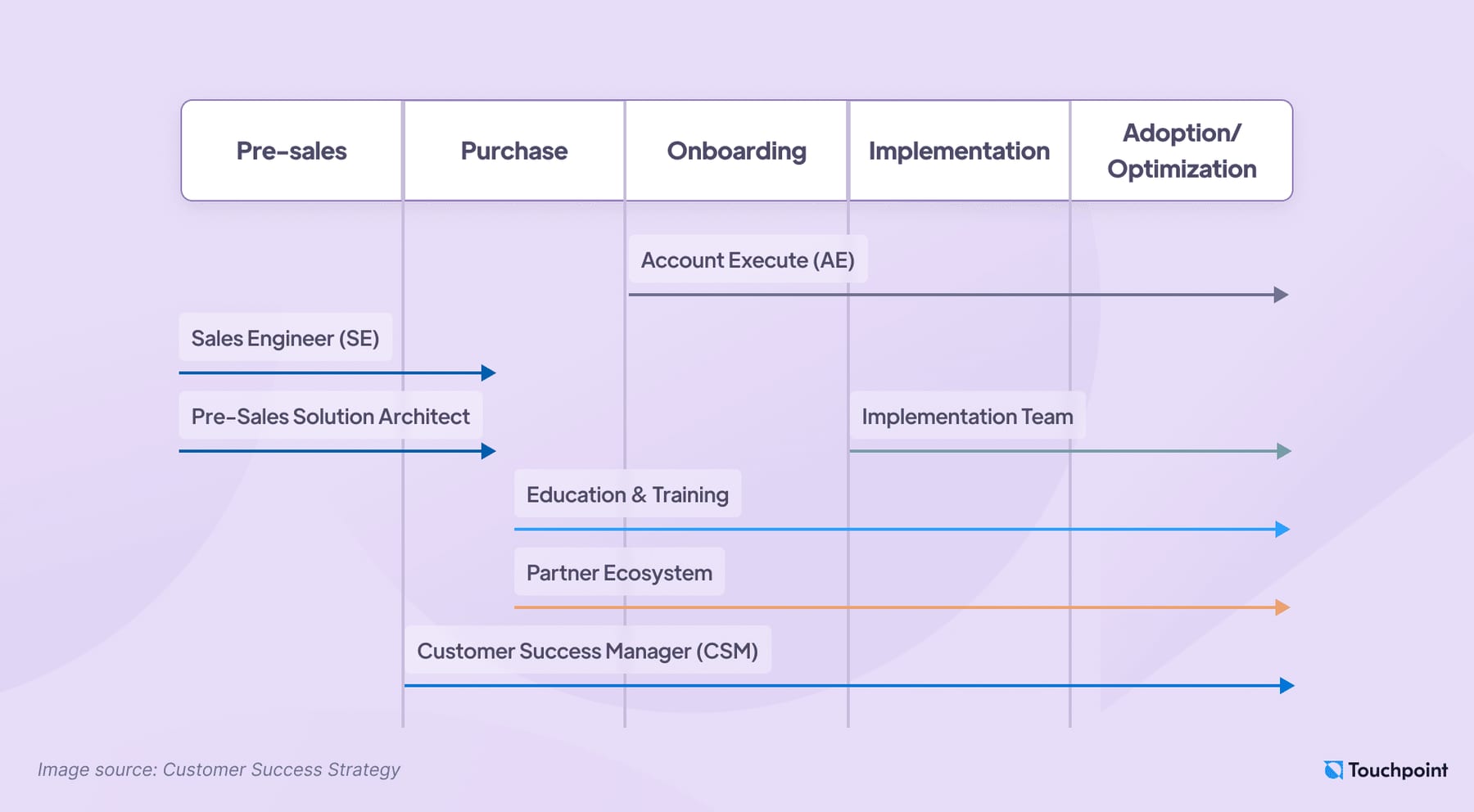
Two adjacent motions tend to arrive at the same stages and are worth planning for together. The first is customer success: once assisted accounts exist, someone has to own their post-sale expansion, and the boundary between "expansion rep" and "CSM" gets contested. The second is partner or channel-sourced accounts, where a reseller or an ecosystem app drives signups that look self-serve but carry a different economics profile. Both draw from the same product-signal infrastructure, so build the data layer once and let all three motions read from it.
Stage-by-stage playbook
Founder-led stage. Instrument first, automate never. Pipe activation events — account created, teammate invited, integration connected, first meaningful output produced — into whatever warehouse you have. Enrich accounts with firmographic data so you know when a recognizable company shows up. Then have a human look at the list every morning. Reach out to five accounts a week, not fifty. The output of this stage is not revenue; it's a written hypothesis of which two or three signals actually predict a team purchase. Write it down, because the scoring model you build later is only as good as this hypothesis.
Queue stage. Replace the daily eyeball with a threshold. The threshold should be composite, never a single event — a rule like "seat count crosses a defined floor AND the account matches ICP AND weekly active users are growing" beats "user clicked pricing page" by a wide margin. Route qualifying accounts into a queue inside Salesforce or HubSpot, with the *why* attached: which users are active, which features they touched, how many seats were added and when. A rep who opens an account and sees a usage story behaves completely differently from one who sees a name and a title. Set a time-to-touch service level of roughly a day; intent decays fast, and a hot account left sitting for a week is functionally a cold lead.
At this stage also define the no-touch lane explicitly. Accounts below threshold get lifecycle email and in-product nurture and never see a rep. This is not a nice-to-have — it's the control group that lets you prove the assist layer added revenue rather than intercepted it.
Tiered stage. Split the queue by expected contract value. The top tier gets a named expansion specialist who multi-threads from the champion to the budget owner to IT and security, clears procurement blockers like SSO, invoicing, security questionnaires, and a custom MSA, and converts per-seat self-serve spend into a committed plan with volume terms. The middle tier gets a lighter touch: one value-led message referencing the team's actual usage, a specific offer such as an admin setup session or an enterprise feature unlock, and a fast path to a contract. The bottom tier stays fully product-led with contextual in-app offers.
Platform stage. Now the handoff becomes a system with feedback loops. Scores are recalculated continuously from warehouse data. Routing accounts for rep capacity, not just territory. Closed-lost and closed-won outcomes feed back into the model so the threshold self-corrects. Quarterly, the definition gets re-reviewed, because product changes shift what a signal means — ship a new onboarding flow and your old activation event stops predicting anything.

Numbers that matter at each stage
Different stages need different scoreboards, and using the wrong one is how teams talk themselves into bad decisions.
Early on, the only numbers worth tracking are learning-rate numbers. How many accounts did a human touch this week, and what fraction turned into a real conversation? A conversation rate that's high tells you your instincts about the signal are working; a rate near zero means you're reading the wrong events. Don't compute conversion percentages on a base of twelve accounts — the noise swamps the signal. Track the absolute count of assisted deals and read the qualitative notes.
In the queue stage, three ratios matter. Handoff-to-opportunity conversion tells you whether the trigger is calibrated: too low and your signals are weak or your outreach is landing badly; suspiciously high and you're probably handing off accounts that were already going to buy — you're taking credit, not creating value. Time-to-touch tells you whether the operational discipline exists at all; if triggered accounts routinely sit for days, no amount of scoring sophistication saves you. And self-serve conversion rate, watched *before and after* you turn the handoff on, is the cannibalization guard. If organic self-serve conversion drops when the assist layer launches, the threshold is too broad and reps are intercepting revenue that would have arrived for free.
At the tiered stage, unit economics take over. Expansion revenue per assisted account, compared against the fully loaded cost of the rep touch, tells you where the tier boundaries actually belong. If a segment's assisted deals produce less incremental revenue than the cost to work them, that segment belongs in the no-touch lane — and the honest answer is often that the boundary sits higher than sales leadership wants it to. Sales-assist cycle time is the companion metric: long cycles in a low-ACV tier usually mean the handoff fires too early, before the account has enough internal consensus to buy.
At scale, net revenue retention becomes the north star, split by cohort. Assisted accounts should show materially better retention and expansion than comparable untouched accounts. If they don't, the assist motion is a cost center wearing a revenue costume. Track accounts-per-rep as the capacity constraint — every expansion specialist has a ceiling on simultaneously active accounts, and blowing past it shows up first as time-to-touch drift, then as retention decay.
A few practical notes on measurement hygiene. Always compare assisted accounts to a held-out control of similar accounts that never got touched; without it you cannot separate the assist from the underlying account quality. Beware attribution windows that are too generous — crediting an assist for an expansion that closed five months later usually means the product did the work. And review the metric definitions on a fixed cadence, because the fastest way to break trust between product and sales is two teams reporting different numbers for the same funnel from two different sources of truth. One warehouse, one definition, one dashboard.
Decision framework
When a team asks "should we build a sales-assist layer yet?", the answer usually falls out of four questions asked in order.
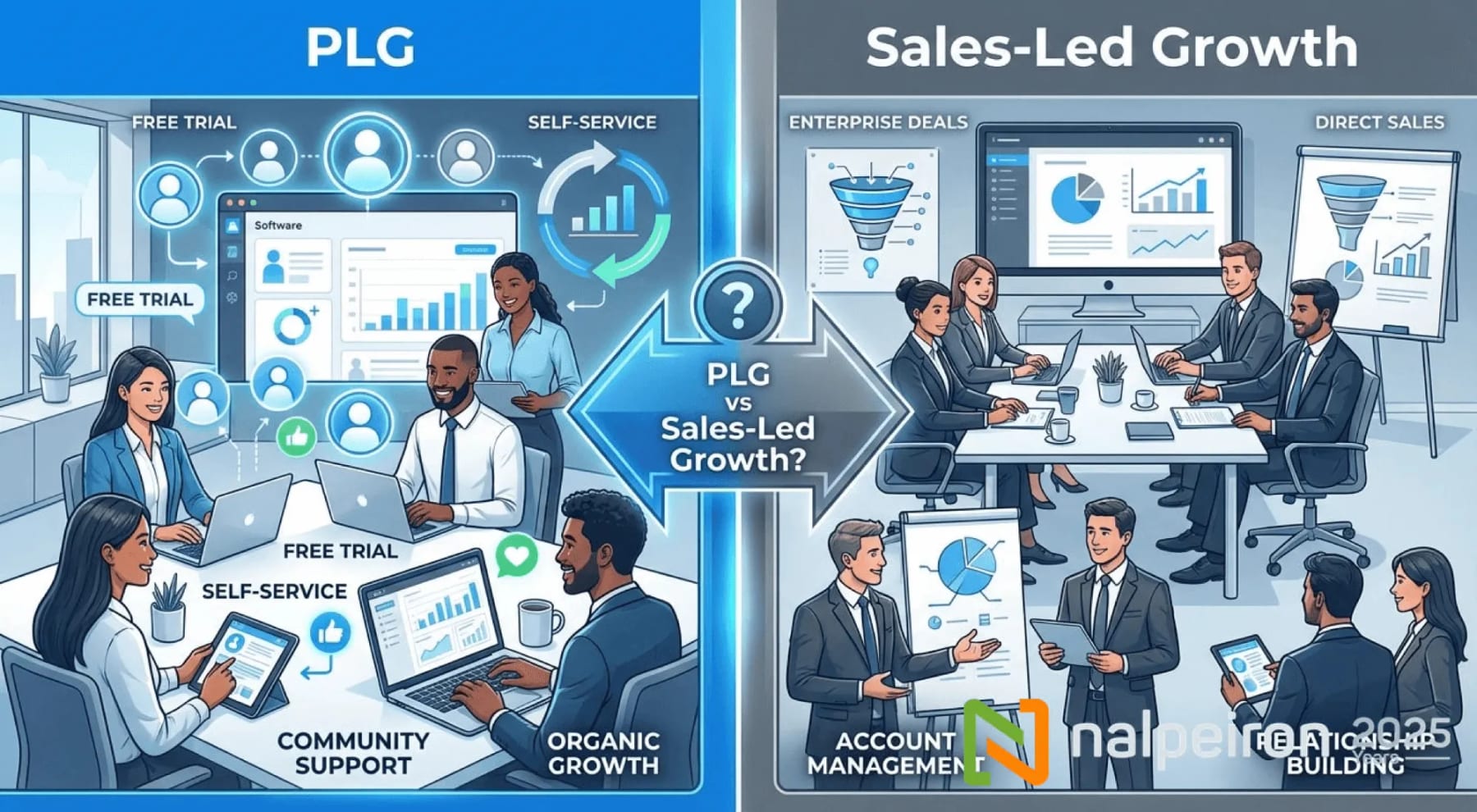
First: is there a ceiling? If self-serve revenue is still growing efficiently and nothing is stalling, adding humans buys you cost, not growth. The signal that a ceiling exists is specific: accounts plateau at a size just below where enterprise features would matter, deals stall on security review or procurement rather than on product value, or you see multiple teams inside one company each paying separately with no path to consolidate. Those are human-shaped blockers. Absent them, keep investing in the product.
Second: is there enough volume to learn from? A scoring model needs a meaningful number of converted accounts to fit against. Below that, you're pattern-matching on anecdotes, and you should stay in founder-led mode where the anecdotes are at least examined carefully by a human.
Third: is the data trustworthy? Product usage that lives only in application logs, doesn't reach a warehouse, and doesn't sync to CRM will produce a scoring model that no rep believes. The moment a rep opens an account flagged as "high intent" and finds a dormant trial, the queue loses credibility permanently. Fix the pipe before building the score.
Fourth: is the compensation aligned? This is the one that quietly ruins otherwise good playbooks. If expansion reps are paid on total closed revenue with no distinction between assisted and would-have-self-converted deals, they will rationally cherry-pick the easiest accounts in the base. Pay on incremental expansion, on retention of the assisted cohort, and — where you can measure it — against the no-touch control. The comp plan is the actual routing policy; the scoring model just makes suggestions.
Two adjacent decisions ride along with this framework. One is whether to route certain triggers to customer success instead of sales — accounts showing adoption decay or support friction usually need help, not a contract conversation, and sending a quota-carrying rep at them damages the relationship. The other is whether an ecosystem or partner-sourced account should enter the same queue; usually it shouldn't, because the economics and the relationship owner both differ, but it should read from the same signal infrastructure.
Where the handoff usually breaks
Most failed playbooks fail in one of a handful of recognizable ways, and knowing the failure modes in advance is cheaper than discovering them.
The first is threshold creep. A team launches with a strict composite trigger, the queue looks thin, someone lowers the bar to keep reps busy, and within two quarters the queue is full of accounts that were never going to buy. Queue volume is not a goal. If the queue is thin and the signals are correct, the honest answer is that you need fewer reps on the motion, not looser triggers.
The second is the cold-open outreach. A rep receives a rich usage story and opens with generic discovery — "I'd love to learn about your goals." The buyer is already using the product; re-selling value they've already experienced reads as though nobody looked at their account. The correct opening references what the team actually did and offers a specific next step. This is the single highest-leverage coaching point in the entire motion.
The third is single-threading on the champion. Product-led accounts almost always start with an individual contributor who has no budget authority. If the rep never gets past them, the deal dies at the first procurement gate. Multi-threading into a budget owner and into IT or security should be a standard step, not an escalation.
The fourth is stale signal definitions. Product ships a redesigned onboarding, the old activation event becomes trivially easy to hit, and the score inflates overnight. Nobody notices for a quarter because the dashboard still looks green. Tie the scoring model review to the product release cadence, not to a calendar quarter that has nothing to do with when signals actually drift.
The fifth is ignoring the downstream. A handoff that converts self-serve teams into contracts creates work for finance, legal, and support that didn't exist before — invoicing, custom terms, security questionnaires, escalation paths for accounts that now have an SLA. Teams that scale the front of the motion without staffing the back end end up with reps doing paperwork instead of expansion conversations, which is the most expensive possible use of that headcount.
Related questions
When should a PLG company hire its first sales rep?
When human-shaped blockers appear repeatedly: deals stalling on security review, procurement, or multi-team consolidation rather than on product value. Volume matters less than pattern consistency. Hire someone who can remove friction and navigate procurement, not a cold-calling closer.
Should sales-assist reps be paid on expansion or new revenue?
Pay primarily on incremental expansion and retention of the assisted cohort. Paying on total closed revenue without distinguishing self-converting accounts leads reps to cherry-pick easy deals from the self-serve base, inflating credit while cannibalizing organic conversion.
How do you keep sales from ruining the self-serve experience?
Maintain an explicit no-touch lane below the threshold, favor contextual in-product offers over unsolicited outreach, and monitor organic self-serve conversion before and after launch. Any measurable drop signals the trigger is too broad.
What product data does a scoring model actually need?
Activation events, seat growth over time, breadth across teams, feature depth, and firmographic fit. All of it in one warehouse, synced to CRM. Data that reps can't verify in the account record is data they'll stop trusting.
Does customer success or sales own an expanding account?
Route by signal type: expansion intent goes to sales, adoption risk and support friction go to customer success. Both read from the same product-signal layer, which is why the data infrastructure should be built once and shared.
FAQ
What is a product-qualified lead versus a product-qualified account?
A product-qualified lead is an individual user who has hit a usage milestone indicating buying intent. A product-qualified account aggregates those signals across an organization. Both are useful, but accounts drive enterprise expansion because contracts, budget, and procurement all live at the company level rather than with a single user.
Can the trigger be a single event, like visiting the pricing page?
Rarely. Single-event triggers generate too much noise and fire on curiosity rather than intent. A composite condition — sustained usage plus seat growth plus ICP fit — dramatically improves precision. Single events are useful as tiebreakers inside a composite score, not as standalone triggers.
How fast should a rep act after a handoff fires?
Fast, ideally within a business day. Product intent decays quickly because the trigger usually corresponds to a specific moment of need, like a team hitting a limit or an admin looking for access controls. If your queue routinely sits for days, fix operational response before investing further in scoring sophistication.
Do you need a dedicated product-led sales platform?
Not at first. Early on, a warehouse query and a shared list work fine and teach you more. A dedicated platform earns its cost when manual review stops scaling, when scores need to write back into CRM automatically, and when routing must account for rep capacity as well as territory.
How do you prove the sales-assist layer actually added revenue?
Hold out a control cohort of similar accounts that never receive a touch, and compare expansion and retention between the two. Without a control, you cannot separate the effect of the assist from the underlying quality of the accounts that happened to trigger.
What should an expansion rep never do on the first outreach?
Never re-pitch value the product already demonstrated. The buyer is a user. Generic discovery signals that nobody looked at the account. Open with something specific about how the team is using the product, then offer a concrete next step such as admin setup, a security review, or an enterprise feature unlock.
Sources
- OpenView Partners — Product-Led Growth research
- a16z — Product-Led Growth resources
- Salesforce Sales Cloud
- HubSpot CRM
- Snowflake — Data Cloud
- Amplitude — Product analytics
- Mixpanel — Product analytics
- Stripe Billing
- Gainsight — Customer success platform
Related on PULSE
This page will be disappearing soon. Save it to your device for $1 — or read it free while it is here.
@Kory-White- · if Venmo asks, the last 4 of my number are 2012
This page is gone.
This one is off the shelf now. $1 keeps it on your phone for good — the whole page, pictures and diagrams included.
 pulse-gtmSales-assisted PLG for mid-market in 2027
 pulse-gtmFounder-led sales GTM motion in 2027
 pulse-gtmTop 10 product-led growth activation plays for SaaS startups in 2027
 pulse-gtmTop 10 pricing tier thresholds for a cloud-based accounting software for freelancers in 2027
 pulse-gtmTop 10 pricing tier thresholds for dental clinic software in 2027
 pulse-gtmHow do you set pricing tier thresholds for an AI recruiting platform in 2027?
 pulse-gtmTop 10 Product-Led Sales GTM Launch Playbooks in 2027
 pulse-gtmLand-and-expand net revenue retention motion in 2027
 pulse-gtmHow do you set pricing tier thresholds for a cybersecurity SaaS targeting SMBs in 2027?
 pulse-gtmVertical SaaS go-to-market playbook for healthcare in 2027