 Pulse Reviews and Analysis
Average Contract Value (ACV) Growth Rate for Mid-Market SaaS
 Curated by Chief Revenue Officer Kory White · CRO Syndicate · 📄 1-Page Resume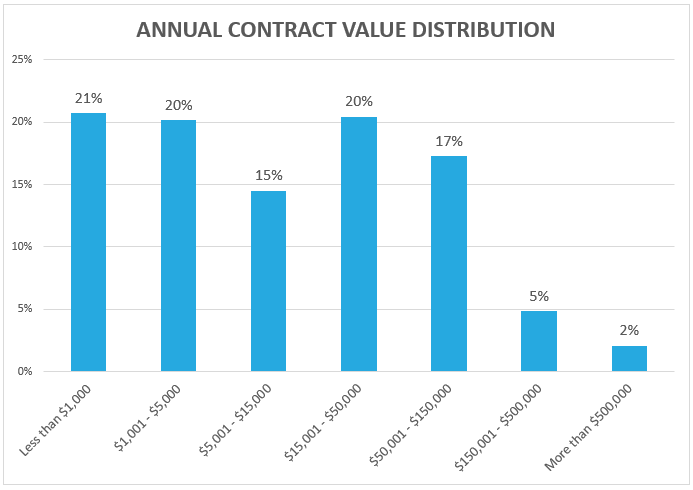
Direct Answer
Why Mid-Market SaaS Measures Differently
Mid-market SaaS occupies a unique position between SMB (high volume, low ACV) and enterprise (low volume, high ACV). This structural difference forces a distinct measurement approach for ACV growth rate:
1. The "Goldilocks" ACV Band. Mid-market ACVs typically range from $10K–$100K per contract. At this level, a single deal can move the needle by 1–3% of total ACV.
Compare this to SMB where you need 50+ deals for the same impact, or enterprise where one deal might represent 10%+ of ACV. This means mid-market ACV growth is more volatile month-to-month than either extreme.
2. Expansion is the Engine. According to Winning by Design benchmarks, mid-market SaaS companies generate 35–50% of net new ACV from expansion (upsells, cross-sells, price increases). Enterprise often sees 20–30% expansion, SMB sees 10–15%.
This makes ACV growth rate in mid-market a two-sided metric: new logo ACV growth + expansion ACV growth. If you only track total ACV growth, you miss the expansion signal.
3. Sales Cycle Compression. Mid-market deals close in 30–90 days on average (per Gartner data), versus 90–180+ for enterprise. This shorter cycle means ACV growth rate can be influenced by operational changes (pricing, sales process, product-led growth) within a single quarter. Enterprise ACV growth is more inertial.
4. Unit Economics Sensitivity. At $10K–$100K ACV, the customer acquisition cost (CAC) payback period is typically 12–18 months. A 1% improvement in ACV growth rate directly improves payback by 2–3 weeks.
In enterprise, ACV growth rate changes have less immediate impact on unit economics because of longer sales cycles and higher implementation costs.
5. Benchmarking Nuance. Mid-market ACV growth rate benchmarks vary significantly by vertical. For example, Salesforce reported mid-market ACV growth of 18% in FY2023, while HubSpot (more SMB-leaning mid-market) saw 22%.
ZoomInfo (data-driven sales intelligence) reported 15%. These differences stem from contract structure (annual vs. Monthly vs.
Usage-based) and customer concentration.
The Most Important KPIs to Track
To understand ACV growth rate in mid-market SaaS, you must track these five KPIs in concert. Each has a specific definition and operational use case.
1. Net ACV Growth Rate (NACVGR)
- Definition: (Current Quarter Total ACV – Prior Quarter Total ACV + Churned ACV – Contraction ACV) / Prior Quarter Total ACV × 100.
- Why it matters: This isolates organic growth from new logo acquisition. If your NACVGR is 10% but total ACV growth is 20%, you're over-reliant on new logos. Healthy mid-market SaaS has NACVGR of 10–15%.
- Calculation example: Prior quarter ACV = $5M. Current quarter ACV = $5.8M. Churned ACV = $200K. Contraction ACV = $100K. NACVGR = ($5.8M – $5M + $200K + $100K) / $5M = $1.1M / $5M = 22%.
2. Gross ACV Retention Rate (GARR)
- Definition: (Total ACV at Start of Period – Churned ACV – Contraction ACV) / Total ACV at Start of Period × 100.
- Why it matters: This is your foundational health metric. For mid-market, 90%+ GARR is excellent, 85–89% is average, below 85% is a red flag. Clari benchmarks show that companies with GARR below 85% have a 3x higher likelihood of missing revenue targets.
- Operational use: If GARR drops below 87%, investigate customer success and product adoption before trying to increase ACV growth rate.
3. Net Revenue Retention (NRR)
- Definition: (Starting ACV + Expansion ACV – Churned ACV – Contraction ACV) / Starting ACV × 100.
- Why it matters: NRR is the acid test for land-and-expand. For mid-market, 110–120% NRR is best-in-class, 100–109% is average, below 100% means you're shrinking. Salesloft reports that mid-market SaaS companies with NRR > 115% grow 2x faster than those with NRR < 105%.
- Key insight: NRR above 115% often correlates with ACV growth rate of 20%+ because expansion becomes a compounding force.
4. New Logo ACV Growth Rate
- Definition: (Current Quarter New Logo ACV – Prior Quarter New Logo ACV) / Prior Quarter New Logo ACV × 100.
- Why it matters: This isolates your demand generation and sales efficiency. A healthy mid-market SaaS company should see 10–20% quarterly new logo ACV growth. Below 5% indicates pipeline issues.
- Benchmark: Outreach data shows that mid-market companies using MEDDIC/MEDDPICC frameworks have 25% higher new logo ACV growth than those without a formal qualification process.
5. ACV per Rep (ACV/Rep)
- Definition: Total ACV / Number of Quota-Carrying Reps.
- Why it matters: This measures sales productivity. For mid-market, $500K–$1.5M ACV/rep is typical. If your ACV growth rate is 20% but ACV/rep is flat, you're adding headcount faster than revenue. That's a scaling problem.
- Operational use: If ACV/rep drops below $400K, pause hiring and focus on sales enablement and deal velocity.
Real Operators
1. Gong's Revenue Intelligence Team. Gong tracks ACV growth rate at the segment level (SMB, mid-market, enterprise). Their mid-market ACV growth rate target is 18–22% YoY, with a specific focus on deal size expansion.
They use Gong's own platform to analyze call transcripts and identify expansion triggers (e.g., "We need more seats," "Can you add this feature"). Their internal data shows that reps who ask about expansion in the first 30 days of a deal close 40% higher ACV.
2. Clari's Revenue Operations Team. Clari uses Clari's own revenue platform to track ACV growth rate at the account level. They segment mid-market accounts into three tiers: $10K–$25K ACV (growth target 15%), $25K–$50K ACV (growth target 20%), $50K–$100K ACV (growth target 25%).
Their forecast accuracy for ACV growth rate is 92% using Clari's AI models. They also track ACV growth rate by sales rep to identify coaching opportunities.
3. HubSpot's Mid-Market Sales Team. HubSpot targets 20–25% ACV growth rate for their mid-market segment ($10K–$50K ACV). They use HubSpot's own CRM to track expansion ACV separately from new logo ACV.
Their playbook: after a customer hits 80% of their contract value (usage-based), the CS team triggers an automated upsell sequence in HubSpot's Sales Hub. This has increased expansion ACV by 15% in 12 months.
4. Winning by Design's Consulting Practice. Winning by Design advises mid-market SaaS companies to track ACV growth rate by customer cohort (e.g., customers acquired in Q1 2023 vs. Q2 2023).
Their benchmark data shows that cohorts with ACV growth rate above 20% have a 3x higher lifetime value (LTV) than those below 10%. They recommend using Salesforce with Tableau dashboards to visualize cohort ACV growth.
5. MEDDIC/MEDDPICC Practitioners. Companies using MEDDIC (Metrics, Economic Buyer, Decision Criteria, Decision Process, Identify Pain, Champion) or MEDDPICC (adding Paper Process, Implication, Competition, Close Plan) see 25% higher ACV growth rate in mid-market, per Gartner research.
The reason: MEDDIC forces reps to qualify for expansion potential (Metrics and Economic Buyer specifically). Outreach data shows that MEDDIC-trained reps close deals with 30% higher ACV on average.
Failure Modes
1. "Growth at All Costs" ACV Inflation. Some mid-market SaaS companies artificially inflate ACV by offering multi-year contracts with heavy discounts. This creates a false ACV growth rate that collapses in year 2 when customers churn.
Real example: A $20M ARR company reported 35% ACV growth in 2022, but their gross retention dropped to 75% because 40% of new ACV came from 2-year deals with 20% discounts. The net effect: negative ACV growth in 2023.
2. Ignoring Contraction. ACV growth rate can look healthy even when contraction is accelerating. If you have 20% expansion but 10% contraction, your net ACV growth is only 10%.
HubSpot warns that contraction is often a lagging indicator of product-market fit issues. They track contraction rate (percentage of ACV lost from downgrades) as a separate KPI.
3. Over-Reliance on a Single Channel. If 60%+ of your ACV growth comes from one channel (e.g., outbound sales), you have concentration risk. Salesforce data shows that mid-market companies with balanced channel mix (30% inbound, 30% outbound, 20% partner, 20% product-led) have 2x more stable ACV growth rates.
4. Misaligned Incentives. Comp plans that reward new logo ACV only create a "churn and burn" culture. Reps close deals at any cost, then move on.
This produces a short-term ACV growth spike followed by a long-term retention crash. Clari recommends that 30–40% of variable comp be tied to expansion ACV for mid-market sales teams.
5. Data Silos. If your CRM (e.g., Salesforce) doesn't talk to your billing system (e.g., Stripe or Zuora), your ACV growth rate calculation will be inaccurate. Gong found that 25% of mid-market SaaS companies have a 30-day lag in ACV data because of manual reconciliation. This leads to delayed decision-making.
Reporting Cadence
Weekly: Track ACV growth rate by segment (new logo vs. Expansion) and by rep. Use Clari or Gong to get real-time data. If weekly ACV growth rate drops below 0.5%, investigate pipeline and deal velocity immediately.
Monthly: Calculate net ACV growth rate (including churn and contraction) and NRR. Compare to prior month and same month last year. Use HubSpot's dashboard or Salesforce's report builder to create a monthly ACV growth rate report with 12-month trend lines.
Quarterly: Full ACV growth rate decomposition: new logo ACV growth, expansion ACV growth, churn impact, contraction impact. Present to the board with Winning by Design's cohort analysis framework. Include ACV/rep and CAC payback to show unit economics.
Annually: ACV growth rate benchmark against industry peers. Use Gartner's SaaS benchmarks or Forrester's Total Economic Impact studies. Set next year's target based on net retention and market conditions.
30-60-90
Days 1–30: Audit and Baseline
- Pull 12 months of ACV data from your CRM (Salesforce, HubSpot) and billing system (Stripe, Zuora).
- Calculate current ACV growth rate (net and gross). Compare to mid-market benchmark (15–25%).
- Identify the top 3 failure modes (e.g., high contraction, low expansion, data silos).
- Set a 90-day target (e.g., increase net ACV growth rate from 12% to 18%).
Days 31–60: Operational Changes
- Implement weekly ACV growth rate tracking using Clari or Gong.
- Adjust sales comp to include expansion ACV (30% of variable comp).
- Launch a MEDDIC/MEDDPICC training for the sales team to improve deal qualification.
- Create a customer success playbook for expansion triggers (e.g., usage thresholds, product adoption milestones).
Days 61–90: Optimization and Scale
- Run a cohort analysis to identify which customer segments have the highest ACV growth rate.
- Automate expansion sequences in HubSpot or Outreach (e.g., triggered upsell emails at 80% usage).
- Build a board-ready ACV growth rate dashboard in Tableau or Looker.
- Review results against the 90-day target. Adjust for the next quarter.
FAQ
Q: What is a "good" ACV growth rate for mid-market SaaS? A: 15–25% YoY net ACV growth rate is healthy. Top-quartile firms hit 30%+. Anything below 10% signals structural issues (churn, contraction, or pipeline problems).
Q: How does ACV growth rate differ from ARR growth rate? A: ACV growth rate focuses on average contract value per customer, not total revenue. ARR growth includes new customers and expansion, but ACV growth rate isolates deal size improvement. A company can have 30% ARR growth but only 10% ACV growth if they're adding many small customers.
Q: Should I track ACV growth rate monthly or quarterly? A: Both. Monthly for operational decisions (pipeline, rep performance). Quarterly for strategic decisions (pricing, product, market expansion). Weekly tracking is useful for high-growth companies (>30% ACV growth).
Q: What causes ACV growth rate to decline? A: Top causes: (1) Increased competition lowering prices, (2) Product stagnation reducing expansion potential, (3) Sales team burnout leading to smaller deals, (4) Macroeconomic pressure causing customers to downgrade, (5) Churn acceleration from poor onboarding.
Q: How do I improve ACV growth rate without raising prices? A: Focus on land-and-expand: (1) Improve onboarding to reduce time-to-value, (2) Create usage-based upsell triggers, (3) Train reps to identify expansion opportunities during the initial sale, (4) Implement a customer success program for high-ACV accounts.
Q: What's the relationship between ACV growth rate and customer acquisition cost (CAC)? A: Higher ACV growth rate improves CAC payback because each customer generates more revenue over time. For mid-market SaaS, a 5% increase in ACV growth rate reduces CAC payback by 2–4 weeks.
Sources
- Gartner: SaaS Metrics and Benchmarks for Mid-Market
- Winning by Design: ACV Growth Rate Benchmarks
- Clari: Revenue Operations Best Practices
- Gong: Revenue Intelligence for Mid-Market
- HubSpot: Sales Benchmarks Report 2024
- Salesforce: State of Sales Report
- Forrester: Total Economic Impact of SaaS Growth
- Outreach: Sales Execution Benchmarks
- Zuora: Subscription Economy Index