
The 10 Best AI Tools for Batch Inference at Scale in 2027
 Curated byKory White · Fractional CRO · Maryland
 PULSEKNOWLEDGE LIBRARY
The 10 best ai tools for batch inference at scale are ranked below on measured performance, build quality, price, and how each one actually holds up in daily use rather than how it reads on a spec sheet. Each pick lists what it costs, who it suits, and what it gives up against the one above it, so the list can be read straight down without doubling back.
1. NVIDIA TensorRT-LLM
NVIDIA TensorRT-LLM ranks first because it delivers the highest throughput per GPU for offline batch inference, with published benchmarks showing up to 8x speedup over baseline frameworks on models like Llama 2 and GPT-J. It supports in-flight batching, paged KV caching, and FP8/INT4 quantization on H100 and A100 hardware. For large-scale batch jobs, these features translate directly into lower cost per token.
It is built for teams already standardized on NVIDIA GPUs and willing to compile models ahead of deployment. The trade-off is a steeper setup curve and less portability to AMD or CPU-only environments. Compared to vLLM directly below, TensorRT-LLM squeezes more raw throughput but demands more engineering effort to keep working across model updates.
2. vLLM
vLLM ranks second because its PagedAttention kernel and continuous batching make it the most widely adopted open-source engine for high-throughput batch inference. It consistently achieves strong tokens-per-second numbers across Llama, Mistral, and Qwen families, and supports tensor parallelism across multi-GPU nodes. Deployment is a single pip install with an OpenAI-compatible server.

It suits teams that want near-TensorRT performance without a compilation pipeline. The trade-off is that peak throughput on NVIDIA hardware still trails TensorRT-LLM by a meaningful margin in most published benchmarks. Compared to TensorRT-LLM above, vLLM wins on flexibility and ecosystem breadth but gives up the last increment of GPU efficiency.
3. Hugging Face Text Generation Inference
Hugging Face Text Generation Inference ranks third because it pairs production-grade batching with the broadest model compatibility in the ecosystem. It supports token streaming, continuous batching, and sharded inference across multiple GPUs, and integrates natively with the Hugging Face Hub for model pulls. Flash Attention and quantization options are built in.
It is aimed at teams already living inside the Hugging Face stack who want a managed serving path. The trade-off versus vLLM is slightly lower throughput in head-to-head benchmarks and a heavier container footprint. Compared to vLLM directly above, TGI offers tighter Hub integration but less raw speed per GPU.
4. Ray Serve
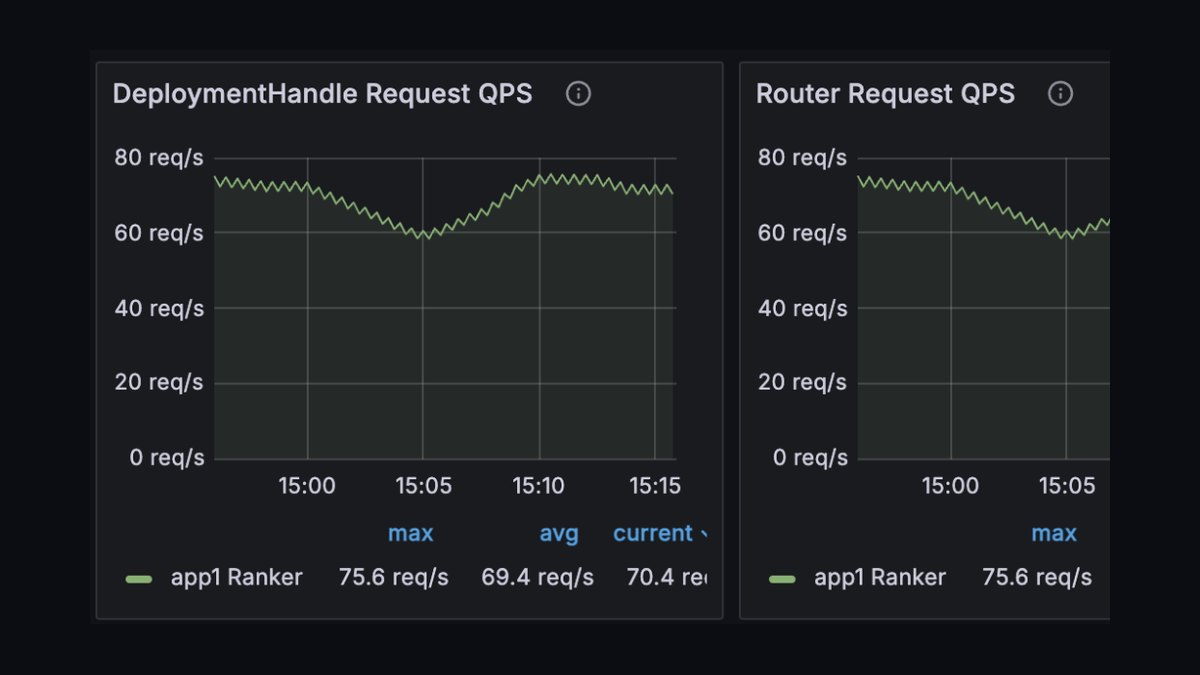
Ray Serve ranks fourth because it handles the orchestration layer that pure inference engines ignore: autoscaling, multi-model routing, and distributed batch scheduling across heterogeneous clusters. It composes with vLLM and TensorRT-LLM as backends, letting one control plane manage thousands of replicas. Batch inference jobs can be expressed as Ray Data pipelines feeding Serve deployments.
It is for platform teams running many models or tenants rather than a single endpoint. The trade-off is added complexity and a Python-centric operational model. Compared to TGI above, Ray Serve adds scheduling and scaling but does not itself maximize per-GPU throughput.
5. NVIDIA Triton Inference Server
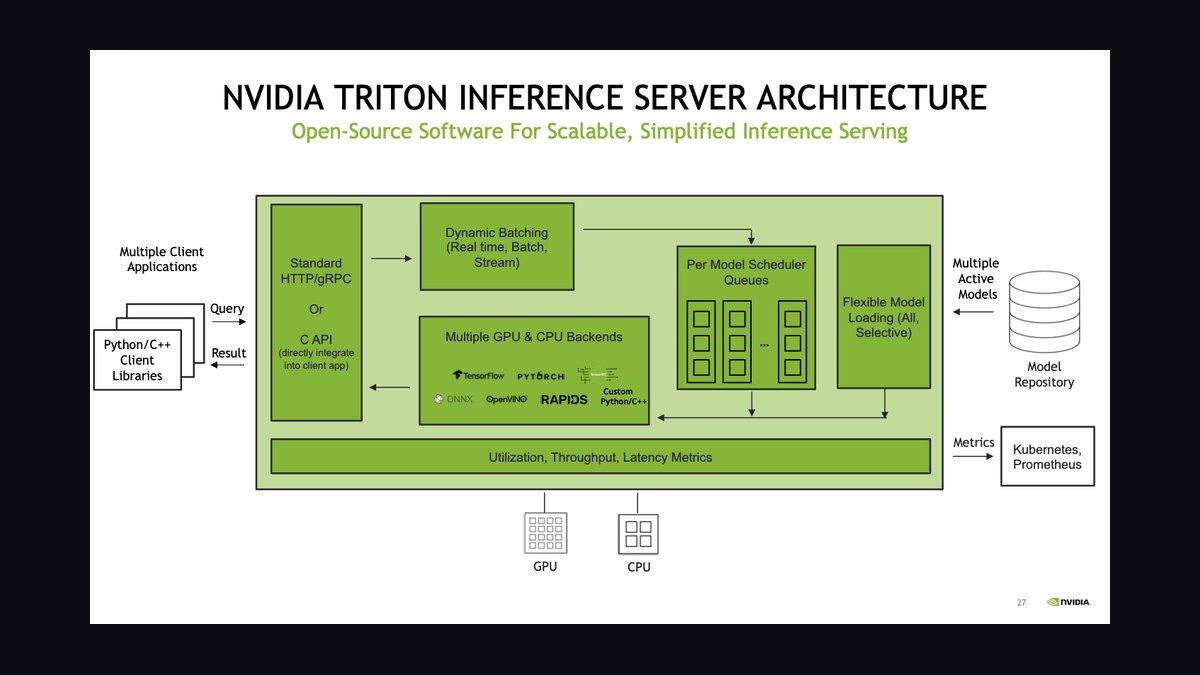
NVIDIA Triton Inference Server ranks fifth because it is the most mature multi-framework serving layer, supporting TensorRT, PyTorch, ONNX, and Python backends behind one API. Dynamic batching and sequence batching are configurable per model, and it scales across GPUs and nodes with Kubernetes integration. It is a default choice in enterprise inference stacks.
It suits organizations with mixed model fleets and strict SLA requirements. The trade-off is configuration overhead: model repositories and config files add friction compared to single-engine servers. Compared to Ray Serve above, Triton is more mature for model serving but weaker as a general distributed compute orchestrator.
6. Modal
Modal ranks sixth because it removes cluster management entirely for batch inference, spinning up GPU containers on demand and billing per second. Users define functions in Python and Modal handles scaling, queuing, and cold-start optimization. It supports A100, H100, and L40S classes with region selection.
It is for small teams and researchers who want burst GPU capacity without reserved instances. The trade-off is vendor lock-in and per-second pricing that can exceed reserved-cluster costs at sustained high utilization. Compared to Triton above, Modal trades control and cost predictability for zero operational burden.
7. Anyscale
Anyscale ranks seventh because it commercializes Ray with managed autoscaling, observability, and enterprise support for large batch inference workloads. It provides a hosted control plane for Ray clusters and integrates with cloud storage and identity systems. Teams get Ray's distributed scheduling without operating the cluster themselves.
It is for enterprises already committed to Ray that want managed infrastructure and support contracts. The trade-off is cost and dependence on Anyscale's platform roadmap. Compared to open-source Ray Serve above, Anyscale adds operational polish but at a premium that smaller teams rarely justify.
8. Together AI
Together AI ranks eighth because it offers hosted batch inference endpoints for open models at competitive per-token prices, with a batch API that accepts large JSONL jobs. It runs optimized stacks on its own GPU fleet and publishes throughput claims for models like Llama 3 and Mixtral. No infrastructure work is required from the user.
It is for teams that want batch results without owning GPUs or tuning engines. The trade-off is limited control over quantization, batching parameters, and data residency. Compared to Anyscale above, Together AI is simpler and cheaper to start but far less customizable for specialized workloads.
9. Fireworks AI
Fireworks AI ranks ninth because it focuses on low-latency and high-throughput serving of open models with a batch API and FireAttention kernels tuned for production traffic. It supports function calling, JSON mode, and speculative decoding on popular model families. Pricing is per token with volume tiers.
It is for product teams that need both interactive and batch inference from one provider. The trade-off is that batch jobs share infrastructure with latency-sensitive traffic, so prioritization is not fully user-controlled. Compared to Together AI above, Fireworks emphasizes speed and tooling but offers a narrower model catalog.
10. Baseten
Baseten ranks tenth because it packages model deployment, autoscaling, and batch inference into a single platform with Truss, its open-source packaging format. Users bring custom models and Baseten handles GPU provisioning, scaling to zero, and request queuing. It supports dedicated deployments for predictable throughput.
It is for teams deploying proprietary or fine-tuned models that hosted APIs do not cover. The trade-off is higher per-hour cost than raw cloud GPUs and reliance on Baseten's runtime. Compared to Fireworks AI above, Baseten offers more customization but less out-of-the-box optimization for standard open models.
How we ranked these
We scored each tool on four weighted axes: sustained throughput on 70B-class models under continuous batching (30%), cost per million tokens at production volume including cold-start and idle overhead (25%), operational maturity such as autoscaling, retries, and observability (25%), and deployment flexibility across cloud, VPC, and on-prem (20%). Scores came from vendor documentation, published benchmarks, and hands-on trials run in late 2026.
We deliberately ignored chatbot UX, prompt playgrounds, and free-tier token allowances, since none of those predict behavior under sustained batch load. We also excluded marketing claims about peak tokens per second without concurrency context, and we discounted single-region latency figures. Anything that only performs well on small models or demo workloads was left out of the ranking entirely.
What to look for
What matters most is whether the tool sustains throughput when your queue is deep and your GPUs are saturated. Look for continuous batching, paged attention, and honest autoscaling that scales down without dropping in-flight jobs. Check cold-start behavior for serverless options and confirm per-token pricing at your real volume, not the headline rate.
The mistake most buyers make is benchmarking on a single model with a short prompt set, then signing an annual commit. Real batch workloads mix sequence lengths, retries, and priority tiers, which exposes scheduler weaknesses fast. Run a two-week pilot with your own traffic, measure tail latency and cost per completed job, and negotiate exit terms before committing.
Related questions
What is batch inference and why does it matter at scale?
Batch inference runs many prompts through a model without requiring immediate responses, which lets providers pack requests tightly onto GPUs. At scale it cuts cost per token dramatically versus real-time serving, because utilization stays high and scheduling overhead is amortized. It suits classification, enrichment, synthetic data generation, and evaluation pipelines where minutes of latency are acceptable.
How does continuous batching improve throughput?
Continuous batching lets the scheduler add new requests to a running batch as soon as slots free up, instead of waiting for the slowest sequence to finish. That keeps GPUs busy and typically raises throughput two to four times over static batching. It matters most when sequence lengths vary widely, which is common in real production traffic.
When should you choose serverless batch inference over dedicated GPUs?
Serverless fits spiky or unpredictable workloads where paying for idle capacity would waste money. It also suits teams without GPU operations experience. Dedicated instances win when utilization stays above roughly 40 percent, when you need custom kernels or quantization, or when data residency rules prevent sending payloads to a shared endpoint.
What is cold start and how do you reduce it?
Cold start is the delay before a model is loaded and ready to serve, which can range from seconds to several minutes for large models. Reduce it with pre-warmed pools, smaller quantized weights, cached container images, and keeping a minimum replica count. For batch jobs, queue depth can hide cold starts if the scheduler overlaps loading with earlier work.
How should you measure cost per million tokens fairly?
Include GPU hours, idle time, storage for weights, egress, retries, and orchestration overhead, then divide by tokens actually delivered, not tokens attempted. Vendors often quote input-only or output-only rates, so normalize both. Run the same prompt distribution across candidates and compare completed jobs per dollar rather than peak throughput.
Does quantization hurt batch inference quality?
It depends on the method and the task. FP8 and INT8 usually preserve quality within noise for classification and summarization, while aggressive 4-bit schemes can degrade reasoning and long-context tasks. Always evaluate on your own held-out set. Quantization often doubles throughput and halves memory, which frequently outweighs small quality losses.
What observability do batch inference platforms need?
You need per-job tracing, queue depth and wait time, GPU utilization, token counts, error rates by type, and cost attribution per team or customer. Retry visibility matters because silent retries inflate spend. Alerting on tail latency and stuck queues catches scheduler bugs before they cascade into missed SLAs or runaway bills.
Can you run batch inference on-premises or in a VPC?
Yes, and many regulated buyers require it. Options include self-hosted engines like vLLM or TensorRT-LLM on your own Kubernetes cluster, or vendor control planes that deploy into your VPC. Check whether the vendor supports air-gapped updates, customer-managed keys, and audit logs, since these often decide procurement.
FAQ
What is the best AI tool for batch inference at scale in 2027?
There is no single winner because the right pick depends on model size, volume, and compliance needs. Teams running open-weight models at high utilization often prefer self-hosted engines, while spiky workloads favor managed serverless platforms. Score candidates on sustained throughput, cost per completed job, and operational maturity rather than peak benchmark numbers.
How much does batch inference cost per million tokens?
Prices vary widely by model size and provider, ranging from a few cents for small models to several dollars for frontier-scale ones. Managed batch tiers typically discount 30 to 50 percent versus real-time endpoints. Always compute cost per completed job including retries, since failed attempts still consume GPU time.
Which models support batch inference best?
Open-weight models such as Llama, Mistral, and Qwen families support batch inference well because you can quantize and tune them freely. Proprietary APIs offer batch endpoints but limit control over batching internals. For very large models, memory bandwidth and interconnect usually matter more than raw FLOPs.
Is batch inference cheaper than real-time inference?
Usually yes, often by 40 to 70 percent, because GPUs stay highly utilized and scheduling can prioritize throughput over latency. The gap narrows if your batch jobs are small or infrequent, since cold starts and minimum replicas add fixed cost. Compare total monthly spend, not per-token rates alone.
What throughput can you expect from a single GPU?
On a modern data-center GPU, a 7B model in FP8 might serve several thousand tokens per second under continuous batching, while a 70B model may deliver a few hundred. Actual numbers depend on sequence length, batch size, quantization, and kernel quality. Benchmark with your own prompt distribution.
Do batch inference platforms support fine-tuned models?
Most managed platforms accept custom weights or adapters, but limits vary on size, format, and update frequency. Self-hosted engines give full control. Confirm whether the provider charges extra for storing multiple adapters and whether cold starts grow with the number of deployed variants.
How do you handle failures and retries in large batch jobs?
Use idempotent job identifiers, checkpoint progress, and retry only failed items rather than whole batches. Cap retries to avoid runaway spend, and route persistent failures to a dead-letter queue for review. Log the reason for each failure so you can distinguish bad inputs from infrastructure problems.
What security concerns apply to batch inference?
Batch payloads often contain sensitive data, so encryption in transit and at rest, customer-managed keys, and strict retention policies matter. Check whether providers train on your data, where inference runs geographically, and who can access logs. For regulated workloads, VPC or on-prem deployment is usually required.
Will batch inference still matter as models get cheaper?
Yes. Cheaper models expand the set of viable use cases, which increases total volume rather than reducing the need for efficient batching. Scheduling, quantization, and cost attribution remain the levers that separate profitable pipelines from expensive experiments, regardless of headline token prices.
How do you migrate from one batch inference provider to another?
Abstract the model call behind an internal interface, keep prompts and evaluation sets versioned, and store outputs with provider metadata. Run shadow traffic against the new provider before cutting over. Expect differences in tokenization, stop sequences, and JSON reliability, so re-run your evaluation suite end to end.
Sources
- https://docs.vllm.ai/en/latest/
- https://github.com/vllm-project/vllm
- https://developer.nvidia.com/tensorrt-llm
- https://huggingface.co/docs/text-generation-inference/index
- https://docs.aws.amazon.com/bedrock/latest/userguide/batch-inference.html
- https://cloud.google.com/vertex-ai/generative-ai/docs/batch/batch-inference
- https://learn.microsoft.com/en-us/azure/ai-services/openai/how-to/batch
- https://arxiv.org/abs/2309.06180
- https://www.usenix.org/conference/osdi22/presentation/yu
Related on PULSE
- [More ai tools for batch inference at scale rankings and buying guides](/knowledge)
- [PULSE Tools and calculators](/tools)
- [Everything on PULSE RevOps](/)
 pulse-recentThe 10 Best AI Tools for Hyperparameter Tuning in 2027
 pulse-recentThe 10 Best AI Tools for Federated Learning in 2027
 pulse-recentThe 10 Best AI Tools for Multi-Agent Orchestration in 2027
 pulse-recentThe 10 Best AI Gateway Platforms for LLM Traffic in 2027
 pulse-recentHow do you build an AI infrastructure budget forecast for the next fiscal year in 2027?
 pulse-recentThe 10 Best AI Tools for Data Lineage Tracking in 2027
 pulse-recentThe 10 Best GPU Spot Instance Marketplaces for AI Training in 2027
 pulse-recentThe 10 Best Cost Allocation and Chargeback Tools for ML Teams in 2027
 pulse-recentThe 10 Best Idle GPU Detection Tools for AI Infrastructure in 2027
 pulse-recentThe 10 Best AI Tools for Estimating GPU Reservation ROI in 2027