
Predictable Revenue by Aaron Ross — Top 10 Key Takeaways for Sales Leaders in 2027
 Curated byKory White · Fractional CRO · Maryland
 PULSEKNOWLEDGE LIBRARY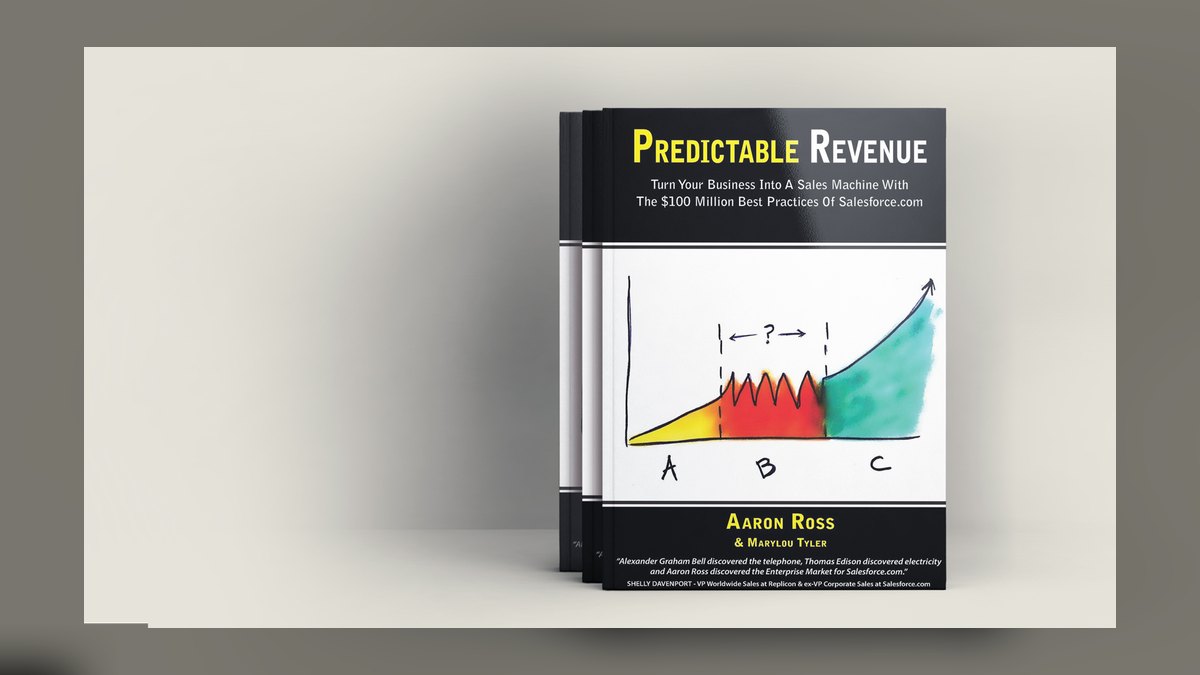
Predictable Revenue by Aaron Ross argues that consistent, forecastable growth comes from specializing sales roles — separating prospecting, closing, and account management — and replacing pure cold calling with "Cold Calling 2.0" outbound built on referrals, targeted research, and short qualifying emails. For sales leaders in 2027, the core takeaway is that pipeline predictability is an org-design and process discipline, not a talent or luck problem.
The outcome you should expect
When a sales organization actually implements the takeaways from Predictable Revenue, the first visible change is not more revenue — it's more predictable revenue. Aaron Ross wrote the book after helping build the outbound sales machine that took Salesforce from roughly $5 million to $100 million in recurring revenue, and the throughline of that case is that growth stopped depending on a handful of star closers and started depending on a repeatable system. Sales leaders who apply the framework correctly should expect three concrete outcomes within two to four quarters: a pipeline that grows in proportion to headcount and activity rather than in proportion to who happens to be having a good month, a measurable drop in the variance between forecasted and actual bookings, and a shift in where new opportunities originate — away from founder or VP-sourced deals and toward a dedicated sales development function.
This is the central promise of the strategy: revenue becomes an engineering problem with known inputs (leads, conversion rates, ramp time) rather than a motivational one. Leaders should also expect friction before the payoff. Splitting a single "full-cycle" sales role into prospecting, closing, and farming responsibilities initially slows down deals that used to close because one relationship-driven rep handled everything end to end. Ross is explicit in the book that this transition period — typically 60 to 120 days — is where most leaders lose their nerve and revert to generalist reps, which is precisely why it's listed as one of the top takeaways: specialization has to be given enough runway to prove out the math before it's judged.
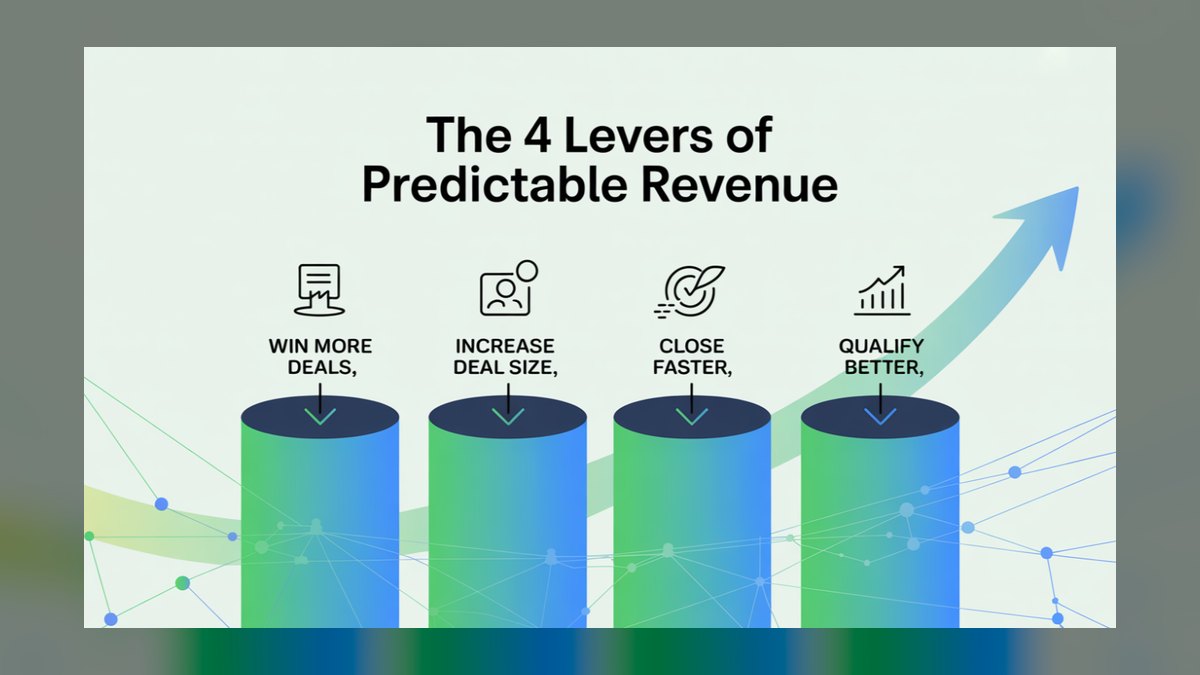
The other outcome leaders should expect is a change in how they talk about the sales leaders' own job. Instead of managing a stack-ranked list of individual quota-carriers, the leader starts managing a small number of levers: number of qualified leads produced per rep per month, meeting-to-opportunity conversion rate, and opportunity-to-close rate. Those levers are what make the pipeline forecastable quarters in advance, which is the entire point of the book's title.
What drives that outcome
The mechanism behind predictable revenue is role specialization feeding a qualification funnel, rather than a single rep owning the whole cycle. Ross's model splits the sales motion into distinct functions — Sales Development Reps (SDRs) who generate and qualify leads, Account Executives who run discovery and close, and Account Managers or "farmers" who handle expansion and renewal — so that each person is optimized for one skill instead of being average at four. Layered on top of that is the "seeds, nets, and spears" lead-generation framework: seeds are referral and word-of-mouth leads (highest quality, lowest volume), nets are inbound/marketing-generated leads (high volume, lower intent), and spears are targeted outbound to named accounts (Cold Calling 2.0). A leader's job is to balance investment across all three rather than over-relying on any single source.

The diagram above captures the loop Ross describes: farmers who manage happy renewing customers become a fresh source of seed referrals, which feeds back into the top of the funnel. This closed loop is what makes the system compounding rather than linear — each cohort of closed customers makes the next quarter's pipeline easier to fill, provided the account management layer is actually asking for referrals and case studies rather than just processing renewals passively.
The other driver is data discipline at the SDR layer. Cold Calling 2.0 isn't "cold calling faster" — it's short, personalized emails sent to a pre-researched list of the right titles at the right companies, designed to get a reply that starts a conversation rather than to pitch on the first touch. The specificity of the targeting (correct persona, correct trigger event, correct company size) is what separates this from spam outbound, and it's why sales leaders in 2027 pair the original framework with intent data, LinkedIn signals, and AI-assisted research to keep the targeting sharp at higher volume.

Benchmarks and realistic ranges
Sales leaders implementing this model need working numbers to plan headcount and quota, even though every market differs. A common starting ratio is one SDR supporting two to four Account Executives, adjusted based on average deal size and sales cycle length — shorter, higher-velocity cycles can support a leaner SDR ratio, while long enterprise cycles often need more SDR capacity per AE to keep the top of funnel full during multi-month sales processes. SDR quota is typically expressed in Sales Qualified Leads (SQLs) or qualified meetings per month rather than dollars; a reasonable range for a mid-market B2B motion is 15 to 30 qualified meetings per SDR per month, though this varies heavily with average selling price and how strict the qualification bar is set.
Conversion benchmarks worth tracking: meeting-to-opportunity conversion commonly falls somewhere between 40% and 70% when qualification criteria are well defined and enforced by both SDR and AE (a meeting that isn't a real opportunity is a qualification failure, not a closing failure). Opportunity-to-close-won rates for a healthy B2B pipeline typically land in the 20% to 30% range, though this compresses for larger enterprise deals and expands for transactional, lower-price-point sales. Ramp time — the point at which a new SDR or AE is producing at full quota — commonly runs 60 to 90 days for SDRs and 90 to 180 days for AEs, and leaders should budget for that lag explicitly rather than expecting new hires to contribute meaningfully in their first month.

On the referral side, Ross's own benchmark from the Salesforce era was that seeds (referral-sourced leads) closed at multiples of the rate of cold outbound and often at a fraction of the sales cycle length, which is why the book treats referral generation as a formal, tracked process rather than something that happens organically. A leader running this model in 2027 should track referral rate as a percentage of new pipeline — a healthy target is for seeds to contribute somewhere in the 10% to 25% range of new opportunities once the account management/farmer function has been running for two or more quarters. If that number stays near zero, it's a signal the farming role isn't actually asking for referrals, not that customers aren't willing to give them.
Risks, edge cases, and failure modes
The most common failure mode is applying the specialization model before there is product-market fit or a repeatable qualification definition. Ross is direct in the book that Cold Calling 2.0 and role specialization amplify whatever is already working — if the ideal customer profile is fuzzy, adding SDRs just produces a higher volume of poorly-qualified meetings that burn out Account Executives and erode trust in the SDR function internally. Sales leaders should validate messaging and ICP with a small number of generalist reps or the founder before scaling a dedicated SDR team against it.

A second failure mode is treating "Cold Calling 2.0" as a synonym for high-volume spam email. The original strategy depends on tight targeting and genuine research per account; when leaders push SDRs toward sheer volume metrics (hundreds of sends per day) without maintaining relevance, reply rates collapse, domain reputation and deliverability suffer, and the qualified-meeting benchmarks above become unreachable regardless of headcount. This is a particularly live risk in 2027 given how much easier mass outbound has become with AI-generated copy — the book's underlying principle (specificity over volume) matters more, not less, when the cost of sending a bad email approaches zero.
A third risk is under-investing in the account management/farmer role, since it's the least glamorous part of the model and the easiest to cut in a budget crunch. Without a dedicated farmer function, expansion revenue and referrals dry up, and the organization ends up re-dependent on new-logo acquisition through SDRs and AEs alone — which is exactly the single-engine dependency the book is designed to eliminate. Leaders should also watch for misaligned incentives between SDRs and AEs: if SDR compensation rewards meeting volume without regard to close quality, and AE compensation punishes AEs for meetings that don't convert, the two roles will optimize against each other instead of toward the shared pipeline goal.

Finally, this model doesn't map cleanly onto every motion — very small deal sizes with self-serve or product-led growth, and extremely long, committee-driven enterprise sales with multi-year cycles, both require adaptations to the base framework. Leaders applying these takeaways should treat the book as a foundational operating model to adapt, not a rigid script to copy exactly.
A practical rollout plan
Turning these takeaways into an actual program works best as a phased rollout rather than a single reorganization announced on one day. The sequence below reflects how Ross describes the original build-out, adjusted for tools available to leaders in 2027.

Phase 1 is defining the ideal customer profile and a written qualification bar (title, company size, trigger event, budget signal) that both SDRs and AEs agree constitutes a real opportunity — skipping this step is the single biggest predictor of the specialization model failing. Phase 2 is hiring one SDR and pairing them with the strongest existing closer, deliberately keeping the pilot small enough to fix messaging quickly. Phase 3 stands up all three lead sources — a referral-ask built into every closed-won and renewal conversation, a lightweight inbound/nets motion, and a targeted outbound list for spears — so the leader can see relative performance rather than betting the whole model on outbound alone. Phase 4 is instrumenting the funnel: leads generated, SQLs, meetings held, opportunities created, and close rate, reviewed weekly for the first two quarters so problems surface before they compound. Phase 5 introduces a dedicated account management or farmer function once there's a renewing customer base large enough to justify it, explicitly tasked with expansion revenue and referral generation. Phase 6 is scaling the SDR-to-AE ratio and hiring plan using the leader's own observed conversion benchmarks rather than industry averages, since deal size, cycle length, and market maturity all shift the right ratio.
Throughout the rollout, the sales leader's role shifts from closing deals personally to managing the handful of conversion metrics described earlier — that shift, more than any single tactic in the book, is what Ross identifies as the difference between a sales org that scales and one that plateaus with its founder.

Related questions
What is Cold Calling 2.0?
Cold Calling 2.0 is Aaron Ross's term for outbound prospecting built on short, personalized emails to well-researched, targeted prospects rather than unsolicited phone cold calls — it prioritizes relevance and reply rate over call volume.
What are seeds, nets, and spears?
They're the three lead sources in Predictable Revenue: seeds are referrals, nets are inbound/marketing leads, and spears are targeted outbound to named accounts. A balanced pipeline draws from all three.
Why does Predictable Revenue recommend separating SDRs from closers?
Specialization lets each role master one skill — prospecting versus closing — instead of being mediocre at both, which increases lead volume, improves qualification quality, and makes output measurable and forecastable.
Does the Predictable Revenue model work for small sales teams?
Yes, but usually only after ICP and qualification criteria are validated with a generalist rep first; specializing roles too early on an unproven message tends to amplify confusion rather than results.
FAQ
Who wrote Predictable Revenue and what is it based on? Aaron Ross co-wrote Predictable Revenue with Marylou Tyler, drawing on his experience building the outbound sales development function at Salesforce that helped scale the company's recurring revenue from roughly $5 million to $100 million.
What is the single biggest takeaway for sales leaders? Specialize sales roles — separate prospecting (SDR), closing (AE), and account management (farmer) — because a single generalist rep handling the full cycle can't scale predictably, while a specialized system with tracked conversion metrics can.
How is Cold Calling 2.0 different from traditional cold calling? It replaces unsolicited phone calls with short, highly targeted emails sent to a researched list of the right titles and companies, aiming to start a conversation rather than pitch immediately — relevance drives reply rate instead of call volume.
How long does it take to see results from this strategy? Most leaders should expect a 60- to 120-day transition period as roles specialize and new reps ramp, with pipeline predictability becoming visible over two to four quarters as conversion data accumulates.
Is this framework still relevant in 2027 with AI-driven sales tools? Yes — the underlying principles of specialization, targeted outbound, and referral generation remain the strategy's foundation; leaders now layer AI research, intent data, and automation onto the same seeds/nets/spears structure rather than replacing it.
What's the most common mistake leaders make applying these takeaways? Scaling SDR headcount and outbound volume before the ideal customer profile and qualification criteria are validated, which produces more meetings but not more qualified pipeline.
Sources
- https://predictablerevenue.com
- https://www.salesforce.com/news/
- https://www.amazon.com/Predictable-Revenue-Business-Practices-Salesforce/dp/0984380213
- https://www.gartner.com
- https://blog.hubspot.com/sales
- https://hbr.org
- https://www.saastr.com
Related on PULSE
- What is a Sales Development Representative (SDR) and what do they do?
- How do you build an outbound sales pipeline from scratch?
- What is the ideal SDR-to-AE ratio for a B2B sales team?
- How do you calculate sales pipeline coverage ratio?
- What is account-based selling and how does it differ from traditional outbound?
- How do you structure sales compensation for SDRs vs. closers?
 pulse-recentAmp It Up by Frank Slootman — Top 10 Key Takeaways for Sales Leaders in 2027
 pulse-recentFrom Impossible to Inevitable by Aaron Ross and Jason Lemkin — Top 10 Key Takeaways for Sales Leaders in 2027
 pulse-recentSales Management Simplified by Mike Weinberg — Top 10 Key Takeaways for Sales Leaders in 2027
 pulse-recentThe SaaS Sales Method by Fernando Pizarro — Top 10 Key Takeaways for Sales Leaders in 2027
 pulse-recentFounding Sales by Peter Kazanjy — Top 10 Key Takeaways for Sales Leaders in 2027
 pulse-recentBlueprints for a SaaS Sales Organization by Jacco van der Kooij — Top 10 Key Takeaways for Sales Leaders in 2027
 pulse-recentThe Sales Development Playbook by Trish Bertuzzi — Top 10 Key Takeaways for Sales Leaders in 2027
 pulse-recentCracking the Sales Management Code by Jason Jordan — Top 10 Key Takeaways for Sales Leaders in 2027
 pulse-recentOutbound Sales No Fluff by Rex Biberston — Top 10 Key Takeaways for Sales Leaders in 2027
 pulse-recentCold Calling Sucks and That’s Why It Works by Armand Farrokh and Nick Cegelski — Top 10 Key Takeaways for Sales Leaders in 2027