
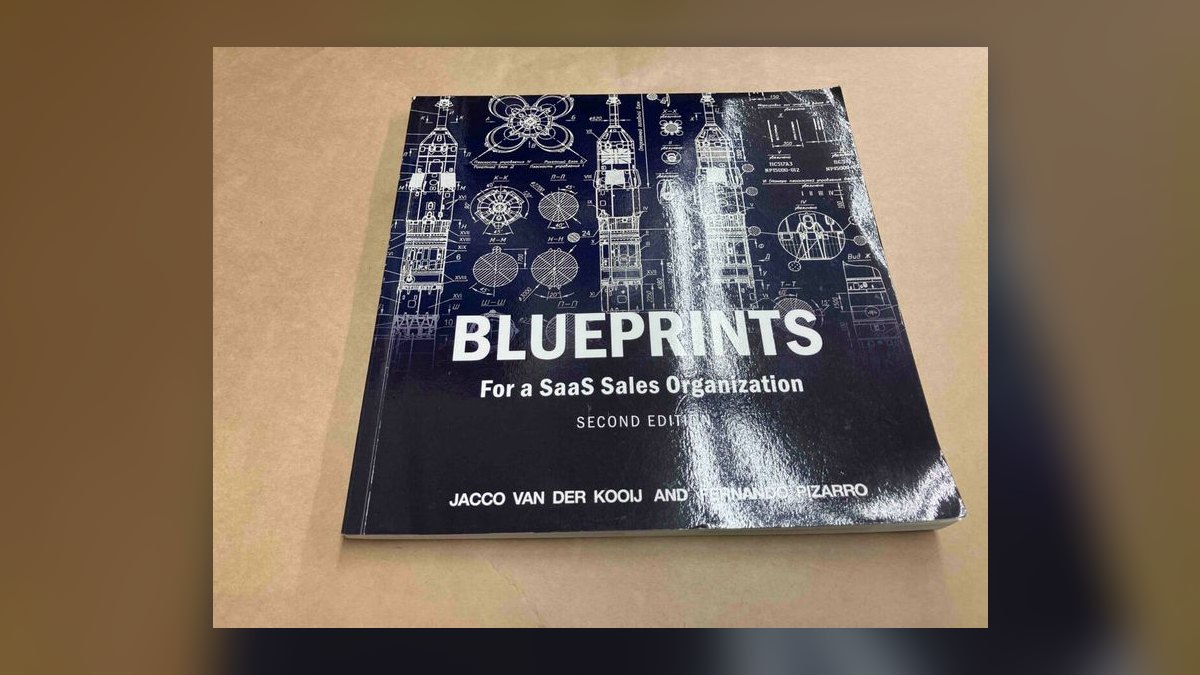
Blueprints for a SaaS Sales Organization by Jacco van der Kooij — Top 10 Key Takeaways for Sales Leaders in 2027
 Curated byKory White · Fractional CRO · Maryland
 PULSEKNOWLEDGE LIBRARY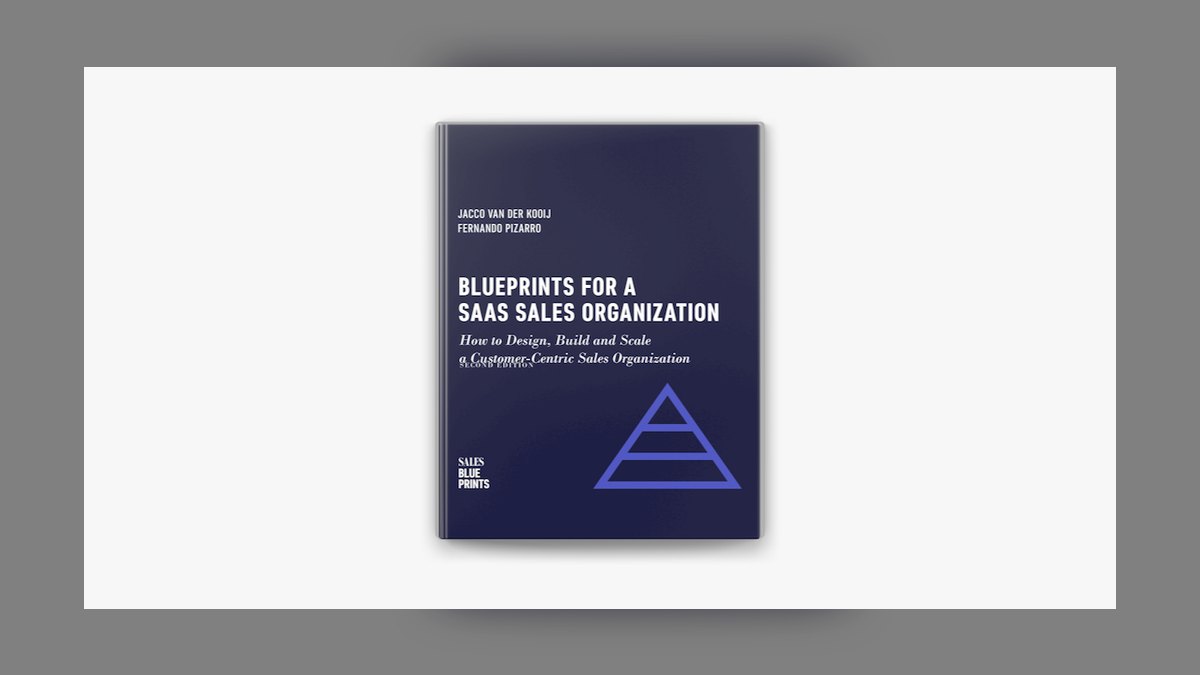
Jacco van der Kooij's *Blueprints for a SaaS Sales Organization* argues that recurring revenue breaks the traditional sales funnel: instead of chasing one-time bookings, sales leaders must design a Bowtie-shaped customer journey — Land, Adopt, Expand, Renew — staffed by specialized roles, measured on net revenue retention, and run on repeatable "recipe cards" rather than individual heroics. The core takeaway for 2027: build process, not personality-dependent selling.
A sales team stuck in a linear funnel
Picture a 40-person SaaS sales organization built the pre-recurring-revenue way: SDRs generate leads, account executives close them, and the moment a contract is signed, the rep moves on to the next prospect. The funnel narrows to a single point — the close — and everything after that is "someone else's problem," usually a thinly staffed customer success team with no defined playbook and no revenue quota of its own. This is the exact structure Jacco van der Kooij diagnoses as broken in *Blueprints for a SaaS Sales Organization*, co-written with Fernando Pizarro and published through the Winning by Design methodology. The problem isn't effort — reps in this model often work harder than anyone — it's that the org chart and the comp plan are still optimized for one-time transactional sales while the business model has quietly become recurring revenue. In a subscription business, a signed contract isn't a finish line; it's the start of an amortized bet the company is making on that customer's continued and expanding usage. When the sales organization treats closing as the endpoint, three things happen predictably: onboarding is inconsistent because no one owns it, expansion revenue is left on the table because no one is incentivized to ask for it, and churn spikes in year two because the relationship went cold right after the signature. Van der Kooij's scenario-based diagnosis is that leaders keep buying more top-of-funnel tools — more SDR headcount, more outbound sequences, more paid leads — to compensate for revenue leaking out the back end, which is the most expensive way possible to grow. The Blueprints framework reframes the sales organization's job: it isn't to close deals, it's to architect and staff a full customer lifecycle where every stage has a named owner, a defined process, and a revenue number attached to it. That reframing is the single biggest mental shift the book asks leaders to make, and it's the lens through which every other takeaway in this list should be read.
How the Bowtie model replaces the funnel
The mechanism van der Kooij proposes to fix the linear funnel is the "Bowtie" — a shape that replaces the single funnel narrowing to a close with two connected funnels: one that narrows toward the initial sale, and a second that widens back out through onboarding, adoption, expansion, and renewal. Instead of the sales motion ending at the pinch point in the middle, the Bowtie treats the moment of closing as the midpoint of the relationship, not the end of it. Each stage in the Bowtie — commonly abbreviated LAER (Land, Adopt, Expand, Renew) — gets its own named role, its own success metric, and its own "recipe card": a documented, repeatable play that any rep can execute without relying on tribal knowledge or individual charisma. A Landing team (SDRs and AEs) owns qualification and initial close. An Onboarding or Adoption team owns time-to-value and product activation. An Expansion team owns upsell and cross-sell once value is proven. A Renewal team owns the recurring-revenue checkpoint before churn risk becomes real. This is a structural break from generalist "full-cycle" reps, and it's deliberate: van der Kooij's research found that specialists who repeat one stage of the journey develop deeper pattern recognition and higher per-stage conversion than generalists spread across the whole lifecycle.
The diagram above is the Bowtie in miniature: revenue doesn't stop flowing once a deal closes, it recirculates through adoption, expansion, and renewal, with an explicit escalation branch when a renewal signals risk instead of growth. Leaders implementing this in 2027 should treat each arrow as a formal handoff with a defined SLA — for example, a maximum number of days between contract signature and the first onboarding touch — because informal handoffs are where the Bowtie model breaks down in practice even when the org chart looks right on paper.
Benchmarks: from bookings to net revenue retention
One of the most concrete Takeaways in the book is a shift in what gets measured. Traditional sales organizations report on bookings, win rate, and quota attainment — all backward-looking snapshots of the Land stage only. Van der Kooij pushes leaders toward metrics that capture the full Bowtie, chiefly net revenue retention (NRR), sometimes called net dollar retention. Industry-wide, SaaS companies considered "best in class" typically post NRR in the 110-130% range, meaning the existing customer base alone grows revenue even before any new logos are added; NRR under 100% signals that expansion and renewal aren't offsetting churn and downgrades, a red flag the book treats as more urgent than a soft quarter of new bookings. Alongside NRR, the framework tracks CAC payback period — how many months of gross margin it takes to recover the cost of acquiring a customer — with healthy SaaS benchmarks generally cited in the 12-18 month range for efficient, capital-conscious growth, and considerably longer payback periods signaling either an overpriced go-to-market motion or an under-monetized product. Time-to-value, the number of days or weeks between contract signature and the customer reaching their first meaningful outcome, is treated as a leading indicator for renewal risk months in advance of the actual renewal date. The book also reframes quota design: rather than a single AE quota measured purely in new-logo ARR, mature SaaS organizations following this blueprint split quota across the Bowtie stages — new business quota for Landing reps, expansion quota for Customer Success or Account Management, and renewal-rate targets for a dedicated renewals function — so that comp plans reinforce the org design instead of undermining it. A sales leader auditing their own organization against these benchmarks should pull NRR, CAC payback, and time-to-value for the trailing four quarters before making any structural change, because these three numbers together diagnose whether the problem is acquisition, activation, or retention — and each has a completely different fix.

Trade-offs: specialization versus generalist reps
Adopting the Bowtie model is not free, and the book is candid about the trade-offs a sales leader takes on. The clearest tension is specialization versus the generalist "full-cycle" rep model that many earlier-stage SaaS companies use by necessity. Specialized roles (dedicated SDRs, AEs, onboarding specialists, expansion reps, renewal managers) produce higher conversion at each stage and let leaders coach a narrower skill set more precisely, but they require enough deal volume to keep every specialist role fully utilized — a five-person sales team splitting into five single-stage specialists usually has too little volume per stage to develop real proficiency, so the model tends to make sense only once an organization has enough pipeline to feed multiple dedicated roles, generally past the early growth stage. The alternative — generalist reps who own a customer end-to-end — trades some conversion efficiency for relationship continuity and lower headcount overhead, and van der Kooij explicitly frames this as the right choice for earlier-stage companies that haven't yet proven their onboarding or expansion motion is repeatable enough to hand off. A second trade-off sits in compensation design: shifting AE comp away from pure new-logo bookings toward a blend that includes retention or expansion outcomes better aligns incentives with the Bowtie, but it also dilutes the aggressive hunting behavior that pure new-business comp plans are good at producing, so leaders have to accept somewhat less new-logo intensity in exchange for healthier lifecycle economics.
Choosing between these paths is a strategy decision, not just an org-chart exercise, and van der Kooij's guidance is to let deal volume and stage of company growth — not a desire to look like a "grown-up" SaaS org — dictate which side of this trade-off a company sits on in any given year.

Common pitfalls in adopting the blueprint
The most common mistake sales leaders make when implementing this blueprint is copying the org-chart shape (SDR, AE, CS, Renewals) without copying the underlying discipline of recipe cards and defined handoff criteria — the result is a Bowtie-shaped org chart still running on funnel-era instincts, where each new role operates from tribal knowledge instead of a documented, repeatable play. A second pitfall is measuring the new organization with old metrics: leaders keep reporting bookings and win rate as the headline numbers while NRR and CAC payback sit buried in a secondary dashboard nobody reviews in the weekly forecast call, which quietly signals to the whole organization that retention still doesn't really matter. A third pitfall is under-resourcing the handoff points themselves — the moments between Land and Adopt, and between Adopt and Expand, are where information and momentum are most often lost, yet they're the stages leaders invest in least because no single role "owns" the seam between two teams. Van der Kooij's guidance for avoiding this is to name an explicit handoff owner and a maximum handoff time (for example, first onboarding call scheduled within 48 hours of signature) rather than leaving the transition as an implicit expectation. A fourth pitfall specific to comp design is rolling out expansion or retention-linked compensation for Customer Success or Account Management without first validating that the product genuinely delivers expansion opportunity — paying a bonus for upsell that the product can't actually support just creates frustrated reps chasing revenue that isn't there. Finally, many organizations attempt to run the full Bowtie model before they have enough deal volume to specialize, which the trade-offs section above already flags as premature — the practical fix is to stage the transition, adding one specialized role (often onboarding first, since time-to-value has the most immediate effect on renewal risk) rather than restructuring the entire sales organization in a single quarter.
Related questions
What is the Bowtie model in SaaS sales?
It's van der Kooij's replacement for the linear sales funnel: instead of narrowing to a single close point, revenue flows through Land, Adopt, Expand, and Renew stages, each staffed and measured separately, so growth compounds through the existing customer base.
Why does net revenue retention matter more than bookings?
Bookings only capture new business; NRR captures whether the existing customer base is expanding or shrinking, which for a recurring-revenue business determines whether growth is compounding or leaking out the back door regardless of how strong new sales look.
Should a small SaaS team specialize into LAER roles right away?
Generally no — specialization only pays off once there's enough deal volume per stage to keep each role busy and improving; earlier-stage teams are usually better served by generalist full-cycle reps.
How fast should onboarding start after a deal closes?
The book recommends defining an explicit, short SLA (often within 48 hours) for the first onboarding touch, since delayed handoffs are one of the most common sources of lost momentum and early churn risk.
FAQ
Who wrote Blueprints for a SaaS Sales Organization? Jacco van der Kooij, founder of the sales methodology firm Winning by Design, co-authored the book with Fernando Pizarro, drawing on their consulting work with recurring-revenue technology companies.
What does "PACT" refer to in the Winning by Design framework? PACT stands for Personas, Alignment, Content, and Tracks — a planning framework used alongside the Bowtie model to define who is sold to, how teams coordinate, what messaging supports each stage, and which repeatable sales plays apply to each customer segment.
Is this book only relevant to venture-backed startups? No — while much of its language reflects high-growth SaaS, the underlying principle (design the organization around the full customer lifecycle, not just the initial sale) applies to any recurring-revenue business, including bootstrapped and enterprise software companies.
What replaces the traditional sales funnel in this model? The Bowtie: two connected funnels, one narrowing toward the initial close and a second widening back out through onboarding, expansion, and renewal, reflecting that revenue continues to be earned (or lost) long after the contract is signed.
How should compensation change under this model? Comp plans should be split across the lifecycle stages a rep or team actually owns — new-logo ARR for Landing roles, expansion revenue for Customer Success or Account Management, and renewal-rate targets for a dedicated renewals function — rather than rewarding only initial bookings.
What's the biggest risk in adopting this blueprint too early? Restructuring into specialized LAER roles before there's enough deal volume to keep each role productive, which spreads a team too thin and slows skill development rather than accelerating it.
Sources
- https://www.oreilly.com/library/view/blueprints-for-a/9781984048433/
- https://winningbydesign.com/
- https://www.saastr.com/
- https://www.gainsight.com/
- https://www.bain.com/insights/topics/net-promoter-system/
- https://www.forentrepreneurs.com/saas-metrics-2/
- https://hbr.org/topic/subject/sales
Related on PULSE
- What is net revenue retention and why does it matter for SaaS growth?
- How should a SaaS company structure its customer success team?
- What is the difference between an SDR and an account executive?
- How do you design sales compensation plans for recurring revenue?
- What causes SaaS customer churn and how is it prevented?
- What is a sales playbook and how do you build one?
 pulse-recentHyper Sales Growth by Jack Daly — Top 10 Key Takeaways for Sales Leaders in 2027
 pulse-recentThe Qualified Sales Leader by John McMahon — Top 10 Key Takeaways for Sales Leaders in 2027
 pulse-recentAmp It Up by Frank Slootman — Top 10 Key Takeaways for Sales Leaders in 2027
 pulse-recentFrom Impossible to Inevitable by Aaron Ross and Jason Lemkin — Top 10 Key Takeaways for Sales Leaders in 2027
 pulse-recentSales Management Simplified by Mike Weinberg — Top 10 Key Takeaways for Sales Leaders in 2027
 pulse-recentThe SaaS Sales Method by Fernando Pizarro — Top 10 Key Takeaways for Sales Leaders in 2027
 pulse-recentFounding Sales by Peter Kazanjy — Top 10 Key Takeaways for Sales Leaders in 2027
 pulse-recentThe Sales Development Playbook by Trish Bertuzzi — Top 10 Key Takeaways for Sales Leaders in 2027
 pulse-recentCracking the Sales Management Code by Jason Jordan — Top 10 Key Takeaways for Sales Leaders in 2027
 pulse-recentPredictable Revenue by Aaron Ross — Top 10 Key Takeaways for Sales Leaders in 2027