
The SaaS Sales Method by Fernando Pizarro — Top 10 Key Takeaways for Sales Leaders in 2027
 Curated byKory White · Fractional CRO · Maryland
 PULSEKNOWLEDGE LIBRARY
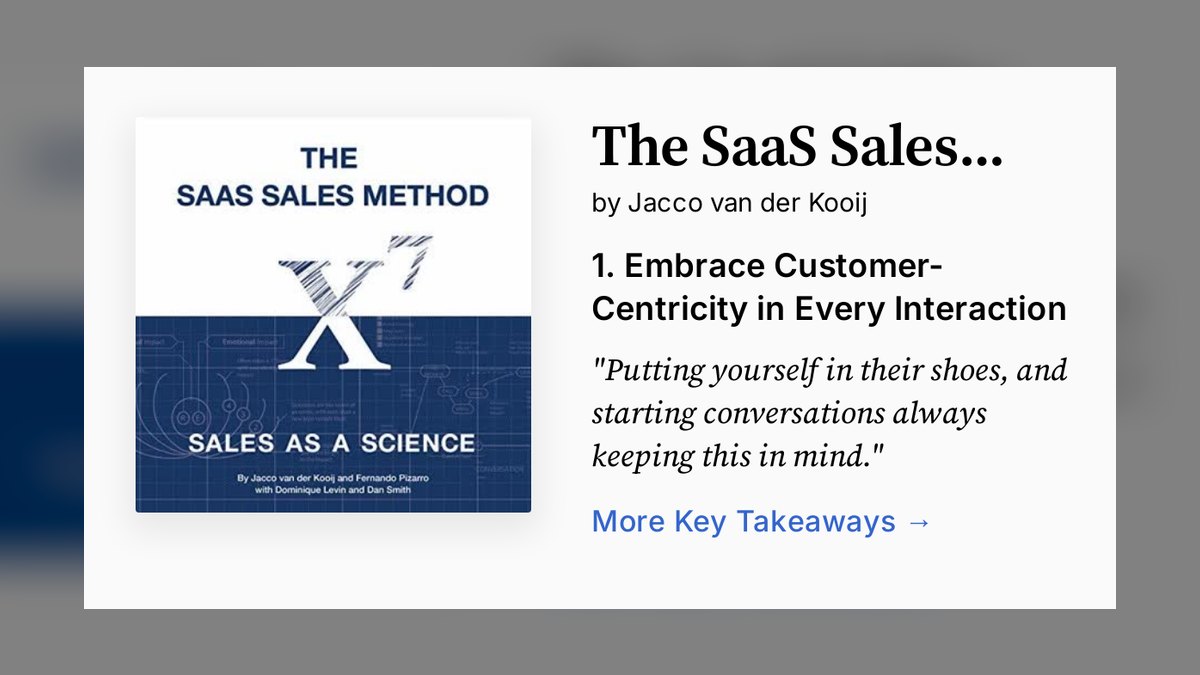
Fernando Pizarro's *The SaaS Sales Method* argues that scalable revenue comes from treating sales as a science, not an art: standardized stages, disciplined qualification, and a "Bowtie" customer lifecycle that extends past the close into onboarding, adoption, and renewal. For sales leaders in 2027, the core takeaway is that predictable growth is a system-design problem, not a talent-acquisition problem.
The outcome you should expect
Leaders who apply the book's framework should expect three concrete shifts within a couple of quarters. First, forecast accuracy improves because deals move through defined stages with explicit exit criteria instead of a rep's gut-feel percentage. When "Stage 3" means the same thing for every account executive on the team, a VP can roll up a pipeline number and trust it within a tight band, typically single digits of variance rather than 20-30% swings.
Second, revenue stops depending on a handful of star performers. Pizarro's central complaint about traditional sales organizations is that they reward heroics — the rep who closes through sheer charisma or a lucky relationship — rather than repeatable behavior. A science-based approach documents what the top decile actually does in discovery calls, negotiation, and multi-threading, then trains the other 80% of the team to do the same thing. The realistic outcome is a narrower gap between your best and median reps, not a magic doubling of the top performer's output.
Third, the revenue motion becomes genuinely cross-functional. Because the method models the customer journey as a Bowtie rather than a funnel — pre-sale activities narrowing to a close, then widening back out through onboarding, adoption, and expansion — marketing, sales, and customer success start operating off one shared map instead of three disconnected ones. Sales leaders stop owning "new logos" in isolation and start owning their contribution to net revenue retention, since renewal and expansion sit inside the same lifecycle they helped originate.
None of this happens overnight. The book is explicit that sales leaders should expect a multi-quarter build: defining stages, instrumenting a CRM to actually enforce them, and retraining muscle memory that took years to form. Leaders looking for a quick script or a single new discovery question will be disappointed — the payoff is structural, and it compounds only after the structure is actually followed rather than treated as a slide deck.

What drives that outcome
The mechanism behind these outcomes is the PACT framework — Predictable, Accountable, Collaborative, Transparent — applied to every stage of the customer lifecycle. Predictable means each stage has a measurable, binary exit criterion (a signed mutual action plan, a technical validation completed, a budget confirmed in writing) rather than a subjective "feels like a 70% deal." Accountable means a single owner is named for every stage, so handoffs between SDR, AE, and customer success don't silently drop a deal. Collaborative means the buyer is treated as a partner co-building a business case, not a target being pitched. Transparent means pricing, next steps, and mutual commitments are stated openly rather than gamed for leverage.
Layered on top of PACT is a structured discovery methodology that borrows the rigor of qualification frameworks like MEDDIC (Metrics, Economic buyer, Decision criteria, Decision process, Identify pain, Champion) but applies it inside the Bowtie rather than only pre-close. That matters because the same discovery discipline that qualifies a new logo — quantifying pain, confirming the economic buyer, mapping the decision process — is reused by customer success to qualify an expansion opportunity, so the organization isn't relearning a new language at every lifecycle stage.
The diagram traces the Bowtie shape: a traditional funnel narrows down to the close, but the method treats the close as the midpoint of a longer curve that widens back out through onboarding, adoption, expansion, and renewal — with renewal data feeding back into how the next cohort is targeted and qualified.
Benchmarks and realistic ranges
Sales leaders implementing this method should anchor decisions to a handful of well-established SaaS benchmarks rather than a single number pulled from the book itself, since the underlying math is standard across the industry. CAC payback period — how many months of gross margin it takes to recoup the fully-loaded cost of acquiring a customer — is commonly targeted in the 12-18 month range for mid-market SaaS, with best-in-class companies pulling that under 12 months. If your payback period is stretching past 24 months, that is usually a signal the sales motion or ICP needs tightening before you add more reps.

Net revenue retention (NRR) is the metric most tied to the Bowtie's expansion side, since it captures upsell and cross-sell against churn and contraction in the existing base. A healthy range for enterprise SaaS is generally cited as 100-120%, meaning the existing customer base grows in value even with zero new logos; SMB-focused businesses often run lower, commonly 90-100%, because smaller accounts churn and contract more easily. Leaders should track this by cohort and by segment rather than as one blended company number, since a strong enterprise NRR can mask a leaking SMB base.
Sales cycle length varies enormously by deal size and buyer sophistication, but for a defined-stage process to actually generate useful forecast signal, most organizations need at least 4-6 discrete, well-instrumented stages between first meeting and close. Quota attainment across a healthy team is often described as a bell curve where roughly 60-70% of reps hit or exceed quota in a well-calibrated territory and comp design; if attainment is either far above that (comp is too generous relative to targets) or far below it (quotas are disconnected from pipeline reality), that is a signal to revisit territory and quota-setting before blaming the reps or the method.

Comp plan structure matters as much as the number itself. A common base-to-variable split for quota-carrying AEs is roughly 50/50 to 60/40, with accelerators kicking in above 100% attainment to reward the outcomes the method is trying to produce — multi-year commitments, expansion-friendly deal structures, and clean handoffs to customer success — rather than only raw bookings velocity.
Risks, edge cases, and failure modes
The most common failure mode leaders report is adopting the vocabulary of the method — "Bowtie," "PACT," defined stages — without changing the underlying incentives. If a rep is still paid purely on closed-won bookings with no accountability for what happens after handoff, they will keep optimizing for the fastest possible close even when the deal is a poor fit, and the expansion side of the Bowtie will quietly starve regardless of how the funnel is labeled in the CRM.

A second risk is over-applying enterprise-grade qualification rigor to a transactional or SMB motion. MEDDIC-style discipline, with a formally identified economic buyer and multi-step decision process, can add friction and cycle time to deals that should close in days, not weeks. Leaders need to calibrate how much process a segment can bear — a self-serve or low-touch motion needs a lighter version of the same principles, not the full enterprise checklist.
Siloed handoffs are a third recurring failure. The Bowtie model only works if sales, onboarding, and customer success share data and definitions. In practice, many organizations run sales on one CRM view and customer success on a separate health-score tool with no common account record, so the "Adopt" and "Expand" stages of the lifecycle are invisible to the people who originated the deal. That breaks the feedback loop the method depends on — sales never learns which deals actually expanded, so qualification never improves.

Forecasting theater is a subtler risk: leaders sometimes impose the stage-and-exit-criteria structure but let reps self-report whether criteria are met, with no independent verification. That produces a forecast that looks disciplined on a dashboard while being just as inflated as the informal system it replaced. Real rigor requires either manager spot-checks or system-enforced evidence (an uploaded mutual action plan, a signed technical validation document) attached to the stage change, not just a dropdown selection.
Finally, scaling the method too fast — rolling it out to fifty reps in one quarter with no pilot — tends to produce inconsistent adoption and CRM data that is too messy to trust, which then discredits the whole approach internally even though the underlying design was sound.

A practical rollout plan
A realistic 90-day rollout starts with an honest audit of the current motion: pull the last two to four quarters of closed-won and closed-lost deals and map what stages actually existed in practice, even if the CRM never formalized them. This reveals where deals really stall, which is almost always more informative than redesigning stages from a whiteboard.
From that audit, define 4-6 stages with binary, evidence-based exit criteria and assign a single owner per stage, including the post-close stages (onboarding complete, first value milestone reached, expansion opportunity identified) that most CRMs never track today. Pick the three to five metrics that matter most for the specific business — commonly CAC payback, NRR, stage conversion rates, and sales cycle length — and build a single dashboard both sales and customer success leadership look at, so there is one shared version of the truth.

Next, retrain the team on the discovery methodology itself, not just the new stage names. This is where most of the multi-quarter timeline goes: reps need repetition and coaching on quantifying pain, confirming an economic buyer, and mapping a decision process before the new stages produce better data than the old ones did. Running this with a pilot pod of two to four reps for a full sales cycle before rolling it company-wide lets a leader catch process gaps — a stage that's ambiguous, an exit criterion nobody can actually satisfy — while the blast radius is small.
Finally, close the loop by wiring customer success and renewal data back into how the sales team qualifies and targets the next cohort, and revisit comp plan design so it rewards the behaviors the strategy is meant to produce, not just the ones the old plan rewarded.

Related questions
What is the Bowtie model in SaaS sales?
It's a customer lifecycle shape that replaces the traditional funnel: activities narrow toward a closed deal, then widen back out through onboarding, adoption, expansion, and renewal, treating post-sale revenue as part of the same designed system as new-logo sales.
What does PACT stand for in Fernando Pizarro's framework?
Predictable, Accountable, Collaborative, Transparent — four qualities each sales stage should have, with a named owner and a measurable exit criterion rather than a subjective "gut feel" progression.
Why does the book call sales a science instead of an art?
Because it argues repeatable growth comes from documenting what top performers actually do and training the rest of the team to replicate it, rather than relying on individual talent or charisma that can't be scaled or hired for reliably.
How is this different from a standard MEDDIC qualification approach?
The method applies MEDDIC-style discovery rigor across the entire Bowtie, not just pre-close, so customer success uses the same qualification language for expansion opportunities that sales used to qualify the original deal.
FAQ
Who is Fernando Pizarro and why does his SaaS Sales Method matter to sales leaders? Fernando Pizarro is a sales leader and educator associated with the Winning by Design consulting and training organization, which built the SaaS Sales Method framework used across the industry. It matters because it packages years of pattern-recognition across many SaaS companies into a teachable, repeatable system rather than leaving process design to each individual leader.
What are the Top 10 Key Takeaways in one sentence each? At a high level: treat sales as a science; use PACT to structure every stage; replace the funnel with a Bowtie; qualify with discipline (not gut feel); own the full customer lifecycle, not just the close; align comp to outcomes beyond bookings; track CAC payback and NRR as core health metrics; document what top performers do and train to it; pilot process changes before scaling them; and treat forecasting as a data discipline requiring evidence, not self-reported confidence.
Is this method only for enterprise SaaS companies? No, but the intensity of process should flex by segment. Enterprise motions benefit from the full discovery and qualification rigor, while SMB or self-serve motions should apply the same underlying principles — clear stages, shared metrics, accountable ownership — with far less friction per deal.
How long does it take to see results after adopting this strategy? Most leaders should expect a multi-quarter build: the first quarter typically goes to auditing and defining stages, the second to retraining and piloting, and measurable forecast-accuracy and retention improvements usually show up from the third quarter onward as data quality catches up to the new process.
Does this replace the need for a strong sales culture or coaching? No — the framework is a scaffold for coaching, not a substitute for it. Managers still need to run pipeline reviews and skill coaching; the method just gives them a shared, evidence-based language and a set of exit criteria to coach against instead of subjective deal reviews.
What's the biggest mistake sales leaders make when rolling this out? Changing the vocabulary and CRM fields without changing compensation and accountability. If reps are still paid purely on closed-won bookings with no stake in onboarding, adoption, or expansion, the Bowtie's back half will underperform no matter how well the front half is designed.
Sources
- https://www.winningbydesign.com/
- https://www.saastr.com/
- https://www.gainsight.com/
- https://chartmogul.com/
- https://openviewpartners.com/
- https://www.bvp.com/atlas
- https://www.forrester.com/
- https://www.gartner.com/en/sales
Related on PULSE
- What is net revenue retention and why does it matter more than new-logo growth?
- How should sales compensation plans change to reward expansion revenue?
- What is MEDDIC qualification and when should sales teams use it?
- How do you calculate CAC payback period for a SaaS business?
- What separates a top-performing sales rep's discovery call from an average one?
- How should sales and customer success share ownership of the customer lifecycle?
 pulse-recentSmart Calling by Art Sobczak — Top 10 Key Takeaways for Sales Leaders in 2027
 pulse-recentINKED by Jeb Blount — Top 10 Key Takeaways for Sales Leaders in 2027
 pulse-recentThe Sales Manager’s Guide to Greatness by Kevin Davis — Top 10 Key Takeaways for Sales Leaders in 2027
 pulse-recentHyper Sales Growth by Jack Daly — Top 10 Key Takeaways for Sales Leaders in 2027
 pulse-recentThe Qualified Sales Leader by John McMahon — Top 10 Key Takeaways for Sales Leaders in 2027
 pulse-recentAmp It Up by Frank Slootman — Top 10 Key Takeaways for Sales Leaders in 2027
 pulse-recentFrom Impossible to Inevitable by Aaron Ross and Jason Lemkin — Top 10 Key Takeaways for Sales Leaders in 2027
 pulse-recentSales Management Simplified by Mike Weinberg — Top 10 Key Takeaways for Sales Leaders in 2027
 pulse-recentFounding Sales by Peter Kazanjy — Top 10 Key Takeaways for Sales Leaders in 2027
 pulse-recentBlueprints for a SaaS Sales Organization by Jacco van der Kooij — Top 10 Key Takeaways for Sales Leaders in 2027