
How Many Employees Should I Schedule Each Shift at My Brewery Taproom in 2026?
 Curated byKory White · Fractional CRO · Maryland
 PULSEKNOWLEDGE LIBRARY
Quality
Certified
Most Brewery Taproom shifts need one bartender per 10 to 15 bar-order seats, plus a floor runner once you pass 40 seats — but size the count off money: divide that shift's average gross profit by a per-person target near $300. Quiet weekdays land at one or two people; peak Friday nights at four or five.
Seats per server versus gross profit per person: the two options compared
There are really only two defensible ways to decide how many bodies stand behind your bar on a given night, and almost every taproom owner is unknowingly running a sloppy hybrid of both.
Option one is the coverage method. You count physical service points and divide. A taproom with a 24-foot bar, 30 bar-order seats, 40 table seats, and a patio has a known number of positions that must be physically occupied for the room to function: someone pouring, someone clearing and running, someone checking IDs at the door on busy nights, someone changing kegs, someone washing glassware. The coverage method asks "what is the smallest number of humans who can physically hold every station without the line reaching the door?" and staffs to that. It is spatial, it is intuitive, and it is what nearly every new operator uses by default because you can do it standing in the empty room before you open.
Option two is the gross-profit method. You ignore geography entirely and stack the schedule against dollars. You set a per-person gross-profit floor — the honest amount of gross profit one average person should generate on one average shift — then divide each shift's trailing average gross profit by that floor. The answer is your headcount. If Friday night reliably produces $1,500 in gross profit and your floor is $300, Friday needs five people. If Tuesday produces $300, Tuesday needs one. No debate, no seniority politics, no "we've always run three."
The two methods answer different questions, which is why hybridizing them by feel goes wrong. Coverage answers *can we physically serve the room*. Gross profit answers *can the room afford the people in it*. A taproom staffed purely on coverage will be profitable on its busiest nights and quietly bleed on its slow ones, because the coverage minimum does not shrink when traffic does — you still "need" a bartender and a runner on a dead Monday, even though Monday generates a fraction of the gross profit needed to carry two people. A taproom staffed purely on gross profit will be beautifully efficient on paper and periodically fall apart in the room, because the math will happily tell you that a 120-seat space with a food truck outside can be run by 1.4 people.
The practical difference shows up in three places. First, variance tolerance: coverage staffing absorbs a surprise 40-person cycling club walking in; gross-profit staffing does not, because it was sized to the average, and averages have no room for the top quartile of nights. Second, labor percentage: coverage staffing produces wildly swinging labor-cost percentages by day (great on Saturday, catastrophic on Tuesday), while gross-profit staffing flattens labor cost to a near-constant share of sales by construction. Third, staff earnings: coverage staffing tends to over-schedule slow shifts, which dilutes tips across too many people and makes your best bartenders quietly resent the schedule. Gross-profit staffing concentrates earnings — fewer people, bigger tip share, higher retention among the people you actually want to keep.
The correct answer for a taproom is not to choose one. It is to use the gross-profit method to set the headcount and the coverage method as a hard floor the math is never allowed to violate. That is a specific, testable rule: people = max(coverage_minimum, round(shift_gross_profit / per_person_target)). Everything below is how to establish both halves of that expression with real numbers from your own POS instead of borrowed rules of thumb.
How to decide between them at your Brewery Taproom
The decision is not philosophical, it is diagnostic. Three properties of your specific room determine which side of the expression dominates, and you can measure all three in an afternoon.
Property one: your coverage floor's rigidity. Order-at-the-bar taprooms have a low, flexible floor — one competent person can technically open, pour, ring, and clear a 40-seat room during a slow afternoon. Full table-service brewpubs with a kitchen have a rigid floor: you cannot run table service, expo, and a bar with one human regardless of what the gross profit says. Measure this by walking a slow shift and asking which stations were genuinely unattended for more than two minutes. If the answer is "none, one person handled it," your floor is soft and the gross-profit method should drive. If the answer is "the bar was abandoned every time an entrée went out," your floor is rigid and coverage drives on every shift with food.
Property two: your gross-profit spread across the week. Pull trailing gross profit by day of week for three to six months and compute the ratio of your best day to your worst day. Taprooms commonly land somewhere between 3x and 8x. If your spread is under about 3x, the two methods converge and it barely matters which you use — a flat schedule is roughly right. If your spread is 5x or more, coverage staffing is actively destroying money on the low end, and the gross-profit method is where your savings live. This single ratio is the most useful number in the whole exercise and almost nobody computes it.
Property three: variance within the same weekday. Take the same daypart — say Thursday 5 to 9 p.m. — across twelve weeks and look at the standard deviation of gross profit, not just the mean. A taproom with a stable Thursday can be scheduled to the average safely. A taproom whose Thursday swings from $200 to $1,400 depending on whether there's trivia, live music, or a release cannot be scheduled to the average at all; it needs event-flagged schedules and an on-call layer. High within-day variance pushes you toward coverage plus a call-in person rather than pure math.
Run this decision once per daypart, not once for the whole business. A single taproom routinely contains both regimes: a soft-floor, low-spread weekday afternoon that the coverage minimum governs, and a rigid-floor, high-variance Friday night that the gross-profit math governs. Treating the room as one uniform staffing problem is the actual root cause of most bad taproom schedules.
The concrete numbers behind each option
Establishing the coverage floor. Do this arithmetically rather than by feel. Time your own service: pouring a pint from a properly balanced tap, capping the transaction, and clearing the interaction takes roughly 30 to 45 seconds for a trained bartender when nothing goes wrong. That arithmetic caps one person at roughly 80 to 120 transactions per hour at absolute full tilt, and real-world throughput lands far lower — call it 50 to 70 — once you add ID checks, flight builds, card declines, keg changes, and someone asking what a gose is. A flight of four 4-ounce pours takes three to four times as long as a single pint. A crowler or growler fill can take two to four minutes and blocks the line completely.
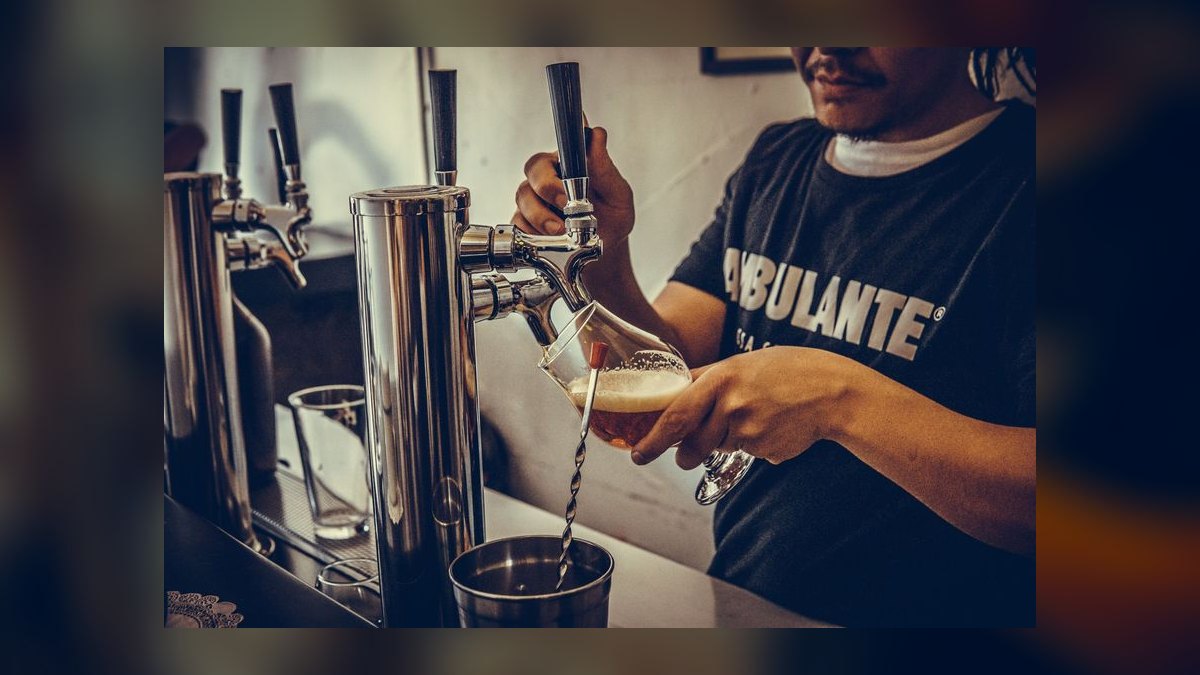
From that, the commonly used planning ratios make sense: one bartender per 10 to 15 order-at-bar seats, and one server per 20 to 30 seats where guests sit and are served at the table. A 60-seat taproom with bar ordering therefore floors out around two people during any hour it expects to be more than a third full. Add a dedicated floor person — clearing glassware, wiping tables, running food from a truck — once you exceed roughly 40 occupied seats, because a bartender who leaves the well to bus tables stops being a bartender. Add a door person for ID checks only on nights where you expect a genuine queue; below that, the bar checks IDs at the point of pour.
Two more floor rules that override everything: never schedule one person alone on a shift where cash handling, late hours, or a solo close is involved — two is a safety and integrity minimum, not an efficiency question. And never schedule below the number of people needed to hit your legally required break coverage, which varies by state.
Establishing the gross-profit target. The per-person floor is a leadership decision you say out loud, not a formula. Set it as the gross profit an average person should generate on an average shift, then publish it: "In this taproom, if you show up, pour for an average crowd, recommend a flight, and keep tables turning, you produce no less than $300 in gross profit per shift." That number is a floor, not a ceiling — the bartender who wants real money hits $300 on ordinary pints and then digs for the next $300 with flights, four-packs to go, and merch.
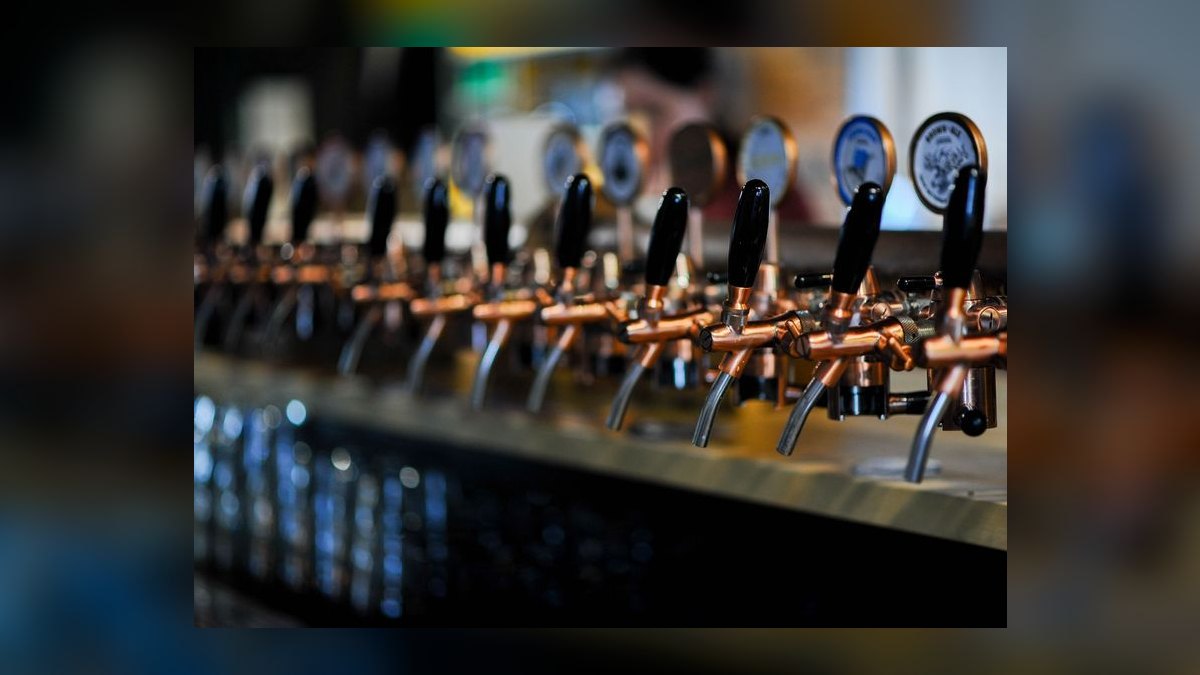
Sanity-check the target against gross margin. Draft beer poured in your own taproom is your highest-margin channel by a wide distance; a pint that costs a couple of dollars in ingredients, packaging-free, and sells for $7 to $9 carries a very high gross margin. Guest taps, wine, cocktails, and food-truck revenue share carry materially lower margins. That matters because gross profit, not revenue, is the denominator that should drive headcount. A busy afternoon of $5 pints can carry fewer people than a slower evening of high-ticket food and cocktails, and only the gross-profit view sees that correctly.
The division in practice. Suppose trailing three-month averages look like this: Monday $250 gross profit, Tuesday $300, Wednesday $550, Thursday $900, Friday $1,500, Saturday $1,800, Sunday $700. At a $300 target that yields 1, 1, 2, 3, 5, 6, and 2 people respectively. Now apply the coverage floor of two — Monday and Tuesday become two people, not one. Total scheduled headcount for the week: 22 person-shifts instead of the 28 a flat "three every day" schedule produces. At six-hour shifts, that is 36 fewer paid hours a week without touching a single peak hour.
Cross-check with sales per labor hour and labor percentage. Divide shift sales by scheduled labor hours; hospitality operators commonly plan against roughly $80 to $120 in sales per labor hour, and total labor typically targets somewhere in the 20% to 30% band of sales for a taproom without a full kitchen, drifting higher once you add a real back-of-house. If your gross-profit division produces a schedule whose sales-per-labor-hour falls under about $70, you are still overstaffed even after the math. If it produces $180, you are about to have a bad night — the coverage floor was too soft.
Where each method breaks: events, food, and the shoulders of the shift
Events destroy the average. Trivia nights, live music, and release days do not behave like the weekday they fall on. A Wednesday release can out-produce a normal Friday, and the trailing average for "Wednesday" will never tell you that. Flag event shifts as their own category and average them against each other, not against the ordinary version of that weekday. In practice that means maintaining three or four schedule templates — ordinary weekday, ordinary weekend, event night, release day — and choosing the template when the event calendar is set, typically two to four weeks out.
Food changes the floor, not the math. Adding a kitchen raises the coverage floor by at least one and usually two people (one cooking, one expediting or running) on every shift the kitchen is open, and it lowers your blended gross margin. Both effects push toward more people per dollar. A food truck parked outside is the opposite: it adds traffic and dwell time without adding your labor, which is precisely why so many taprooms prefer the arrangement. If your truck schedule varies by night, your staffing should vary with it — a truck night usually behaves like a half-step-up in daypart.

The shoulders leak the most money. Most taprooms lose more labor dollars to badly placed shifts than to badly counted ones. The count tells you how many; the receipt timing tells you when. Pull hourly transaction counts and you will typically see a thin early afternoon, a hard after-work spike from roughly 5 to 8 p.m., and a long weekend evening. If everyone clocks in at 3 p.m. and out at close, you paid full coverage through two dead hours and were still short during the spike. Six-hour shifts staggered against the curve — one opener carrying the quiet stretch, two or three arriving 30 to 60 minutes ahead of the spike, one closer overlapping for breakdown — routinely recovers 10% to 15% of scheduled hours with no reduction in peak coverage.
Tip dilution is a real constraint. Adding a fifth person to a four-person Friday cuts each person's tip share by roughly 20%. Do that repeatedly and your strongest bartenders start trading shifts away or leaving. Overstaffing is not just a labor-cost problem; it is a retention problem, and the retention cost never shows up on the P&L line you are trying to optimize.
Compliance overrides everything. Predictive-scheduling and fair-workweek ordinances in a number of cities and states impose advance-notice windows and premium pay for last-minute changes, generally above certain employee-count thresholds — check whether yours applies before you build an on-call layer. Tip-credit and tipped-minimum-wage rules vary by state and change what an extra scheduled person actually costs you. Overtime obligations at 40 hours in a workweek mean a fifth shift for a full-timer can cost 1.5x, which frequently makes a part-timer the cheaper coverage for a marginal peak hour.
How to Schedule Employees week by week: implementation and sequencing
Do this in order. Skipping to step four is why most attempts fail.
Step one — set and publish the per-person gross-profit target. Pick the number with your leadership, say it to the whole team, and explain that it is a floor everyone is measured against equally. The transparency is the point: it removes the "manager schedules their friends on Friday" dynamic by making the schedule a division problem rather than a favor economy.
Step two — pull trailing gross profit by day and daypart. Three to six months minimum. Gross profit, not revenue: pull cost of goods by category so that draft, guest taps, packaged to-go, food, and merch each carry their real margin. Most POS systems will export this; if yours won't split margin by category, apply your own category margins to the revenue mix by hand. It's an hour of work once.

Step three — compute the coverage floor per daypart. Walk the room, time your service, count stations. Write the floor down per daypart as a hard integer. This is the number the math may never go below.
Step four — run the division and take the max. people = max(coverage_floor, round(shift_GP / target)) for every daypart of every day. You now have a headcount grid, not a schedule.
Step five — place the bodies against the hourly receipt curve. Convert headcount into staggered start and end times using hourly transaction data. Aim for arrivals 30 to 60 minutes before each spike and overlapping closes rather than uniform shifts.
Step six — publish 10 to 14 days ahead and hold it. Advance notice is what lets you run lean: people plan around a schedule they trust, and no-shows are what actually force overstaffing. Any scheduling app your team already uses handles the publishing and swap logistics — 7shifts, Homebase, When I Work, Deputy, and Sling all cover this ground, and several tie schedules to POS sales data so you can watch labor percentage against forecast as the week runs. Pricing and tiers change, so verify current plans directly with the vendor. The tool is not the method; the division is the method.
Step seven — reconcile weekly and re-baseline monthly. Every Monday, compare scheduled hours to actual and gross profit to forecast per shift. Any shift more than about 20% off forecast gets flagged. Every month, re-run the trailing averages and reset the grid — seasonality in a taproom is severe, and a January grid will overstaff you through a slow March or understaff you through a busy July.
Expect the first two cycles to feel wrong. The grid will tell you to run one or two people on shifts you have always covered with three, and the room will feel thin for a week while the remaining staff adjust their movement patterns. Watch two signals during that window: guest wait time at the bar during the spike hour, and sales per labor hour for the shift. If wait times hold and sales per labor hour climbs, the reduction was real slack. If wait times stretch past a few minutes at the well, your coverage floor was set too low — raise the floor for that daypart and leave the target alone.
Related questions
What is the absolute minimum number of people I can open with?
Two, on any shift involving cash handling or a solo close — one for safety and integrity, one to keep the bar attended. A one-person shift is only defensible for a very small order-at-bar room during a genuinely dead daypart with a manager reachable on call.
Should I schedule to revenue or to gross profit?
Gross profit. Revenue treats a $5 house pint and a $5 slice of low-margin food as identical, and they are not. Draft poured in your own room carries far higher margin than guest taps, cocktails, or food, so revenue-based staffing systematically overstaffs low-margin dayparts.
How far ahead should the schedule be published?
Ten to fourteen days is the practical sweet spot: far enough that staff plan around it and no-shows fall, close enough that you can still use the event calendar. Some jurisdictions legally mandate advance notice above certain employee-count thresholds — confirm your local rule.
How do I handle a brand-new taproom with no sales history?
Staff to the coverage floor plus one for the first four to six weeks, and treat that period as data collection rather than optimization. Log hourly transactions from day one; after six weeks you have enough of a curve to start running the division honestly.
Does a food truck change my headcount?
It changes traffic and dwell time without adding your labor, so it usually behaves like a half-step-up in daypart — often one additional floor person for clearing, not an additional bartender. A real kitchen is different: it raises the coverage floor by one to two on every shift it's open.
FAQ
How many bartenders do I need for a busy Friday night?
Work it from both directions. Coverage says one bartender per 10 to 15 order-at-bar seats plus a floor runner past 40 occupied seats — for a 60-seat room, that's three to four. Gross profit says divide Friday's trailing average gross profit by your per-person target, so $1,500 at a $300 target is five. Take the higher of the two and stagger the arrivals against your 5-to-8 spike.
What should my per-person gross-profit target actually be?
It's a leadership decision, not a formula, and it should be a floor an average performer clears on an average shift. Many small taprooms land near $300 per person per shift. Sanity-check it against sales per labor hour — roughly $80 to $120 is a common planning band — and against total labor as a share of sales, typically 20% to 30% for a taproom without a full kitchen.
How do I keep slow shifts from wasting labor?
Hold the two-person safety floor, then load the downtime with real work: keg rotation, glassware, cooler resets, line cleaning prep, merch restock, inventory counts, and to-go can packing. Cross-train so the person on a dead Tuesday is genuinely productive rather than wiping the same glass for an hour. Shorter six-hour shifts on slow days beat eight-hour shifts with two dead tails.
What if my sales swing wildly week to week?
Separate the swing's cause. If it's event-driven, build event-specific templates and average event nights against each other instead of against the ordinary weekday. If it's genuinely random, schedule to the trailing average and add one on-call person who is paid something for availability — then check whether a predictive-scheduling ordinance applies to you before you rely on call-ins.
Won't scheduling fewer people hurt my tips and my team?
The opposite, usually. Overstaffing a slow shift splits a small tip pool across too many people, which is exactly what drives your best bartenders to trade shifts away. Concentrating headcount raises per-person earnings on the shifts where the money is. What actually hurts the team is understaffing a peak, which is why the coverage floor is a hard override on the math.
How often should I rebuild the grid?
Reconcile weekly — scheduled hours versus actual, gross profit versus forecast, flagging any shift off by 20% or more — and re-baseline the trailing averages monthly. Taproom seasonality is severe enough that a winter grid will misstaff a summer patio badly in both directions if you leave it alone.
Sources
- https://www.brewersassociation.org/
- https://restaurant.org/
- https://www.bls.gov/ooh/food-preparation-and-serving/bartenders.htm
- https://www.dol.gov/agencies/whd/flsa
- https://www.dol.gov/agencies/whd/state/minimum-wage/tipped
- https://www.dol.gov/agencies/whd/overtime
- https://pos.toasttab.com/blog/on-the-line
- https://www.7shifts.com/blog
- https://craftbeerandbrewing.com/
Related on PULSE
- How Many Employees Should I Schedule Each Shift at My Thrift Store?
- How Many Employees Should I Schedule Each Shift at My Vintage Clothing Store?
- How Many Employees Should I Schedule Each Shift at My Record Store?
- How Many Employees Should I Schedule Each Shift at My Comic Book Store?
- How Many Employees Should I Schedule Each Shift at My Smoke and Vape Shop?
- How Many Employees Should I Schedule Each Shift at My Aquarium Store?
This page will be disappearing soon. Save it to your device for $1 — or read it free while it is here.
@Kory-White- · if Venmo asks, the last 4 of my number are 2012
This page is gone.
This one is off the shelf now. $1 keeps it on your phone for good — the whole page, pictures and diagrams included.
 pulse-qHow Do I Make My Sales Goals Visible to the Whole Team in 2026?
 pulse-qHow Do I Calculate the Right Service Fee to Charge in 2026?
 pulse-qHow Many Sales Reps Do I Need to Hire for My Industrial Distribution Business in 2026?
 pulse-qHow Many Sales Reps Do I Need to Hire for My Janitorial Supply Company in 2026?
 pulse-qHow Many Sales Reps Do I Need to Hire for My VoIP Company in 2026?
 pulse-qHow Many Sales Reps Do I Need to Hire for My Dental Equipment Company in 2026?
 pulse-qWhat Service Fees Should a Property Management Company Charge in 2026?
 pulse-qWhat Service Fees Should a Gym or Fitness Studio Charge in 2026?
 pulse-qWhat Service Fees Should a Junk Removal Company Charge in 2026?
 pulse-qHow Do I Raise Contribution Margin Without Raising My Prices in 2026?