
Do I Need a Fractional CRO for My Home Services Business in 2026?
 Curated byKory White · Fractional CRO · Maryland
 PULSEKNOWLEDGE LIBRARY
Quality
Certified

You likely need a fractional CRO if your home services business runs $2M–$10M, has three or more sellers, and converts booked calls inconsistently despite steady lead flow. At roughly $4,000–$12,000 monthly, the role installs pricing, comp, and conversion systems without a $300K+ full-time executive commitment.
The two-truck HVAC company that could not explain its own revenue
Picture a residential HVAC company doing $6.8M a year across eleven trucks in a single metro. Summer is chaos — dispatch is triple-booking, the owner is answering escalations at 9 p.m., and the phone rings so much that nobody questions whether it is being answered well. November arrives, revenue drops by half, and the owner starts buying more leads to compensate. That reflex — spend more when revenue dips — is the single most common capital-destroying habit in the trades, and it is exactly the habit a revenue operator is hired to interrupt.
Here is what an audit typically surfaces in a company like that. The call center answers roughly 1,100 inbound calls a month during peak. Of those, some meaningful fraction never converts to a booked appointment — not because the caller was a tire-kicker, but because the call was abandoned on hold, went to voicemail after hours, or the CSR quoted a diagnostic fee and the caller hung up. Every point of booking rate on 1,100 calls is 11 additional appointments. At a $600 average ticket, that is $6,600 a month per point. Move booking rate from 68% to 80% and you have added roughly $79,000 in monthly revenue from calls you already paid to generate. No new ad spend. No new truck. No new tech.
Now look at the other end. Two technicians on the same truck class run the same category of call. One writes an average ticket of $480. The other writes $1,150. The owner's instinct is that one guy is a "natural salesperson." The real difference is almost always systemic: the higher performer presents three options instead of one, mentions financing before the price lands, and offers the maintenance membership on every single call rather than when he feels like it. That is a repeatable process, not a personality trait — and codifying it across the whole crew is a revenue-leadership job, not a dispatch-manager job.
The third thing that surfaces is attribution. The company spends money across Google Local Services Ads, paid search, a direct-mail piece, a yard-sign program, and a home-show booth. The owner can tell you total marketing spend to the dollar. He cannot tell you cost per booked job by channel, and he definitely cannot tell you gross profit per booked job by channel — which is the number that actually matters, because a channel producing $200 diagnostic calls at $90 per booked job is a worse business than a channel producing $4,000 replacements at $400 per booked job.
None of those three problems are lead-volume problems. They are conversion, pricing, and measurement problems — and that is the specific diagnosis that says a fractional CRO is the right hire rather than another marketing agency.
How the engagement mechanism actually works
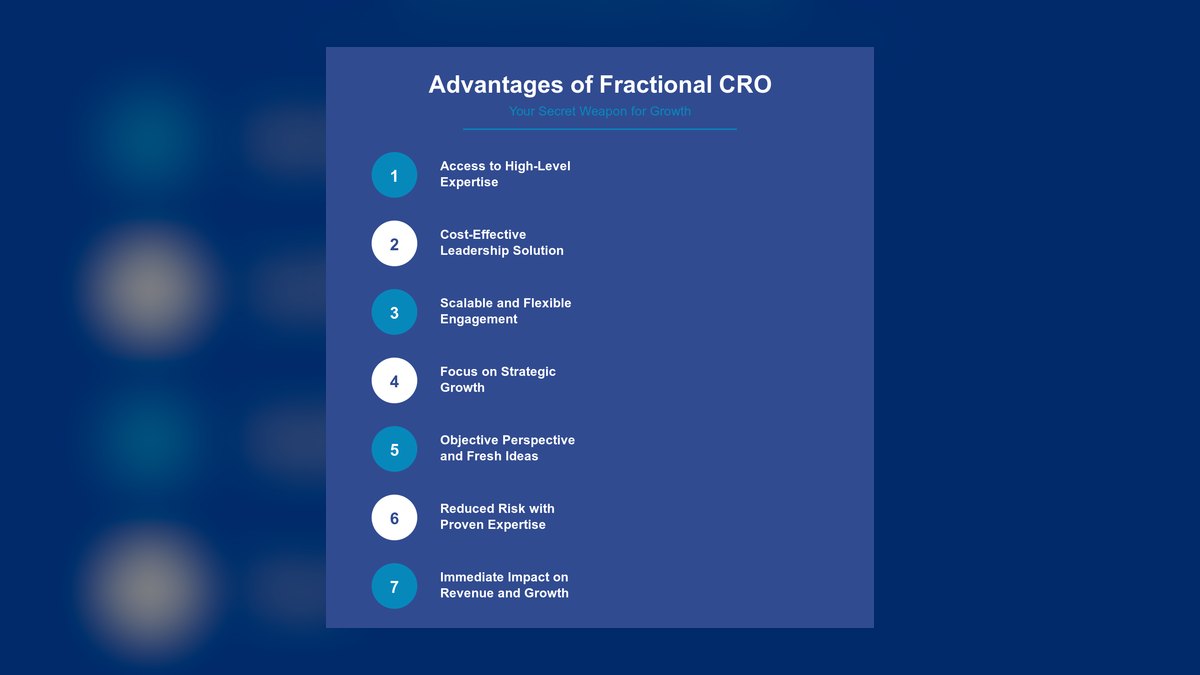
A fractional CRO is not a consultant who delivers a deck. The structural difference is accountability: they own revenue outcomes and sit in your operating rhythm, typically two to six days a month, on a fixed retainer with a three-to-six-month minimum so there is enough runway to change anything real.
Days 1–30: diagnosis and instrumentation. The first move is establishing a truthful baseline in whatever field service management system you run — ServiceTitan, Housecall Pro, Jobber, or a spreadsheet if that is genuinely where you are. The baseline set for a trades business is narrow and non-negotiable: booked-call rate by CSR and by hour of day, average ticket by technician and by service line, close rate on estimates over some dollar threshold, cost per booked job by lead source, membership attach rate and membership retention, and gross profit per job by crew. If that data does not exist cleanly, the first two weeks get spent building it — which is billable time you can avoid by cleaning up your CRM before the engagement starts.
Days 31–60: the operating system takes shape. This is where the redesign work happens. Call scripts get rebuilt so the CSR's job is booking the appointment, not defending the diagnostic fee. The in-home presentation gets standardized into a good/better/best option sheet with financing disclosed as a monthly figure up front. Technicians get a menu they are expected to present in full on every call — repair options, replacement options, membership, and the relevant add-ons for that system's age and condition. The comp plan gets rewritten so that selling the full menu and protecting gross margin both pay, instead of paying on revenue alone (which quietly rewards discounting).

Days 61–90: the rhythm and the handoff. Weekly pipeline and performance reviews start running on a fixed cadence with the sales manager and call-center lead present. A dashboard goes live with the metrics above, reviewed the same day each week. Critically, this phase is about transferring ownership — the fractional CRO's job is to make your internal leaders capable of running the system so the retainer can step down to a lighter maintenance level rather than becoming a permanent dependency.
Month 4 onward: steady-state. Cadence drops to strategic work — refining LSA and paid spend against cost-per-booked-job data, building the referral and reactivation programs, adding service lines, coaching on objection handling, and producing the monthly forecast your lender or partner actually needs.

Real numbers: what it costs and what has to move to justify it
Start with the alternative you are pricing against. A full-time Chief Revenue Officer carries a base salary roughly in the $180,000–$350,000 range, and once you add bonus, equity or phantom equity, payroll taxes, benefits, and a vehicle or travel allowance, all-in cost lands closer to $300,000–$500,000. Recruiting fees for an executive search run 20–30% of first-year base, which is another $40,000–$100,000 before the person starts. Ramp to full productivity is typically 90–120 days. And if the hire misses, severance plus the cost of re-running the search can exceed $50,000 on its own. That is a $400,000-plus first-year commitment for a business whose net margin may be 8–12%.
A fractional engagement typically prices between $4,000 and $12,000 per month depending on scope, seniority, and how many days a month you are buying. Annualized, that is $48,000–$144,000 — roughly a third to half of a full-time CRO's total cost, with no recruiting fee, no severance exposure, and no equity dilution. Scope is also seasonal-friendly: you can buy a heavier engagement during your peak booking months and step down during the slow quarter, which fits the cash-flow shape of an HVAC, roofing, or landscaping business far better than a fixed executive salary does.
The break-even math. Take a $6,000/month retainer — $72,000 a year. On a $6M business at a 45% gross margin, you need roughly $160,000 in incremental revenue to cover the retainer in gross profit terms. Framed against the levers above, that is a small ask: on 1,100 monthly calls at a $600 average ticket, two points of booking rate is about $158,000 a year. A $50 lift in average ticket across 700 monthly tickets is $420,000 a year. A membership attach improvement that adds 300 members at $20/month is $72,000 in recurring revenue plus the pull-through of the maintenance visits themselves. You do not need a transformation to clear the retainer. You need one lever moved competently.

The revenue band where it fits. The model works best between roughly $2M and $15M in annual revenue. Below about $1.5M you generally have one or two people selling and the leverage of executive-level systems thinking is thin — a sales coach or a good training program is the better spend. Above $15–20M you can usually justify the full-time hire outright, and you want the person in the building daily. The band in between is the structural gap the fractional model exists to fill: you need CRO-level architecture but the P&L cannot absorb CRO-level payroll.
Realistic improvement ranges. Be skeptical of anyone promising a specific percentage before they have seen your data. What is defensible to expect is directional: measurable movement in booked-call rate once the CSR script and after-hours coverage are fixed, a step change in average ticket once option-based presentation is standardized, and better marketing efficiency once spend is judged on cost per booked job rather than cost per lead. The honest framing is that a competent operator finds the leak fast and the size of the win depends entirely on how big your leak was — which is why the 30-day diagnostic exists before anyone commits to a longer term.

Structuring the deal. Common structures are a flat monthly retainer, a retainer plus a performance component tied to a specific metric, or a day-rate arrangement. Insist on three things regardless of structure: a defined scope in writing, a named set of metrics you will both be judged on, and a 30–60 day out clause at the start. If the fit is wrong, you should be able to end it cleanly.
Trade-offs and what else you could buy instead
The fractional CRO is one option on a spectrum, and it is genuinely wrong for some businesses. Here is the honest comparison.
A marketing agency costs $2,000–$10,000 a month and owns a channel — ads, SEO, LSA management. If your actual problem is that not enough people know you exist, an agency is the correct and cheaper answer. The agency's failure mode is that it optimizes for leads, because leads are what it can control, and it has no authority over what happens after the phone rings. If you already have call volume and are losing money after the ring, more agency spend makes the leak bigger, not smaller.

A sales trainer or coach runs $1,500–$5,000 a month or a per-workshop fee, and is excellent at raising the skill of individual technicians on ride-alongs. What a trainer does not do is rewrite the comp plan, restructure pricing tiers, or change how marketing spend is allocated — because those are not their decision rights. Training a tech to sell the full menu while the comp plan pays flat on revenue will produce a short-lived bump that decays within a quarter.
A full-time sales manager at $80,000–$130,000 plus commission is the right hire when your problem is daily execution: ride-alongs, accountability, dispatch coordination, coaching the underperformer. A manager runs the system. A CRO designs it. Hiring a manager to fix a broken architecture is asking someone to drive a car that has not been built yet.

A revenue operations contractor at $3,000–$8,000 a month can clean and instrument your CRM, build the dashboards, and fix reporting. If your only real gap is that you cannot see your numbers, this is a cheaper and more targeted purchase — and it is often the correct *first* step before a fractional CRO, because it removes the two weeks of data archaeology from the front of a more expensive engagement.
Doing nothing and reinvesting in capacity — another truck, another tech — is a legitimate choice when your conversion is already strong and you are genuinely turning away work. If you are booking 85% of calls, presenting options consistently, and running at capacity in shoulder season, your constraint is trucks, not revenue leadership. Buy the truck.
The conditions that mean you are not ready yet
Hiring prematurely wastes retainer and creates friction. Four disqualifiers come up repeatedly, and each has a concrete threshold.

Your revenue data is not clean. If you cannot state close rate by service line — emergency plumbing versus planned maintenance versus water heater replacement — or cost per booked job by channel, or twelve-month revenue per customer, the first month of the engagement becomes bookkeeping. The practical minimum is six months of CRM history with accurate lead-source tagging and consistent job-status discipline. Getting there costs a fraction of a CRO retainer if an operations manager or bookkeeper does it first, and it makes everything after it faster.
You have fewer than three people selling. The leverage in this role comes from systematizing what multiple people do repeatedly. With one or two sellers and under roughly 50–100 leads a month, there is not enough surface area for process design to compound, and the same money buys more outcome as direct coaching.

Your service delivery is not solid. This is the most-skipped prerequisite. If technicians arrive outside the window, the call center has long hold times, or your Google rating sits below about 4.2 stars, no revenue system will hold. Customers feel the mismatch between a polished sales presentation and a sloppy experience, and your own techs stop believing the pitch. Get on-time arrival above 90% and your review average solidly above 4.5 before you pay someone to sell harder against a broken product.
You are not actually willing to change how you sell. A fractional CRO will challenge paper estimates, flat commission structures, resistance to CRM adoption, and the underperformer everybody protects. If the honest answer to "will I let an outsider rewrite my comp plan and my scripts" is no, the engagement will frustrate both sides. Wait until you are ready — the readiness is the prerequisite, not the retainer.
And the pitfalls once you have hired. Three kill engagements: hiring someone with no trades operating experience, because SaaS pipeline theory does not survive contact with a dispatch board; refusing to give them decision rights over pricing and comp, which reduces them to an expensive advisor; and never planning the handoff, which turns a bridge into a permanent line item. Name the internal person who inherits the system on day one, and build the engagement to make them capable.
Related questions
How long should a fractional CRO engagement last?
Most run three to twelve months. Ninety days covers diagnosis, redesign, and installing the rhythm; months four onward are steady-state and handoff. If you are still fully dependent at month twelve, the engagement failed at knowledge transfer.
Can a fractional CRO work across multiple locations?
Yes, and multi-location is where the model earns most. Standardizing pricing, comp, and call handling across branches is exactly the architecture problem a fractional operator solves, and it scales better than hiring a revenue leader per market.
Should the fractional CRO manage my marketing agency?
Usually yes. Giving them authority over agency direction lets them judge spend on cost per booked job rather than cost per lead. Without that authority, marketing keeps optimizing for volume while conversion stays broken.
What if my business is seasonal?
Structure the retainer to flex. Buy a heavier engagement heading into and through peak, step down in the slow quarter. Seasonality is an argument for the fractional model, not against it.
FAQ
What exactly does a fractional CRO do for a home services business?
They own the full revenue engine part-time — lead generation, call handling, in-home selling, pricing, comp, and retention — as one connected system rather than separate departments. Practically, that means auditing your numbers, rebuilding scripts and option-based presentations, restructuring the commission plan around margin, installing a weekly review cadence, and coaching your sales manager and call-center lead to run it without them.
How much does a fractional CRO cost?
Typically $4,000 to $12,000 per month depending on scope and days purchased, which annualizes to $48,000–$144,000. Compare that to $300,000–$500,000 all-in for a full-time CRO plus a 20–30% recruiting fee. Some engagements use a flat retainer, others a retainer plus a performance component tied to a named metric.
How is this different from a marketing agency or a consultant?
An agency owns a channel and is measured on leads. A consultant delivers recommendations and leaves. A fractional CRO is embedded in your operating rhythm and is measured on the same outcomes a full-time executive would be — booking rate, average ticket, close rate, cost per booked job, and gross profit per job.
What revenue level makes this worth it?
The model fits best between roughly $2M and $15M in annual revenue with at least three people selling and 50–100 or more leads flowing monthly. Below that band, a sales coach usually returns more per dollar. Above roughly $20M, hire full-time.
Will they replace my sales manager?
No — they should make your sales manager better. The manager runs daily execution: ride-alongs, accountability, dispatch coordination. The CRO designs the system the manager runs. A well-structured engagement ends with the manager owning the operating rhythm and the retainer stepping down.
What is the fastest lever they typically pull first?
Almost always booked-call rate, because the calls are already paid for. Fixing after-hours coverage, hold times, and how the CSR handles the diagnostic fee tends to move revenue within weeks, which funds the slower work on average ticket and comp redesign.
Sources
- https://www.sba.gov/business-guide/manage-your-business/grow-your-business
- https://hbr.org/topic/subject/sales
- https://www.bls.gov/oes/current/oes119199.htm
- https://www.mckinsey.com/capabilities/growth-marketing-and-sales/our-insights
- https://www.servicetitan.com/blog
- https://www.acca.org/
- https://www.nahb.org/
- https://www.irs.gov/businesses/small-businesses-self-employed
- https://www.score.org/resource/business-planning-financial-statements-template-gallery
Related on PULSE
- How Do I Get My Home Services Sales Team to Sell the Full Menu?
- What Service Fees Should a Home Inspection Business Charge?
- How Many Sales Reps Do I Need to Hire for My Home Health Agency?
- Should I open or buy a West Shore Home franchise in 2027?
- Should I open or buy a Home Helpers Home Care franchise in 2027?
- Should I open or buy a FirstLight Home Care franchise in 2027?
This page will be disappearing soon. Save it to your device for $1 — or read it free while it is here.
@Kory-White- · if Venmo asks, the last 4 of my number are 2012
This page is gone.
This one is off the shelf now. $1 keeps it on your phone for good — the whole page, pictures and diagrams included.
 pulse-qHow Do I Set Attach Rates for My Service Fees in 2026?
 pulse-qHow Do I Make a Service Fee Tangible So It Adds Real Value in 2026?
 pulse-qWhat Service Fees Should a Veterinary Clinic Charge in 2026?
 pulse-qHow Do I Get My Jewelry Staff to Offer Financing on Every Sale in 2026?
 pulse-qHow Many Employees Should I Schedule Each Shift at My Tutoring Center in 2026?
 pulse-qHow Many Employees Should I Schedule Each Shift at My Shoe Repair Shop in 2027?
 pulse-qHow Many Employees Should I Schedule Each Shift at My Wine Bar in 2026?
 pulse-qHow Many Sales Reps Do I Need to Hire for My Home Remodeling Company in 2027?
 pulse-qHow Many Sales Reps Do I Need to Hire for My SaaS Company to Hit Next Year''s Goal in 2026?
 pulse-qHow Many Sales Reps Do I Need to Hire for My Prefab Home Builder in 2026?