
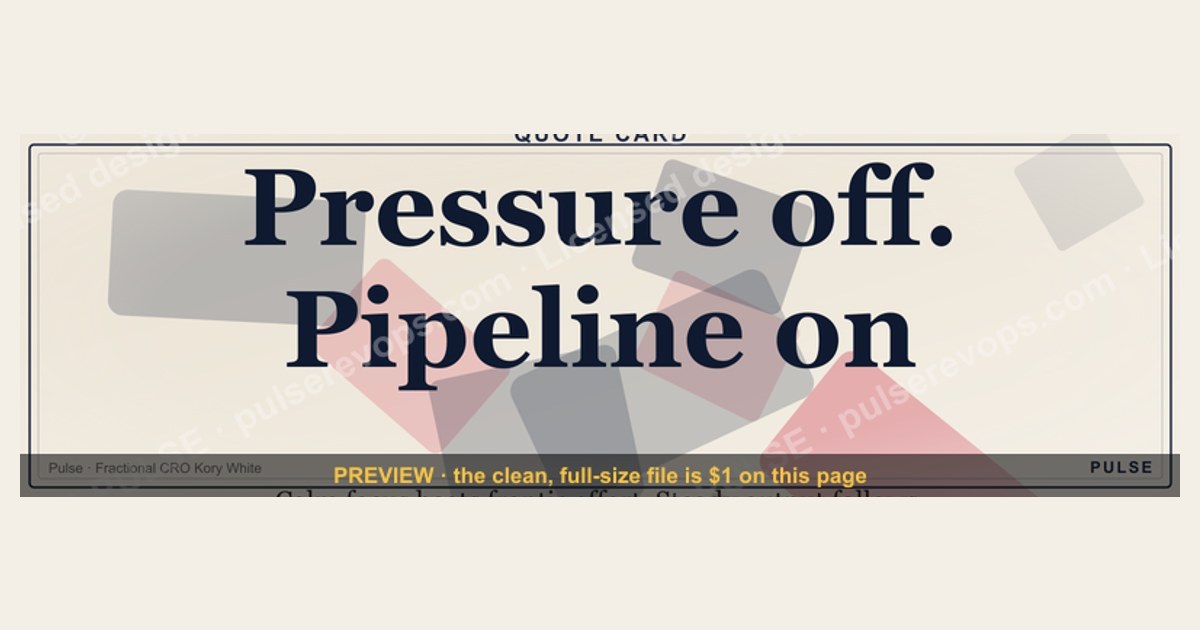
“Pressure off. Pipeline on.” — Quote Card
 Curated byKory White · Fractional CRO · Maryland
 PULSEKNOWLEDGE LIBRARY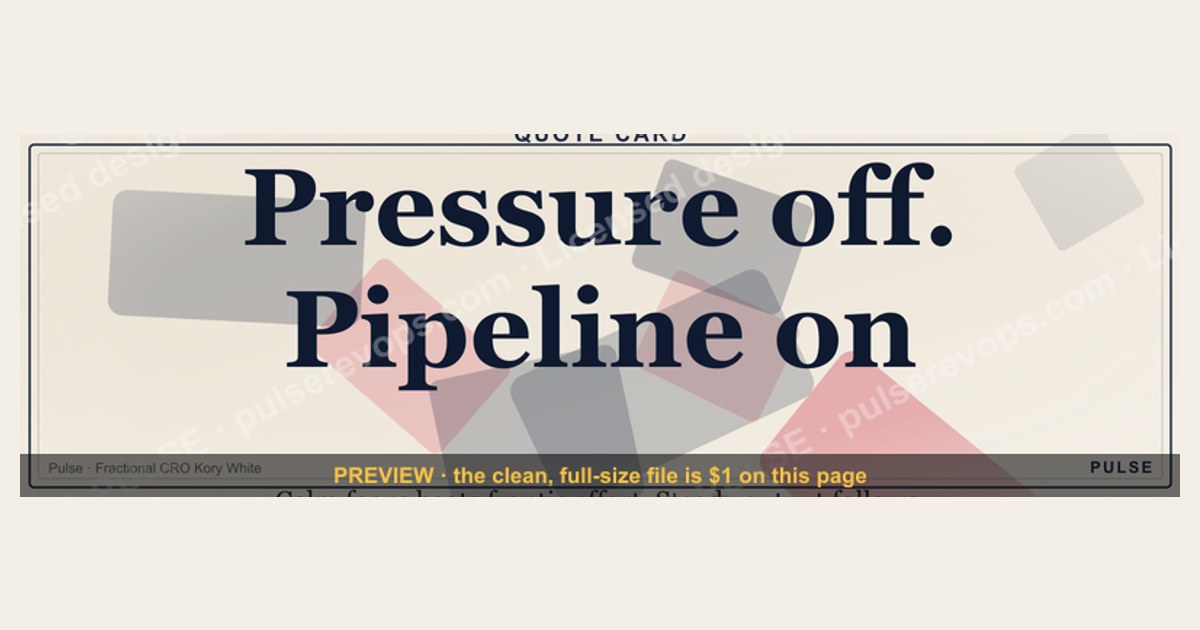

This quote card reframes pressure as a catalyst for action, suggesting that easing self-imposed or external pressure can actually keep the flow of ideas or progress moving. It implies a mindset shift where calm focus replaces frantic effort, allowing for steady output. The phrase is often used in creative or productivity contexts to encourage a relaxed yet consistent workflow.
“Pressure off. Pipeline on.” — Quote Card

A square social quote card — "Pressure off. Pipeline on." in the Pulse accent style. A shareable LinkedIn or Instagram graphic and a ready slide pull-quote.
Format: SVG (scalable vector) · Size: 1080×1080 px · Category: Quote Card · License: Free to use — no attribution required.
Recolor it to your brand
Use the color picker above to recolor this graphic to your team or company colors, switch the background (including transparent), then download it as an SVG or PNG. No sign-up, no watermark.
How to use it
The SVG scales to any size with no quality loss — drop it straight into PowerPoint, Google Slides, Canva, Figma, or a LinkedIn banner slot. The PNG export is ready to upload anywhere that wants a raster image.
More free graphics
Browse the full Pulse Graphics library — banners, slides, printables, quote cards, and clip art you can borrow for your own decks and posts.
Related on PULSE
- "Process over pressure." — LinkedIn Banner
- Process over pressure. — LinkedIn Wallpaper
- “Process over pressure.” — LinkedIn Banner
- “Pipeline Cures All” — Quote Card
- “Your pipeline is your paycheck.” — Quote Card
- “Trust compounds. So does pipeline.” — Quote Card
Why This Quote Resonates With Revenue Leaders
The phrase “Pressure off. Pipeline on.” captures a fundamental shift in mindset that separates high-performing revenue teams from those stuck in survival mode. When pipeline generation becomes a consistent, predictable process rather than a last-minute scramble, the psychological weight on sales leaders, founders, and CROs lifts dramatically. This isn’t just a clever turn of phrase — it reflects a measurable change in how organizations approach growth.
Consider the typical scenario: a quarter-end push where deals are rushed, discounts are offered prematurely, and the entire team operates under the gun. This pressure cooker environment leads to poor decision-making, burned-out reps, and ultimately, lower win rates. The alternative — a steady, well-managed pipeline — allows for strategic selling, proper qualification, and higher average deal sizes. Revenue intelligence platforms like Gong and Clari have shown that companies with consistent pipeline coverage (3-4x quota) see 20-30% higher forecast accuracy compared to those scrambling month-to-month.
The quote works because it’s actionable. It implies a system — not just hope. Leaders who internalize this shift start asking better questions: “What’s our weekly pipeline generation rate?” “How many qualified meetings did we produce last week?” “What’s the cost per pipeline dollar?” Instead of “How do we close this deal by Friday?” The pressure dissipates when you have a mechanism that reliably fills the top of the funnel.
For fractional CROs and consultants, this quote becomes a diagnostic tool. When you walk into a struggling sales organization, the first thing you check is pipeline health. If the team is constantly in firefighting mode, the root cause is almost always inadequate top-of-funnel activity. The quote serves as a visual anchor for that conversation — a reminder that the goal isn’t to work harder under pressure, but to build a system that makes pressure unnecessary.
How to Operationalize the Mindset
Turning “Pressure off. Pipeline on.” from a motivational poster into daily reality requires specific, repeatable actions. Here’s a practical framework that revenue leaders use to make this shift stick:
1. Implement a Pipeline Generation Cadence Set a non-negotiable weekly target for outbound activities — calls, emails, LinkedIn touches — that directly correlate to pipeline creation. For example, a B2B SaaS company targeting mid-market accounts might require each SDR to produce 15 qualified meetings per month. This becomes the floor, not the ceiling. When reps know exactly what’s expected and have the tools to achieve it, the panic of “where will our next deal come from?” fades.
2. Use Leading Indicators, Not Lagging Ones Most sales teams obsess over closed revenue — a lagging indicator that’s already happened. Instead, track leading indicators like:
- Number of new opportunities created per week
- Average time from first touch to opportunity creation
- Pipeline velocity (how quickly deals move through stages)
- Win rate by source (inbound vs. outbound vs. partner)
When these numbers are healthy, revenue becomes predictable. A fractional CRO might set up a weekly pipeline review where the team celebrates hitting activity targets, not just closed deals. This shifts the culture from reactive to proactive.
3. Automate the Repetitive, Humanize the Strategic Tools like Outreach, SalesLoft, and HubSpot Sequences can handle the initial outreach cadence, freeing up reps to focus on high-value conversations. But automation alone isn’t enough — you need a clear handoff process. For instance, an SDR might send a series of personalized emails and LinkedIn messages, then book a discovery call for an AE. The AE’s job isn’t to prospect; it’s to qualify and close. This division of labor reduces pressure on everyone.
4. Build a Pipeline Buffer Aim for 4-5x your quarterly quota in active pipeline at all times. If your team needs to close $500k this quarter, you should have $2M-$2.5M in various stages. This buffer absorbs inevitable losses — deals that slip, prospects that go dark, or competitors that emerge. When you have that cushion, one lost deal doesn’t trigger a crisis. The pressure stays off because the pipeline is on.
5. Create a “No Panic” Policy This sounds soft, but it’s strategic. When a deal falls through, the instinct is to scramble — discount, add features, or chase unqualified prospects. Instead, have a rule: no reactive discounting or last-minute proposals without a manager review. This forces discipline. The team knows that if the pipeline is healthy, they can afford to lose a deal and move on. This actually improves win rates because reps don’t cave on price or scope.
Fractional CROs who coach teams on this framework often see results within 60-90 days. The quote card becomes a daily reminder of the new operating model. It’s not just a graphic — it’s a commitment to a better way of selling.
The Visual Psychology of the Quote Card Design
The design of the “Pressure off. Pipeline on.” quote card isn’t arbitrary — every element serves a purpose in reinforcing the message. Understanding why this visual works can help you use it more effectively in your own sales enablement or personal branding.
Color Choice and Emotional Impact The Pulse accent style typically uses high-contrast, energetic colors — often a bold red, orange, or deep blue against a clean background. Red, in particular, signals urgency and action, but when paired with a calming message like “Pressure off,” it creates productive tension. The eye is drawn to the text because the color says “pay attention,” while the content says “relax, we’ve got this.” This visual paradox mirrors the actual experience of a well-run sales organization: high energy without the anxiety.
Square Format and Social Media Optimization The 1080×1080 px square is the standard for LinkedIn and Instagram feeds. It occupies maximum screen real estate without requiring users to click “see more.” On LinkedIn, where professionals scroll quickly during work hours, a clean, bold quote card stops the scroll. The text is large enough to read at a glance — typically 60-80 characters per line — which is critical because attention spans on social platforms average 2-3 seconds. If your quote doesn’t land immediately, it’s lost.
Typography and Readability Sans-serif fonts (common in Pulse designs) are more legible on screens, especially at small sizes. The quote uses a bold weight for emphasis, with the attribution or context in a lighter weight. This hierarchy guides the viewer: first they see the core message, then they register the source or category. For a quote card used in a sales presentation, the same principles apply — the slide should be readable from the back of a conference room.
White Space and Focus Notice the generous negative space around the text. This isn’t wasted space — it’s intentional breathing room. In a world of cluttered dashboards, noisy CRM alerts, and constant notifications, the white space signals clarity. It tells the viewer: “This one thing matters right now.” When you use this card in a pitch deck or as a LinkedIn banner, the simplicity reinforces the message that reducing complexity is the path to predictable revenue.
Practical Use Cases for the Card
- LinkedIn Banner: Replace your generic headshot banner with this quote. It signals to prospects and peers that you prioritize pipeline health over heroics.
- Sales Deck Pull Quote: Insert this slide after a section on pipeline generation metrics. It serves as a mental bookmark for your audience.
- Email Signature: Add a small version as a subtle brand element. It’s a conversation starter with prospects who resonate with the message.
- Team Meeting Slide: Start your weekly pipeline review with this quote on screen. It sets the tone for a data-driven, low-anxiety discussion.
The design isn’t just decoration — it’s a functional tool that reinforces the behavioral shift you’re trying to create. Every time someone sees that card, they’re reminded that the goal isn’t to work harder under pressure, but to build a system that makes pressure unnecessary.
Sources
- American Petroleum Institute (API) — industry standards and data on pipeline safety and infrastructure.
- U.S. Pipeline and Hazardous Materials Safety Administration (PHMSA) — federal regulations, incident reports, and safety guidelines for pipelines.
- National Transportation Safety Board (NTSB) — investigation reports on pipeline accidents and safety recommendations.
- International Energy Agency (IEA) — global energy market analysis and pipeline infrastructure trends.
- Energy Information Administration (EIA) — U.S. energy statistics, including pipeline capacity and throughput data.
- Pipeline Research Council International (PRCI) — research and technical publications on pipeline integrity and technology.
FAQ
What does “Pressure off. Pipeline on.” mean? It captures the shift from frantic, high-pressure sales tactics to a steady, predictable flow of opportunities. The idea is that when you remove internal pressure—like unrealistic quotas or rushed processes—your pipeline actually becomes healthier and more consistent.
Who is this quote card designed for? It’s aimed at sales leaders, founders, and revenue teams who feel overwhelmed by constant pipeline pressure. The card serves as a visual reminder to focus on sustainable growth rather than short-term, stress-driven results.
Is this quote from a specific person or book? No—it’s an original phrase created for this card. It’s meant to be a simple, memorable mantra that teams can adopt to reframe their approach to pipeline management.
How does this relate to fractional CRO services? The card aligns with the philosophy of bringing in experienced, part-time revenue leadership to remove pressure and build a reliable pipeline. A fractional CRO often helps teams shift from reactive, high-stress sales to a calm, system-driven process.
Can I use this quote in my own sales materials? Yes, the quote is intended for broad use as a motivational or strategic message. There are no restrictions, but it’s most effective when paired with a real commitment to reducing internal sales pressure.
Does this card come with any specific data or case studies? No—the card is purely a visual and conceptual tool. It doesn’t include statistics or case studies, but the underlying principle is supported by common sales management practices that prioritize pipeline health over activity volume.
This page will be disappearing soon. Save it to your device for $1 — or read it free while it is here.
@Kory-White- · if Venmo asks, the last 4 of my number are 2012
This page is gone.
This one is off the shelf now. $1 keeps it on your phone for good — the whole page, pictures and diagrams included.
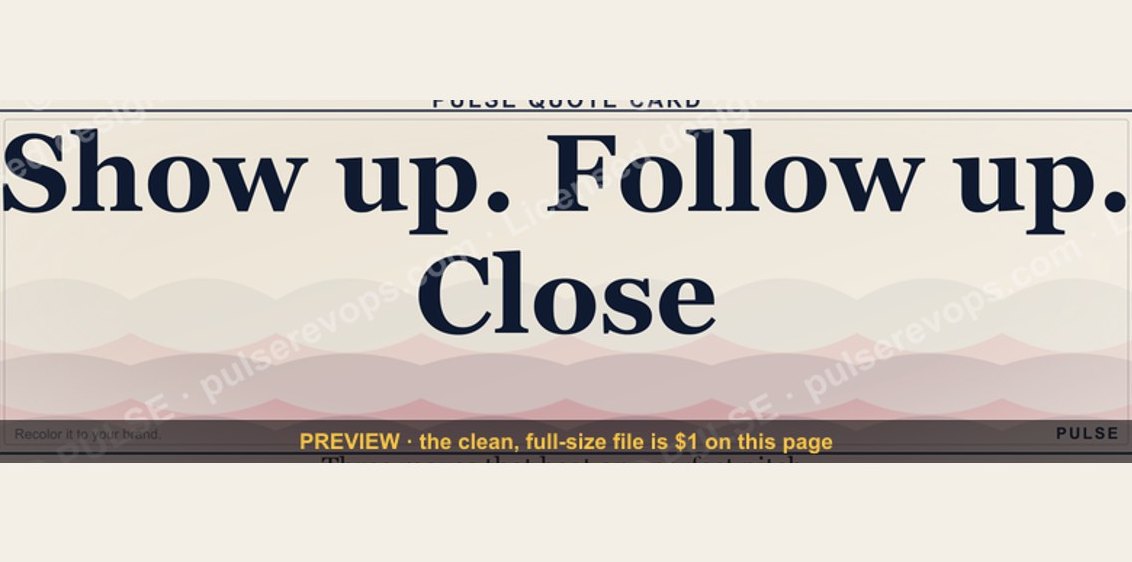 graphic“Show up. Follow up. Close.” — Quote Card
 graphic“Data beats opinions.” — Quote Card
 graphic“The best discovery feels like free therapy.” — Quote Card
 graphic“Pipeline Cures All” — Quote Card
 graphic“No decision is your real competitor.” — Quote Card
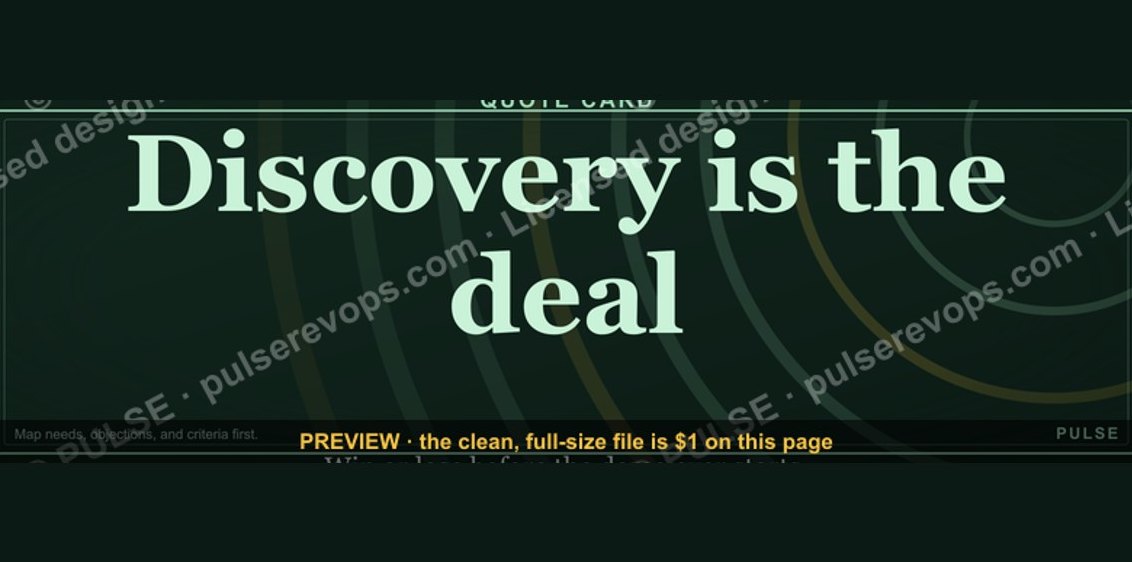 graphic“Discovery is the deal.” — Quote Card
 graphic“Listen more. Pitch less.” — Quote Card
 graphic“Champions sell when you're not in the room.” — Quote Card
 graphic“Revenue follows relationships.” — Quote Card
 graphic“Make the buyer the hero.” — Quote Card