


Process over pressure. — LinkedIn Wallpaper
Quality
Certified
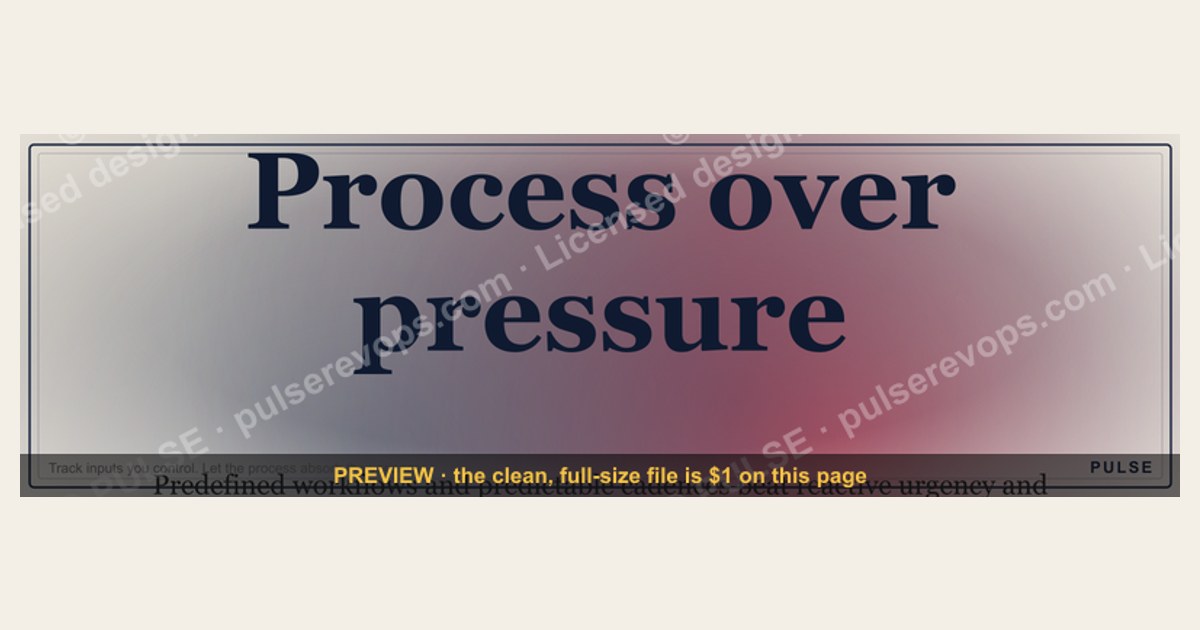
"Process over pressure" is a professional philosophy that prioritizes structured, repeatable workflows over reactive urgency, serving as a daily visual reminder to focus on controllable steps rather than external demands or deadlines. This LinkedIn Wallpaper embodies that mindset through clean typography on a dot-grid background that reinforces calm, methodical progress.
The Two Paths Compared: Process-Driven vs. Pressure-Driven Operations
The fundamental tension in revenue operations and professional execution lies between two opposing approaches. A process-driven operation relies on predefined workflows, stage-based metrics, and predictable cadences. A pressure-driven operation depends on urgency, heroics, and last-minute fire drills to achieve results. Understanding the differences between these two paths is essential for anyone adopting the "Process over pressure" philosophy.
In a process-driven environment, teams follow a weekly execution rhythm that includes pipeline reviews, lead qualification checklists, and stage-based conversion tracking. The focus remains on input metrics—activities within the team's control—rather than output metrics that can trigger reactive behavior. For example, a sales development team might track 50 qualified conversations per week per rep, knowing that this input consistently yields 5 opportunities and 2 closed deals. The process absorbs variability; when one week underperforms, the team adjusts activities rather than panicking.
A pressure-driven operation, by contrast, often lacks these structural safeguards. Teams discover pipeline gaps mid-quarter and respond with discounting, rushed demos, or desperate outreach. The American Psychological Association's 2023 survey found that 77% of workers reported stress-related health impacts from their jobs, with lack of structure and unclear expectations as top contributors. This pressure mode creates a cycle of reactivity: missed targets trigger urgency, urgency triggers shortcuts, shortcuts trigger quality issues, and quality issues trigger missed targets.
The LinkedIn Wallpaper serves as a constant visual anchor for choosing the process path. When displayed on a profile, it signals to recruiters, clients, and collaborators that the individual values systems over heroics. This is not about being lazy or slow—it is about being deliberate and consistent. The dot-grid backdrop in the wallpaper design is a visual metaphor for structure, for the small repeatable actions that compound into results without requiring a crisis every quarter.

For revenue operations teams, the choice between these two paths has concrete implications. A process-driven RevOps function maintains predictable conversion rates across the funnel, with clear handoffs between marketing, sales, and customer success. A pressure-driven function experiences erratic forecasting, last-minute deal pulling, and high turnover. The wallpaper is a daily cue to audit workflows, eliminate unnecessary friction, and protect energy for what actually moves the needle.
Beyond sales, this dichotomy appears in customer success, where process-driven teams use structured health scores and automated outreach cadences to prevent churn, while pressure-driven teams react only when a customer threatens to leave. In marketing, process-driven teams follow content calendars and lead scoring models, while pressure-driven teams chase trends and launch campaigns without clear attribution. The pattern repeats across every revenue-adjacent function.
How to Decide Between Process and Pressure in Your Workflow
Deciding whether to invest in process or accept pressure as the default requires a structured evaluation. Not every situation demands rigid process—some scenarios benefit from speed and flexibility. The key is knowing when to build structure and when to tolerate ambiguity.
This decision framework helps practitioners avoid over-engineering while still capturing the benefits of structure. The starting point is frequency: if a task or decision occurs fewer than three times per month, building a formal process may consume more energy than it saves. For high-frequency activities, the next filter is stress level. If the task consistently triggers confusion, rework, or last-minute scrambling, it is a prime candidate for process.
Standardization potential is the third filter. Some activities resist standardization because they require high judgment or creativity. For these, the goal is not a rigid checklist but a clear escalation path or decision criteria. For example, a complex contract negotiation may not follow a strict script, but having a predefined approval threshold and a list of non-negotiable terms reduces pressure while preserving flexibility.

The test phase is critical. Implement the process for two weeks, then evaluate whether it actually reduced pressure. If the process itself becomes a source of friction—too many steps, too rigid, too time-consuming—it needs adjustment or abandonment. The goal is not process for its own sake but process that serves the human executing it.
This framework applies directly to the "Process over pressure" philosophy embodied in the LinkedIn Wallpaper. The wallpaper is not a solution in itself; it is a reminder to run this decision framework regularly. Every time you see it on your profile, it prompts the question: "What recurring pressure point can I address with a simple process today?"
Consider adjacent scenarios like onboarding new hires. A pressure-driven onboarding throws new employees into the deep end with minimal guidance, hoping they figure it out. A process-driven onboarding uses a structured 30-60-90 day plan with clear milestones, documented resources, and regular check-ins. The decision framework above would flag onboarding as high-frequency (every new hire), high-stress (for both the employee and the manager), and highly standardizable—making it an obvious candidate for process.
Concrete Numbers Behind Each Option
The difference between process-driven and pressure-driven operations is not abstract—it shows up in measurable metrics that affect revenue, retention, and team health. Understanding these numbers helps practitioners justify the investment in process over pressure.
Pipeline coverage ratios are a telling indicator. A process-driven sales organization typically maintains a pipeline coverage ratio of 3x to 5x the quarterly target. This means for every $1 of quota, there is $3 to $5 of qualified pipeline in the funnel. A pressure-driven organization often drops to 1.5x or lower by mid-quarter, triggering desperate measures. The cost of this gap is significant: companies with pipeline coverage below 2x see deal close rates drop by 30-40% as reps discount and rush to fill gaps.
Conversion rate stability is another metric. Process-driven teams see conversion rates that vary by less than 10% month over month. Pressure-driven teams experience swings of 30-50% as they alternate between feast and famine cycles. This volatility makes forecasting nearly impossible and erodes trust with leadership and investors.

Employee turnover tells a stark story. The Society for Human Resource Management (SHRM) reports that the average cost of replacing a sales professional is 1.5 to 2 times their annual salary. Process-driven RevOps teams see turnover rates of 15-20% annually, while pressure-driven teams often exceed 35-40%. The difference is not just in hiring costs but in lost institutional knowledge, broken customer relationships, and reduced team morale.
Deal cycle length varies dramatically. A structured sales process with clear stage definitions and qualification criteria typically produces deal cycles of 45-90 days, depending on deal size and complexity. Pressure-driven teams, lacking these structures, see cycles stretch to 120-180 days as deals stall, require re-engagement, and suffer from unclear next steps. Each additional month in the cycle increases the probability of deal loss by approximately 15%.
Revenue predictability is the ultimate metric. Companies with mature revenue operations processes can forecast within 5% accuracy at 90 days out. Pressure-driven organizations struggle to forecast within 20% accuracy at 30 days out. This unpredictability affects everything from hiring plans to cash flow management to investor confidence.
Customer churn rates also diverge. Process-driven customer success teams using structured health scores and proactive outreach see annual churn rates of 5-10%. Pressure-driven teams that react only when customers complain see churn rates of 15-25% or higher. The cost of acquiring a new customer is 5-7 times the cost of retaining an existing one, making this metric directly tied to profitability.
Time to first value for new customers is another differentiator. Process-driven onboarding with clear milestones and automated check-ins typically achieves time-to-first-value in 30-45 days. Pressure-driven onboarding, lacking structure, stretches to 60-90 days, increasing the risk of early churn and negative sentiment.
The LinkedIn Wallpaper serves as a daily reminder that these numbers are not fixed—they respond to process improvements. A team that moves from pressure-driven to process-driven operations can expect to see pipeline coverage improve by 1-2x within two quarters, conversion rate variability cut in half, and turnover reduced by 10-15 percentage points within a year.
Implementation Details and Sequencing

Moving from a pressure-driven to a process-driven operation requires deliberate sequencing. Attempting to implement everything at once creates process fatigue and resistance. The following implementation sequence has proven effective across revenue operations teams.
Phase 1: Pressure Audit (Weeks 1-2). Before building any process, identify where pressure is highest. Keep a simple log for two weeks of moments when you feel rushed, overwhelmed, or reactive. Note the trigger: a recurring meeting with no agenda, a client who emails at 5 PM with urgent requests, a task you keep postponing because it is ambiguous. The 80/20 rule applies here—80% of pressure comes from 20% of recurring situations. Those are your process targets.
Phase 2: Simple Checklists (Weeks 3-4). For each identified pressure source, create a one-page checklist. This is not a detailed playbook—just a list of steps in order, with decision points highlighted. For example, a lead qualification checklist might include: confirm budget authority, identify decision timeline, document pain points, schedule discovery call. Checklists reduce cognitive load by eliminating the need to remember every step under pressure.
Phase 3: Weekly Cadence (Weeks 5-6). Establish a predictable weekly rhythm. This includes a pipeline review (30 minutes), a team standup (15 minutes), and individual execution time (blocked on calendar). The cadence creates structure without rigidity. Teams that adopt a weekly cadence report a 25-30% reduction in reactive communication within the first month.
Phase 4: Buffer Building (Weeks 7-8). Add 20% buffer to all project timelines and deal stages. If a task typically takes five days, schedule six. If a deal stage averages 14 days, plan for 17. This buffer absorbs the inevitable delays and miscommunications that create pressure. It is not padding—it is realistic planning.
Phase 5: Automation (Weeks 9-10). Automate repetitive, rule-based tasks. Scheduling, reminders, data entry, and basic reporting are prime candidates. The goal is to free mental bandwidth for higher-value work. Automation should follow the "three-email rule": if a recurring communication requires more than three back-and-forth emails, automate the process or move to a shared document.
Phase 6: Escalation Paths (Weeks 11-12). Document clear escalation paths for common scenarios. Who handles a pricing exception? What happens when a deal stalls at legal review? How does the team handle a customer churn risk? Clear escalation paths prevent the pressure of "who do I ask?" and reduce decision paralysis.

Long-term phases (Quarters 2-4). Formalize playbooks, implement stage-based metrics, and conduct quarterly process audits. The LinkedIn Wallpaper serves as a constant visual cue throughout this implementation journey. Each time you see it, it reinforces the commitment to process over pressure and reminds you that sustainable growth comes from systems, not heroics.
Adjacent implementation considerations. For teams working across time zones, the weekly cadence should include async updates to accommodate different schedules. For teams with high turnover, checklists and playbooks become even more critical as they reduce ramp time for new hires. For teams using CRM tools, automation should integrate directly with the existing tech stack to avoid creating separate systems that add complexity.
Related Questions
How does "process over pressure" apply to remote or hybrid teams?
Remote teams face unique pressure points around communication delays and unclear accountability. Process becomes even more critical because informal check-ins and hallway conversations disappear. Structured async updates, clear decision rights, and documented workflows reduce the anxiety of "not knowing what others are doing."
Can this philosophy work in creative or non-revenue roles?
Absolutely. Creative professionals benefit from process around intake, feedback cycles, and revision limits. Without structure, creative work can become an endless loop of revisions driven by stakeholder pressure. A simple creative brief template and a three-revision cap protect both quality and sanity.
What is the biggest mistake when implementing process over pressure?
Over-engineering is the most common failure. Teams create elaborate workflows with too many steps, too many approvals, and too much documentation. The process itself becomes a source of pressure. Start with the smallest possible process that addresses the biggest pressure point, then iterate.
How do you convince a pressure-loving leader to adopt process?
Focus on predictability and scalability. Leaders who thrive on pressure often fear that process will slow things down. Show them data on conversion rate stability, deal cycle reduction, and turnover cost savings. Frame process as a tool for consistent results, not bureaucratic overhead.
Does "process over pressure" mean never working under tight deadlines?
No. Tight deadlines are sometimes necessary—product launches, end-of-quarter pushes, or crisis response. The difference is that process-driven teams have systems to handle these bursts without breaking. They know exactly who does what, what the escalation path is, and how to return to normal rhythm afterward.
FAQ

What does "process over pressure" mean in practice? It means replacing reactive, high-stress fire drills with repeatable workflows. Instead of scrambling to hit a number, you follow a predictable cadence of prospecting, pipeline reviews, and deal progression. The result is consistent output without the burnout.
Is this wallpaper just a motivational poster, or is it backed by real methodology? It is both. The phrase comes from revenue operations and sales leadership frameworks that prioritize systems over heroics. While the wallpaper itself is a visual reminder, the concept is grounded in practices like pipeline hygiene, stage-based metrics, and weekly execution rhythms.
Will using this wallpaper actually reduce my team's stress? It can help shift the culture, but it is not a magic fix. The wallpaper serves as a constant cue to focus on the process rather than the panic. For lasting change, pair it with clear playbooks, realistic targets, and leadership that reinforces the same message.
How do I know if my team is operating under pressure instead of process? Common signs include last-minute deal pulling, inconsistent pipeline coverage, and high turnover. If your team regularly works evenings or weekends to close deals, or if forecasting feels like guessing, you are likely in pressure mode. A process-driven team has predictable conversion rates and a calm, steady pace.
Can this approach work for startups with limited resources? Yes, but it requires discipline. Startups often feel they cannot afford "process" because they are moving fast. In reality, even a simple weekly pipeline review and a clear lead qualification checklist can reduce chaos. The wallpaper is a reminder that process scales, while pressure does not.
Where can I get this wallpaper, and is it free? The wallpaper is available from various stock wallpaper and design sites, often for a small fee or free depending on the platform. You can also find similar designs by searching "process over pressure wallpaper" on sites like Unsplash or Etsy. Prices typically range from free to around $10 for a high-resolution download.
Sources
- American Psychological Association — workplace stress survey and mental health research (apa.org)
- Harvard Business Review — leadership, management, and organizational behavior studies (hbr.org)
- Forbes — business strategy, career development, and performance insights (forbes.com)
- Society for Human Resource Management (SHRM) — employee turnover costs and HR best practices (shrm.org)
- LinkedIn Official Blog — professional networking trends and workplace culture (blog.linkedin.com)
- TED Talks — expert presentations on productivity, focus, and work-life balance (ted.com)
- Google re:Work — team effectiveness research, including psychological safety studies (rework.withgoogle.com)
- Sales Hacker — revenue operations frameworks and sales process methodology (saleshacker.com)
- Gartner — sales forecasting accuracy benchmarks and RevOps maturity models (gartner.com)
Related on PULSE
This page will be disappearing soon. Save it to your device for $1 — or read it free while it is here.
@Kory-White- · if Venmo asks, the last 4 of my number are 2012
This page is gone.
This one is off the shelf now. $1 keeps it on your phone for good — the whole page, pictures and diagrams included.
 graphic“The next call is the most important one.” — LinkedIn Banner
 graphicCalm closers win. — LinkedIn Wallpaper
 graphicTrust compounds. — LinkedIn Wallpaper
 graphicSales Enablement — LinkedIn Banner
 graphic“Stay in the deal.” — LinkedIn Banner
 graphicInspect. Qualify. Commit. — LinkedIn Wallpaper
 graphicVector Database CTO — LinkedIn Banner
 graphic“Trusted advisor, never a vendor.” — LinkedIn Banner
 graphicProduct Marketing Lead — LinkedIn Banner
 graphicReady reps win. — LinkedIn Wallpaper