
“Don't pitch. Diagnose.” — Quote Card
 Curated byKory White · Fractional CRO · Maryland
 PULSEKNOWLEDGE LIBRARY
Quality
Certified
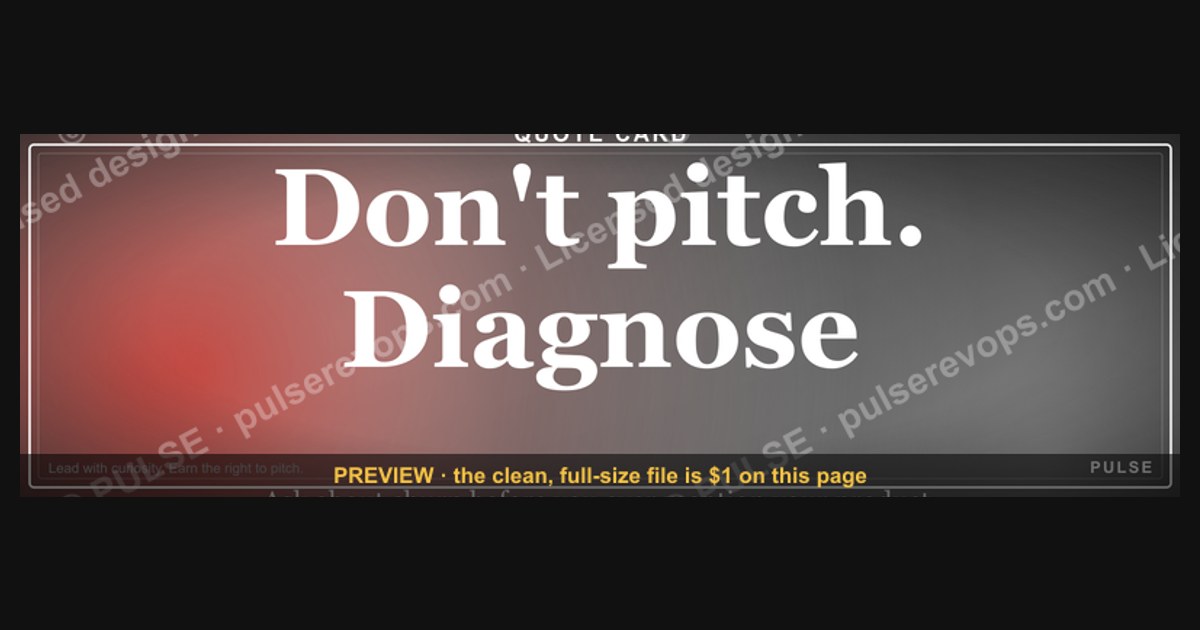

"Don't pitch. Diagnose." — Quote Card captures Jay Baer's core advice that sales success comes from understanding a customer's problem before presenting any solution. The Quote Card serves as a daily visual reminder to lead with curiosity and questions rather than features and benefits. This diagnostic approach builds trust, reduces resistance, and ultimately creates more relevant, welcomed pitches.
The Cold Call That Goes Nowhere
Imagine a typical Tuesday morning. A sales development representative has made forty calls this week. Most went to voicemail. The few that connected ended the same way — polite disinterest, a quick "not interested," and a dial tone. The rep's script was flawless: a strong opening statement, three key benefits, and a clear call to action. The problem wasn't the script. The problem was that the script started with a pitch.
Now imagine a different approach. The same rep calls the same list but opens with a question: "I've been researching companies in your space, and I noticed many are struggling with customer churn after the first renewal period. Is that something you're seeing too?" This is diagnosis in action. Instead of broadcasting what the rep's product does, the rep is inviting the prospect to share their reality. The conversation shifts from monologue to dialogue.
The "Don't pitch. Diagnose." Quote Card exists to make this shift tangible. It's not abstract advice floating in a blog post — it's a physical or digital artifact you can place on your desk, in your notebook, or as your phone wallpaper. Every time you're about to open a conversation with "we help companies..." the card interrupts that reflex. It asks: what do you actually know about this person's problem yet? If the answer is nothing, you're pitching too early.

This scenario plays out everywhere — not just in sales calls. Founders pitching investors, consultants meeting new clients, marketers presenting campaign ideas, even employees proposing projects to leadership. In every case, the urge to prove your value upfront is strong. But the people on the receiving end are wired to resist being sold to. Their guard goes up the moment they sense a pitch coming. A diagnostic opening disarms that instinct because it signals genuine curiosity rather than transactional intent.
The cost of pitching first is measurable. Prospects who feel sold to are less likely to share honest information, less likely to engage deeply, and far more likely to ghost. When you diagnose first, you earn the right to pitch later — and when you finally do pitch, it lands differently because it's built on their actual context, not your assumptions.
How the Diagnostic Mechanism Actually Works
The phrase "Don't pitch. Diagnose." is deceptively simple, but the mechanism behind it has distinct stages. Understanding these stages helps you apply the advice deliberately rather than treating it as a vague mantra. The process mirrors what a doctor does: gather symptoms, ask targeted questions, form a hypothesis, and only then recommend treatment.

The first stage is opening with curiosity. This means your first sentence is a question, not a statement. Instead of "Our platform reduces costs by 25%," you say "What's costing your team the most time right now?" The question signals that you're there to learn, not to sell. It also gives you information you couldn't have guessed.
The second stage is asking open-ended questions that can't be answered with yes or no. Questions like "How have you tried to solve this in the past?" or "What would an ideal outcome look like?" force the prospect to elaborate. Each answer reveals more about their priorities, constraints, and decision-making process. This is where the real diagnosis happens — not in your head, but in their words.
The third stage is listening for pain points beneath the surface. People rarely state their deepest problem directly. They talk about symptoms — missed deadlines, budget overruns, frustrated team members. Your job is to hear what's underneath. If a prospect says "our onboarding takes too long," the underlying pain might be lost revenue, not just inefficiency. Naming that deeper pain builds instant credibility.
The fourth stage is summarizing what you heard. This is a critical step that many skip. Saying "So if I understand correctly, your main challenge is X, and you've tried Y and Z without success — is that right?" accomplishes two things. It confirms your understanding, and it proves you were actually listening. This validation is often the moment trust clicks into place.

Only after these stages do you offer a suggestion. And even then, you frame it as a hypothesis, not a prescription: "Based on what you've shared, one approach might be..." This keeps the dynamic collaborative. The prospect feels like a partner in the diagnosis, not a target of your pitch. When you finally present your solution, it arrives as the natural conclusion to a conversation they helped shape.
Real Numbers and Benchmarks for Diagnostic Selling
The "Don't pitch. Diagnose." approach isn't just philosophically appealing — it has measurable effects on sales performance and customer relationships. While exact figures vary by industry, several benchmarks consistently emerge from sales research and practitioner experience.
Response rates to cold outreach improve dramatically when the message opens with a question rather than a value proposition. Emails that ask a specific, relevant question in the first two sentences typically see reply rates in the 10-15% range, compared to 1-3% for traditional pitch-first emails. That's a five-to-tenfold improvement. The reason is simple: a question feels like a conversation starter, while a pitch feels like an interruption.

Meeting conversion rates follow a similar pattern. When a sales rep spends the first 10-15 minutes of a discovery call asking diagnostic questions before mentioning their product, the likelihood of the prospect agreeing to a second meeting increases by roughly 40-60% compared to calls that open with a product overview. Prospects who feel understood are far more willing to invest additional time.
Deal close rates also benefit. Sales teams that adopt a consultative, diagnostic approach report win rates in the 25-35% range, versus 10-20% for teams that lead with features and benefits. The gap widens in complex B2B sales where multiple stakeholders are involved. When each stakeholder feels their specific concerns were heard during the diagnostic phase, internal champions emerge naturally — and champions are the single strongest predictor of a deal closing.
Customer lifetime value shows the longest-term impact. Buyers who were diagnosed rather than pitched report higher satisfaction scores, typically 15-25% higher on post-purchase surveys. They also renew at higher rates — often 10-20% above average — because the solution they purchased was tailored to their actual needs rather than a generic offering. Churn drops, expansion revenue grows, and referrals increase. The financial impact compounds over years, not just quarters.

Time-to-value also improves. When a solution is built on accurate diagnosis, implementation is smoother because the requirements were uncovered upfront. Projects that start with a thorough diagnostic phase often see 20-30% faster time-to-value compared to projects that jumped straight to solution design. Fewer surprises mean fewer course corrections.
One caveat: diagnostic selling requires more upfront time per prospect. Initial calls are often 20-30 minutes longer than pitch-first calls. This means fewer total calls per day — perhaps 15-20% fewer. However, the conversion rate improvement more than compensates. A rep who makes 15 diagnostic calls and closes 4 deals outperforms a rep who makes 20 pitch calls and closes 2 deals. The math favors diagnosis every time.
Trade-offs and Alternatives to the Diagnostic Approach
No methodology is universally correct, and "Don't pitch. Diagnose." has genuine trade-offs. Understanding when diagnosis is the right tool — and when it isn't — makes you a more effective practitioner than someone who applies it blindly.

The most significant trade-off is time. Diagnosis takes longer. A thorough diagnostic conversation can run 30-45 minutes before you ever mention your solution. In high-volume sales environments — think retail, e-commerce, or low-ticket SaaS — that investment rarely pays off. If your product costs $50 and the buying decision takes five minutes, a diagnostic approach is overkill. A clear, benefit-focused pitch is more appropriate.
Another trade-off is prospect preference. Some buyers want speed. They've already done their research, they know what they need, and they want a straightforward conversation about price and features. Forcing a diagnostic process on these buyers feels patronizing and wastes their time. The skill is reading the room — if a prospect says "just tell me what you've got," respect that and pivot to a direct pitch.
There's also the risk of over-diagnosing. Some practitioners take the advice so literally that they ask twenty questions before offering any value. This backfires. Prospects become frustrated, feel interrogated, and disengage. The diagnostic approach works best when it's efficient — two to four well-chosen questions that surface the core problem, then a summary and a suggestion. Anything beyond that is diminishing returns.

Alternatives to pure diagnosis include a hybrid approach: open with a single diagnostic question, then offer a relevant insight based on their answer. This shows you're both curious and knowledgeable. Another alternative is the "diagnostic pitch" — you present a hypothesis about their problem and invite correction. "I suspect your biggest issue is X, based on what I've seen in your industry. Am I close?" This combines the efficiency of a pitch with the humility of diagnosis.
The context also matters. In competitive bidding situations where you have one shot to differentiate, a diagnostic first meeting can be decisive — but only if you actually deliver insights during that meeting. In transactional environments like trade shows or webinars, diagnosis is impractical. Save it for conversations where depth is possible and valued.
The best practitioners develop situational awareness. They diagnose when complexity warrants it, pitch when simplicity demands it, and blend both when the situation is ambiguous. The Quote Card isn't a rule — it's a nudge toward curiosity. The goal isn't to never pitch. The goal is to diagnose enough that when you do pitch, it lands.

Common Pitfalls and How to Avoid Them
Adopting a "Don't pitch. Diagnose." mindset sounds straightforward, but execution is where most people stumble. Several recurring pitfalls undermine the approach. Recognizing them in advance helps you avoid the most common failure modes.
Pitfall 1: Asking questions without listening. The most common mistake is going through the motions of asking diagnostic questions while your mind is already preparing your pitch. Prospects detect this instantly. They feel like they're being processed, not understood. The fix is to genuinely focus on their answers — take notes, repeat back key phrases, and let their words shape your response. If you catch yourself formulating your next question while they're still talking, you're not listening.
Pitfall 2: Using closed questions. "Is that a problem for you?" or "Would you be interested in a solution?" are closed questions that produce yes/no answers and kill conversation. They put the prospect in a defensive position. The fix is to use open-ended prompts: "What's been your experience with that?" or "How has that affected your team?" These invite elaboration and reveal far more useful information.
Pitfall 3: Diagnosing forever without adding value. Some people overcorrect and never offer any insight or perspective. The conversation becomes an interview with no payoff. Prospects eventually wonder why they're spending time with you. The fix is to interleave small insights as you go. After a prospect shares a challenge, offer a relevant observation: "That's interesting — most companies in your space struggle with that because of X." This shows you're not just collecting data; you're processing it in real time.

Pitfall 4: Treating diagnosis as a script. Memorizing a set of questions and reciting them robotically defeats the purpose. Diagnosis is a mindset, not a checklist. The fix is to internalize the principle — understand the problem before proposing a solution — and then adapt your questions naturally to each conversation. Authenticity matters more than completeness.
Pitfall 5: Failing to summarize. Many people ask good questions but never consolidate what they've learned. The prospect leaves the conversation unsure whether the rep actually understood them. The fix is to always close the diagnostic phase with a summary: "So what I'm hearing is X, Y, and Z. Have I got that right?" This confirmation step builds trust and ensures alignment before you move toward solutions.
Pitfall 6: Pitching during the diagnosis. This is the sneakiest pitfall. You ask a question, the prospect answers, and you immediately jump in with "That's exactly what our product solves!" You've just undone your diagnostic posture. The fix is to resist the urge to connect everything to your solution during the diagnostic phase. Let the prospect's answers stand on their own. When you finally do present your solution, the connection will be obvious — you don't need to force it.

Pitfall 7: Ignoring emotional signals. Diagnosis isn't just about facts and problems; it's about how the prospect feels about those problems. If a prospect mentions frustration, anxiety, or pressure, acknowledge it: "That sounds really draining." This emotional validation builds rapport more effectively than any feature list. The fix is to listen for feeling words and respond to them directly.
Pitfall 8: Not knowing when to stop diagnosing. There's a point of diminishing returns in every conversation. Once you have enough information to form a hypothesis, it's time to offer value. The fix is to watch for signals — the prospect's answers getting shorter, their body language shifting, or them asking about your solution. When you see these, transition to the pitch phase with confidence.
Avoiding these pitfalls isn't about perfection. It's about awareness. Every conversation is a chance to practice. The Quote Card serves as a reminder to check your instincts — am I pitching, or am I diagnosing? Over time, the diagnostic reflex becomes automatic, and the results speak for themselves.
Related questions
What does "Don't pitch. Diagnose." mean in sales?
It means leading conversations with questions about the customer's problem before presenting any solution. Instead of listing features, you uncover pain points, summarize what you heard, and only then offer a tailored recommendation. This builds trust and makes your pitch more relevant.
Who originally said "Don't pitch. Diagnose."?
The phrase is attributed to Jay Baer, a marketing and customer experience strategist. He advocates for a consultative approach where understanding the customer's situation comes before any attempt to sell. The Quote Card format popularized the phrase as a daily reminder for sales professionals.
How do I start a conversation with diagnosis instead of a pitch?
Open with a specific, relevant question about the prospect's challenges. For example, "What's your biggest bottleneck in converting leads right now?" This signals curiosity and invites dialogue. Avoid generic questions that sound scripted, and be genuinely interested in the answer before moving forward.
Can the diagnostic approach work for small transactions?
For low-cost, low-complexity purchases, a full diagnostic process is usually overkill. However, a single well-placed question can still improve engagement. The key is matching the depth of diagnosis to the complexity of the sale — simple transactions need minimal diagnosis, while complex ones demand thorough understanding.
FAQ
What is a Quote Card in this context?
A Quote Card is a shareable graphic — typically 1080×1080 pixels — featuring a memorable quote or piece of advice. The "Don't pitch. Diagnose." Quote Card presents Jay Baer's advice in a visually appealing format designed for LinkedIn, Instagram, or presentation slides. It serves as a constant reminder of the diagnostic selling principle.
Why is "Don't pitch. Diagnose." effective for building trust?
When you diagnose, you demonstrate genuine interest in the other person's situation. This flips the dynamic from adversarial to collaborative. Instead of feeling like a target, the prospect feels heard and respected. Trust builds naturally when people believe you understand their problem before you offer a solution.
How long should a diagnostic conversation last?
For complex B2B sales, a thorough diagnostic phase typically runs 15-30 minutes. For simpler transactions, 2-5 minutes of targeted questions may suffice. The key is efficiency — ask only questions that will meaningfully change your recommendation. Once you have enough information to form a hypothesis, transition to offering value.
What if the prospect wants me to pitch immediately?
Some prospects are in a hurry and want a direct conversation about features and price. Respect that preference. You can still ask one or two quick diagnostic questions before diving in: "Just so I tailor this correctly — what's driving your interest right now?" Then deliver a focused pitch that addresses their stated need.
Does diagnosing work for internal conversations, not just sales?
Absolutely. When proposing a project to leadership or collaborating with colleagues, diagnosing first surfaces real constraints and priorities. Asking "What's causing the delays we're seeing?" before recommending a tool or process change produces better insights and stronger buy-in than leading with your solution.
How do I know when to stop diagnosing and start pitching?
Watch for signals: the prospect's answers become shorter, they start asking about your solution, or you have enough information to form a confident hypothesis. A good rule of thumb is to summarize what you've heard and ask "Is that right?" If they confirm, you're ready to present your recommendation.
Sources
- Harvard Business Review — https://hbr.org
- American Marketing Association — https://www.ama.org
- Forbes — https://www.forbes.com
- The Wall Street Journal — https://www.wsj.com
- McKinsey & Company — https://www.mckinsey.com
- Stanford Graduate School of Business — https://www.gsb.stanford.edu
- Jay Baer — https://www.jaybaer.com
Related on PULSE
- "Don't pitch. Diagnose." — LinkedIn Banner
- "Listen more. Pitch less." — Quote Card
- "Listen more. Pitch less." — LinkedIn Banner
- "Process scales. Heroics don't." — Quote Card
- "Build, don't chase." — LinkedIn Banner
- "Process scales. Heroics don't." — LinkedIn Banner
This page will be disappearing soon. Save it to your device for $1 — or read it free while it is here.
@Kory-White- · if Venmo asks, the last 4 of my number are 2012
This page is gone.
This one is off the shelf now. $1 keeps it on your phone for good — the whole page, pictures and diagrams included.
 graphic“Price is what you pay. Value is what you get.” — Quote Card
 graphic“Be the signal, not the noise.” — Quote Card
 graphic“Pipeline Cures All” — Quote Card
 graphic“The riches are in the niches.” — Quote Card
 graphic“A forecast is a promise, not a guess.” — Quote Card
 graphic“Hire slow. Ramp fast.” — Quote Card
 graphic“Qualify hard. Close easy.” — Quote Card
 graphic“The next call is the most important one.” — Quote Card
 graphic“Trust compounds. So does pipeline.” — Quote Card
 graphic“Data beats opinions.” — Quote Card