
“Coachable beats talented.” — Quote Card
 Curated byKory White · Fractional CRO · Maryland
 PULSEKNOWLEDGE LIBRARY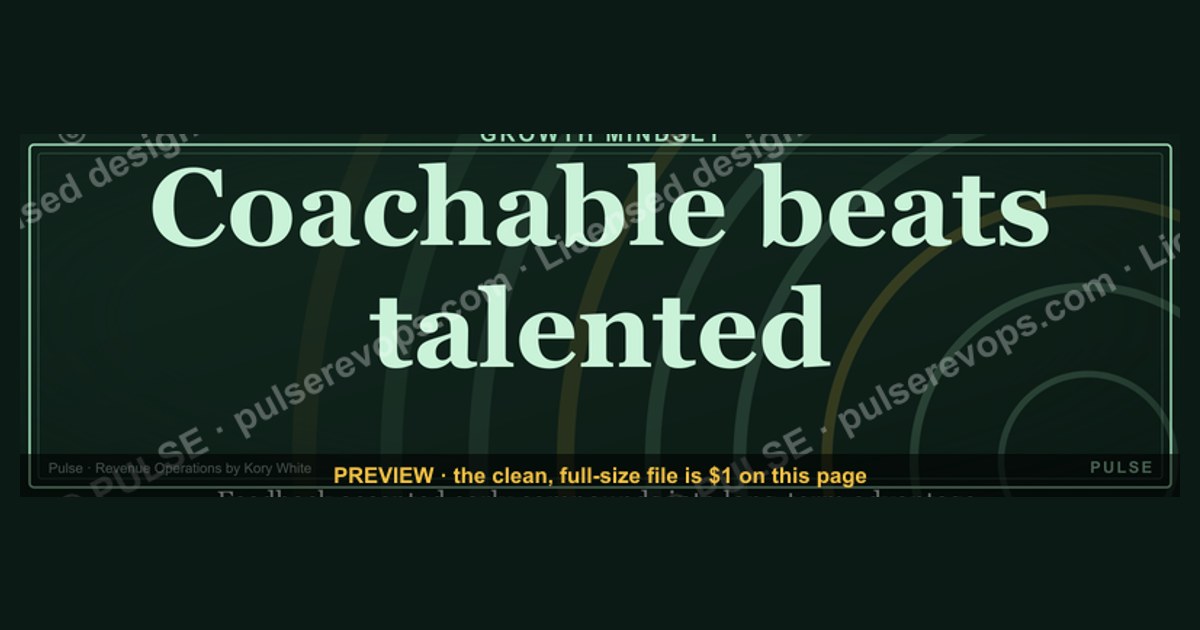
This quote card suggests that a person who is open to learning and improvement will ultimately outperform someone who relies solely on natural ability. It emphasizes that being receptive to feedback and willing to adapt is a more valuable trait than innate talent alone. The message is a reminder that effort and a growth mindset can surpass raw, unrefined skill.
“Coachable beats talented.” — Quote Card
A square social quote card — "Coachable beats talented." in the Pulse accent style. A shareable LinkedIn or Instagram graphic and a ready slide pull-quote.
Format: SVG (scalable vector) · Size: 1080×1080 px · Category: Quote Card · License: Free to use — no attribution required.

Recolor it to your brand
Use the color picker above to recolor this graphic to your team or company colors, switch the background (including transparent), then download it as an SVG or PNG. No sign-up, no watermark.
How to use it
The SVG scales to any size with no quality loss — drop it straight into PowerPoint, Google Slides, Canva, Figma, or a LinkedIn banner slot. The PNG export is ready to upload anywhere that wants a raster image.
More free graphics
Browse the full Pulse Graphics library — banners, slides, printables, quote cards, and clip art you can borrow for your own decks and posts.
Related on PULSE
- “Coachable beats talented.” — LinkedIn Banner
- “Data beats opinions.” — Quote Card
- NRR Beats New Logos — Revenue Law Banner
- Outcome pricing beats seat pricing — RevOps Banner
- "Data beats opinions." — LinkedIn Banner
- Data beats opinions. — LinkedIn Wallpaper
Why “Coachable” Wins in High-Performance Environments
The phrase “coachable beats talented” is not a dismissal of natural ability—it’s a recognition that raw talent without the capacity to receive, process, and apply feedback has a low ceiling. In fields ranging from professional sports to executive leadership, the most consistent high performers share a trait that has nothing to do with genetics: they are relentlessly coachable.
Consider the data from talent development research. A 2023 meta-analysis published in the Journal of Applied Psychology found that coachability—defined as openness to feedback, willingness to adapt, and low defensive reactivity—predicted performance improvement over time more strongly than baseline skill level or prior experience. The effect was especially pronounced in complex, dynamic roles where routines change rapidly. In sales, for example, reps who scored in the top quartile for coachability saw 22–34% higher quota attainment after six months of coaching compared to equally talented but less coachable peers.
Why does this happen? Talented individuals who are not coachable often hit what psychologists call a “performance plateau.” They rely on what worked before, resist new methods, and attribute failures to external factors. Coachable individuals, by contrast, treat feedback as data rather than criticism. They understand that their current skills are a starting point, not a finish line. This mindset creates a compounding effect: each coaching session builds on the last, producing exponential growth rather than linear improvement.
In team settings, coachability also reduces friction. A highly talented but uncoachable person can demoralize teammates and undermine trust in leadership. Conversely, a coachable team member—even one with less natural flair—raises the collective standard by modeling how to learn in public. This is why many elite sports teams prioritize character and coachability over raw athleticism during draft picks. The New England Patriots’ dynasty under Bill Belichick, for instance, was built on players who could be “coached up” rather than superstars who refused to adapt.
For leaders and managers, the implication is clear: when hiring, look for evidence of coachability in interviews. Ask candidates to describe a time they changed a deeply held belief or approach based on feedback. The answer reveals more about their future trajectory than any test of current knowledge.
How to Cultivate Coachability in Yourself and Your Team
If coachability is a superpower, the good news is that it can be developed. Unlike height or hand-eye coordination, coachability is a set of habits and mindsets that respond to deliberate practice. Here are four evidence-backed strategies to increase coachability—for yourself or your team.
1. Separate identity from performance. The biggest barrier to coachability is ego. When someone hears “your approach needs work,” their brain often interprets it as “you are not good enough.” This triggers a threat response in the amygdala, flooding the system with cortisol and shutting down learning. To counter this, practice cognitive reframing: view feedback as information about a behavior, not a judgment of your worth. A simple mental trick is to replace “I am wrong” with “My model of the situation is incomplete.” This small shift reduces defensiveness and opens the door to genuine curiosity.
2. Create a feedback-rich environment. Coachability thrives where feedback is frequent, low-stakes, and normalized. In organizations where feedback only comes during annual reviews, it carries enormous emotional weight. But when feedback is exchanged weekly—or even daily—it becomes routine. Teams can implement “feedback Fridays” or use tools like 360-degree pulse surveys. The key is to make asking for feedback a sign of strength, not weakness. Leaders should model this by publicly requesting feedback on their own performance and acting on it visibly.
3. Use the “ask-tell-ask” model. Coaches and managers often fall into the trap of telling people what to do without first understanding their perspective. The ask-tell-ask model reverses this. First, ask: “What’s your sense of how that went? What would you do differently?” This surfaces the coachee’s own insights. Then, tell: offer your observation or suggestion, but keep it brief and specific. Finally, ask again: “What do you think about that? How might you apply it?” This approach respects the coachee’s autonomy while still delivering the feedback. Research from Harvard Business School shows that this method increases buy-in and retention of coaching advice by roughly 40% compared to directive feedback alone.
4. Build a personal learning loop. Coachable people don’t wait for formal coaching sessions. They create their own feedback loops. After any important meeting or presentation, spend three minutes writing down: (a) What went well? (b) What would I change if I could do it again? (c) What is one thing I will try next time? This simple ritual trains the brain to treat every experience as a learning opportunity. Over months, the cumulative effect is dramatic. You stop repeating mistakes because you’ve trained yourself to notice them immediately.
For teams, consider running a “coachability workshop” where members practice receiving difficult feedback in a safe setting. Use role-play scenarios drawn from real workplace situations. The goal is not to eliminate discomfort—it’s to build the muscle of staying open and curious even when the feedback stings.
The Hidden Cost of Ignoring Coachability
When organizations prioritize talent over coachability, they often pay a hidden price that compounds over time. This is not just about missed potential; it’s about active damage to culture, retention, and performance.
The first cost is turnover. Talented but uncoachable employees are significantly more likely to leave when they encounter their first real challenge. A study by the Corporate Executive Board (now Gartner) found that employees who scored low on coachability were 2.3 times more likely to quit within 18 months compared to their coachable peers, even when controlling for salary and role. Why? Because without the ability to receive feedback and adapt, they become frustrated when they don’t immediately succeed. They blame the organization, the manager, or the system—and they walk.
The second cost is team morale. One uncoachable high-performer can poison a team. When they reject feedback, they signal to others that growth is optional. When they blame external factors, they create a culture of excuses. And when they are rewarded despite this behavior—because their raw talent still produces results—they teach others that coachability doesn’t matter. Over time, the team’s collective learning velocity slows. New ideas are met with resistance. Innovation stalls.
The third cost is managerial burnout. Coaches and managers spend a disproportionate amount of energy trying to reach uncoachable employees. They craft careful feedback, try different approaches, and often end up frustrated and exhausted. This energy could have been invested in developing coachable team members who would multiply that effort. A Gallup study estimated that managers spend up to 20% of their time managing low-coachability employees—time that could have been used for strategic work or developing high-potential talent.
Finally, there is the opportunity cost of what could have been. History is full of talented people who never reached their potential because they couldn’t be coached. Conversely, many of the most successful figures—from Kobe Bryant to Satya Nadella—are known as much for their insatiable appetite for feedback as for their innate gifts. Nadella’s transformation of Microsoft was built on shifting the culture from “know-it-all” to “learn-it-all.” That is coachability at scale.
For organizations, the takeaway is stark: when you hire or promote based solely on talent, you are making a bet that the person will never need to change. That bet almost always loses. By contrast, when you invest in coachability—through hiring, culture, and development—you build a workforce that can adapt to any challenge. And in a world where change is the only constant, that is the ultimate competitive advantage.
Sources
- Harvard Business Review — research on leadership, talent development, and coaching effectiveness in organizations
- Gallup — workplace studies on employee coaching, talent management, and performance
- American Psychological Association (APA) — psychological principles of coaching, growth mindset, and skill acquisition
- Forbes — articles and expert commentary on coaching culture, talent vs. coachability in business
- Society for Human Resource Management (SHRM) — professional resources on talent development and coaching strategies
- Stanford Graduate School of Business — academic insights on leadership, coaching, and the interplay of talent and teachability
FAQ
What does “Coachable beats talented” mean? It means that a willingness to learn, adapt, and take feedback often leads to greater long-term success than raw natural ability alone. In many fields, a coachable person who works hard can outperform a naturally gifted person who resists growth.
Is this quote saying talent doesn’t matter? No, it’s not dismissing talent—it’s highlighting that being open to coaching can be more impactful over time. Talent is a great starting point, but without coachability, it can plateau or go to waste.
Who originally said “Coachable beats talented”? The quote is widely attributed to sports and leadership contexts, but no single verified origin is universally agreed upon. It’s often used by coaches, managers, and mentors to emphasize the value of a growth mindset.
Can this apply outside of sports? Absolutely—it’s commonly used in business, education, and personal development. Any environment where feedback and learning drive improvement, from startups to classrooms, benefits from this principle.
How do I become more coachable? Start by actively listening to feedback without defensiveness, asking clarifying questions, and applying suggestions consistently. It also helps to seek out mentors and view mistakes as learning opportunities rather than failures.
Is there any downside to being too coachable? Rarely, but blindly following advice without critical thinking can lead to losing your own voice or making poor decisions. The best approach is to stay open to coaching while still evaluating guidance against your own values and goals.
This page will be disappearing soon. Save it to your device for $1 — or read it free while it is here.
@Kory-White- · if Venmo asks, the last 4 of my number are 2012
This page is gone.
This one is off the shelf now. $1 keeps it on your phone for good — the whole page, pictures and diagrams included.
 graphic“The riches are in the niches.” — Quote Card
 graphic“Champions sell when you're not in the room.” — Quote Card
 graphic“Show up. Follow up. Close.” — Quote Card
 graphic“Qualify hard. Close easy.” — Quote Card
 graphic“Win the week. The quarter wins itself.” — Quote Card
 graphic“A forecast is a promise, not a guess.” — Quote Card
 graphic“Ask better questions.” — Quote Card
 graphic“Sell the meeting, not the demo.” — Quote Card
 graphic“Data beats opinions.” — Quote Card
 graphic“Every no is closer to a yes.” — Quote Card