
“12 TIMES. NO REPLY.” — Sales Meme
 Curated byKory White · Fractional CRO · Maryland
 PULSEKNOWLEDGE LIBRARY
Quality
Certified
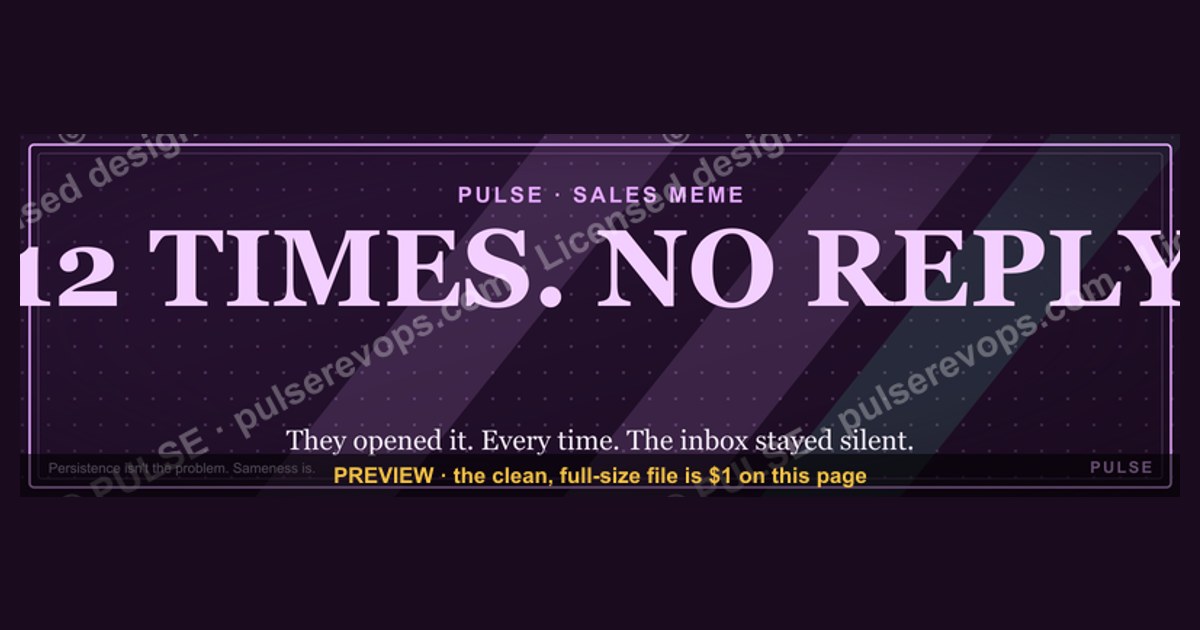
The "12 times. No reply." meme captures the gap every prospector knows: you send the email, you see the open notification, you follow up again and again — and the inbox stays silent. It's funny because it's true, and it's painful for the same reason. Silence in cold outreach almost never means "no." More often it means your message landed in a flooded inbox, hit the wrong person, arrived at the wrong moment, or simply didn't give the buyer a reason to act. The practical takeaway behind the joke: persistence alone doesn't convert. If you're 12 touches deep with nothing back, the fix is rarely a 13th identical message — it's a change in channel, angle, or target. Below we unpack why the silence happens, what to do when you hit the wall, and how to design outreach so you rarely reach "12 times" in the first place.
“12 TIMES. NO REPLY.” — Sales Meme

A clean vector sales meme — "THEY OPENED MY EMAIL" over "12 TIMES. NO REPLY." with a pulse-monitor motif. Light, shareable humor for your sales Slack or kickoff.
Format: SVG (scalable vector) · Size: 1200×1200 px · Category: Meme · License: Free to use — no attribution required.
Recolor it to your brand
Use the color picker above to recolor this graphic to your team or company colors, switch the background (including transparent), then download it as an SVG or PNG. No sign-up, no watermark.
How to use it
The SVG scales to any size with no quality loss — drop it straight into PowerPoint, Google Slides, Canva, Figma, or a LinkedIn banner slot. The PNG export is ready to upload anywhere that wants a raster image.
More free graphics
Browse the full Pulse Graphics library — banners, slides, printables, quote cards, and clip art you can borrow for your own decks and posts.

Related on PULSE
- “CHASE THE NO” — Sales Floor Print
- ICP Discipline: Say No to Win More — Banner
- “Every no is closer to a yes.” — Quote Card
- “No decision is your real competitor.” — Quote Card
- "Every no is data." — LinkedIn Banner
- Chase the no. — LinkedIn Wallpaper
The Psychology Behind the “12 Times. No Reply.” Meme
The meme resonates because it captures something sharper than ordinary persistence — it captures the sting of *invisible* rejection. A flat "no" at least gives you closure. Silence gives you nothing to work with, so your brain fills the void: Was my timing off? Did the subject line flop? Is the product even relevant? Psychologists describe this kind of open-ended uncertainty as an "ambiguous loss" — a loss without resolution — and it's uniquely draining precisely because there's no signal to respond to.
Part of what makes the silence feel personal is sheer volume on the other side. Decision-makers routinely field dozens of emails a day, and during busy quarters that load climbs higher. Your dozen outreach attempts aren't competing against one rival — they're competing against every other vendor, every internal request, and every newsletter fighting for the same attention. Seen from the buyer's chair, ignoring an unfamiliar sender isn't rudeness; it's triage. Silence is the default defense against noise.
There's a deeper layer the meme only hints at: the reciprocity gap. When you've poured in real effort — genuine research, a thoughtful value proposition, follow-ups that reference earlier context — and get nothing back, it creates a quiet cognitive dissonance. Some part of you insists, *this effort deserves a response.* The market's blunt answer is that buyers owe you nothing. The reps who last internalize that not as a wound but as a prompt to recalibrate. The problem with "12 times" is almost never the number — it's doing the *same thing* twelve times and expecting a different result.
The humor also masks a real occupational risk: burnout. Long stretches of unanswered outreach, with no support and no change in strategy, wear people down. That's why the strongest practitioners build a circuit breaker into their own process: after a handful of unanswered touches, they change the channel entirely — email to phone, phone to social, social to a physical note. The absurdity in the meme lives in the stubbornness, not in the persistence itself.
Strategic Pivots When You’ve Hit “12 Times. No Reply.”
If you've genuinely made a dozen thoughtful, personalized touches across channels and gotten nothing, the issue isn't your grit — it's your approach or your targeting. Three pivots that disciplined sales teams reach for at this wall:
1. The "Breakup" Email, Reframed as a Question The classic breakup — "I'll stop reaching out unless I hear back" — has been so overused that buyers tune it out. A more honest variation tends to land better because it lowers the pressure and invites a one-word reply: *"I've reached out a few times without connecting, and I'd genuinely rather learn than keep guessing. Is this a timing issue, the wrong person, or just not relevant? Even a one-word reply helps — no hard feelings either way."* The mechanism here isn't a trick; it's that you've made responding nearly effortless and removed the implied obligation to commit. Buyers can smell a scripted breakup, so the authenticity matters more than the format.
2. Channel Escalation With Context If email and LinkedIn are exhausted, a physical touch can cut through precisely because it's rare. A short handwritten note — not a printed card — that acknowledges your prior attempts without being creepy can re-open the door: *"I've tried reaching you a couple of times online. I know you're slammed, but I think we could help with [specific problem]. If a five-minute chat is worth it, reply here; if not, I'll take the hint."* The combination of a tangible artifact and explicit permission to ignore is what makes it work. A note costs a few dollars including postage, which makes it a cheap, high-effort signal reserved for accounts you genuinely believe in.
3. The Referral Loop After a long unanswered sequence, the odds of a cold direct reply keep shrinking, so your best move is to stop going through the front door. Use LinkedIn to find a mutual connection and ask for a low-friction introduction: *"I've been trying to reach [name] about [topic] without luck. Would you be open to a quick intro? I promise not to waste their time — just five minutes to see if there's a fit."* Even a loose connection carries more trust than a cold sender, which is exactly why warm intros outperform another follow-up. Make it effortless for the referrer by handing them a one-sentence message they can forward as-is.
How to Prevent “12 Times. No Reply.” From Happening in the First Place
The meme is relatable, but the best reps rarely live it — because they build systems that force a strategy change long before touch ten. Four habits that keep you out of the trap:
1. Run a "3-Touch Rule" With Channel Rotation Conversation-intelligence platforms like Gong consistently find that response rates fade when you keep hammering the same channel. A more effective cadence rotates: Touch 1 (email with a concrete value point), Touch 2 (phone call with a specific insight), Touch 3 (LinkedIn message tying the two together), then a deliberate switch. If three touches yield nothing, change the *value proposition* — not just the medium. If your first three leaned on cost savings, pivot the next set to time savings or competitive risk. That breaks the "same message, different envelope" fatigue that leads straight to the meme's punchline.
2. Use Intent Signals to Decide Who Earns a Long Sequence Not every prospect deserves a dozen attempts. Intent data — from tools like Bombora, G2, or LinkedIn Sales Navigator — helps you spot accounts showing real buying signals: leadership changes, funding news, competitor research, or content consumption. If a prospect ignores your first several touches and shows no intent signals, move them to a light nurture cadence rather than a high-frequency chase. Reserve your most persistent sequences for accounts where the timing actually looks live, and you'll spend your energy where it can convert.
3. Build a "Stop Condition" Into Your CRM The most dangerous phrase in sales is "I'll just try one more time." Counter it with a hard stop: after a set number of touches with zero engagement, the sequence automatically routes the lead into a long-term nurture stage with a re-engagement message scheduled months out. That removes the decision from the moment of frustration and forces a real choice — get a referral, change the approach, or accept the timing is wrong. The discipline of the stop condition is what separates a professional from the meme's protagonist.
4. Place Your Personalization Where It Pays Off Many reps pour effort into personalizing the first few touches, then default to generic blasts for the rest. That's backwards. Spread your high-effort, genuinely personalized touches across the sequence rather than front-loading them, so a busy prospect who re-surfaces later still meets a message that feels written for them. Keep the in-between touches short and templated. The meme's protagonist most likely spent all their personalization energy early, leaving the tail end as generic noise that was easy to skip.
The "12 Times. No Reply." meme will always land because it reflects a real truth: rejection — and silence — is part of the job. But the best reps treat it as a diagnostic, not a badge of honor. If you're a dozen touches in with nothing back, the problem isn't your persistence. It's your strategy. Pivot early, pivot often, and don't let the meme become your reality.
Sources
- Harvard Business Review — Sales & Marketing — research and analysis on selling, buyer behavior, and communication.
- HubSpot Sales Blog — practical guides on outreach cadence, follow-up, and cold email etiquette.
- Salesforce — Sales Resources — CRM best practices, prospecting, and pipeline management.
- LinkedIn Sales Solutions Blog — modern selling, social outreach, and lead generation guidance.
- Gong — Sales Research & Labs — conversation-intelligence findings on outreach cadence and channel use.
- American Marketing Association — publications on buyer behavior and marketing–sales alignment.
FAQ
What does “12 times. No reply.” actually mean in sales? It describes the common experience of reaching out to a prospect repeatedly — by email, phone, or LinkedIn — without ever getting a response. The "12" isn't a rule; it's comic exaggeration of the persistence cold outreach can require. Real-world sequences usually run somewhere in the range of 5 to 15 touches before a rep decides to stop or change tack.
Is the meme making fun of salespeople or prospects? It's almost always shared by salespeople as a self-deprecating joke about the grind of prospecting. The humor comes from the absurdity of messaging someone who clearly isn't engaging — but it also quietly acknowledges that plenty of legitimate deals do take several follow-ups before a buyer responds at all.
Does following up 12 times actually work? Sometimes, but it depends entirely on relevance and timing. Multi-touch sequences exist because a single message rarely lands at the right moment. The catch is that piling on identical messages past a reasonable point starts to read as spam. What works isn't raw volume — it's varying the channel, changing the angle, and spacing touches out over weeks rather than days.
How many follow-ups should I really send before giving up? There's no magic number, but a common, defensible approach is roughly 6 to 10 touches across a few weeks, mixing channels, ending with a low-pressure breakup message. If there's still nothing, it's usually better to move the contact to a long-term nurture and revisit months later with a fresh angle. The "12 times" framing is more about attitude than a literal target.
Is the meme only relevant for cold email? No — it applies across every outbound channel: phone calls, LinkedIn messages, voicemails, even direct mail. The core idea is the same regardless of medium: repeated, unanswered outreach. It tends to resonate most with B2B sellers who juggle several touchpoints inside a single campaign.
What’s the best way to avoid becoming the “12 times, no reply” person? Add something useful in every touch instead of just "circling back." Personalize where it counts, reference prior attempts politely, and rotate channels rather than repeating yourself. Most importantly, watch your response data — if you're routinely hitting double-digit touches with zero replies, the signal is to fix your targeting or messaging, not to add more volume.
This page will be disappearing soon. Save it to your device for $1 — or read it free while it is here.
@Kory-White- · if Venmo asks, the last 4 of my number are 2012
This page is gone.
This one is off the shelf now. $1 keeps it on your phone for good — the whole page, pictures and diagrams included.
 graphic“...AFTER THE DEAL CLOSES” — Sales Meme
 graphic“IT'S A NOT YET” — Sales Meme
 graphic“TIME TO DO IT AGAIN” — Sales Meme
 graphic“PANIC SUNDAY NIGHT” — Sales Meme
 graphic“FOR THE 6TH TIME” — Sales Meme
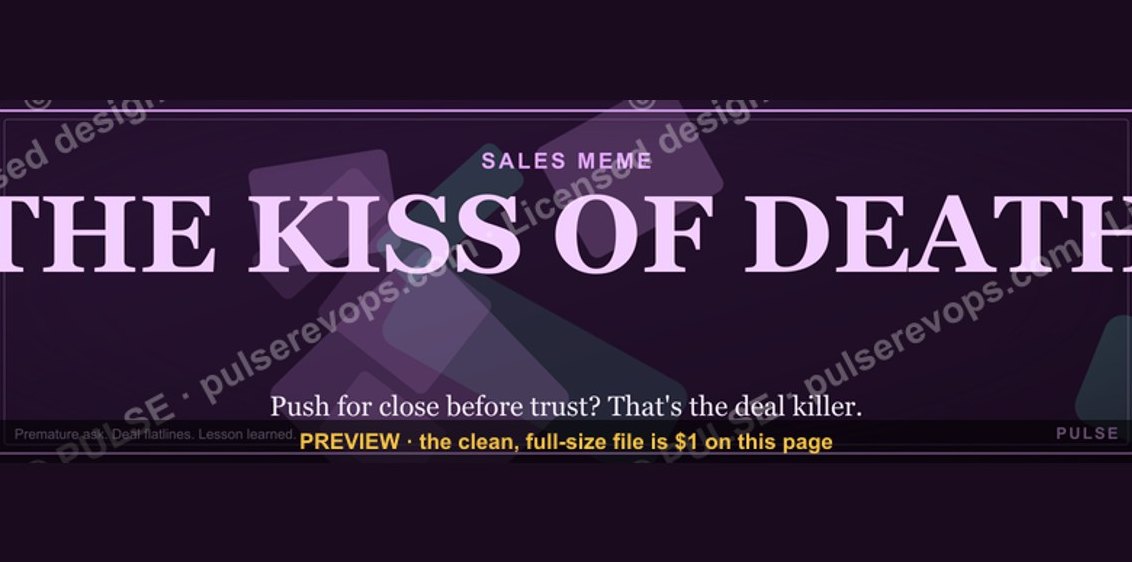 graphic“THE KISS OF DEATH” — Sales Meme
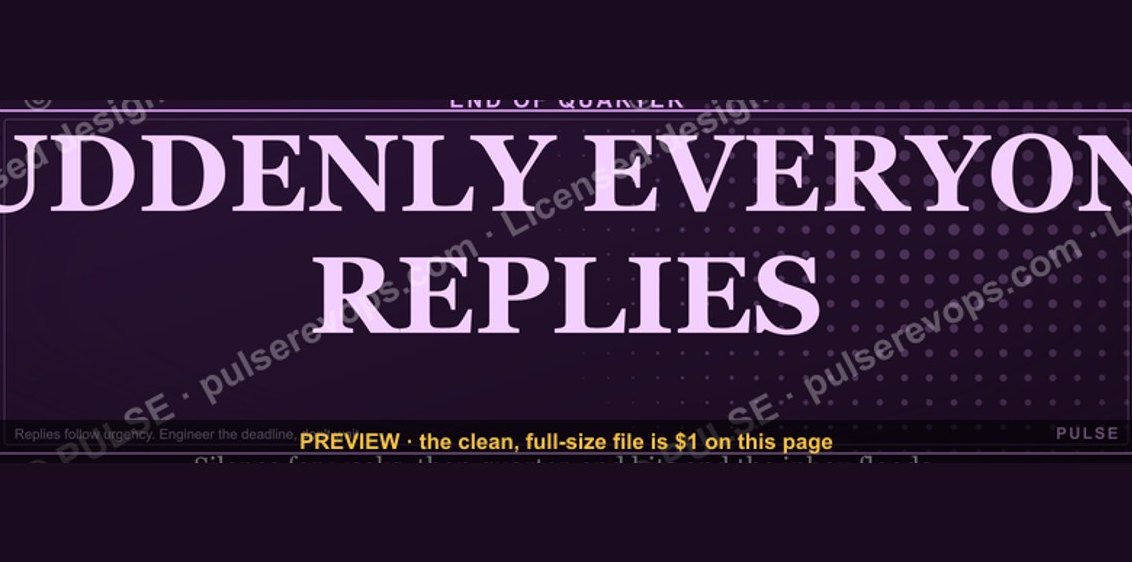 graphic“SUDDENLY EVERYONE REPLIES” — Sales Meme
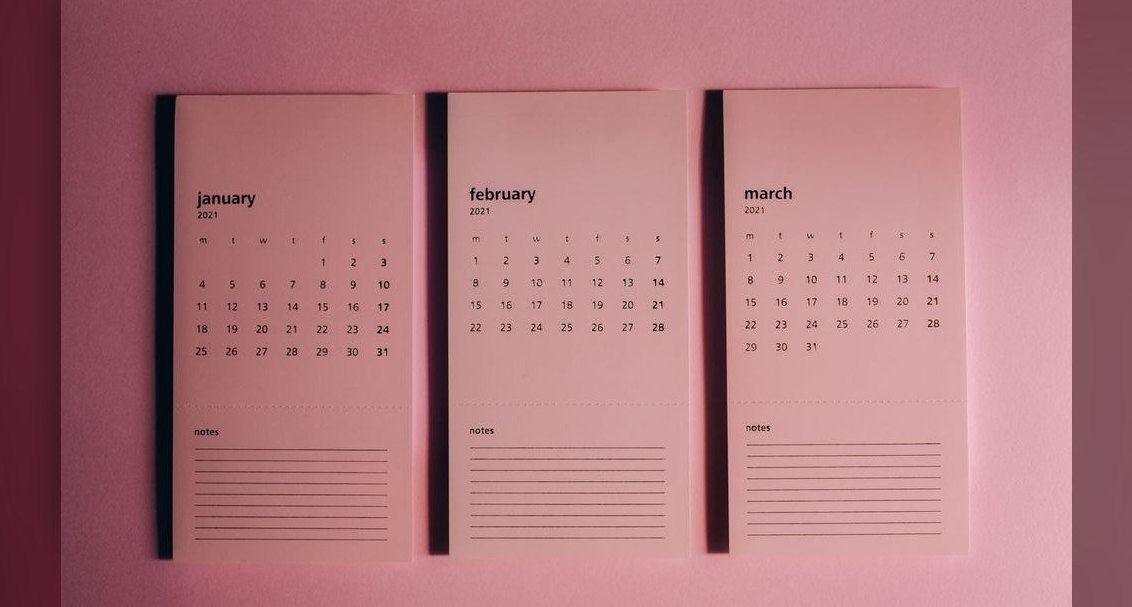 graphic“EVERY. SINGLE. MONTH.” — Sales Meme
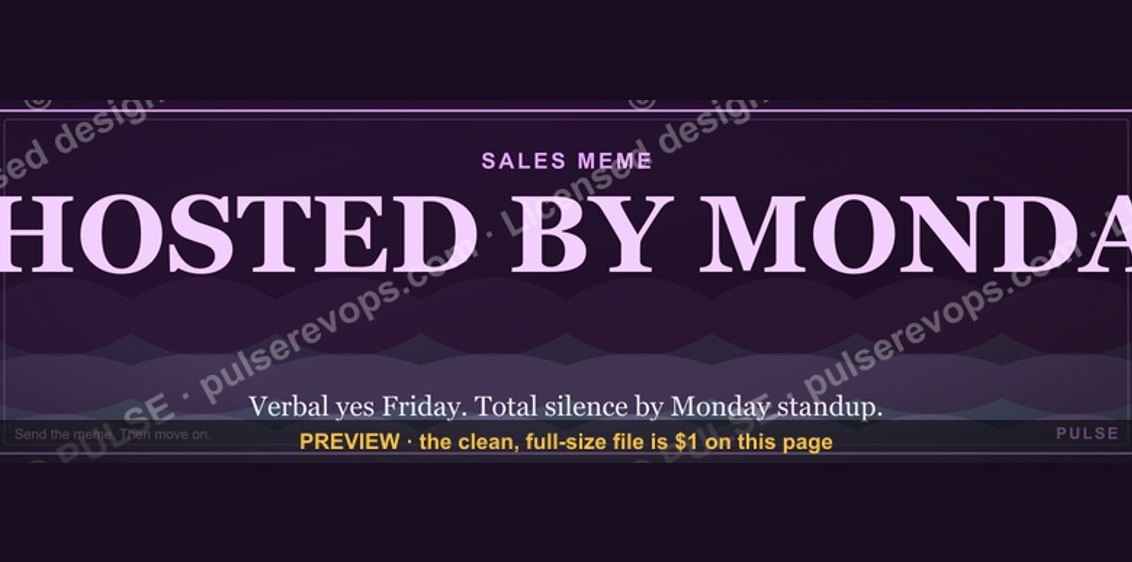 graphic“GHOSTED BY MONDAY” — Sales Meme
 graphic“BOUGHT THE COMPETITOR” — Sales Meme